Steel Nerves

Miles Powell

Dr. Gonzalez

GSS 101

19 February 2016

Steel Nerves

What do Anderson Cooper, Tim Cook, and Neil Patrick Harris have in common? Beyond mere fame, they share wealth, white skin, and urban lives; in other words, each involuntarily matches stereotypical public perceptions of LGBTQ+ (hereafter “queer”) existence. In fact, Out.com’s recent “Power 50” list of “the most influential voices in LGBT America” includes only sixteen women and twelve non-whites, with significant overlap between categories (“Out”). If Out’s list is indicative of Americans’ perceptions regarding queer demographics, then the public may believe white gay males actually comprise fifty-two percent of the entire queer community. Such parochial assumptions are troubling for numerous reasons worthy of confrontation. In Dr. Anne Balay’s 2014 work Steel Closets: Voices of Gay, Lesbian, and Transgender Steelworkers, she challenges popular public stereotypes of queers as invariably educated, middle-class, gay Caucasians. Balay accomplishes this through an enormous five-year research monograph including forty personal testimonies related by queer steelworkers, whose lives operate in the dangerous intersection of archaic labor, ossified masculinity, and public blindness. Already, Steel Closets has won the Lambda Literary Emerging Writer Award and the Sarah A. Whaley Book Award for its compelling narrative organization (Author).

Balay didn’t set out intending to complete such laborious research. But no such data or stories had ever before been collected and published. Even in encompassing Ivy League libraries, research on blue-collar queer existence was woefully lacking, forcing Balay to pursue field work in steel mills, gay bars, even remote trailer parks. Dressing in a car mechanic’s jacket from prior work, Balay shed her professorial image to emerge approachable and relatable, thereby maximizing her ability to connect with potential interviewees. While transcribing forty queer steelworkers’ personal testimonies and distilling them into a coherent call-to-arms, she discovers the incredible courage of a vulnerable population. As Balay relates, “there is no safe way to be gay in the mills” (Balay p. 59). And yet, queer steelworkers “would always keep [their] heads up and try and carry on [their lives] the way [they] wanted to,” demonstrating a remarkably persistent flame of humanity flickering on Lake Michigan’s windswept shores (p.156).

But public perceptions of queer existence remain grounded in a singular, stereotypical narrative: gay, male, white-collar, educated, urban, monogamous. This is problematic for many  reasons, ranging from the fact that “gay” represents only a speck along the greater spectrum of sexuality, male isn’t even half of the population because the binary is falsely dichotomous, white-collar ignores both blue-collar workers and non labor –force individuals, few Americans ever receive college diplomas, many queers reside outside major metropolises, and sexual liberation applies not only to heterosexuals. By examining queer existence in perhaps the most repressive, masculine, industrial environment still operating, Balay increases visibility of all queers outside popular imagination and thereby redirects the ears of policymakers towards an audience never before considered. Already, her channeling of marginalized working-class queer personal testimonies has produced reform momentum.

Balay is uniquely qualified to investigate and translate queer steelworker life. Having both a PhD in English from the University of Chicago, and experience working in an auto shop as a gay women, Balay possesses the ability to contextualize and empathize with her subjects in profound ways.

Balay grew up in New Haven, Connecticut, the daughter of a Yale University librarian (AB’86). After earning a Doctorate in English from the University of Chicago, she “promptly” became a car mechanic, a fact she now relates with a wry chuckle (SPEECH AT DAVIDSON). She spent several years navigating this physical, blue-collar job– a heterosexual, masculine, men’s club offering “more danger and dirt than respect—“   as a lesbian woman, later recalling bonding with coworkers by sexualizing women and procuring bulk sales of “girlfriend parts” (p. 8, 16). Never did she challenge underlying assumptions of attraction to women present in her hypersexualized work space. Quite contrarily, she played up her “shared interest in women” to “gain respect and fit in” with coworkers (p. 13). This background, bringing calloused hands, forward self-presentation, a mechanic’s jacket, and blunt humor, would prove invaluable during subsequent career stages.

Balay eventually abandoned auto repair work and returned to academia to teach at the University of Illinois and at Indiana University Northwest. Throughout her teaching career, however, even amidst university pomp and polish, she always retained strong interest in blue collar environments. In Gary, Indiana, her curiosity manifested itself in her compulsion to unearth queer steelworker stories. However, no germane research existed, so she changed “costumes” from professor to mechanic, and began a relentless five-year hunt for knowledge, balancing her previous and current images to optimize research. Because Balay is a white, well-off, educated, monogamous, committed lesbian, great irony exists in that the stereotype incarnate is fights its own propagation. In a sense, she isn’t particularly distanced from the singular narrative whose perceived ubiquity she seeks to disprove.

Though Steel Closets is divided into seven chapters, Balay’s ethnographic work can be segmented into three rhetorical sections: structural chapters about mill history and operation, human chapters about queer invisibility and gender-specific experience, and policy chapters about vulnerability and union involvement.

Age is etched into daily working in steel mills. It’s inescapable; steel and associated metaphors frame American lore. Sheer factory enormity intimidates workers and represents an era gone by. Balay is blunt: “Resistance to change… characterizes the physical space of the mills and rubs off on the people whose lives are shaped by them” (p. 22). Moreover, what little change has occurred is concentrated in technological advancement, leading to reductions in the work force and thereby reducing mill visibility in steel regions. This isolation, according to Balay, constitutes a “closed community” in which inherited patterns are reinforced (p. 23). Thus, separate and apart from evolution just outside mill boundaries, within the complexes, everything stereotypical hyper-masculinity entails has been preserved and propagated. Steelworkers take substantial down time to bond over shared “palpable bitterness and insecurity,” often being extremely explicit (p.35). This creates tremendous anxiety among queer workers, because in detailed conversations meandering through family and romantic relationships, they must toe the line between friendliness and self-preservation. Workers have been yelled at for not socializing enough, for not sharing enough— of necessity, queer “steelworkers perfect the art of talking without saying anything” (42). Such conditions preclude community development and are both demoralizing and dehumanizing.

Human conditions are as impersonal as the physical and hierarchical structures maintaining them. Even when harassment isn’t explicit, there is a prevailing “atmosphere of constant antagonism” (p. 65). Public presuppositions about queerness and blue-collar labor create mutually-sustaining social attitudes toward both. Inhospitality is so cutting, and protective laws so nonexistent, that queer populations suffer significantly heightened rates of alcoholism (around Gary, Indiana, some queer millworkers refer to Alcoholics Anonymous as “Gay A” (p. 69)). Queer men and women run different gauntlets each day at the mill. Steel’s masculine history effectively erases femininity from contemporary mills. Women, typically lesbian, must exhibit masculinity and sexually objectify women to “fit in” at work—sometimes even as a “price of admission” (p. 87). Women are also subjected to intimidation up to and including rape. Despite attempts to change gende Female mill workers can be sexist; Fern, a worker, believes few women can take a “true ass-chewing” without tears (p. 81). Men, by contrast, exhibit masculinity not to fit in, per se, but as a defense mechanism implying heterosexuality. Risk-seeking behavior in particular helps men assert masculinity, with gay men often taking chances especially desperately (p. 110). Interestingly, owing to the working-class homoerotic continuum, masculinity is determined not by sexual partners but by gender presentation (p. 115). But perhaps most tragic is the inescapable sense of entrapment many queers feel knowing that coming out and remaining closeted both “foster self-loathing and self-blame” (p. 67).

Policy structures accomplish similar end results by pandering to popular support in a cowardly method failing to uphold any normative judgments. Unions do woefully little to safeguard members’ rights, preferring to stick to the “straighter path” to maximize popular support (p. 152). This effectively means ignoring queer suffering entirely, even as queers express concern at being killed by purposeful coworker negligence and at becoming mere statistics (p. 123). Generally speaking, unions are helpful in processing external claims against firms, but tend to turn a blind eye toward internal harassment of queers. In such alienating environments, is it any wonder “most [queer] folks… believed they were the only gay person working in basic steel” (p. 9)?

Balay exceeds expectations in her unique ability to bridge the socioeconomic divide between privileged target audience and silenced sample population. She distills, rather than dilutes, the heart-wrenching narratives of abuse and trauma suffered by queer steelworkers. She thus delivers a concentrated jolt to readers’ hearts and minds alike, engendering perspectival broadening and painful realizations of the duality privilege and subjugation constitute in modern America. Who could argue? Working class bodies are devalued and queer bodies even more so. Of the forty people interviewed, twenty-five currently have cancer. Many more are, presumably, currently developing serious career-related health complications. Steelworkers interviewed by Balay agree: “it’s a man’s world… a good meal ticket at the price of ten years off your life” (p. 30). Furthermore, Balay exhibits a unique emphasis on empowering women’s voices; (AB’86) only two percent of millworkers identify as women (four transgender people were interviewed) but women receive half of Steel Closets’ interview slots. Though some might regard such over-representation of women as underrepresentation of men, given Balay’s explicit aspiration to provide invisible and silenced peoples with opportunities to be heard, relative overrepresentation of women reinforces functionality of form.

Systemic underrepresentation is also present, however. The glaring flaw in Steel Closets is lack of racial diversity. In Balay’s sample group of men, nineteen of twenty are white. Women’s diversity is hardly better, with fourteen of twenty being white. When considering systemic subjugation and silencing of sexual and racial minorities, providing representative anecdotal data is crucial. Especially considering de facto segregation, in which the “hot side” of steel mills “houses the hardest, hottest, and most dangerous work… [and] the lowest-paid jobs… and the most minority workers,” hearing these voices is necessary for Balay’s undertaking to achieve well-roundedness (p.33). A truly phenomenal iteration of Balay’s project would seek to tease minority queer steelworkers from their work “against the brutal scale of the mill and its machinery” (p. 5). However, given the difficulty in connecting with white queer workers, it is unsurprising that so few even less privileged minority queer workers responded. Compounding queerness with racial minority status and the innumerable burdens thereby imposed by society creates a perfect storm of vulnerability, so Balay cannot personally be held accountable for such little minority representation when lacking participation is borne of a need for survival.

Balay’s Steel Closets has not only disproven conventional stereotypes about queer existence, but has helped redefine what it means to be queer across socioeconomic spectrums. LGBTQ+ existence can so conveniently be imagined in terms of educated, white, well-off gays, but that ignores the vast majority of queer populations. And even though social acceptance of non-heterosexuality is increasing, “working-class and poor gay people don’t benefit from this change as much as urban, middle-class queers do” (p. 6). It is only through forceful distillation of raw personal testimonies that ideological, social, and policy change can be catalyzed- other mediums lack the brutal pathos Steel Closets so deftly. After all, as Balay states, “stories are power” (p. 6).


Works Cited:

“Anne Balay, AB’86, AM’88, PhD’94.” University of Chicago LGBT Alumni Network. Web. 19

            Feb. 2016.

Anne Balay at Davidson College. By Anne Balay. Hance Auditorium, Davidson, NC. 4 Feb. 2016. Performance.

“Anne Balay — Author, Professor, Activist, Mother.” Anne Balay. Web. 19 Feb. 2016.

Balay, Anne. Steel Closets: Voices of Gay, Lesbian, and Transgender Steelworkers. Chapel Hill,

NC: UNC, 2014. Print.

“Power 50 Famous Gay People.” Out. Web. 21 Feb. 2016.


A Nuanced Presentation of Gender in the Middle East

k8281

Until recently, little work has been done to sufficiently address the extensive history of women in the Middle East. Much of this shortcoming arises from the inherent difficulties of finding documentation and sources to trace the history of a marginalized group. As women in the Middle East have traditionally been confined to roles in the home, little is known about their unique history. Middle Eastern history in general is problematic because of the lack of written documentation until around the third Islamic century (tenth century C.E.).[1] Nikki Keddie’s book Women in the Middle East Past and Present serves to correct the faults of recent histories by bringing pieces of this complex puzzle together and attempting to create a broad overview of the field. To accomplish this daunting task, Keddie’s work attempts to take current work pertaining to Middle Eastern women’s history and compiles them into a singular narrative history ranging from pre-Islamic times to the present.

In the introduction to her work, Keddie lays the groundwork for her analysis, engaging with the reader and discussing her arguments and choices in compiling this history. Within the book, she divides her discussions of women’s histories largely by country. Although she does acknowledge that the borders in the Middle East are largely arbitrary, Keddie uses them as an appropriate means of analysis given that different nations have adopted different legal policies on gender. Though she deliberately engages in country division within chapters, she states that her divisions between chapters are fairly random as she traces this history.

Engaging with so many different sources also lends itself to a variety of interpretations. Within this work, Keddie attempts to capture the different viewpoints and stances that people take on various historical artifacts. She makes this choice because historians decide to spin sources uniquely. Historically, Western interpretations have heavily focused on the negative side of the treatment of women, while in fact many of these documents contain nuanced takes on gender relations. However, until recently sources have been limited to elite men writing about upper class women, and thus there has been a lack of information on the life of the “everyday” woman in the Middle East.

Keddie later addresses the issue of Islam and its link to women’s subjugation. She writes, “it is impossible to escape an emphasis on early Islam and the Quran, as these have been central themes of local discourse about women over the centuries and to a degree remain so today” (10). It is important to recognize that in the Middle East much of women’s subjugation has come about as a result of Qur’anic interpretation and judicial rulings rather than the actual text itself. Too often, the West tends to intricately link Islam to the oppression of women when in fact the Quran proves to be a fairly gender-egalitarian text for the time it was written in. Furthermore, Keddie points out that gender relations in Middle Eastern countries were often more egalitarian in practice than texts would suggest. Women for centuries have been finding ways within existing structures to find agency and empowerment in subtle, subversive ways.

Keddie bases her analysis not just on other people’s work, but also explores legal and official state documents from Middle Eastern empires. Furthermore, she uses information from present-day Middle Eastern states to inform her analysis of more recent history. She opens the book by examining gender roles in pre-Islamic times, demonstrating the differences that existed in a decentralized society. Essentially, gender roles arose out of the necessity to protect male honor. Keddie talks about how, historically, female virginity and chastity have been primary components of the preservation of male honor (17). Because of this emphasis on male honor, wealthier urban families tended to isolate their women in the home and veil them. Conversely, nomadic tribes could not afford to do the same because the women were central to everyday life in their societies. Keddie writes, “nomadic tribes had far less economic surplus and hence less social and gender stratification, as everyone had to do various physical tasks” (16). Keddie’s next section of the book focuses on the solidification of gender stratification in Middle Eastern society after the rise of Islam. Islam led to the collective unification of much of the Middle East, and as a result much of society settled in towns or villages and nomadic tribes ceased to be prevalent. During this time period, legal rulings and precedent solidified gender roles in Islamic nations for hundreds of years to follow. Keddie asserts, “the writings of the strict ulama (men with Islamic education and functions) stressed the importance of clear definition and separation of male and female, with no cross-dressing or homosexuality permitted” (31). Thus, Islamic jurisprudence played a central role in dividing men and women and creating a divided, heteronormative society. For the rest of the book, Keddie divides her discussion into specific time periods, including the invasion of the Mongols in the Middle Ages, the 19th century, the start of World War I to the end of World War II, and then all the way up to the present. Within each of these periods, she examines the changes that occurred in Middle Eastern civilization in different countries, specifically looking at them through the lens of gender relations. Her discussion is too broad to examine in detail, thus I will be looking at some specific examples discussing Egypt from each of her sections to demonstrate how she paints this broad picture.

During Mamluk rule in medieval Egypt, women found ways to circumvent social codes or avoid them altogether. Indeed, one scholar was extremely distraught at all of the activities that women were partaking in. Keddie writes, “these included women’s going out in several ways that allowed their being in contact with men, including shopping, … , partying and picnicking with their families in public parks, and even receiving unrelated men in their homes” (52). Even though women were restricted, they worked around the rules to take control and agency over their circumstances. Dissent towards legal discourse tended to be dispersed until mainstream discussion and writing arose in the late nineteenth century. Qasim Amin, a notable Egyptian writer, voiced loud dissent in The Liberation of Women (1899). Keddie writes, “Amin advocated Western ways and strongly criticized Egyptian ones, especially the ulama’s ideas. Amin used Islamic modernist arguments to oppose patriarchal oppression” (71). Later as time went on women became more influential in mainstream discussion and discourse, “their role is often ignored in discussions of Middle Eastern intellectual history. Their writings on scientific domesticity included much practical advice on homemaking and child rearing, including health, hygiene, and child care at a time when infant and child mortality was high” (92). Finally, modern day discussions about feminism and modernity often concern the imposition of Western culture. Keddie elaborates, “Egypt, like several Arab countries, has also seen growing concern about ‘authenticity,’ both Islamic and national, in part against feminisms that are tainted as being Western” (126-127). This idea has been a major hindrance towards the advancement of women’s rights in Egypt and the Middle East in general.

I would argue that the major strength of Keddie’s book comes from her effective synthesis of vast swaths of information. She tackles a large mountain of information and delivers it in a digestible manner. She successfully takes hundreds of years of history and packs it into 150 pages of valuable information and analysis. Furthermore, taking a narrative approach allows the history to unfold like a story. While her synthesis is powerful, Keddie’s narrative plays into the weaknesses of previous narratives and focuses largely on the experiences of the elite, creating a narrow viewpoint of class. Though this weakness comes as a result of the nature of the sources she works with, she does little to address different classes given the opportunity in her chapter addressing modern times. Ultimately, Keddie’s overview comes at the cost of painting too broad of a picture that groups diverse Middle Eastern women together.

Keddie seeks to offer a general overview of the field in as simple a way as possible. She was extremely qualified to write this book based on her past academic work. For decades, Keddie has been one of the foremost academics in the field of Middle Eastern studies. Within this field, her specialty has always been women’s issues. By tracing this history she creates a more comprehensive narrative than ever before created. Overall, it presents a good starting point for further comprehensive work on the subject of Middle Eastern women’s history.

[1] Nikki R. Keddie, Women in the Middle East Past and Present, (Princeton: Princeton University Press, 2007), 9.

Hook Ups: A Pervasive Force on College Campuses

Thrill seeking, sexual gratification, and intense infatuation are all reasons college students engage in hookup culture as Kathleen Bogle describes in Hooking Up: Sex, Dating, and Relationship On Campus (2008), the culmination of years of research done on two college campuses that includes studies of sexual double standards, gender norms, and how relationships and sex have changed overtime. Bogle chronologically presents the evolution of hookup culture, from its roots in dating and calling to its present widespread cultural norm. Through interviews with seventy-six people (fifty-one undergraduates and twenty-five alumni), Bogle questions how these students understand this culture, how they participate, their interaction with the opposite and same sex, as well as fall into the structural roles that this sexual culture makes available.


In Hooking Up, Bogle addresses the chronology of hookup culture and how it has changed over time. Yet, she lacks a central argument. The interviews and reasoning based on opinions that she hears are not brought forth in a constructed viewpoint; rather the argument is left for the reader to construct. However, Bogle’s work does present a couple major conclusions. First, hookup culture and its script are less gendered, as both men and women have the ability to access these sexual interactions. Second, even with different powers in this system, there are still double standards between men and women that negatively affect the success and experiences of college women. Third, hookup culture supports those in the majority in terms of race, ethnicity, gender, and sexuality. Heterosexual white men, especially those involved in Greek life, tend to maintain dominance in this world of hook ups, while heterosexual women, gays, lesbians, minorities, and others are subverted and forced to find other methods of socialization. This book carries importance in understanding how hookup culture has evolved and changes within itself; the culture is very fluid and influential, but there are not many mainstream works that compile some brutally honest, eye-opening, and comprehensive discourse on this aspect of college like Kathleen Bogle has. Hooking Up provides many examples on the emotional, institutional, and systematic ways in which men have successfully taken full advantage of this hookup culture, while in the process of participation, have been able to maintain a higher status and control than women could ever hope to have.


Dr. Kathleen Bogle, author of Hooking Up, is an assistant professor of sociology and criminal justice at LaSalle University in Philadelphia, Pennsylvania. She received her bachelor’s and master’s degrees from St. Joseph’s University and her Ph.D. from the University of Delaware. Hooking Up is her first book, but she has also published an article titled “The Shift from dating to hooking up in college: What scholars have missed” and a paper titled “Exploring the Connection between Pornography and Sexual Violence.” To this conversation of youth hookup culture, Dr. Bogle’s publications rightfully place her in the middle of the conversation; more than a few times in Hooking Up, she speaks to her work as being one of its kind as many previous scholars have failed to study this subject in the same way.


To compile her research, Boyle conducted qualitative data collection from 2001-2006 through interviews with thirty-three college women, eighteen college men, sixteen male alumni, and nine female alumni (Bogle 187-188). To find these interviewees, she asked professors at an unnamed religious college and a state university to find volunteers for her study. She used vague solicitations to these students so that a larger group of people would be interested in being a part of the study instead of a small group deciding to participate based on very specific characteristics (187-188) Her interviews were recorded and transcribed, lasting between one hour and ninety minutes (187-188). In this interview process, Bogle used a relaxed, conversational way of interviewing as a way to gain as much knowledge as possible from the participant, as the likelihood remains that they would reveal more of their opinions if they were comfortable.


In Bogle’s work, she gives chronological background to dating and hookup culture, interspersing quotes and conversation from interviews as they fit into this discourse. In the second half of her work, she includes more interviews as she tries to reveal more intrinsic and subconscious aspects of the culture. Beginning with a definition of a hookup, Bogle cites a national study of college women’s sexual behaviors that states that a hookup occurs when a girl and a guy get together for a physical encounter and don’t necessarily expect anything further (2). She proceeds to describe to question the change from adolescence to college life to life as an adult as denoting different norms of what sex and romantic culture should look like. She describes different sexual scripts that culture participants use in their different encounters overtime; in the early 1900s, the practice of calling, where young men call young women in the hope of getting invited to the woman’s home to meet their family, was well-practiced, but as time persisted, the concept of the date came around, as dating was more individual and less focused on the family (7, 12, 14).


The gender imbalance of power in the hookup culture arguably began as men went off to war in the 1940s. There were a lot fewer men available and after they returned from overseas, the popularized concept of domestic life took hold for a few decades (17). Men were the ones who held the jobs, made money, paid for dates, and made decisions regarding where they and their significant other were going and doing. In addition to the post-World War II culture change, the 1960s were a defining decade in terms of liberation and feminist movements, group socialization, and party culture. Feminist movements encouraged women to be free as sexual beings and to value the expression of personal choice (21-22). This support of free expression was only furthered by the increased availability of the birth control pill (21). Both men and women were encouraged to start sexual interactions, taking away the role traditionally served by the male. Sexuality became more public, accepted, and supported; this openness can be considered a catalyst for the rise and continued popularity of hookup culture.


After describing the evolution of this culture, Bogle transcribes many interviews that ask students how hooking up occurs, stereotypes and sexualization of the other gender, factors that play into the hookup, and the gender roles that come into effect in a hookup. Bogle finds that women can remain under the impression that they must not be as sexually active in a first hookup with a male so as to be sure that the male does not think less of them because they are perceived as being aggressively sexual (38). This is only one of the many places in which Bogle points to the unfair conceptions of this culture that males and females undertake.
Later, Bogle speaks more to the logistics of hooking up on a college campus. As women tend to be enrolled in college at a greater ratio than men (80 men to 100 women), this presents another structural constraint to the already marginalized female (19). There remains very little incentive for men to settle into one relationship; instead, it has become normalized that males can have sexual interactions with more women than is acceptable for women to have with men (55). In these situations, alcohol is a resource that makes initiating sexual contact a much easier feat, as it sets a tone of relaxation (63).


After an exploration of campus culture and the logistics of a hook up, Bogle summarizes different arguments and opinions regarding the double standards that persist for men and women. Using Doris Day and Sandra Dee as examples of the squeaky clean, virginlike image of a woman, she divides undergraduate sexual desires as women looking more for relationships and men enjoying the status quo of the hookup culture (96, 97). Men garner little to no stigma for their sexual exploits, even if they are called a man-whore or slut, it tends to be perceived as a joke; for women, it is very easy to be labeled as a slut (103-104). Bogle describes this process of labeling as being one that alters one’s sense of self and leads to a self-fulfilling prophecy that subverts and harms, even if it was not their own construction (113).


Many of the factors that affect hooking up disappear after college as individuals tend to become more isolated and have less factors and comparisons to create between them and their peers. Alcohol remains central to adult socializing, but hooking up with strangers in unfamiliar places is a logistic factor that presents itself in this adult world (130, 133). Though these adults are older than their college days, there remain sentiments of a game, arguably inspired by the college hookup culture, including being more respectful, polite, and caring to women, as the circumstances expect formality as well as seriousness (137). Speaking to adult relationships, one male interviewee indicates that the less a girl does sexually the better (150). Though one’s environment has changed from the college campus to the working adult environment, this process of othering and subverting the woman, even as an adult, seems to have persisted.

One of Bogle’s strengths in her book and research is that she offers very clear examples of the gender hierarchy and the beliefs, concepts, and areas of influence that gender comes into effect. Bogle will question the men she interviews when they tell her their opinions on what women should do in their role in hookup culture and she turns the question to them, asking why he should not adhere to the same expectations.

A very obvious weakness is Bogle’s research is the lack of minority acknowledgment inside this college culture. At the schools she surveyed, there was a predominantly white student body, but there was a significant amount of minority (racial, sexual, etc.) representation. In the few thoughts she contributed to the discussion of minority students, she generalizes opinions heard from interviewees and says that many minority students are not interested in sexual encounters with white students and vice versa (68). Though she does speak to the lack of queer-positive cultures and spaces on college campuses, she marginalizes the already less supported minority groups by putting them all in the categories of inner-socialization and tied to friends from home (68-69).

In my opinion, Bogle’s Hooking Up does offer a more contemporary and knowledgeable analysis of the hookup culture that has become normalized since its evolution from the era of calling and dating. Personally, I thought the shear amount of interviews she had with clear demonstrations of male privilege and the subversion of women were very valuable to her overarching arguments. One can talk about the sexual double standard, but until those opinions are truly expressed with valid examples, there will be no acknowledgment of a need for change. Bogle’s research does well in identifying the amount of sexualization, stereotypes, and preconceptions play into the game of hooking up. Though Bogle has recognized that this work is not intended to speak to all of college students, as well as in any large way to minorities, it would be good for further research to expand on Bogle’s to include sexual, ethnic, and racial minority hook up culture, so as to offer some deeper insight in the possible different spectrums of college youth culture. Audiences that enjoy this work would include college students, as a way to reflect on one’s role in the culture that may or may not be present around them, as well as adults, administrators, and other outsiders that would like to learn more about the sexual culture perpetuated on college campuses.


BookReview (Full paper attached w/ footnotes included)

The Happy in Unhappiness

978-0-8223-4725-5_pr

The cover of Sara Ahmed’s The Promise of Happiness seems designed to evoke the emotion of happiness. Titled Happiness Isn’t Happiness without a Violin Playing Goat, everything in the artwork, from the design, to the colors, to the title, exudes light-hearted whimsy. It seems to be a cover that conceals happy contents, but it encloses a book that critiques the emotion the artwork attempts to portray: happiness (Collura). While the idea that happiness is good and that unhappiness is bad is generally accepted as a common worldview, Ahmed challenges this viewpoint by examining how we act and react to the promise of happiness. She primarily does this by observing how groups such as feminists, queers, and migrants are exposed to different expectations for happiness and to different experiences of the emotion. Although she does not explore a topic as lighthearted as the cover suggests, Ahmed’s exploration of the concept of happiness effectively brings the problematic associations of the emotion to light.

The author of the book, Sara Ahmed, is a professor of race and cultural studies at Goldsmiths College, University of London, and she serves as an important voice in the fields of feminism, queer theory, race, and affect theory. When discussing migrants in The Promise of Happiness, she states that she was born to a Pakistani father and English mother, and she comments on the fact that her experiences being in the second-generation of a mixed race family has given her insight into how migrants view happiness (Ahmed 248). She has written several other books that deal with similar topics to the ones discussed in this monograph, such as Queer Phenomenology: Orientations, Objects, Others and Differences that Matter: Feminist Theory and Postmodernism. The Promise of Happiness has not been her first book to deal with affect theory; she also wrote The Cultural Politics of Emotion, demonstrating that on top of focusing on her obvious specialty of cultural studies, she also looks into the culture of emotions. The fact that she is an expert in many different fields of study allows her to provide insight on a topic as broad as the impact of happiness.

The objective of Ahmed’s work in this book is to examine how different groups of people are promised happiness and how this promise affects these people. She focuses primarily on affect aliens, “those who are alienated by virtue of how they are affected by the world or how they affect others in the world” (164). These are the people who do not receive the same promise of happiness as the privileged and those in the majority, and the affect aliens she focuses on are the feminist killjoy, the unhappy queer, the melancholic migrant, and the hopeless revolutionary. In the book, Ahmed gives stories as to why these groups of people are not met with happiness by the people around them and why this absence of happiness results in them being recognized as unhappy people. By analyzing these judgments of unhappiness and the lack of possibility for a traditionally happy future for affect aliens, Ahmed argues that unhappiness is not necessarily a bad thing and that happiness is not necessarily a good thing. Her book serves as an argument that “we need to think about unhappiness as more than a feeling that should be overcome” (217). She explores the idea that simply because these affect aliens do not experience traditional representations of happiness and face more challenges than those in the majority does not mean that they are worse off than those who fit the mold as being “happy.” Although unexpected, this argument caused me to recognize the problematic tendencies with the construct of happiness.

Ahmed’s method of research involves her following the word happiness as it appears in mediums such as movies, novels, and scholarly works as a way to uncover information about how the promise of happiness affects different groups of people. “[She tracks] the word happiness, asking what histories are evoked by the mobility of this word” as a way to view what the usage of this word implies and study the effect that it has (14). She uses this method in order to uncover how happiness promises hope. She defines this “the promise of happiness [as] what makes certain objects proximate, affecting how the world gathers around us,” and by tracking the word, she is able to view how this promise of happiness affects different people (14). Her main sources are “unhappy archives,” which are primarily books and films that are “assembled around the struggle against happiness” (18). She discusses books such as George Eliot’s The Mill on the Floss to discuss finding happiness as a feminist and Annie on My Mind to discuss the the power parents have in determining happiness for queers. She also looks into movies such as The Hours, If These Walls Could Talk 2, Bend it Like Beckham, and Children of Men, which all look at happiness from the perspective of affect aliens. She also states that her archive for the book draws from more than simply just books and films, and that “[her] archive is also [her] world, [her] life-world, [her] past as well as present, where the word happiness has echoed so powerfully” (19). Encounters with happiness occur in all mediums, so Ahmed follows the emotion wherever it takes her.

On top of an examination of popular constructions, Ahmed also looks into the analysis of happiness from scholarly perspectives. Ahmed combines her expertise on her specialties of affect theory, gender theory, and feminist theory with philosophy and positive psychology in her research. This includes a focus on works done on happiness by philosophers such as Nietzche, Aristotle, Rosseau, and Kant, on top of looking at works by psychologists such as Alan Carr and Michael Argyle. Her incorporation of these authors demonstrates how her work combines aspects of multiple different fields of studies. Her analysis allows her to expand on and also to negate the popular ideas on happiness made by other scholars. This commentary along with her personal research allows her to insert herself into the scholarly conversation on happiness. By combining works of specialists in these fields with her own findings on the cultural productions from her “unhappy archives,” Ahmed creates a portfolio of sources that examine the effects of the promise of happiness.

Out of all of the sources that Ahmed uses from her unhappy archives, cultural productions are what the majority of her arguments are based off of. She uses both books and movies that center around characters who identify as affect aliens, and she uses the stories of these characters as her sources about how happiness affects individuals. However, by focusing on the happiness of characters instead of real people, her arguments on the happiness of actual feminists, queers, migrants and others seems inauthentic. Books and movies are created in order to be dramatic, so the stories of characters in them do not necessarily depict real-life experiences. Therefore, I have trouble with the fact that Ahmed uses these sources as examples of the struggles that affect aliens go through. Some of the stories that she follows may depict real-life situations, but as a whole, the plotlines that she examines are fictional. Because of this, I left the book wishing that she had examined the stories of real people as in-depth as she examines cultural productions. The anecdotes from other people that she mentioned were some of the most impactful parts of her book. For example, Ahmed uses a story from Audre Lorde about being spit on by white men as a young, black child to consider the unhappiness surrounding racism (82-83). After I finished the book, I did not remember the details about every cultural production that Ahmed examined, but this account of racism made a lasting impact. Therefore, I wish that Ahmed had used more stories like this one.

Despite some problems, as a whole, I believe that the majority of Ahmed’s arguments rang true, and I left the book questioning if happiness was in fact a positive construct. I especially identified with her analysis on the ways most people, myself included, feel inclined to appear happy for those around us. She argues that “we have a responsibility for our own happiness insofar as promoting our own happiness is what enables us to increase other people’s happiness” (9). We feel obligated to always project ourselves as happy people because by appearing unhappy, we are preventing happiness from spreading. Feminists are often labelled as “killjoys” because they refuse to participate in this cycle of false happiness. Shulamith Firestone led a feminist movement to encourage women to only project signs of happiness when they felt truly happy, demonstrating that “feminism involves challenging the very ‘pressure’ of happiness, the way it restricts the possibilities for finding excitement, of being excited” (69). This desire to limit portrayals of happiness that only are for show has resulted in feminists often becoming labelled as killjoys because they reject the pressure of presenting themselves as “people pleasers.” I had never paid much attention to the pressure placed on me or the people around me to never appear unhappy, but this book prompted me to notice it. I found this theme explored by Ahmed to be her most effective argument in terms of explaining the role of happiness in my day-to-day life, and her discussion on this subject has been my biggest takeaway from the book. She allowed me to further understand the negative perceptions surrounding feminism, and as a feminist, her argument caused me to start to make more of an effort to let go of my desire to people please.

The Promise of Happiness offers a perspective on happiness that goes against the norm. Calling happiness bad seems to be an oxymoron, and the same goes for calling unhappiness good. However, Ahmed argues that these associations should be made more often. She convinced me to stop automatically assuming that happiness is always positive. On top of agreeing with what Ahmed said, I enjoyed reading her arguments. Her book was well-written, easy to follow, and I would definitely recommend it. Although she primarily studies the effects of happiness on affect aliens, her study on happiness can be applied to how all groups of people react to the emotion and judge the happiness of those around them.


Works Cited

Ahmed, Sara. The Promise of Happiness. Durham NC: Duke University Press Books, 2010. Print.

Collura, Reyna. Happiness Isn’t Happiness without a Violin-Playing Goat. n.d.


A Review of Racial Castration: Managing Masculinity in Asian America

During my Davidson career, I have become increasingly interested in Asian American Studies. For my book review, I decided to take advantage of the flexibility of the topic and expand on my knowledge in the subject. In Racial Castration: Managing Masculinity in Asian America, David L. Eng creates the argument that race and sexuality are connected. Eng supports his argument by analyzing the subject of Asian American masculinity. By applying psychoanalytic theory to literary works, Eng shows that race and sexuality cannot be separated from each other. Overall, his argument brings new insight to the subject of Asian American masculinity and also Queer studies, but a couple writing decisions that Eng makes prevent full comprehension of the topic.

Firstly, Eng analyzes two works, China Men and Donald Duk, that question the historical photo of the “Golden Spike” ceremony, the event where the east and west sides of the transcontinental railroad were connected. In the photo, the Asian American workforce was not represented, rendering their work and the lives lost invisible. Eng begins his analysis with a deconstruction of photographs as a medium of information and connects them to gaze, look, and screen from the Four Fundamental Concepts of Psycho-Analysis. I believe, however, that this connection required too much explanation. While the information is applicable to China Men and Donald Duk, it isn’t necessary to be able to understand the analysis and arguments made in the rest of the book.

In Donald Duk, Frank Chin tells the story of a boy, Donald Duk, who at first rejects his Chinese American culture, but eventually grows to embrace it. Eng uses psychoanalysis to come to the conclusion that Donald Duk’s dreams provide him an outlet to escape societal structure. Through his unconsciousness, Donald Duk is able to connect with his Chinese culture and is eventually able to bring this connection to his conscious state. Eng, however, criticizes Chin’s vision for the Asian American identity for excluding Asian American women and gay men.

Next, Eng analyzes the primal scene in “The Shoyu Kid” by Lonny Kaneko. The story takes place in a Japanese concentration camp during World War II. Itchy, looking for the Shoyu Kid, finds him being sodomized by a white, male camp guard. This causes Itchy and his friends to lash out and denounce Japanese culture and homosexuality. Eng relates this scene to how people react to Asian American sterotypes of homosexuality and femininity. He criticizes this reaction, saying that, “Psychic Salvation for the Asian American male cannot be the monopoly of a masculinist compulsory heterosexuality” (Eng 136). Eng again challenges society’s view on race through the lense of sexuality.

Eng narrows her scope in her analysis of M. Butterfly by David Henry Hwang, looking at Gallimard’s racialized homosexuality. In this play, Gallimard has an affair with Song Liling. Even though Song is male, his Oriental identity prevents Gallimard from seeing Song’s penis. Eng explains this phenomenon of misgendering Song through Freud’s theory of the divided ego. Freud’s psychoanalytic theory is usually used to describe female castration, in which men will fetishize a part of a woman, such as her hair, in order to project a substitute of a penis onto her. Gallimard’s situation however, is an occurrence of racial castration. Gallimard’s reverse fetishism of Song’s asian identity projects Song as a female, even though his penis is clearly visible. Eng believes that this is possible due to the situation’s commonality with traditional power relations. In Gallimard’s relationship with Song, the white male is in the same dominant position as a traditional relationship between a white male and female. Eng argues that M. Butterfly portrays the silent oppression of compulsory heterosexuality and whiteness and that the key to eliminating their power is to make them visible.

In Racial Castration, Eng also addresses the Asian American phenomenon of male hysteria. Hysteria, understood to predominantly be experienced by women, occurs when the emotions that come from the refusal to accept a societal position cannot be explained through language and are thus expressed through the body. Freud attempts to explain the possibilities of male hysteria, but is unable to due to his positionality. Eng clams that, “in a patriarchal world, the presence of the male hysteric would paradoxically imply the refusal of that male subject to occupy a symbolic position that prizes his social role above those of all others” (177). Male hysteric, however can be theorized in the case of Asian American men due to systemic oppression. Hysteria occurs in Asian American men when they refuse to play the role of the emasculated man. Eng gives an example of such hysteria in Eat a Bowl of Tea by David Wong Louie. When Ben Loy is finally able to bring his wife from China to the U.S., he is unable to consummate their reunion due to his impotence, revealing his lack of power and masculinity.

While Asian American male hysteria was caused by Yellow Peril and its exclusion acts, Eng claims that the Model Minority myth also causes the same issue of hysteria. He labels the psychological burden of the myth, “internal exile”(199). By attempting gain acceptance and achieve assimilation by living out the Model Minority myth, Asian Americans are making personal sacrifices toward a lost cause. Eng refers to “Birthday” by Louie for his analysis of the model minority myth, which feels out of place in his argument due to the lack of psychoanalysis. This ultimately makes his connection between Yellow Peril in the Myth more of a mention than a strong argument.

In his last section on male hysteria, Eng refers to Pangs of Love once again, but this time to address the hysteria that could occur in the queer community. Bagel is a gay Asian American that lives with three other gay men who are white. In their house, everything is white. The only thing that isn’t is Bagel. Not only is he Chinese American, but his muscle tone, and his colored clothes make him out of place in the environment as well. Eng states that: This is a queer affiliation, which demands the imitation of whiteness but ultimately finds this imitation intolerable” (201). While Bagel identifies as queer, his surroundings symbolize the white, silent denial of assimilation into the queer community.

Eng concludes his book with the subject of queerness and diaspora. In his epilogue, Eng increases the scope of his discussion and proposes that the intersection of queerness and diaspora with Asian American studies should be addressed in scholarly conversation. She states that the knowledge jurisdiction of Asian American studies is expanding using post- 1965 Asian immigrant communities as an example, as most of their identity was created outside of the United States. I think that Eng is arguing that as knowledge continues to extend outside of the United States, a diasporic approach needs to be taken towards analysis.

Eng also addresses the argument of whether or not to place a hyphen between, “Asian American.” Eng sees the hyphen as a symbol of repression and believes that it should be omitted: “the elimination of the hyphen from this term clams not only psychic but also spatial entitlement to Asian American membership within the larger U.S. national collective” (211). Eng appears to be referring to a previous debate about the subject, but seeing that this book was published in 2001, I am too young to remember this academic conversation and will have to do further research to understand it.

While Eng uses the epilogue to present many questions, by doing so explicitly he makes it difficult for the reader to differentiate which ones will be answered later in his discourse. This leads to paragraphs that contain nothing but questions, breaking the reader’s attention. Ultimately, Eng’s approach to raising questions takes away from the structure and message of his closing remarks.

Finally, Eng analyzes Rolling the R’s by R. Zamora Linmark to show the power of intersecting queer and Asian American perspectives: “Indeed, Linmark extends this project to its imaginable limits by bringing together the model minority myth with the image of the flaming Filipino faggot” (227). Through Linmark’s work, Eng believes that the combination of identities, “allows this explosion and reworking of stereotypical images and categories” (228). In conclusion, Eng achieves her objective in Racial Castration and starts the conversation of how race and sexuality can bring valuable insight to the subject of Asian American masculinity.

Works Cited

Eng, David L. Racial castration: managing masculinity in Asian America. Duke University Press, 2001.

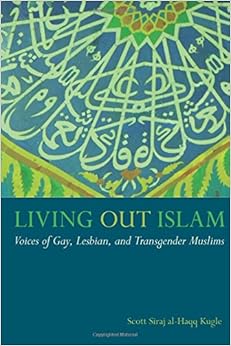
Living Out Islam: Voices of Gay, Lesbian, and Transgender Muslims

Almost a year ago same sex marriage was legalized in the United States. After the legalization, homosexuality became a more integrated topic of conversation in the media. However, it is easy to forget that legalization of same sex marriage does not solve all of the struggles of LGBTQ persons. There are still communities within the encompassing queer community that need more representation. With all of the recent discourse surrounding the LGBTQ community, there has not been much mainstream discussion on minorities within the already minority community. However, diversity within the LGBTQ community is important and should be discussed. I wanted to research a minority group in the LGBTQ community so I chose to focus on LGBTQ Muslims. In Living Out Islam: Voices of Gay, Lesbian, and Transgender Muslims, Scott Siraj al-Haqq Kugle brings the rarely heard stories of gay, lesbian, and transgender Muslims to the forefront of discussion by exploring how Muslims reconcile their sexuality with their faith through a series of interviews.

Kugle begins with problems he found in past research on gay, lesbian, and transgender Muslims and challenges previous notions of identity formation. In order to set up his argument, Kugle situates himself in opposition to Joseph Massad’s Desiring Arabs in the introduction of the book. According to Kugle, Massad contends that the “gay and lesbian identity is imposed upon Arab and Middle Eastern societies as part of a ‘gay international agenda’ of American neoimperialism in the region.”[1] Massad faults the “gay and lesbian identity” on an American agenda, which demeans the identities, that queer Muslims form. Massad’s attempts to find blame for homosexuality or to make homosexuality seem “imposed” contrast what Kugle seeks to accomplish in his research.

While Kugle challenges Massad’s work, he also notes that his work is “theoretically indebted”[2] other authors, including Saba Mahmood and Talal Asad. In Formations of the Secular: Christianity, Islam, Modernity, Asad invalidates the assumption that religion and secular practices are “contradictory loyalties.”[3] Kugle pushes Asad’s work further by proving that a person can be openly homosexual while still maintaining a deep respect and commitment to Islam. Kugle also uses Mahmood’s theoretical approach from her book The Politics of Piety: The Islamic Revival and Feminist Subject where Mahmood delves into Michel Foucault’s theory of subjectivity.[4] Mahmood recognizes that individuals have more agency in their lives than writers like Massad attribute them. Kugle draws from both Asad and Mahmood’s arguments in order to further his own argument regarding the lives of gay, lesbian, and transgender Muslims.

Kugle elucidates, “this book documents the lives of the kind of activists who Massad denounces.”[5] In Kugle’s case, “activists” are people who want to change the social relationships in their lives in order to achieve justice. He credits the mere desire to create social change as activism, which makes the term “activist” more accessible to the average person. Reinterpreting the term “activist” is important because by doing so Kugle avoids alienating people who do not want to be in the forefront of the queer activism. Essentially any queer person who struggles with his/her/their plight as a minority is an activist. Living as an out homosexual is difficult in Muslim communities, so he recognizes the interviewees’ bravery whether or not they are actively involved in organizations.

Keeping in mind his definition of “activist,” Kugle interviewed fifteen lesbian, gay, and transgender activists to document an oral history of an underrepresented minority within the Muslim community. Kugle only interviewed Muslims living in countries with democratic constitutions such as the United States, South Africa, Canada, the Netherlands, and the United Kingdom. While Kugle does have diverse accounts in the book, he limits himself by only focusing on countries with democratic constitutions and therefore neglects the countries with the largest Muslim populations like Indonesia, Pakistan, and India. Another limitation Kugle grappled with in his research was sexual orientation. Kugle does not use the term LGBTQ in the book because he only has interviews from gay, lesbian, and transgender persons and within that group he has significantly more interviews from gay men than lesbians and transgender persons.[6] Despite the fact that Kugle focused only on certain sexualities, his research opens the door for more writers to explore the complex lives of queer Muslims.

Even with such diversity of location, the stories of those Kugle interviewed are all connected through a deep understanding of their faith as well as with their struggles sexualities and gender identities. Each chapter of the book explores a different “mode of activism,”[7] which are “patterns of action, decision, and compromise”[8] that disclose one’s identity formation in the setting of Islamic communities. The structure that the specific modes of activism provide allows Kugle to pair certain parts of certain interviews together in a fluid and cohesive manner that helps the reader draw connections between experiences naturally. Kugle weaves the various interviews in order to give a multi-faceted view of lesbian, gay, and transgender Muslims while simultaneously illuminating a common thread between them.

The first chapter introduces the first mode of activism, which is activism through “engaging religious tradition.”[9] Here Kugle focuses on the stories of a gay man, a lesbian woman, and a male-to-female transgender woman. He questions all three about their experiences with religion and sexuality, specifically how important the both are to their identity formations. All three participants stress the significance of Islam in their lives and present nuanced interpretations of the Qur’an that allow for self acceptance of their sexual orientations. One of the interviewees, Muhsin, who is an out gay man, spoke extensively on ways to interpret the Qur’an to be accepting of one’s nature. Muhsin helped start the Al-Fitra Foundation, which one of the first support groups for gay, lesbian, and transgender Muslims in Cape Town. Kugle uses this passage from the Qur’an to demonstrate how Muhsin chooses to read the Qur’an:

‘So set your face toward the moral obligation in a true way, according to the essential nature granted by God, upon which God fashioned people, for there is no changing the creation of God! That is the original and steadfast moral obligation, but most of the people do not understand.’ (Q 30:30)

Most people interpret “original and steadfast” as referring to the Islam and subsequently a universal human nature but many gay, lesbian, and transgender Muslims see it differently. They believe God makes each person with an original nature and that nature cannot be altered. Then the “original and steadfast” religion is to “return to God in harmony with one’s own nature.”[10] With this interpretation one’s sexual identity becomes an unalterable part of them and therefore a homosexual person is following the Qur’an by being true to their nature. This example of activism by engaging religious tradition is just one of many unique ways that gay, lesbian, and transgender Muslims justify their sexual identities and their commitment to Islam.

Kugle captures how his interviewees employ both an open minded and analytical approach to the Qur’an, which again offsets assumptions that gay, lesbian, and transgender Muslims have to choose between their religion and sexual identity. Kugle focuses on the Qur’an as his primary evidence as he unpacks the passages that Muhsin, Nafeesa, and Tamsila (the third interviewee in this chapter) bring to his attention. The focus on the Qur’an and testimonies from real people as the main sources contributes to the authenticity of the book. Kugle dispels previous perceptions of how gay, lesbian, and transgender Muslims engage with Islam, particularly the assumption that queer Muslims must leave Islam in order “to live with dignity and pursue social reform.”[11] Muhsin, Nafeesa and Tamsila all prove that it is possible to have a non-heterosexual identity and remain a devout Muslim. Kugle also uses this chapter to uncover where the stigma surrounding homosexuality comes from in Islamic communities. Trans woman, Nafeesa, simply states, “Show me that the Qur’an says being gay is not allowed in Islam!”[12] Nafeesa has a point since nowhere in the Qur’an does it explicitly condemn or approve homosexuality[13]. With the new interpretations of the Qur’an, Kugle makes the reader question where the stigma comes from if the Qur’an does not present an opinion on homosexuality? Muhsin, Nafeesa, and Tamsila agree that the shame surrounding homosexuality comes not from Islam but from the dominant interpretations of Islamic tradition.

The Islamic community is the main focus of the second chapter, in which the mode of activism is “challenging family and community.”[14] This type of activism is different from the previous chapter since it more actively engages family expectations rather than Islamic tradition. This chapter delves into how personal relationships are affected when someone comes out in an Islamic community. Nargis, a lesbian woman in Cape Town, South Africa, describes her struggle with her parent’s control over her after they discovered her relationship with another woman. Nargis notes that it was the “prospect of community shame”[15] that drove her father to withdraw her from university and isolate her from society. Her family used the Qur’an and shariʻa law to argue with her about her sexual orientation so Nargis joined support groups like The Inner Circle and The Triangle Project for solace. Nargis used religion to help her come out again to her family by using the example of Sufi woman, Rabiʻa of Basra who never married due to her love of God. The use of religious tradition helped Nargis’s family understand her sexuality. Kugle notes that for many gay, lesbian, and transgender Muslims, Islam is important as “a symbol of family cohesion and care.”[16] The coming out experiences of queer Muslims in Islamic communities are difficult due to the stigma surrounding homosexuality but Kugle points out the that the emergence of support groups like The Inner Circle and the Al-Fitra Foundation help create new Islamic community where religion and sexuality are not at odds. Disowned gay, lesbian, and transgender Muslims often recognize members of their support groups as “found families.”[17]

Kugle’s interviews and analysis provide the reader with an insight into of the lives of gay, lesbian, and transgender Muslims today. Many of the people Kugle interviewed had been disowned by their families because of their sexuality or gender identity. While Kugle brings awareness to their pain, he also focuses on how they got to where they are now in terms of self-acceptance. The answer for many of them was religion. Kugle cleverly anticipates our outside assumptions from the beginning and works at disbanding them in order to provide an authentic perspective on the intersection between religion, sexuality and gender identity. I think that Kugle’s sharp analysis of the Qur’an contributes to the persuasiveness of the text. Where the Qur’an is used by some Islamic communities as a reason to reject homosexuality, Kugle interprets the Qur’an in a way to justify a person’s nature, which encompasses sexuality and gender identity.


[1] Kugle, Living Out Islam: The Voices of Gay, Lesbian, and Transgender Muslims (New York: NYU Press, 2013), 4.

[2] Ibid, 5.

[3] Ibid, 5.

[4] Ibid, 6.

[5] Ibid, 4.

[6] Ibid, 21

[7] Ibid, 3.

[8] Ibid, 3.

[9] Ibid, 21.

[10] Ibid, 25.

[11] Ibid, 53.

[12] Ibid, 39.

[13] Ibid, 25.

[14] Ibid, 55.

[15] Ibid, 61.

[16] Ibid, 78.

[17] Ibid, 40.

Work Cited

Kugle, S. A. (2013). Living Out Islam : Voices of Gay, Lesbian, and Transgender Muslims. New York: NYU Press.

Interconnectedness of Politics, Sexuality, and Race

Imposing Decency: The Politics of Sexuality and Race in Puerto Rico, 1870-1920 by Eileen J. Suárez Findlay highlights the changing politics in Puerto Rico from 1870-1920, focusing on how sexuality and race impacted politics and vice versa. Imposing Decency also looks at how race and social class were indicative of sexuality, or at least perceived sexuality. Findlay shows that politics, sexuality, and race are interdependent and impact history, urging us to look at history through a lens broader than simply looking at political events by themselves or the rise of feminism and instead see their relation.

Eileen Findlay teaches in the Department of History at American University. Professor Findlay also is involved with Women’s, Gender, and Sexuality studies at the University. Imposing Decency: The Politics of Sexuality and Race in Puerto Rico, 1870-1920 was her first book, but since she has written another book and two articles on Puerto Rico’s issues of sexuality and gender. She has numerous other works in progress. Her PhD is in Latin American History, and she is fluent in Spanish. Findlay has won several awards, including the Alice Paul Award for Life-long Achievement in the Advancement for Women, and others recognizing outstanding teaching and involvement in multicultural affairs and international students (American University).

In her book Findlay depicts 50 years of roller-coaster-esque, back and forth change in Puerto Rico, specifically in relation to politics of sexuality and race. According to Findlay, “this book demonstrates that throughout the period in question, race was quite important to Puerto Rican familial, community, and national politics, but often in subtle, shifting ways” and that “ ‘Cultural competencies and sexual practices,’ as well as material resources and physical phenotype, helped create individual and collective racial identities” (Findlay 7). Findlay acknowledges the impact of Spanish rule and later United States political rule on race and sexuality. Specifically, Findlay shows these political changes via the treatment of prostitution during the time as well as the shift to a legal divorce system. Findlay walks through the progression of views on prostitution, beginning with the non-confrontational acceptance of prostitution during the mid 1800’s and Spanish rule. In the 1890’s a “moral panic” emerged and prostitutes were pushed towards poor areas and were required to register as prostitutes as part of “Reglamento de Higiene” (150, 83). Along with registration came rough, embarrassing physical exams every other week to check for venereal disease (89). A positive result would end in confinement in the Hygiene Hospital (89). Then came the influence of the United States and their push towards revamping other areas of politics, so prostitution is momentarily overlooked once again until the U.S. realizes the state of prostitution in the country and begins to work on eliminating that as well. However, prostitution was seen as the fault of the woman, and not the reaction to desires of men (88, 94).

Additionally, Findlay relates race to sexuality. As in many parts of the world, whiteness was the ideal and often denoted the elite. In Puerto Rico during this time, there did exist “plebian white(s)” as well (32). Whiteness was the ideal, and as such people of color strived to achieve whiteness through action as well as physical change of color (23). Since there were many people of mixed-race, the lighter a person was, the better (23). One could “whiten” themselves through dress, marriage, respectability, manners, money, and more (23). On the other hand, “blackness” was seen as dirty and as such linked to sexual promiscuity, especially by women, and poverty (168). In terms of race and class, lower class people tended to live with their sexual partners in consensual unions (121). The lower in class and the “blacker” a person, the less likely that virginity was inferred, and the more likely that a rumors of sexual impurity would be understood to be true and have to be disproven rather than proven (25). Additionally, the elite had to worry about reputations and honor being lost due to a loss of virginity, which was not as high of a concern for lower class Puerto Ricans (23). The lower classes and racially inferior for the time were also used by the elite for sexual pleasure both consensually and through rape (147-148).

To make her claims, Findlay relies on past literature as well as personal interviews with Puerto Ricans. Findlay many times references an interview where a person directly commented on an aspect of history or sexuality, many times in relation to the legalization of divorce, as relating to a direct ancestor, such as a grandmother.

In terms of other literature, Findlay references many authors we have looked at so far this semester, including Foucault and Capetillo. Importantly, Findlay recognizes Capetillo’s harsh accusations at other women as potential areas that created enemies and limited her popularity (164). Findlay cites particularly harsh views Capetillo has of other women, including the idea that women who did not leave abusive or unsatisfactory mariages/relationships were “stupid” or “idiots” (162). Findlay would use this statement to bolster her argument that Capetillo was not as popular as she could have been; however, I would point to this to argue Capetillo was a bit hypocritical as well. Capetillo used her children’s father for financial support, allowed herself to be under strict surveillance of him, and knew he was off having sexual relations with other women (159). Only after he left did she begin to work to provide for her family and begin criticizing masculine roles and feminine submission. Though influential and important, I would argue Capetillo not only criticized other women but also hypocritically criticized other women. Findlay certainly is valid in saying Capetillo could have been more popular without the backlash towards other women. She may have been more productive if she had fought her battle and empowered the victims rather than blamed them.

Findlay also acknowledges 19th century feminists’ views that “educated mothers were essential in the creation of a responsible citizenry,” but she also acknowledges views on education that push past simply education for stereotypical female purposes as a mother and wife (67). Interestingly, during around the same time Elizabeth Cady Stanton was arguing for education of women in America for purposes related to raising children and bolstering the current male-centered regime (Stanton 123).

In terms of the book itself, it is well laid-out and flows together nicely. The book’s points are understandable and Findlay does a good job of indicating how the time period, the politics, and society are all connected. However, the book is not as concise as it could have been and often repeats seemingly unnecessary points to the arguments being made. The inclusion of anecdotes and short stories are not only interesting and add dimension and a personal feel to the book, but also solidify information given and arguments made by Findlay.

Imposing Decency: The Politics of Sexuality and Race in Puerto Rico, 1870-1920 was highly informative and caused me to think about race and sexuality in a greater context than simply the United States. Often we get stuck thinking about issues only in terms of the environment we are in, but culture and history around the world plays a large role in influencing issues such as race and sexuality. Not being particularly inclined to history myself, this book surprised me in how engaged I was and how much knowledge I took away from it. Being a psychology major, I enjoyed the anecdotes about real people and what they went through. I also highly enjoyed how Findlay structured the book so that you could clearly see what influenced what and why it was influential. For instance, the changing politics and people in power were important to understanding the changing views and policies relating to prostitution. Findlay also interestingly portrayed the impact of Puerto Rico’s gendered and sexual inequalities on racial discrimination.


**information regarding Eileen J. Suárez Findlay found at http://www.american.edu/cas/faculty/efindla.cfm

Findlay, Eileen J. Suárez Findlay. Imposing Decency: The Politics of Sexuality and Race in Puerto Rico, 1870-1920. Durham and London: Duke University Press, 1999. Print.

Stanton, Elizabeth Cady. “The Solitude of Self.” The Essential Feminist Reader 1892: 122-127. Print.

Latino Masculinity and Machismo: Hombres y Machos

415n45D2FPL._SY344_BO1,204,203,200_

I decided to read Alfredo Mirandé’s book, Hombres y Machos, because growing up in a Hispanic family myself, I heard the phrase macho many times in my life. I never really associated this phrase with a negative connotation, but as I grew older, I began to see that others around me did not view the phrase as I did. As I began to read the book, Miranda approached the Cult of Masculinity, Machismo (in Spanish), through a personal level as he sought to find Latino men in parts of Northern California as well as Texas and interview them about their perception of Macho and Machismo. Miranda also seeks to study important events in Latin Culture, specifically Mexican culture, to truly understand the patterns he observed when interviewing his participants. After reading this book, Miranda’s findings and studies have helped me understand the false perceptions present about Machismo before his study and what it truly means to be a Macho.

Alfredo Mirandé was a professor of sociology and ethnic studies at the University of California. He was warded a Rockefeller Foundation research fellowship to conduct a study of Latino men and what they defined as the role in their family. This study would be what would lead the publishing of Hombres y Machos. Before this book was published in 1997, however, Mirandé had already written a book titled La Chicana in 1979 where he explores the oppression of women under the cult of machismo by tracking the role of Chicanas, a woman of Mexican descent, from pre-Columbian society to the present which at the time was late 1970s. After the publishing of this book, Mirandé attributes his writing of Hombres y Machos to the lack of connection he felt towards the Chicana experience and the generalizations made on Latino masculinity based on misinterpreted evidence and lack of research. Mirandé also credits his research from a personal life as a Mexican father of three: “At a deeper and more personal level, I believe that I undertook this study because I was dissatisfied with the images of Latino men and masculinity that prevailed not only in the social science literature but also in the society at large. I felt that these images were used to perpetuate negative conceptions of Mexicans and to legitimate our economic and political subordination” (5). In addition, Mirandé expresses different goals he had when researching for his book. The first was to “undertake a study of Latino men that did not begin with the premise that Latino culture and Latino masculinity were inherently negative or pathological” (6), the second was to “look at Latino men in a way that reflected the richness and complexity of Latino masculinities — a study, in other words, that would incorporate men who were as different and diverse as my father and uncles” (6) and the third to “was to articulate an insider ’ s perspective that would reflect the images that Latino men themselves have of machismo, masculinity, and fatherhood” (6). In studying masculinity in Latin culture, Mirandé focuses on a historical analysis of Latino men and masculinity and the correspondence of data through the Bem (BSRI) and Mirandé (MSRI) scales.

Mirandé argues throughout the book that the contemporary ideology behind Machismo during the publishing of the book is a false perception based on universalism by the white male norm and this norm only reflects the dominant theories and generalizations while forgetting to acknowledge the studies of specific groups. After conducting research and bringing his data from interviews, Mirandé concludes that what Latino men define as a good father is not external qualities such as success and wealth, but internal qualities like responsibility, selflessness, and moral character (115). In the end of his book, Mirandé asks for a deeper understanding of Latino masculinity through the fields of men’s studies and feminist scholarship while criticizing the way in which there has been a larger awareness of Chicanas and Latin Women, but little effort to asses the studies of Latino men and Latino masculinities (118).

Hombres y Machos is divided two major sections. The first section consists of chapter one and two in which Mirandé presents a summation of research on Latino men as well as background info on Bem and Mirandé’s scales and then goes on to present historical information to enhance one’s understanding of the manifestation of masculinity and manhood. In chapter one, Mirandé introduces the reader to the Bem Sex Role Inventory, BSRI, which is a scale designed by psychologist Sandra Bem in 1974 to measure masculine and feminine traits based on responses to different items within the scale (14). In his study, Mirandé did not want to include this scale to measure masculinity in Latino culture because he believed masculinity was defined differently. In the end, Mirandé decided to develop his own scale called the Mirandé Sex Role Inventory, MSRI, which is also a measure of masculinity like the BSRI, but includes traditional and nontraditional items unlike the BSRI (15). In chapter two of his book, Mirandé presents different historical context of Latino culture, specifically Mexican culture, to explain the surge of Machismo. Mirandé directly links masculinity in Mexico to the Spanish Conquest and states that masculinity was either “a response to the intense and persistent feelings of powerlessness and weakness” (34), a characteristic “imposed on the Indian in the same way that Catholicism, horses, pork and deadly diseases” (35) or that masculine displays “have had pre-Columbian origins that predated the arrival of the Spaniards” (35). Each of these explanations has valid argument and helps bring forth aspects of what former generalizations of masculinity in Latin culture lack: studies in the field of Latin culture. By bringing forth these ideals, Mirandé provides credibility to his method of finding data.

The second section of Hombres y Machos consists of chapter three, four, and five where Mirandé explores the perception of Latino men of the words Macho and Machismo, provides a structured investigation of the perceptions found and compares them using the BSRI and MSRI, and develops a thorough analysis of how regional, occupational, income, and language differences were found between the BSRI and MSRI. In chapter three, Mirandé studied the way the men he interviewed perceived the meaning of macho. To hiss surprise, Mirandé states, “Only 31 percent of the men were positive in their views of macho, compared to 57 percent who were classified as negative. This means, in effect, that more than two-thirds of the respondents believed that the word “macho” had either negative or neutral connotations” (68). Mirandé was surprised because he expected the men with greater ties to Latino culture to identify positive associations with the word macho, but that was not the case in the study as more individuals who decided to be interviewed in Spanish had a positive connotation to the word macho than those who were interviewed in English. In chapter four, Mirandé assessed how he came about making the responses into quantitative data. The way Mirandé did so was that he used a statistical method called “factor analysis” to cluster variables, in this case “items”, to be associated in in a predictable way. After this was done, Mirandé used “factor loadings” which, in Mirandé’s, words “tell us the relative strength of a factor by showing how much of the variation in an item or variable is explained by a particular factor” (84). After finding the factor loading within the BSRI and MRSI scales, Mirandé concluded that the MRSI demonstrated that men with a higher education and higher incomes were less traditional in ideas of gender, but the BSRI demonstrated that that men with a higher education and income were more likely to score higher on the masculinity factor than feminine factor (98). In chapter five, Mirandé analyzes his data altogether to conclude the way his participants view masculinity and father hood. Mirandé concludes his research and suggests that the conception of dominant America of Latino culture involving masculinity is radically different from the results he found in his research. In the end of the chapter, he states, “According to this ethic, whether a person is considered to be a successful man or a good father is determined not so much by such external qualities as success, fame, or wealth but by such internal qualities as responsibility selflessness, and moral character” (115).  Mirandé’s conclusion achieves the goals he set at the beginning of his research and go on to prove that the universal generalization of masculinity within Latino culture are no more than false perception lacking knowledge in the field of Latin studies.

The reason I really enjoyed reading Hombres y Machos is that Mirandé did an excellent job in structuring his book. While most authors writing a book on research would go straight into evaluating how they conducted their research, Mirandé begins by giving historical concepts and informing the readers about possible explanations towards Latin masculinity based purely on historical context. Mirandé included this context to not only to inform the people who are not familiar with Latin culture, but also to educate those who come from a Latino background on why negative generalizations on masculinity without proper background exist. Another major strength within the book is the personal connection Mirandé holds to the subject at hand and how his personal life pushes the research forward. Coming from a Mexican background myself, I am able to fully connect to Mirandé’s goals and experiences. It is this personal connection Mirandé holds that let him conduct research smoothly. In the book, Mirandé mentions how easy it was for him to find subjects for an interview when he says “Obtaining confianza (trust) or legitimacy is critical in carrying out research in the Latino community” (21). In addition, by learning about Mirandé’s personal life, the reader is able to understand why the research means so much to him and what his finding mean for the Latino community and the way masculinity in Latin culture is reflected.  This personal devotion towards the research is not only presented in the way Mirandé portrayed the qualitative data within his research, but also in the way Mirandé went through the method of turning this data into quantitative data through his use of the BSRI and MSRI scale. By providing a structural way to demonstrate his findings, Mirandé allowed the reader to observe the many patterns found within the results. For example, the way in which the participants who had more education, higher incomes, and chose to speak in English appeared to be less androgynous than those who ha lower income and chose to be interviewed in Spanish (95). Mirandé not only found the different opinions about associations with machismo, but also sought to find trends within his results and the ways in which language, regional, and economical aspects affected these associations.

With so many strengths within Hombres y Machos, it is hard to find many weaknesses. The only possible flaws I see within Mirandé’s method of obtaining data is the way in which he chose to only interview participants in the U.S and in certain states only. Mirandé mentioned he chose to interview men in Northern California and Texas. I believe it would have been interesting gif Mirandé would have also interviewed men in Mexico and parts of Southern California as well as men who resided in close to the border between Mexico and the U.S. If Mirandé would have done such, I believe he would have come across an even more interesting conclusion. Another way Mirandé could have improved his research would be y giving his participants more open-ended questions and including women in his interviews. Doing so would give a more in depth look on how men and women of the Latino culture view masculinity and what the people of Latin background feel about the generalizations made on machismo. However, I feel Mirandé did an excellent job of uncovering why it is that the generalization of masculinity is falsely perceived and in doing so he was able to accomplish a lot for Latino studies, the perception of masculinity, the goals he had coming into the research, and for his own personal growth as a father.

Alfredo Mirandé productively puts all the generalizations made on masculinity in Latin culture to rest through his research on Latino men, his outline of historical context, his narrative of personal life, and his systematic portrayal of qualitative and quantitative data. Through his work, the reader clearly visions Mirandé’s passion of the subject at hand the way in which the research not only changed the ideas held by society at the time, but the way in which the research changed Mirandé as a person and father. Although I am able to connect deeper with Mirandé on the fact I am a Latino American, Hombres y Machos is a book I would recommend for anyone who wants to learn more of what masculinity means in the Latin community. Before reading the book, I did not have a clear understanding of what it meant to be a macho. I never associated the phrase with a negative or positive connotation because I was aware of the different ways people understood the phrase. After reading Hombres y Machos, I now have a deeper meaning of what it means to be a macho and hope to read more of Mirandé’s works in the near future.

Mirandé, Alfredo. Hombres Y Machos: Masculinity and Latino Culture. Boulder, CO: Westview, 1997. Print.

Italian Feminism During the Fascist Regime: La Donna-Crisi

As a student who studied abroad in Florence, Italy, I have become fascinated in Italian culture. Living with an Italian host family and being around Italians, I have come to realize that the mother figure in every household is considered to be at the top of the familial hierarchy. The mother figure worked every day and came home to cook dinner every night. In addition, they cleaned the house, took care of the kids, and did the laundry for everyone. Italians are also known for defending their mothers when they have been criticized. To learn more about the Italian Feminist culture, I chose the book, The Crisis-Woman: Body Politics and the Modern Woman in Fascist Italy, by Natasha V. Chang.

During the time of World War I, Italy decided to join the Allies as method to create a sense of nation in order to promote nation cohesion by having Italians fight for their own country as well as benefits of new land that would come with winning the war. With the Allies’ victory, Italy was on the winning side, however, they did not receive any benefits that they were promised. With Italy being in an economic crisis and being on the verge of chaos, Mussolini came into power as the fascist party. The fascist party had their emphasis rooted in Italian nationalism and their desire to restore and expand Italian territories after the war.

At the same time, the idea of donna-crisi or crisis-woman emerged in Italy as a result of the aftermath of World War I. Chang’s primary argument is that the donna-crisi was an object of negativity, which portrayed the sterile and changing social roles of women that went against the ideals of the healthy and fertile fascist party. The Italian nation’s rate of industrialization and urbanization increased as a result of rapid growth of consumerism and mass culture that women began to occupy more visible positions in the public sphere and in the workplace (10). The notion was due to economic necessity rather than a desire to improve the condition of women in Italy.

Together, on the sociocultural front, the emergence of the modern woman came about, which was being supported by the strengthening market of Italian feminist campaigns. The modern woman was sought out to be a positive figure that raised concerns for issues such as suffrage, admission for women to higher education, wage equality, as well as support for mothers and pregnant women. Mussolini emphasized the idea of Italian nationalism and perceived women as child bearers who should be honored to be the reproducers of the nation. Therefore, the fascist party viewed the newly established notion of the modern woman as a threat to the nation.

The Italian modern woman took up activities that were traditionally considered to be male activities, such as smoking cigarettes in public, wearing pants, and driving a car at top speed. Fascist saw the Italian modern woman as a dangerous figure because they were cosmopolitan women depicted as extremely thin and consequently sterile body that were a deviant masculinization of the naturally curvy and fertile female body, which also portrayed non-domestic and non-maternal ideals. The modern women went against Fascists’ interest and were a threat to the regime because they caused a threat to the biological ability to bear health children and to her social inclination to do so. As a result, the term donna-crisi was coined by the Fascist party as a propaganda campaign against unhealthy, non-fascist images of the modern woman because they threaten the nation as a whole (13). Since thinness of the female body lead to sterility, if the idea of crisis-woman were left unaddressed, it would contribute to a rapidly declining birth rate and result in the weakening and the death of the Italian nation.

Since many characteristic of the modern woman challenged the traditional gender norms, Chang argues that she was represented negatively by the Fascist party because, ironically, I believe that this was due the concept that the modern women held such great power in determining the future of the Italian nation. The Fascist propaganda manufactured two female images, which included donna-crisi and donna-madre, when translated means mother-woman. The donna-madre was a national woman who was portrayed as robust and able to bear a child. Knowing how the culture functions in today’s society, I see that the idea behind donna-madre still exists in the Italian household. Italians view mothers in the household as important figures that maintain and keep the house together. The donna-crisi became a figure that represented a range of anxieties that included changing social roles of the urban woman to the decline of stable racial boundaries between the Italian nation and its colonies.

Chang explains that the construction of a crisis in Italy was parallel to the construction of the female body. The body was a crucial instrument of control that affected the future of the Italian nation. The Italian nation was a body that needed to be protected and defended which operated on the principle of building a cohesive nation by building the bodies of individuals, which was the power of childbearing through the bodies of women. As a result, I feel that the female body was seen as the center of great dangers as well as great potentials.

To support her argument, Chang explored Italian texts about the fashion industry of Italy in her book that depicted the representations of the modern woman. Chang investigated an Italian fashion magazine, Lidel, which published an article describing the liberated modern woman as being transformed (24). The modern woman is a new woman that is independent, physically active, and sensuously reveals her body by wearing clothing that exposed of her arms and legs. In the same article, it continues to mention a metamorphosis of the female body by writing about a woman who stained her clothes and later return looking “immacolata” or immaculate (26). It was revealed that the women just simply removed her dress and put it on backwards.

Chang explains that this body of text erases the traditional signs of sexual differences, the idea that the dress is cut the same in the front and in the back, which does not suggest a woman’s anatomical difference from a man. Additionally, luxury fashion trends became highly assessable for the lower class, which resulted in a rise of the new middle class that made it difficult to distinguish between the economic classes. In the Fascist party’s eye, the blurring of the lines between class differences was a danger to the nation. Chang used the basis of this notion to explore the fashion industry in order to explain that the sterility and distasteful masculine attributes of the crisis-woman, which caused anxiety and placed a fear of changing gender roles in the Fascist party.

Throughout the text, Chang explores the scientific discourse in terms of the crisis-woman. In her research, she found scientific studies that concerned the physical characteristics of a prolific woman in terms of distance between the shoulders and distance between the hips. The researcher of this study, Nicola Pende, reported his finding that the fertile maternal type of woman has hips that are broader than her shoulders where as less fertile non-maternal women has broader shoulder and narrower hips (46). Here, the physical structure of the less fertile non-maternal woman has similar anatomy associated with male bodies. Chang argues that the skeletal feature of the crisis-woman created political anxieties about the waning demographic power of the nation due to the notion behind less fertile women. As a result, it would lead to the decline of the Italian nation if females were unable to bear children. Overall, Chang claims throughout her book that the image of donna-crisi does not reflect or describe a crisis as simple as the social, economic, and historical realities of Italy, but rather the figure must be examined by the role that she plays in Fascist ideology.

A major strength in Chang’s arguments is that she used important context such as the fashion industry and scientific research in order to support her claims. Since Italy is known as an important fashion industry and that the term “made in Italy” has a positive connotation, using the fashion industry to support her claims helped her made her arguments more relevant. Additionally, using scientific findings also allowed her claims to be justified in a world that has many credentials. A major weakness in her argument is that it does not consider the idea of other culture that may come into play. The idea of the crisis-woman seemed very dominated by the racial preference of white individuals. Seeing that I had recently visited Italy, I know that there is a wide variety of different cultural background that exists. Without consideration of other cultural backgrounds, Chang does not examine other factors that may come into play for women of different backgrounds. Overall, the idea of crisis-woman is very interesting to me, especially seeing how the Italian culture is today in terms of the power that mother figures in the household has.

Natasha V. Chang is a visiting assistant professor in the Department of Comparative Literature and is the Dean of Brainerd Commons at Middlebury College. She teaches courses primarily in Italian language, literature, culture, and history. Her research interest includes twentieth-century Italian literature and culture with emphasis on gender studies.


References:

Chang, Natasha V. The Crisis-Woman : Body Politics And The Modern Woman In Fascist Italy. Toronto: University of Toronto Press, Scholarly Publishing Division, 2014. eBook Academic Collection (EBSCOhost). Web. 19 Feb. 2016.

Playground for the World’s Sexual Fantasies

Kamala Kempadoo begins her monograph, Sexing the Caribbean: Gender, Race, and Sexual Labor, with the following quote: “Territories that once served as ex-havens for the colonial elite are today frequented by sex tourists, and several of the island economies now depend upon the region’s racialized, sexualized image” (1). This statement sets the tone for the rest of her book as she analyzes the intersection of gender, sexuality, and race with economics in the Caribbean. Kempadoo argues that there is an engrained “heteropatriarchy” seen through Caribbean societies, which draw from colonial theory to continue oppressive practices to further economic advances in the islands (9). Sexing the Caribbean strives to provide its audience with a dynamic, non-Western ethnocentric understanding of the history and role of prostitution and sex labor in the Caribbean today.

Sexing the Caribbean begins with the historical background of colonial involvement in the islands, like Jamaica, Trinidad, and Curacao, and how race came to be sexualized. Kempadoo retells the history of different areas in the Caribbean being settled by colonial powers, which imposed new social hierarchal frameworks that were mostly based on race (5). Even after emancipation from these white men, white bias still defined sexual relations as local men began to prefer one skin color of women to another. Here the introduction of the “SanDom,” or “a migrant woman of lightly brown skin tone with a slender though shapely body and loosely curling hair,” became a common reference in society (144). Kempadoo continues to explain the impact of migrants to the countries located in the Caribbean, not only racially but also economically. Through her retelling of women’s internalization of gender roles and their role in society as sex workers, she highlights the intersection of race and economics. The intersectionality of race and economics was explored by Kempadoo in her analysis of sex laborers and the job opportunities available to them based on race. It was intriguing to read about how women in the Caribbean took pride in the fact that—for the majority of sex laborers—they envisioned themselves as their own boss, creating their own hours; it was a form of women empowerment in a paternalistic society. Sex became a source of power for women as they “capitalized upon white men’s sexual desire for women of color” (54). Women in this environment established their dominance and power by setting boundaries with clients—such as certain body parts like lips and breast were off limits—and defined the notion of romance and love for their community. Through this loophole of empowerment, women of the Caribbean found a way to be economically sufficient and gain power in society. Although Kempadoo champions the strength of these women of color, she also recognizes that not every woman was so lucky to gain a hold in society. For example, she touches on stories of women acting as “pimps” of other women, and men controlling the income and working hours of a prostitute. Just as women affected each other, men visiting the Caribbean also played a role in determining the economics of prostitution. As tourism plays a huge part in the economics of the Caribbean, Kempadoo also interviewed many male tourists looking for female company. She states that, “The woman are not, in the imaginations of the men, prostitutes who are having sex for money, but are perceived as poor women who genuinely enjoy the sex” (123). This particular framing shows the different global perspectives of prostitution and how the local interpretation based on colonial history and job opportunities greatly differ.

Kamala Kempadoo says that her work draws on the foundations of Third World feminism, which is based on gender relations and “material-feminist traditions” (11). As written about in her work, she relies on a bottom up approach to her qualitative research through interviews, recording personal stories, and local opinions and myths (11, 65). Kempadoo shares little research has been done on this region of the world in regards to the “historical racialization of social relations” (55, 64). Therefore, the basis of her data collection—before she could conduct any interviews—relied on the works of scholars, historians, and anthropologists (17). Synthesizing the information of other scholars is how Kamala Kempadoo situates herself in conversation with other authors. By learning the structure of society and the influence of cultural in specific areas, Kempadoo could contextualize the impact that colonial history had on defining race and sexuality in the Caribbean. Important structural factors Kempadoo had to analyze ware the legal codes written about prostitution. I found this aspect of her work to be a strength of her argument as it gave the readers a better understanding of the time and history of how government played a part in regulating prostitution (89). As well as relational structures, the author continually references to the importance of needing to know the local slang, like SanDom, to comprehend the complexity of the history and role sex laborers play in everyday society.

While reading Sexing the Caribbean, Kamala Kempadoo did a brilliant job of both intriguing and greatly disturbing her readers. As a political science major, I find one of the most intriguing features of sex work in the Caribbean to be the role of the government institutionalizing legal regulations for prostitution by women, but also, on the flip side, criminalizing the economic transactions of sex by homosexual or bisexual men. This in depth analysis of the intersectionality of politics and sexuality was very interesting to me. One story she including about “The Happy Camp in Curacao” was particularly disturbing and illustrative of the oppressive situation surrounding sex (90). Kempadoo did a wonderful job of drawing her readers in through similar stories of how men referred to workingwomen. One quote that stood out to me was a man referring to a woman as “butt ugly” (124). The way Kempadoo reflects the cultural interpretation of “hegemonic constructs of sexuality” served her purpose as hooking the audience into the conversation about sexuality and politics in the Caribbean (2).

Another area I thought Kempadoo did justice in explaining was the role of the HIV/AIDS epidemic in the Caribbean. Kempadoo acknowledges that “AIDS is now established as the leading cause of death in the Caribbean” and the “initial problem of the HIV/AIDS epidemic in the Caribbean is traced to gay sex tourism” (167). She traces the history of the epidemic as well as explains the role this disease has in the local communities regarding gender roles, sexuality, and economic consequences. One question I had for the author was how the organizations targeting vulnerable populations, such as female sex laborers, and the government interacted since the government regulated these “vectors of disease” in the first place and criminalized homosexual acts (169, 170). Another question I had for Kempadoo is why she did not focus on organizations—if any—trying to reach homosexual sex laborers as she previously states the illness was introduced via “gay sex tourism” (167). Also I have questions about how the these organizations were continuing to operate within a society that regulates and perpetuates a stigma of discrimination against sex workers. Many scholars forget to include the vulnerable populations, such as sex workers, migrants, and adolescents, but Kamala Kempadoo successfully created a mental picture of the complexity of the HIV/AIDS issue at hand in the Caribbean. As someone who has an interest in medical humanities, her inclusion of medical violence as a disturbing aspect of daily life was very effective. She discusses how although “the government tolerates all activities in the name of servicing male sexual desires” many at risk groups for contracting HIV are denied healthcare and treatment (102).

Kamala Kempadoo effectively outlines the influence of colonial history on the racial and economic boundaries seen today in the Caribbean, especially when discussing women in sex work. She also includes a political aspect to her analysis, which adds another dimension to her argument that gender roles were established by colonial powers and instilled in local culture. Kempadoo demonstrates strength as an author by equally intriguing and disturbing her audience as well as providing an informative historical and legal context. Sexing the Caribbean should definitely be read by students participating in a Gender and Sexuality Studies course, if they have an interest in human rights and prostitution, or would simply like to be well aware of the impact of colonialism has today on social structures and sex work.

Kempadoo, Kamala. Sexing the Caribbean: Gender, Race, and Sexual Labor. New York: Routledge, 2004. Print.

Gaga Feminism

Erica Miller

Professor Gonzalez

GSS 101

18 February 2016

Gaga Feminism: Radical or Realistic?

Lady Gaga has become an iconic 21st century figure through her radical costumes, performances, and songs. Author J. Jack Halberstam[1] argues that if society follows her push against normality and continues forward with a rebellious attitude, an unstructured society will emerge in which equality is a reality for everyone. By eliminating all social norms, there will be no such thing as a social outlier or ‘freak.’ Halberstam argues that many of the modern feminist and gay-rights movements actually reaffirm society’s need of a ‘correct’ and ‘incorrect’ way of life, which ultimately only benefit the ‘white’ feminist and gay culture.

Halberstam breaks his argument down into three main points: ‘Gaga Genders,’ ‘Gaga Sexualities,’ and ‘Gaga Relations.’ He then uses the arguments made in these three sections to create his overarching idea of ‘Gaga Feminism’ and what it would mean for society to take on these ideas. For Halberstam, the entire point of going Gaga is to express the most radical parts of yourself so that eventually it will not be seen as ‘heroic’ to have radical self-expression. Instead, this will be understood as everyday expression and there will no longer be limiting sexual, gender, or relationship categories to which people must belong. Instead, people will just be seen as people. The constraining labels forced upon us by society will no longer have a purpose and everyone will “value mutation and uniqueness, no longer investing in the normal and the lack of difference, because there will no longer be a ‘normal’ to identify with” (141).

Jack Halberstam is a known gender theorist and professor. Self-identifying as gender-fluid, he has transitioned from female to male, but retained the name Judith, as well as Jack. Jack is in a relationship with a self-identified queer female, who remains unnamed throughout the book, but whom he often looks to when creating personal narrative and dialogue. As a gender studies professor, he has visited numerous countries, and often draws on these experiences to portray the differences in American gender and sexual relations from other countries around the world. However, Gaga Feminism is more closely directed at the American public, using examples from movies and television shows that are primarily American to illustrate his different points.

In order to make his points relatable to his reader, he uses examples that come from Hollywood that seem to ‘push the boundaries’ of subject material. Instead of praising these movies and shows that finally seem to highlight scenarios other than the ‘typical nuclear family,’ he criticizes them by explaining how putting them on display actually codifies that specific type of relationship, so that any variant of that relationship is perceived as atypical.

With new technologies becoming available that make it easier for non-traditional families to become pregnant and have children, society must reevaluate the different boxes it has for gender and each gender’s reproductive capabilities. In the section titled Gaga Genders, Halberstam reflects on societies obsession with breaking out of the typical gender roles and recognizing famous variations in these roles. In examples such as the “first pregnant man” and the movie The Switch, Halberstam points out how society believes it is being progressive for showcasing these non-traditional families. In the movies such as Switch Up, society is tricked into believing it is promoting female liberation from men, and celebrating the newfound independence of women in the 21st century. However, Halberstam points out “these new narratives about female independence tend to be white, because it is white women who see single motherhood as an opportunity rather than a burden” (40). These narratives are necessary, because they are “correct in predicting that when shifts occur in the realm of reproductive technologies, social change is inevitable” (35). However, when these narratives only look at the “white stereotypical lesbian” and are encouraged by the general population, a sense of ‘correct lesbian’ and ‘weird lesbian’ is embedded in societies mind.

This is a strong point made, as much of the feminist and queer activist literature is produced with racial blind spots. Halberstam does a good job of critiquing the typical feminist approach, applying his approach, and then explaining how his approach will help those of color instead of ignoring or hindering them. For example, when talking about gay-rights and social activism, Halberstam brought up the issues faced in San Francisco in the early 1970s. In order to try to achieve social equality, many gay-rights activists argued for further protection of the San Francisco queer population. However, “this drive to make the streets safe for white queer people resulted all too often in increased policing for people of color” (106). By adopting Halberstams policy and ‘going gaga sexually’ there would no longer be a need for protection for specific individuals. The idea of sexuality itself would be completely reimagined in which there were no categories of gay, straight, or lesbian. Instead, people would be individuals, with a fluid sexuality, in which people would appear to be located on different parts of the spectrum, but this spectrum would be identical for everyone.

Similarly, Halberstam takes a stand against the legalization of gay marriage. He argues that marriage as an institution is plagued with historical hatred and exclusivity. Instead of promoting the “pricey and pretentious wedding ceremony” (96) he supports the idea of a completely new system, dismantling the old system. Legalizing gay marriage within the classical marriage system would create two separate ideas of ‘homosexual marriage’ and ‘straight marriage’ creating a sort of “speciation within the homosexual and heterosexual people” (99).

I will agree that marriage as an institution has a long history of class exclusion, racial segregation, and religious purity. However, I do not think that it is reasonable to call for the complete disbandment of marriage ties. Socially, this is an idea that will never take hold. Too many of our social relations rely on the idea of a marriage vow, and I believe Halberstam underestimates the importance today’s youth puts on the marriage title. He tries to make the argument that in a sexually fluid society, it would be considered normal for individuals to live together without any title. This social community would be inclusive for all individuals, no longer having the ‘typical’ families that are arranged by marriage. This argument is set up for a communistic society, could never flourish in America. Couples are too dependent financially, and often time’s marriage is able to relieve some of the burdens. In addition, individuals are already living together free of the marriage title, however, many still desire this state recognition of their love.

By going Gaga, Halberstam is arguing for more than agreeing with the ideas that Lady Gaga promotes in her speeches and songs. Instead, he is promoting social chaos and becoming a “wretch in the machinery that is society” (140) that she embodies in all her social expressions. Society cannot advance with individuals sitting around complacent and falling into compartments that are created for them. Halberstam does a good job explaining how these compartments could be eliminated from society. However, the complete elimination on the scale that he is looking for is not one that I believe can be achieved. With everyone trying to ‘clog the machinery’ society would break apart. Anarchism would rise and there would no longer be a society in which to function. In a hypothetical world, Halberstam has created the ideal living situations. However, in reality, these situations cannot be produced.

[1] The book in which Halberstam makes these claims is Gaga Feminism.

Halberstam, Judith. Gaga Feminism: Sex, Gender, and the End of Normal. Boston: Beacon, 2012. Print

Freud’s Castration: Reexamination of Asian American Masculinity

978-0-8223-2636-6_pr

In Racial Castration, David Eng quotes Song Liling from David Hwang’s play M. Butterfly, “I am an Oriental. And being an Oriental, I could never be completely a man” (Eng 1).

Thus, Eng sets the tone of his book to analyze the image of the emasculated, homosexual and “never-completely-a-man” Asian American male. Currently an English Professor at University of Pennsylvania, Eng brings his specialized knowledge in Asian American studies, psychoanalysis, critical race theory, queer studies, and gender studies to deconstruct the Asian American masculinity as influenced by racism and sexism. Using psychoanalytic theory as foundation, Eng observes the images evoked in canonical and noncanonical Asian American texts. He situates the literature within their historical contexts, splitting his book into four focus: “the building of the transcontinental railroad, the internment of Japanese Americans during World War II, the era of cold war diplomacy, and the rescinding of immigration exclusion and the liberalization of immigrant policy from 1943 to 1965” (Eng 29). Eng uses a variety of literary texts to analyze the authors’ uses of racial and sexual images that influence the Asian American male characters’ psyche. Offering a unique analysis of the emasculated Asian American man, Eng provides an intriguing reevaluation of the science of psychoanalysis as a key component of Asian American male identity formations, arguing that racial and sexual fantasies intersect as legibility and social powers that form narratives of the Asian American man.

Eng insists on psychoanalysis as a science to properly dissect the construction of Asian American male narratives due to the convergence of sexual and racial differences in early psychoanalysis theories. While this particular field heavily influences feminist and queer theories due to its direct ties with sexuality, not much work has been done to connect psychoanalysis with racial concepts. However, race and sexuality have gone hand-in-hand to form the white man’s fantasies of the Oriental. Eng argues for the “impossibility of thinking about racism and sexism as separate discourses or distinct spheres of analysis” because “Asian American male is both materially and psychically feminized within the context of a larger U.S. cultural imaginary” (2). Incidentally, feminist and queer theories have a major blind spot. Their emphasis on “(hetero)sexual difference over and above every other type of social difference” provides a limiting understanding of masculinity, especially within Asian American discourse (5). Eng reexamines psychoanalysis, citing Freud’s “logic of fetishism” and narcissism, to insert race as a major factor that constructed the notions of aberrant and sexual perversions. Freud characterizes two important figures in his writings – the primitive and sexually degraded man in Totem and Taboo and the homosexual man in his essay “On Narcissim.” In the former, Freud pinpoints “primitive” sexual practices against the “civilized” man (6). Coincidentally, the primitive man symbolizes the “dark origins” of the “contemporary European psyche” and has not developed the modernity of the white European man (6). The primitive man captures a “well-preserved pictures of an early stage of [white European man’s] development” because he can’t control his wild sexual desires (7). Freud’s works reveals the racialized description of sexual acts, providing the foundation of a philosophical science that “helps authorize and reinforce the (re)production of social hierarchies, such as sexuality and race, as the essentialized and naturalized order of things” (5). In “On Narcissism,” Freud establishes the homosexual man as the model of “a stalled and pathological narcissism” and further connecting narcissism with the sexual libido and mental lives of “children and primitive peoples” (10). Freud’s descriptions of the uncivil primitive man, children and homosexual man – all who represent everything opposite of white racial progress – normalizes heterosexuality simultaneously with whiteness and stumped growth. Citing Judith Butler in Bodies That Matter, Eng further shows the layered identity of Asian American male bodies that experience sexualization and racialization. Butler, too, argues that compulsory heterosexuality works in hegemonic forms where the “threat of homosexuality” connects with “hegemonic, unmarked whiteness” (13). As race images reinforce sexual images and vice versa, the Asian American man becomes racially and sexually perverse, excluded from the normative.

Eng’s description of Asian American masculinity is nuanced and full of plurality. His careful reconstruction asks us readers to be cautious of constructing an antisexist identity that only serves to reaffirm white supremacy. Eng looks at the history of Asian American men such as their economic feminization (Asian male immigrants worked feminized professions such as in laundries, restaurants and tailor’s shops), political disenfranchisement (voting rights were not granted to Asian men until 1943-1952) and antimiscegenation and exclusion laws (such as the Page Act Law of 1875 that made communities like Chinatowns “exclusive ‘bachelor’ communities). These incidents stripped Asian American men from their rights to “normative (hetero)sexual reproduction, nuclear family formations, and entitlements to community” (18). Within this history, Asian American men internalizes this dominant narrative and exercises “self-regulation, “constrain[ing] the psychic limits of Asian American male subjectivity” (19). Eng cites the editors of Aiiieeee! as those who have met this constraint in thought. They argue that Asian American masculinity will be restored through a pure Asian martial tradition. Unfortunately, this tradition ties with “strident cultural nationalism, with its doctrine of compulsory heterosexuality and cultural authenticity” (21). The figure of the Asian American homosexual man is banned from the landscape. On the other hand, using psychoanalysis thought as well as gender and queer theory, Eng challenges racial black and white, as well as black and white sexuality. Thus, he puts the plurality of Asian American masculinity and identity at the forefront of his studies.

Despite it’s strong psychologically analysis of the Asian American man, Eng fails to give a strong analysis of the relationship between Asian American man and Asian American women. His chapters analyze Asian American male characters’ actions and their influences on women in literary texts, yet the direct relationship between the two genders of the community could be studied with more depth to understand gender relations within the community. This could be valuable in determining the mutual gaze of the two genders influenced under the context of white supremacy. Finally, Eng makes Freud’s works and theories relevant to convey new ones. With a political agenda to reaffirm positive images of Asian American men, Eng will find limits in this psychoanalysis tool due to the problematic ideas embedded in Freud’s oeuvres. Do we really need to make Freud relevant in new theories? I believe in the essential understanding of Freud, yet we should give him a critical eye when we want to adopt certain theories.

Racial Castration examines the patriarchal and sexist institution that formed the emasculated Asian American male identity. Eng provides us with a theory that is both “descriptive and political” (28). He uses psychoanalytical theory to describe the Asian American identity formation and subjectivity in terms of its racial and sexual conditions. At the same time, he “reformulate(s) and … transform(s) the conditions under which we claim our identities and communities” (28). The self-assertion tone, based on interdisciplinary groundwork, gives the book a powerfully positive agenda to reconstruct a healthy racial and sexual image of Asian American men.


The Nuptial Deal: Same Sex Marriage and Neo-Liberal Governance

9780226895291

On June 26, 2015 the Supreme Court legalized same-sex marriage. Thousands of LGBT couples can now receive state recognition for their partnerships. Some of these couples had been together for decades and they understood better than most heterosexual couples just what their marriage meant. Homosexual couples now had access to 1,138 federal rights only available to married people, they could rest easy knowing they would not be barred from seeing one another and their children in the hospital, and they hoped that this legal decision would increase public acceptance.  This issue had become a social focal point for the LGBT community taking precedent over issues such as improved welfare state. Jaye Cee Whitehead’s 2011 The Nuptial Deal: Same Sex Marriage & Neo-Liberal Governance explains the arguments leading up to this historic decision and explores the reasoning and exclusions that made marriage equality the focal issue for the LGBT community.

Whitehead expertly explains neo-liberal governance and how this ideology structures the arguments both for and against marriage equality in the United States. Neo liberalism is the application of efficiency and practicality to the management of the population. Whitehead emphasizes the use of governance rather than government because often this management occurs not through formalized laws but through underlying institutions. Neo-liberal governance stresses methods of self-governance by pushing responsibility away from the state and on to the self. Marriage is, therefore, a technology of neo-liberal governance because it transfers problems such as poverty or care for the sick from the social sphere to the private family sphere.

Whitehead argues that the prominent LGBT dialogue, particularly from Marriage Rights Now[i] (MRN) the group she investigated, plays in to the neo-liberal framework by promising to reinforce rather than destabilize the social structure. In the “nuptial deal” homosexual partners agree to maintain marriage systems that reduce state expenditures and the state in return provides privacy and legitimization to their union. The nuptial deal of course only benefits those who have enough resources to share or pass on, and the book focuses almost exclusively on these privileged stories. Whitehead demonstrates how nearly every argument for marriage equality is structured, and sometimes censored, so that it fits a neo-liberal narrative. Through the obvious argument of increased tax revenues for the state, the argument that marriage benefits all homosexuals by promoting acceptance and understanding in society, homosexual’s desires to internalize their family health and economic concerns, and an overemphasis on the homonormative monogamy in the LGBT community Whitehead demonstrates why homosexuals traded other social concerns to fight for same-sex marriage. One powerful quote reads, “Proponents of same-sex marriage do not question the symbolic power of the state to create social groups or categories… instead, they struggle for the capital of recognition that these categories afford” (108).

Dr. Whitehead is aptly positioned to render this study and discuss its results as she is a sociologist with specializations in gender, sexuality, family, emotions, and social theory. A professor at Pacific University in Oregon she has contributed a great deal to this field of literature through books, papers, lectures, and opinion pieces. Although The Nuptial Deal is partially ethnographic, and Whitehead therefore recounts many of her own experiences, she refrains almost completely from including her own opinions about the marriage equality movement or the efforts of MRN activists. The reader’s only insight is a brief paragraph in chapter one where Whitehead announces her own opposition to legal marriage as a restrictive institution, and although she celebrates the victories MRN achieved she is discouraged by the neglect necessary for these victories.

The Nuptial Deal is interdisciplinary in nature as it draws upon Whitehead’s background in sociological theory, ethnographic observations and interviews, and textual analysis of official court documents to present its arguments. Additionally Whitehead’s work situates comfortably between several literature narratives while adding an otherwise absent ethnographic component. She writes,

The concurrent development of the ‘right to marry’ and assaults on those who fail or refuse to live up to the neo-liberal model of the dual earning-couple have been at the forefront of queer, feminist, and gay and lesbian analysis of the family. With my discursive ethnography of same-sex marriage activism, I build on this literature by explaining how marriage can make neo-liberal calls for self regulation of population-level problems so enticing (18).

She additionally relies on, though does not elaborate, upon literature describing the history of same-sex marriage and its social contexts, and utilizes Foucault’s work on government and Bourdieu’s concepts of symbolic power to craft the reader’s understanding of neo-liberal governance.

While I found all components of The Nuptial Deal compelling, it is Whitehead’s unique use of ethnographic interviews that served to best convince the reader of the influences of neo-liberalism in the marriage equality movement. She includes quotes and stories both promoted and silenced by MRN, and through these she uncovers what is unnatural about the argument that marriage is a natural union. The first example is one of careful language choice that demonstrates how pointed MRN’s argument was. Whitehead observed a discussion between new members; they used the phrase “same-sex marriage” several times before being interrupted by a leader. “It’s called ‘marriage equality,’ not ‘same-sex marriage.’ We really don’t want to use those words because it brings the bedroom into it” (96). This quote serves as a convenient and convincing way for Whitehead to articulate MRN’s desires to normalize the gay community to the public.

Another key argument in The Nuptial Deal is that the same-sex arguments fights the slippery slope argument my buttressing the superiority of monogamy in promoting stable societies. This secures gay marriages without leaving the door open for a fundamental change in the institution of marriage or allowing similar rights to polyamorous relationships. Whitehead’s interviews with various MRN members reveal how strongly this point is emphasized as well as the opinions of members who disagree but do not speak out. For example when she asked one member about marriage’s discrimination of alternate forms of intimacy he replied, “It’s definitely on the fringe… I am just personally such a strong believer in monogamy that, um, I don’t [see it]. I have a hard time seeing it as discrimination” (144); while others expressed agreement with Whitehead’s point and did not agree with the inherent dangers at the end of the “slippery slope.”

Much like the speaker in the quote above the reader is unfortunately not brought to see the true discrimination of marriage. Whitehead includes stories of middle class gay couples struggling with school pick-ups or filling out forms, but she does not include stories of those truly marginalized by the institution of marriage. She looks for blind spots within MRN noting that all leadership positions are held by white upper-middle class homonormative couples, but she does little to correct for these blind spots in her own analysis. An ethnographic account of someone who rejects marriage, even the author herself, would have served her argument well, and without it we are left, like many in MRN, “not seeing” the full oppression of marriage.

Whitehead is convincing in her claims of the influences of neo-liberalism on the discourse of marriage equality, but as a reader I was left desiring a stronger historical exploration of just how the two ideas emerged and eventually converged. Whitehead contrasts the current gay respectability to the more radical standpoints of the 60s and 70s. She also contrasts current neo-liberal concepts to an earlier time when the state was seen in opposition to the free market, but she does explain how we got where we are today. Although a full discussion of these two evolutions might prove too lengthy or beside the point, I was disappointed by the lack of historical discussion on the two prominent ideas in the book.

As is mentioned above I found The Nuptial Deal to be clearly written, expertly argued, and generally compelling[ii]. As a child from a single-parent household I am no stranger to the structural and sociological benefits marriage provides. For this reason I was, like Whitehead, able to appreciate the strides made for marriage equality while still being conscious of those that were excluded from the nuptial deal. I believe the author focused too narrowly on her fieldwork with MRN, and an increase in the dissenting opinions throughout history and today would give the reader a fuller understanding of the problem at hand. Nonetheless the book excels in its contributions to queer studies, sociological and family studies, and the general public’s discourse on same-sex marriage. Although written during the pinnacle of the marriage equality debate The Nuptial Deal remains an important discussion of the impact of neo-liberal governance and will remain relevant long after the court’s 2015 decision.

[i] Marriage Rights Now! is a pseudonym for the actual organization Whitehead studied.

[ii] Although I don’t recommend reading most of the book on Valentine’s Day, as I did, if you plan to celebrate the inherently monogamous holiday.


Bibliography

Whitehead, Jaye Cee. The Nuptial Deal: Same Sex Marriage and Neo-Liberal      Governance. University of Chicago Press. December 2011. Print

“Jaye Cee Whitehead, PhD.” Pacific University Oregon Website. Pacific.edu. n.d. Web. 15 February 2015.


Black Masculinity and the U.S. South: From Uncle Tom to Gangsta

Black Masculinity

I first picked up Riché Richardson’s book, Black Masculinity in the U.S. South: From Uncle Tom to Gangsta solely because I have great respect anyone who can get a scholarly work published with the word “gangsta” in the title. I was unprepared for the depth and scope of the work I had before me. Upon initially picking up the book, I was surprised by what felt like a narrow approach to a broad topic. Richardson approaches her subject through the lens of southern black literature (not the well-known kind) published mostly in the 1960’s-1980’s. As I read, I changed my mind about just how narrow Richardson’s lens was. Upon finishing the book, Richardson’s choice of popular film, literature, and music appeared suited vehicles through which to explore to the portrayal of black southern masculinity.

Riché Richardson was an associate professor of English at the University of California Davis when she first published Black Masculinity. She credits personal interest in the south as one of the major motivators in pursuing the project: “Admittedly, my background as an African American born and raised in the south has partly fueled my passion to engage in systematic critical reflection on the region,” says Richardson in her introduction.[1] She credits scholars in the Duke English department for allowing her the creativity to be experimental in her methods in a time when the field of “southern studies” was in the process of big change. The change to which Richardson referred was the development of the field of “new southern Studies;” Black Masculinity is Richardson’s foray into this field. Richardson’s second intervention is into the field of black masculinity. Recent years have brought scholarship investigating hierarchies of sexuality within black masculinity, “however,” Richardson argues, “beyond the expanded conceptions of black masculinity yielded by the work on sexuality, black men frequently continue to be treated as an undifferentiated and monolithic racial and gender category.”[2] Black Masculinity and the U.S. South is Richardson’s venture into the intersecting fields of southern studies and studies of black masculinity.

Richardson’s analysis of southern black masculinity follows a rough timeline from the roots of the Jim Crow south in the beginning of the Klu Klux Klan, through the civil rights movements of the 1960’s, and into today’s “Southern Rap” movement. She argues that southern black masculinity exists at the bottom of a hierarchy of black masculinities, and that culturally prevalent “types” of the southern black masculine identity are the foundation of the hierarchy. Types such as the “uncle Tom” or the “black rapist” are rooted in the Jim Crow and slavery south, and are the tools through which southern black masculinity has been subjugated to other black masculinities. Richardson calls for studies that probe distinctive black masculinities, and proposes her study founded on regional masculinity as the beginning of such a process.

Richardson begins chapter one with the identification of three “types” of black masculinity, both of which are clearly rooted in the south: the bad negro and the black rapist. The bad negro is the black man who is a lawbreaker and a trouble maker. Richardson roots the bad negro type firmly in the south by claiming him as “an outgrowth of the “rebel slave,” with roots in African American folklore.”[3] The bad negro of the civil rights era was “not essentially bad so much as the fruit of the repressive southern Jim Crow ethos.”[4] The second type –the black rapist—grows out of the bad negro. The black rapist is the white supremacist version of the bad negro. He is not only bad, he is dirty and animalistic: he has designs to pollute the white race by raping white women. The third type is the antithesis of the first two: the uncle Tom is the passive and has evolved into an asexual (and sometimes homosexual) type. The black rapist is primarily a vehicle of white oppression, the uncle Tom is primarily a vehicle of black oppression: the bad negro has been used by both groups to oppress southern black men.

All three types are key to Richardson’s analysis. In Chapter one, Richardson turns to a reflection of the bad negro and the black rapist in white supremacist thought as explored in William Bradford Huie’s novel The Klansman. (Which is itself a complicated parody of and reflection upon the white supremacist thought prevalent in The Birth of a Nation and The Clansman). The movie The Klansman, released seven years later, offers a reflection on the way that the types influenced the black power movements of the 1960’s. Richardson argues that changes made in Huie’s novel when it was adapted for screenplay reflect the appropriation of the bad negro type by the black power movement. Authentic black masculinity was linked with violence in resistance: by shifting a key scene in the novel away from the rape of a black woman and onto the lynching of a black man, the creators of the movie the Klansman highlight white supremacists’ attack on black masculinity. Richardson finishes her chapter with an analysis of O.J. Simpson’s characterization of a “bad negro” type following his arrest ad highly-publicized trial. The bad negro and the black rapist type are mixed in O.J.’s portrayal when his white wife is examined as a part of his identity.

Chapters two and three move beyond Richardson’s analysis of black masculine identity in the south as formulated by white supremacists and into the inner hierarchies of black masculinity. Richardson uses chapter two to explore the hierarchies of black masculinity, and chapter three to connect the white supremacist ideologies of the bad negro and black rapist to the formation of the black masculine hierarchy. Richardson uses the vehicle of Charles Fuller’s work A Soldier’s Play to begin to examine how black men relate among themselves. Through the struggles of an all-black army unit in WWII, Richardson argues that Fuller exposes the stereotypes of southern black men that are used for their degradation, such as stupidity and animalistic sexuality (both of which are based in the white supremacist thought that produced types such as the black rapist). In Richardson’s argument, I was beginning to see the connection between a black southern masculine identity, as defined by white supremacists, and the denigration of black southern men by other black men. Fuller’s exploration of this denigration, argues Richardson, was intended to expose the flaws in hierarchical black masculinity. Richardson believes Fuller failed, and I was inclined to agree. Fuller, in assigning the Northern Black male as the hero of the story and relegating the southern male character to a silent death, perpetuates the hierarchy that places southern black masculinity below that of the urban north.

Chapter three, and Ralph Elison’s Invisible Man, allow Richardson to explain why hierarchies like those exposed through Fuller’s A Soldier’s Play exist, through the lens of black rural otherness. Richardson argues that Elison’s use of Invisible Man to juxtapose white American subjectivity with elite notions of blackness within the African American south exposes the root of the subjugation of southern black masculinities to other black masculinities: the discourse of southern white supremacists, who use the black rapist character to identify the southern black male with animalistic sexuality, allows other black masculinities a sense of superiority. Richardson’s exploration of Invisible Man was the glue that held chapters one and two together, and began to weave the created types of black masculine identity into black men’s own performance of their masculinity.

Richardson is careful to point out that ultimately Elison, like Fuller, is unable to escape the trap of perpetuating the stereotypes of black masculinity: Elison’s hero (like Fuller’s) ultimately ends up appealing to the north for the formation of his authentic masculine identity. “The novel advances the logic of urban as authentic in definitions of black masculinity.”[5] Richardson demonstrated that because  black masculinity in both Elison and Fuller’s stories was constructed by, but not of, the southern types against which it was opposed, northern black masculinity dominated.

Richardson explores how this dominant ideology of northern (and urban) masculinity was expanded by the  black power movement of the 1960’s: specifically the speeches of Malcom X. Malcom X subjugated not only southern black masculinity, in ferociously denying his southern roots, but also through the use of the uncle Tom type. In several speeches, Malcom X invoked the uncle Tom as not only a rural and passive character, but also as a character that was homosexual: pleasing his white master and desiring him in an erotic and subservient way. By invoking the uncle Tom as homosexual, rural, and passive, Richardson holds that Malcom X links authentic black masculinity with an urban setting, heterosexuality, and violence. According to Richardson, this hyper-masculine, sexualized type of back masculinity is perpetuated by Spike Lee in his films of the 1960’s such as Get on the Bus, School Daze, and Bamboozled. Richardson sets up her final chapter when she argues that Malcom X and Spike Lee’s promotion of violent urban and sexualized black masculinity paved the way for the rise of gangsta rap.

The final chapter is where I finally began to see how the strands of Richardson’s narrative came together to offer a coherent description of black masculinity. Chapter five presents Richardson’s analysis of modern “southern rap” as it engages with the types present throughout all of black masculinity. In the beginning of the chapter, Richardson raises the question: Does the popularity of southern rap (rap being an inherently urban and masculine art) gained in recent years through the success of groups like No Limit records and Cash Money Millionaires, represent an elevation of black southern masculinity in the hierarchy of black masculinity itself? Richardson’s analysis would seem to say no. Richardson’s southern rappers are not freeing themselves through their rise in popular rap culture; they are only binding themselves again to the oppressive types of southern masculinity originally propagated by white supremacists.

Richardson shows how young black rappers claiming to “gangstas” and “playas” is just a re-casting of the bad negro and black rapist types initiated by white supremacists in the beginning of the formation of black masculine identity in the south. Southern rap has thrived playing with the stereotypes of which it is all-too conscious. Southern rappers have “turned southern stereotypes into a commodity.”[6] Yet, it appeared to me that the black southern rappers of Richardson’s final

The Album Cover of Joe Blakk's "Way Down South"
The Album Cover of Joe Blakk’s “Way Down South”

chapter fell into just the same traps as the novelists in the chapters before them; calling out southern stereotypes only reinforces them, and secures the idea of a urban and northern masculine identity. At one point, Richardson analyzes Joe Blakk’s “Way Down South” and comes to the same conclusions as I did: “While it confronts the condescending attitudes of Northerners, the message of “Way Down South,” which at bottom, says that “we are just like you” in some ways concedes the superiority and exemplariness of northern models of black masculinity. The South emerges as a mere simulacrum by its logic.”[7]

The South emerges as a mere simulacrum… Richardson’s own words critique her work, for after reading Black Masculinity, I can see the southern black masculine identity as nothing but a simulacrum. The problem with Black Masculinity is its inherent suggestion that the nature of black masculine identity is the shadow of the reflection of white supremacist thought. After finishing Richardson’s book I was left wondering, what is the true nature of black southern masculinity? It has been cast as the uncle tom, or the bad negro, or the black rapist. It has been subjugated below violent urban masculinity by non-southern black men’s appropriation of white supremacist types of black masculinity. If southern black masculinity really is the root of so much of universal black masculinity (as Richardson claims), why can she not offer a concrete definition of black masculinity apart from the ghost of white supremacism? Throughout her whole work, Richardson never once suggests a definition for black masculinity.

And maybe, just maybe, a definition of the essence of southern black masculinity was not the goal for which Richardson was aiming. Black Masculinity and the U.S. South is a strong examination of the historical treatment of the black male identity as evidenced through cultural artifacts. Richardson’s use of texts and film is engaging, and effective when in each chapter she pairs the cultural artifact with a historical or current event. When discussing The Birth of a Nation, for example, Richardson displayed the relevance of her argument by connecting her theory of the film to O.J. Simpson’s trial. After reading Black Masculinity, I am convinced of the need for a geographical analysis of identity categories, especially when it comes to race. Richardson’s argument that much of universal black masculinity finds its roots in the south is compelling, as is her argument that southern black masculinity is subjugated through the use of historical types. In light of this subjugation, asking for a historical definition of southern black masculinity may be beside the point. The most important part of investigating black masculinity in the U.S. south may be the way it engages historically, not its essence. Maybe all Richardson’s work needs is a new title : Cultural Reactions to Black Masculinity and the U.S. South, or something along those lines. Of course, if only for the sake of my own interest, she’ll have to keep “gangsta” in the title.


[1] Richardson, Black Masculinity and the U.S. South (Athens: University of Georgia Press, 2007), 11.

[2] Ibid, 8.

[3] Ibid, 33.

[4] Ibid, 34.

[5] Ibid, 156.

[6] Ibid, 207.

[7] Ibid, 218.