Some of my fondest childhood memories are of my dad and I singing classic rock as we drove through the countryside. I happily swung my feet as my dad inserted Lola Versus Powerman and the Moneygoround, Part One—an album released by The Kinks—into the CD player. Finally, my favorite song, Lola, played as I cheerfully belted out the lyrics. It was in my adolescence that I learned the true meaning of Lola.
The song begins with the narrator going to a club where the “champagne…tastes just like Coca-Cola.” While not immediately clear, this line foreshadows later themes of the song, introducing the idea of something appearing as it originally wasn’t. Despite the difference, it is still enjoyable. It is at this point that listeners meet Lola, a woman that captivates the narrator.
She walked up to me and she asked me to dance
I asked her her name and in a dark brown voice she said Lola
…
Well, I’m not the world’s most physical guy
But when she squeezed me tight she nearly broke my spine
…
Well, I’m not dumb but I can’t understand
Why she walked like a woman but talked like a man
When listeners first meet Lola, she is introduced as having a deep and husky voice. She is also described as strong, capable of hugging the narrator in a way that overpowers him. The narrator depicts Lola as being quite masculine, going as far as to state that she “talked like a man.” Despite this, he is still enjoying his time with her and they spend the rest of their night drinking and dancing. Eventually, Lola asks him if he’ll come home with her, to which he agrees.
I pushed her away
I walked to the door
I fell to the floor
I got down on my knees
Then I looked at her and she at me
It is at this moment that the narrator realizes that Lola is not a cisgender woman. While he is initially shocked and even begins to leave, he quickly realizes that she is still Lola.
Well, that’s the way that I want it to stay
And I always want it to be that way for my Lola
…
Girls will be boys and boys will be girls
It’s a mixed up, muddled up, shook up world, except for Lola
The narrator states that he wants Lola to be a transgender woman because that is what makes her Lola. He further notes that there is a lot of confusion in the world, but Lola isn’t confused. She is confident in her identity.
But I know what I am and I’m glad I’m a man
And so is Lola
This is the most famous line of the song, as it is ambiguous. It is unclear if Lola is glad that the narrator is a man, or if she is a man. The popular belief is that she is glad that she is a male so that she could experience what it means to be a trans woman. While the lyrics may be a bit outdated—a product of the time that it was written in—it is still a transfemme love song nonetheless. Lola discusses transness in a positive light, signaling that transgender people are lovable. At the time of the song’s release, the topic of being trans was not widely discussed or understood, and when it occasionally was, transgender individuals were often painted in a poor light. Lola is progressive for its time, portraying trans women as sexy and desirable, a notion that was revolutionary for its time.
When I first heard about this assignment, I immediately thought of Lizzo’s “Like A Girl.” To me, it is the epitome of a feminist anthem that proclaims the power of women.
Woke up feelin’ like I just might run for President Even if there ain’t no precedent, switchin’ up the messaging I’m about to add a little estrogen Buy my whip by myself Pay my rent by myself
Only exes that I care about are in my fucking chromosomes I don’t really need you, I’m Macaulay Culkin home alone Bad bitch, diamonds in my collarbone Buy my whip by myself Pay my rent by myself
This opening verse is an embodiment of female power. In Lizzo’s eyes, there’s never been a female president—so what? There needs to be, and I can do it! It is incredibly self-empowering and asserts the independence of women. Who needs a man to help pay rent? I’m doing just fine on my own.
Sugar, spice, and I’m nice Show me what you’re made of Crazy, sexy, cool, baby With or without makeup Got nothing to prove But I’ma show you how I do
I really enjoy these lyrics because they take the common stereotypical image of a woman or belief of what women should be—“sugar, spice, and everything nice”—and both accept it and turn it on its head. Lizzo asserts that she is sugar, spice, and nice, but also crazy, sexy, and cool—with or without makeup. This is fighting back against the idea that women are only beautiful with makeup or that makeup is a method to cover insecurities or build confidence. Lizzo is saying that she wears makeup because she wants to, not because she needs to—she’s sexy without it too and she doesn’t have to prove it to you.
Find me up in Magic City bustin’ hundreds by the bands And I throw it like a girl Throw it, throw it like a girl Hangin’ out the 750 Feelin’ bossy in my city ‘Cause I run it like a girl Run it, run it like a girl I work my femininity I make these boys get on their knees Now watch me do it, watch me do it Look it, look it, I’ma do it Like a girl (like a girl) Like a girl (like a girl)
In modern culture, the phrase “like a girl” has a negative connotation: if you throw like a girl or hit like a girl, you’re doing it weakly or daintily. Lizzo is arguing the opposite. She’s painting her “throwing it and running it” like a girl as powerful and strong, and perhaps even surpassing the power and strength of boys as she sings “I make these boys get on their knees.”
Shoot the car through the fire, light the kerosene (we can do it) Lauryn Hill told me everything is everything (we can do it) Serena Willy showed me I can win the Wimbledon (we can do it) Put me on a pedestal Bet on me, bet I will
Here, Lizzo is citing specific women as inspiration for her self-empowerment. She mentions Lauryn Hill, who is often regarded as one of the most influential musicians of her generation and one of the greatest rappers of all time, and Serena Williams, who is among the greatest tennis players of all time, as encouragement for her realization of what she can do. The background vocals also chant “we can do it,” a reference to Rosie the Riveter’s popular phrase that asserts female empowerment.
So if you fight like a girl, cry like a girl Do your thing, run the whole damn world If you feel like a girl then you real like a girl Do your thing, run the whole damn world If you fight like a girl, cry like a girl Do your thing, run the whole damn world If you feel like a girl then you real like a girl Do your thing, run the whole damn world
This echoes the earlier positive reframing of the phrase “like a girl.” I also especially like the line “If you feel like a girl then you real like a girl.” To me, this is an intentional effort to include trans women in the conversation, saying that trans women are also real women and are just as powerful.
Overall, this song is a wonderful feminist anthem that encourages women to claim their rightful power and strength. Its message is that of self-empowerment and self-love. I highly recommend that everyone listen to it whenever they need a good confidence boost.
I woke up and immediately headed to the gym. I had noticed that I had gained a bit of weight over the summer, so when I came back to Davidson in the fall, I created a strict exercise routine. I exercise for my health, but my mind can’t help but think about the possibility of losing weight as a positive side effect. I exercised for longer and more intensely than usual today I think subconsciously because I’m going to see my parents on Tuesday for Thanksgiving break. For some backstory, I grew up not exercising quite as regularly as the rest of my family, so my parents would warn me about gaining weight. I think I subconsciously want my parents to notice that I’ve been exercising and am keeping weight off.
Tuesday, November 22
I arrived in Asheville right before dinnertime, so we headed to a nice restaurant. I hadn’t eaten much beforehand, so I was really hungry and cleaned my plate. Growing up I was always told that I ate “like a bird,” so my mother commented that she’d never seen me eat that much. I sheepishly answered that I had been hungry, thinking to myself that maybe I should have slowed down a bit.
Thursday, November 24
After cooking all morning, we enjoyed a lovely and delicious Thanksgiving meal for lunch. My mom asked me what my favorite Thanksgiving dish was growing up, and I answered that dressing (which I’ve been told some people call stuffing?) has always been my favorite as I stood up to get a second serving. “I love it too, but it’s way too carb-y,” she replied as she looked down and patted her thighs. “We need to go work out to burn all this off!” I didn’t get as much for my second serving.
Friday, November 25
I had been talking with my mother about my exercise habits, so the morning after Thanksgiving we got up and went to the gym together. As I lifted weights, wearing leggings and only a sports bra, my mom admired my form. “You look great,” she said. “You’re so skinny!” I felt some pride that she noticed, but knew it wasn’t an accurate reflection of my health—my diet and sleep schedule for the previous few weeks had been exceptionally poor.
On November 14th, I attended an event co-hosted by AKA, Connor House, and PPGA titled “My Body, My Choice, My Voice.” I went to this event partially to fulfill an education credit for my eating house, as it fit in the health and wellness category of the requirement, but it was incredibly informative about abortion and abortion access in North Carolina. I have attended some PPGA meetings and consider myself to be relatively informed about how abortions work, and the about the work of Planned Parenthood and other organizations do to to increase access to safe abortions across the country. However, when we did a Kahoot to test our knowledge, I was surprised that there were some questions I had no idea how to answer. One of these questions was about what percentage of counties in North Carolina have an abortion clinic. I figured that the number was low, maybe around 30-35%, but in reality it was closer to 13% if I remember correctly. This was shocking to me, and shows how I had taken for granted our proximity to Charlotte, a major city with a Planned Parenthood. The presenters also talked a bit about anti-abortion organizations that disguise themselves as abortion clinics. I find it unbelievable that such organizations are allowed to operate legally, and force their anti-abortion rhetoric onto pregnant people seeking an abortion, without their consent.
The presenters also talked about different ways to circumvent abortion bans in states like Texas, in lieu of the recent overturn of Roe v. Wade. I had no idea that there are volunteers who will mail abortion pills across state lines, or shuttle people over the border into Mexico to receive safe abortions. This type of work is incredible, and shows how we can resist unjust government restrictions that control pregnant people’s bodies. This talk inspired me to get more involved in pro-choice advocacy, with organizations like Planned Parenthood. There are so many things we can do as citizens, like volunteer to work as an escort at a clinic, that can improve people’s access to safe abortions, but we need to continue to vote and fight against legislation that seeks to control our bodies.
I am a huge Mitski fan and think that her song Me and My Husband offers an interesting commentary on traditional gender roles within a marriage, through a fictional narrative of a devoted wife who derives her self-worth from her relationship with her husband. The lyrics are as follows:
“But me and my husband
We’re doing better
It’s always been just him and me
Together
So I bet all I have on that
Furrowed brow
And at least in this lifetime
We’re sticking together
Me and my husband
We’re sticking together
And I am the idiot with the painted face
In the corner, taking up space
But when he walks in, I am loved, I am loved
…
So I bet all I have on that
Furrowed brow
And at least in this lifetime
We’re sticking together”
The narrative voice in this song is a woman who adopts a very “stand by your man attitude;” this perspective was praised as the domestic ideal for women, especially in the mid-century United States. The lyrics “we’re doing better…. and at least in this lifetime we are sticking together” indicate that the narrator and her husband faced adversity within their marriage, but the wife made the conscious decision to preserve the relationship, even if just to protect the couple’s public image. The description of the wife as “an idiot with the painted face” also indicates that the wife has been disrespected by her husband, either through infidelity or otherwise. However, she describes how the hardship is worth it because she feels validated when her husband enters the room. This assertion is supported by the lyric stating that “when he walks in, I am loved, I am loved.” This quote indicates that the narrator feels recognized only when her husband gives her attention. This dependency upon her husband, and the apparent risks at stake if she were to end the relationship, reminds me of our conversations in class about housewives’ roles in the 1950s and 1960s. In this time, it was impossible for a woman to have control over her own finances without the support of a male relative or husband. Although this song is not a direct reference to this historical era, or the discriminatory policies against women at that time, the narrator in this song appears similarly stuck and dependent on her husband for both external validation and general security. To me, this song is very reminiscent of the relationship between Jackie O and JFK, or other similar celebrity relationships where the wife was aware of infidelity, but chose to remain in the marriage to preserve the public image and maintain her loyalty to her husband.
I believe that the song “Boys Will Be Boys” by Dua Lipa is incredibly important and relates to feminism, especially considering bell hooks’ definition of it: “feminism is a movement to end sexism, sexist exploitation, and oppression.” The song addresses the problem of gender-based violence and sexism at its roots, talking about what children are taught and what women experience.
The song starts off by mentioning an experience that too many women are familiar with:
“It’s second nature to walk home before the sun goes down
And put your keys between your knuckles when there’s boys around
Isn’t it funny how we laugh it off to hide our fear?
When there’s nothing funny here”
There are so many strategies that women implement in their daily life – when walking alone, they always have pepper spray on them, keys between fingers, cross the street when there is a man on the same side of the road; when being in an uncomfortable situation, the strategy often entails laughing or smiling in fear that if we address the problem, it might escalate.
Men are never taught those strategies. Perhaps, more and more of them realize that it is often frightening for women to walk alone at night, and they try to, for example, cross to the other side of the street to not seem like they are following a woman, to make her feel safer. However, it is not emphasized enough, especially from the younge age.
“No, the kids ain’t alright
Oh, and they do what they see
‘Cause it’s all on TV
Oh, the kids ain’t alright”
People’s perception of the world starts to form at a very young age. Girls are taught consistently what to do not to get raped, but boys are hardly ever taught not to rape. People consistently see in the media scenes where consent is nonexistent, how women are treated, and they follow those examples. Additionally, men’s and boys’ bad behavior is often dismissed; girls are taught in schools that if a boy hits them, it means that he likes them. It literally teaches young boys that violence is associated with love.
“Boys will be boys
But girls will be women”
We should hold men accountable for their words and actions, especially from a young age. Dismissing sexist comments by saying “boys will be boys” and “you know how men are” will never help solve the problem of sexism and gender-based violence. I believe that by creating this song, Dua Lipa strives to uphold feminist values by raising awareness about what women experience and how their experiences might be due to what children are taught from a very young age.
For everyone, the word utopia may take the form of many different ideas and concepts. It might be a world free of war, a world free of crime, or for many members of the LGBTQ+ community: a world free of discrimination and bigotry. Everyone will be able to live however they want without holding back from expressing their true, authentic selves. However, most of us can agree that these worlds are called utopias simply because they are ideals. The etymology of utopia is quite literally “nowhere.” As tragic as it might be, it is and will forever be impossible for everyone to live in harmony. Well, José Esteban Muñoz invites readers in Cruising Utopia: The Then and There of Queer Futurity to shift the focus away from the logistics and examine the past and present efforts that are stepping stones for the potential utopia. He claims that people have been too focused on the practical issues of the present day (LGBTQ+ in the military for example) and are not celebrating the progress that was made in the past. Not just merely dwelling in the past, Muñoz created a new definition of queerness in which everything must be seen with a beacon of hope. Without hope, nothing can be achieved.
José Muñoz was a Cuban American who specialized in the fields of queer theory and cultural studies. He went to Sarah Lawrence College for his undergrad and Duke University for his doctorate. He was a professor and former chair of the Department of Performance Studies at New York University’s Tisch School of the Arts. While he was working on his third book, he passed away in New York City. In this book, he redefined what “queerness” means.
“Queerness is not yet here.” (Muñoz 1). That’s the first sentence of this work. Five simple words encapsulated one of the most important messages that he wanted to deliver to the audience. Essentially, queerness is unattainable nor is it an identity for people to embody. Essentially, he claimed that queerness is simply a synonymous term to hope. Rather for people to focus on the practical issues of battling with the government and opposition to gain rights and affirmation of their identity, taking another look at the aesthetic art and culture that have been inspired by queerness is another method in which people can gain a better understanding of what the term truly means. From that argument alone, there are some strengths and also faults that I find. In terms of strengths, Muñoz turned the public’s glances away from the dirty politics and the never-ending fight that it posed in front of us. It is definitely empowering and invigorating to look at the progress that manifested itself in the form of art, exhibited in museums and cultures all around the world. Sometimes, we are too focused on the obstacle that’s present in front of us that we forget to celebrate what has come before. It should be mentioned that this book was written before the legalization of same-sex marriage in the United States, so some of the current events obviously don’t match up with the society we live in today. That being said, I do find some of his arguments somewhat controversial. The LGBTQ+ struggle for equal rights has been something that has been ongoing for decades, even centuries. Yes, I agree that we do have to look at past successes and acknowledge how far and how much progress was made. At the same time, we must not grow complacent when the struggle for equality is not over.
While the hope is the main focus of Muñoz’s works, he wasn’t completely fixated on the idea that everything will be optimistic in the future. Understanding that hope can easily disintegrate in front of huge obstacles, he urged people not to grow pessimistic about the changes that are going to be made in the future. Perusing this section was a bit confusing, especially when he claimed earlier that political goals shouldn’t be the main aim of the community. In my own interpretation, I believe that he was calling for another sense of viewing queerness rather than stopping political progress entirely. He also imagined a future society in which people aren’t necessarily living in an all-perfect world, but a world that has evolved from the present one we have today with an element of queerness. Muñoz didn’t specify any detail that this new society would include, and regardless of being intentional or not, this concept gives readers the freedom to imagine a world in which they would be willing to live in without any restraints of individual expression. What’s truly utopian is our understanding of the many forms of art.
Overall, José Muñoz’s Cruising Utopia: The Then and There of Queer Futurity is an interesting book to gain a new perspective in regards to a modern-day viewpoint of queer theory. While this book is quite interesting, it’s also very confusing to go through. There were many sections that I had to reread to fully understand or even just to interpret what the author might’ve meant. While this book is popular, the theory and argument behind it haven’t necessarily made their way into the current landscape of popular gender theories. For those who are interested in the connection of the world of art to queer society, I believe that this book is a great choice to begin with.
Works Cited:
New York University Press. (2009). Cruising Utopia: The Then and There of Queer Futurity.
The Man by Taylor Swift is a song through which Swift depicts the gender inequality that exists today. She highlights how the same behaviors, characteristics, and personality types are perceived differently based on gender.
“I’d be a fearless leader
I’d be an alpha type
When everyone believes ya
What’s that like?”
Through this verse, Swift portrays how men are considered to be natural or born leaders. Men in leadership positions are described with valuable qualities. For example, a male leader is fearless, whereas a woman is considered reckless. Men in positions of authority are considered assertive and dominant, whereas women are considered aggressive, nasty, or self-centered. Swift also directly addresses men by asking them how it feels to be taken seriously. Men’s thoughts and opinions in leadership positions are valued, whereas women are never taken seriously, and their perspectives are never considered good enough.
“They’d say I hustled
Put in the work
They wouldn’t shake their heads and question how much of this I deserve
What I was wearing
If I was rude
“Could all be separated from my good ideas and power moves?”
Swift also indirectly highlights the workplace stereotypes that exist concerning promotions. When men are promoted, no one questions how much of it they deserve. They are considered hustlers, hard workers, and providers for their families; hence, the promotion is well-deserved. If a woman is promoted too early or at a young age, her eligibility is questioned by everyone. Most people assume she would have had a sexual or romantic relationship with the promoter. Women in leadership positions are constantly attacked and never really seen as individuals who are worthy of the role.
“I’m so sick of running as fast as I can
Wondering if I’d get there more quicker
“If I was a man.”
These lines form the chorus and are repeated throughout the song. It highlights Swift’s anxiety, frustration, and rage with her journey through the industry. She visualizes her journey as a race, which she runs the fastest she can. Yet, there is a feeling of loss and hopelessness attached to it. She wonders if she could have reached her destination or achieved her goals earlier if she had been born a man.
I attended a Gender and sexuality presentation over working thesis that each student presented through their research questions. In this presentation I saw a diverse variety of students who I had previously talked to/ and were new to me. The first student presenting title was “You look Gay: imagining queer body liberation alongside the canon of queer aesthetics”. My initial thought was that I loved the title it was very creative. As they presented, we learned about the queer theories liberations and what they tell us about the queer experiences. She went into further detail about Jose Esteban Munoz whose theory is important because the understanding queerness has a purpose. At first, I was not sure what the presentation was trying to argue however I did understand that the person presenting was focused on the mainstream queer aesthetic of clothing. For the second presentation Grant Hearn who is double majoring in GSS and Economics, had the question “to what degree are incarcerated workers economically exploited, and how does the exploitation of incarcerated workers operate to serve bio/capitalist agenda”. Grant brought up so many facts that I was not aware of and some that I was. He stated that there are “5 times more black men than white men in prison”, which was something that I was not aware of, a least not the exact percentage. He later brought awareness how although the 13 amendment was put to place, there is still forced labor throughout the prison system. I was not aware to what extent force labor was in the United States and how 16 states use this as a form of criminal punishment. I really liked how he mention The New Jim Crow by Michelle Alexander, this book is so essential for people to read because it states many current events of The war on drugs that president Nixon, and Clinton brought into play.
I attended a webinar that hosted a conversation with Katharina Warda. Katharina Warda is a sociologist, literary scholar, and freelance writer who focuses on East Germany, marginalized identities, racism, classism, and punk. In her project Dunkeldeutschland (Dark Germany), she explores the post-reunification period from the social margins. In addition, she illuminates blind spots in German historiography based on her experiences as a Black East German woman in the GDR and after 1989/90.
Her description of the subtle differences in racism in East and West Germany was fascinating. She talked about how racism existed at different levels. Institutional racism was most prominent. Migrant laborers of color were subjected to spatial and social isolation. They were kept in buildings on the outskirts of East Germany, away from the white Germans. Racism amongst the population and within communities was also very evident. However, everyday racism and race-based violence were something that was often overlooked. Although racism was abolished, it existed in indirect ways. For instance, POCs were considered lazy and untrustworthy. They were called ‘knife men’ and rapists. Chasing migrants from public spaces and throwing them into the village river were considered a sport. What struck me the most from these descriptions was how similar it was to the racism that exists today. These incidents from the 1970s don’t seem that distant, as police brutality and institutional racism continue to exist.
What I found most interesting was Katherina Wards’s struggle to come to terms with her identity. She talked about experiencing double invisibility- being black and East German- two marginalized identities in Germany. Living in Germany as a Black East German woman meant that her opinions, ideas, and advocacy were often not taken seriously. However, through research, conversations, and readings of her history, she has been able to learn more about and connect with her identity. This inspires her to continue advocating for German POCs and work to fill the blind spots in German history.
This past week I attended an EDU event called My Body, My Voice, My Choice which was hosted by PPGA, AKA, and Connor House. This event was very informative and especially interesting when compared with the abortion topic we covered in class earlier this semester. The session began with a Kahoot which tested our current knowledge of abortion healthcare. I would consider myself relatively informed on the topic of abortion so I was surprised that I got a few of the answers wrong. One specifical answer I got incorrect was the lack of abortion access in North Carolina. I don’t remember the exact statistic, but I believe it was that only around 13% of all counties in North Carolina have access to abortion centers. I was surprised by how low this number was and many of the other members of the audience were surprised as well.
Although I was familiar with the topic of abortion from the unit within our class as well as my personal knowledge outside of the classroom, it was beneficial to hear a concise and well-though out presentation discussing many of the various components. One note made at the start of the presentation was the distinction of terminology. The presenters made a point to use gender inclusive language throughout the presentation and referred to individuals who could receive abortions as those with uteruses. Another part I found particularly helpful was the information around the two different types of abortion, medical and surgical. It was interesting to learn more information about these types of abortions and the specific instances they were used. The presentation ended with slides that demonstrated various resources available to Davidson students and others in the surrounding community.
Overall the presentation followed similar themes to those we discussed in our classes about abortion. The following quotation from Feminist Perspectives on Reproduction and the Family from Stanford Encyclopedia of Philosophy exemplifies the importance of choice discussed in the presentation and our class discussion, “contract or choice based feminists would allow individuals themselves to determine what kinds of families they want to create.”
I step on the scale at 6:45 am and am currently down 14 pounds from what I weighed over the summer. I compete at 125lbs as a member of Davidson College’s Division 1 wrestling team. My body fat is around 10% (still considered a healthy value) and I am standing within 5% of my projected weight class. I finish a lift with my team and eat a low-calorie meal consisting of 2 slices of keto-bread, egg whites, and low-fat cheese. I rehydrate with 32 oz of water before going about my day. Later, I eat lunch comprised of chicken and rice and another 32 oz of water. At this point I check my weight again: the scale reads 131 lbs. I go to my second practice of the day and lose around 3.5-4 lbs. Again, I step on the scale before eating dinner. My dinner is composed of some beef, turkey, quinoa, and another 32 oz of water. I step on the scale before sleeping and end with a low-calorie protein shake before bed.
Wednesday, November 9 (3-days out from weigh-in)
I woke up and ate a low-calorie egg sandwich to provide me with some energy before going to work out with one of my teammates. We wrestle hard and I lose around 2 lbs. After practice I step on the scale: 129.6 lbs. I rehydrate and eat lunch a little while later. Again, I return for a 4:30 pm practice in all hoodie and sweatpants where I am able to drop my weight to 128 lbs. I eat a dinner consisting of a turkey burger patty, rice, and some shredded chicken. I check my weight before sleeping once again.
Friday, November 11 (Day of weigh ins)
I wake up around 128 lbs. This is a pretty good weight for me to wake up at when I compete at 125 lbs. I am definitely dehydrated and hungry. I eat a light breakfast of some eggs, a piece of toast, and turkey sausage. I drink a bottle of water throughout the day and show up to our pre-match practice at 128 lbs. We workout hard and I get down to the 125 lb weight allowance. I step on the scale and breathe a sigh of relief. I quickly rehydrate with Pedialyte, Gatorade, water and fuel up with bagels, honey, fruits, and more. My weight returns to normal, and I prepare to make the weight again the following week.
Notes:
Despite what my body-mass index would imply, this lifestyle is not healthy. I have become skilled at losing a large amount of weight at a time while causing minimal harm to my body. However, this process is immensely difficult mentally and physically. It’s no surprise that a large majority of wrestlers obtain eating disorders throughout the season. Weight cutting when taken to the extremes can be fatal. There definitely is an issue with weight classes and wrestling. I do not understand why everyone cannot wrestle their each other at their natural weights. Regardless, losing weight whether it be through dieting for athletic purposes or aesthetic purposes can lead to severe eating disorders, body dysmorphia, and harmful physical effects.
On December 7, 2022, I attended a presentation about students majoring in Gender and Sexuality Studies. Each student spoke about their working thesis and research question of the year.
Grant Hearne is a student at Davidson College who is double majoring in Gender and Sexuality Studies and Economics. His presentation was about analyzing monopsony exploitation and necropolitical expropriation in prison labor. His research questions were the following: “To what degree are incarcerated workers economically exploited, and how does the exploitation of incarcerated workers operate to serve a bio/capitalist agenda?” Grant explained how the United States has the highest number of incarcerated people, specifically black men. There are 5 times more black men than white men in prison. In addition, the purpose of the 13th Amendment was to free all African American slaves throughout the US. However, 16 states present-day use forced labor as a form of criminal punishment. This has become a form of modern-day slavery. The worst part is that the United States is aware of this action but allows these 16 states to break the law. So much for “nobody is above the law.” Moreover, Grant defined the term monopsony. Monopsony is a firm in a noncompetitive labor market in which this company holds all the power. This firm has the capability of setting their wages as low as zero dollars if they wish. The concept of monopsony lead to new questions that embarked on Grant’s mind. One was “Why are companies hiring people that are not helping make revenue.”
In my opinion, I thought Grant’s presentation was very interesting. I wish him the best of luck with his thesis project. I could tell how happy he was with his research project through the way he illustrated his work. He did a great job keeping everyone’s eyes glued to the screen.
I attended a presentation called Gender Oppression Against Women in South Asia by the South Asian Student Association (SASA). The presenter was Sahana Athreya and she is the Vice President of SASA. Her presentation was divided into three main categories: cultural and religious, crime against women, and honor killings.
The first part covered culture and religion in South Asia. Sahana began with social norms and how South Asia’s society is patriarchal. For example, women are viewed as mentally, physically, and emotionally inferior to men. It is also typical for women to receive a “virginity test,” which is supposed to measure her purity; if she passes, she will be worthy of marriage. Another social norm mentioned in the presentation was that women and girls have access to less education and are expected to fulfill their “duty” as caregivers, wives, and mothers. In addition, religion plays a huge role in how the society of South Asia is constructed. For instance, for those who practice Hinduism, when girls get their menstrual cycle, they are viewed as “impure.” On top of this, when women are on their periods, they are locked up and isolated from men until their cycle is over, and are not allowed to pray.
The second part of the presentation explained a type of crime committed against women in South Asia known as acid attacks. The purpose of acid attacks is to cause permanent damage to a woman as a form of revenge. Men are allowed to commit this crime if a female ever hurt their feelings in any way and allows them to feel more powerful. In 2013, there were approximately 113 attacks, and 252 in 2017. However, acid attacks are not the only acts of violence toward women; some include rape, abuse, and murder. The worst part is that a man can justify any of these actions by explaining that they were stressed because of personal problems such as household issues, food shortages, and instability.
In the final section, Sahana touched upon honor killings. This type of murder is allowed because it is an attempt to fix the reputation of a family after a family member has brought “shame” with their actions. These actions include rival relationships and premarital sex. About ⅕ of honor killings are committed in Pakistan, and laws allow many people to get away with this crime.
In my opinion, the presentation was excellent. I enjoyed learning about the oppression that women in South Asia face. Although it was terrifying because I can only imagine how women must feel every day, it helped grow my awareness of this issue. I hope and pray that over time someone takes initiative to find a solution on how to make the society of South Asia safer for women all over.
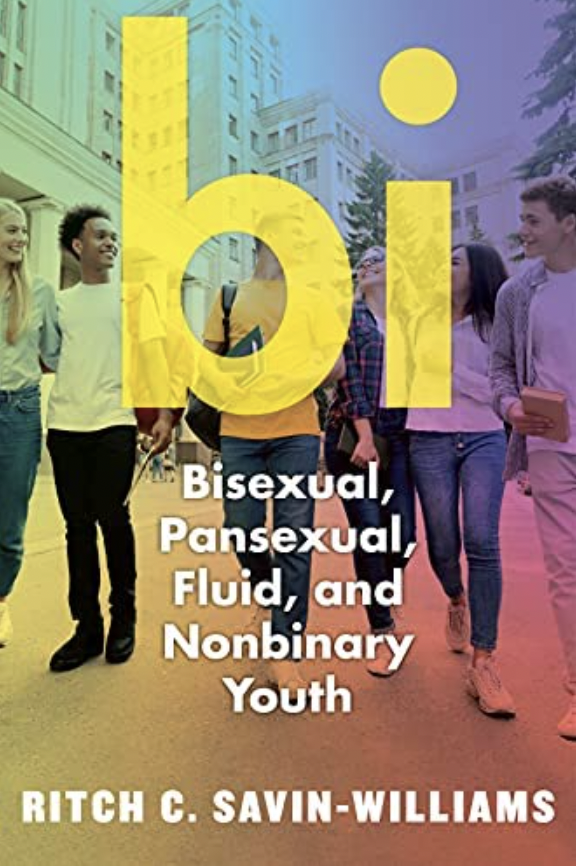
Book Review of Bi: Bisexual, Pansexual, Fluid, and Nonbinary Youth
How many times have you heard of someone who identifies as bisexual being discredited or accused of queer-baiting, just because they are in a heterosexual relationship, or because they don’t act “gay enough”? This phenomenon is called bisexual erasure, and it is now, more prevalent than ever in our media and our society today. The book Bi: Bisexual, Pansexual, Fluid, and Nonbinary Youth by Ritch C. Savin-Williams, aims to discuss the often disregarded complexity behind term bisexuality, and bring to light the prevalence and relevance of emerging fluidity and varying sexualities and genders. The author does this through the stories and experiences of college aged students who have had varying journeys regarding their sexuality and/or gender.
An overarching and important theme throughout this work, is the idea that the term “bisexual” is an “inadequate namesake” (Savin-Williams 21), as stated in the introduction of the book however the term is widely accepted by the public, which is why so many stereotypes and misconceptions have emerged out of this term. Many, as the author calls it, “individuals who are, to varying degrees, sexually and/or romantically attracted to multiple genders or sexes” (Savin-Williams 21), will refer to themseleves using the term bisexual, because it is really the only publicly accepted term other than gay or straight. However, because of this, many of the complexities of sexual attraction, gender, and fluidity are hidden, because when the public sees “bi”, they automatically think boy and girl. The pervasive bisexual stereotypes that rule a lot of our society and media, and how they can be dangerous are a big point in this book. The author is ultimately aiming to discuss many of the lesser known identities that are often hidden behind the veil of bisexuality, and bring to light the term’s complexity, as well as intersectionality between sexuality, gender identity, and other things like race and social class.
Ritch C. Savin-Williams is a developmental psychology professor at Cornell University as well as a licenced clinical psychologist who got his PhD at the University of Chicago, and he specializes in researching and writing about the sexual and romantic development of mainly adolescent and young adults of varying genders and sexualities. He is known for writing books on adolescent development, with this being his 10th book in that subject area. Having the baseline of adolescent developmental psychology, and having studied young men and women of all varying identities, with many different backgrounds this has helped him bring his expertise into more niche areas like being an expert witness for cases involving same sex marriage, gay adoption, and intersectionalities of gender/sexuality and race. Having this background has put him in a good place to write so many books on adolescent development, many of which involve the complexities of fluidity of sexuality and gender.
For this particular book, Dr. Savin-Williams conducted three studies where he interviewed and listened to the stories and journeys of 69 college aged students, focusing on the fluidity and spectrum of sexuality and gender. The interview contained many open ended questions about their development from both sexual and romantic perspectives, and the participants were asked to talk about broad topics from this lens, ranging from their early memories to where they see themselves in the future. He emphasizes that the questions were open ended and were asked, “not as an inquisition but as an explanation” (Savin-Williams 16). It was essential for the author to use this style of interview, so that the process would almost be led by the participants, taking Savin-Williams to where they wanted to go when discussing their experiences. He says, “Young people want to tell us their stories, their secrets, all we have to do is to want to listen”. The stories gained from this interview are the basis of the book and help the author show that the nuance to bisexuality, fluidity, pansexuality, etc, is a lot deeper and more complex than many think. Savin-Williams admits that almost three quarters of his participants “reported that they are white and grew up in middle or upper class homes in small or medium sized towns throughout the United States” (Savin Williams 15). He later goes on to say that urban and rural communities were represented in the participants, as well as young people of color or young people that grew up in lower class households, however, the majority of his participants fit that first bill.
One thing this book does very well is discussing the distinction between romantic and sexual attraction. This is something that is not talked about very much, because so many people blur the lines between these two things, and while there can often be some crossover, the bottom line is that these two things are separate. When considering parts of one’s identity, this work describes sexual, romantic, and gender aspects, drawing a clear line between sexual and romantic attraction, as well as touching on the idea that attraction/sexuality and gender are also separate things that are often lumped together. It is made clear in this work that sexual and romantic attraction for others can be- and is often- varying and fluid for different genders, body types, personality types, etc. For example, someone can be sexually attracted to both men and women, but not romantically attracted to men. For many, this is a complex idea to grasp, because for a large majority of people sexual attraction is supposed to come with romantic attraction and vise versa. Savin-Williams says that something in common with many of the youths he interviewed was that many of them had, “ an assortment of sexual and romantic attractions, a mixture of sex and romance that did not always corespond to their attractions, and a search for an identity that made sense”. In other words, it is often confusing for many young people (as demonstrated by the youths interviewed), to make sense of their attractions and sexuality, when their sexual and romantic appeals did not line up. This distinction is extremely important to talk about, especially in today’s environment, and this book did an excellent job of working through and discussing this.
I believe that this book would have benefited from more intersectional participation in the interview. While it should be noted that this lack of inclusion is something that the author addresses and discloses towards the start of the book, the book would have benefited if the author had just included more intersectional diversity in the first place when the interviews were taking place. The junctions between sexuality and gender, along with race, religion, class, and/or upbringing are important to discuss and it would have been interesting and more complex to hear about more of the different experiences between, say, a white, upperclass person who identifies as bisexual, and a person of color from a different upbringing who identifies as bisexual. There is some of this in the book towards the middle of the interviews, but increasing the intersectionality of participants would help this book be more well rounded.
I really enjoyed reading this book, because as someone who identifies as bisexual, I have struggled with many of the stereotypes, questions, and definitions discussed in this book. I myself, am pretty sure that I might be pansexual or some other sexuality, but up until recently I call myself bisexual because as stated in this book, it is the most widely accepted term other than gay or straight. However, more recently, I have stuck with the bisexual label because I realized that the term is expansive, and can mean many things- something that this book has affirmed. This book resonated with me because I was able to read stories about young people around my age who have had similar experiences to me: my dad refusing to accept that I am bi because I have only ever been in heterosexual relationships; struggling with separating romatic and sexual attraction and figuring out where they intersect for me; struggling to find a label that fits. I would recommend this book for almost everyone to read, I think that no matter your sexuality or gender, you could benefit and gain new understanding by reading this book. However, if I were to be more specific, I would especially recommend this book to anyone who identifies as something in between gay and straight- somewhere on the spectrum but you are not sure where- this book will help with understanding of the complexities and fluidity that come with adolescent development no matter your identity.
Sources:
SAVIN-WILLIAMS, RITCH C. Bi: Bisexual, Pansexual, Fluid, and Nonbinary Youth. NEW YORK UNIVERSITY PRESS, 2023.
“Ritch Savin-Williams.” Cornell College of Human Ecology, https://www.human.cornell.edu/people/rsw36.