Moppa, Interrupted


The lives and experiences of trans* people are rapidly becoming more commonplace in conversations in mainstream media. I Am Cait, Orange is the New Black, and Katie Couric’s interview of Laverne Cox and Carmen Carrera on Good Morning America (however problematic) are evidence that television is becoming more representative of cultural diversity in terms of race, sexuality and, more recently, gender. Jill Soloway’s critically acclaimed Amazon original series, Transparent, has gained traction and interest beyond the trans* community for its raw, honest portrayal of the confusion experienced by a family accepting that its patriarch has come out as transgender. The Pfefferman family does not take the announcement in stride, but battles grief and denial with regards to the loss of its father figure in order to make way for another mother. The show broaches the question of whether a series so uniquely diverse in its field ought to assume an educator’s role for its viewers. The show-runners faced the dilemma of whether or not to accept the didactic responsibility of representing the underrepresented. Does a series about topics newly introduced to public conversation have the luxury of serving their audiences’ basic need for entertainment? As evidenced by the second episode of season two, Transparent says yes. The series serves to entertain its audience with education, but is not a visual textbook. Ultimately, Transparent is not didactic and maintains the right to ambiguity.

screen-shot-2016-09-17-at-9-03-11-pm

Discussions of identifying beyond the traditional gender binary necessitate the destruction of the perceived notion of “realness” or legitimacy associated with being a man or a woman. Thus, the International Bill of Gender Rights as adopted in 1995 asserted each individual’s right to define or change his or her own gender. According to Riki Wilchins in Queer Theory, Gender Theory: An Instant Primer, there is a “fascism of meaning” behind the association with certain physical or personality traits with femininity or masculinity; it is “an assault of meaning that forces people to live as gendered impossibilities” (38). Maura Pfefferman, known affectionately as “Moppa” (an amalgamation of “mom” and “poppa”) by her children, is depicted in the arc of each episode of Transparent as attempting to liberate herself from those “gendered impossibilities.” By the second season, she has succeeded, to a vast degree, by identifying as a woman to her family and to strangers. She proudly presents and lives as female.

screen-shot-2016-09-17-at-8-42-14-pmIn episode 202, “Flicky-Flicky Thump-Thump,” Maura is forced to confront the emotional implications her ability to fulfill her sense of self has on her interpersonal relationships while engaging in digital penetration with her friend and ex-wife, Shelly. The scene is set in the bathroom of Shelly’s retirement condo, where the two once again live together. Shelly relaxes in the bathtub while Maura scrutinizes her image in the mirror, wearing a black bathing suit with synthetic breasts. Their conversation derails from Maura’s body image to a reflection on their previous life as husband and wife. While Shelly is enthusiastic to reflect on their sexual experiences together, Maura resists. Her expression shifts from the frown of a perfectionist, searching for physical flaws to one marred by pain and resentment. Even as she engages Shelly, Maura is emotionally disengaged from the experience. She glowers down at Shelly, ignorant to this in her ecstasy. While Maura can dress, walk, dine, and sleep as a woman, Shelly displays one pleasure Maura cannot know. Shelly, as per usual, is oblivious to her ignorance of Maura’s emotional needs. Afterward, Maura shakes off her feelings by wrapping herself in a kimono, checking her hair and replying to Shelly’s offers of reciprocation with a curt, “I’m good.” The sumptuous nature of the kimono’s material, for Maura, must patch the divide between giving and receiving pleasure and emotional fulfillment.

screen-shot-2016-09-17-at-8-42-52-pm

Despite the groundbreaking nature of a sex scene between two older women, one of whom has a penis, the continuously muddied waters of the relationship between Maura and Shelly are the focus of the scene rather than the mechanics of their sex. In an article for The New York Times Magazine, Emily Bobrow describes the Pfeffermans as a “loving family in which everyone seems uncomfortable in their skin.” Her observation, while not subversive, is true. The Pfeffermans’ discomfort with their evolving family dynamic is at the heart of the series’ intrigue. Thus, in order to propel a dynamic and engaging plot, Maura’s discomfort, physical and emotional, cannot be shied away from. The silent tension at the conclusion of the pivotal scene in “Flicky-Flicky Thump-Thump” exists solely because the writers chose to reject conversation of Maura’s genitals. The richness and depth of the tension, both emotional and sexual, stems from the decades of imbalance in Maura and Shelly’s former marriage. Maura’s actions are indicative of her weariness of giving all of herself to Shelly’s demands without the emotional reciprocation or attention she deserves. The episode’s power lies in its illustration of Maura’s life as complicated because of the typical strain of interpersonal relationships, not because of her transition.

However, that the scene includes Maura’s hesitance to fully engage sexually with Shelly rather than allowing Shelly to reciprocate confronts some feminists’ argument to exclude trans-women. Trans-exclusionary radical feminists’ essentialist notion of womanhood excludes trans-women because of their genitals. While the voices of these feminists may not be the majority, their opinions are relevant in the modern conversation of trans* experiences’ place in a culture only beginning to accept that life exists beyond the gender binary. Michelle Goldberg encapsulates this in her article “What is a Woman?” for The New Yorker, when she addresses the seemingly anachronistic perspective of these women, “at a time when transgender rights are ascendant, radical feminists insist on regarding transgender women as men, who should not be allowed to use women’s facilities, such as public rest rooms, or to participate in events organized exclusively for women.” Thus, addressing what would have happened if Maura had decided to stay in the bathroom with Shelly becomes relevant. According to trans-exclusionary radical feminists, Maura is not a woman at all. However, her womanhood is the driving force for the inception of the series’ intrigue.

The writers ignore all of this. In the context of the greater conversation between the show-runners and the audience, the focus on the emotional side of Maura’s transition rather than the physical aspect is representative of their choice not to fully engage in questions of gender politics. The position is a strange one to take by those at the helm of a show with content that can be so easily politicized. The episode effectively introduces the audience to conversations of what Leila Rupp calls “different-status sex” in Toward a Global History of Same-Sex Sexuality in order to address the correlation between transgressions of gender norms and transgressions of the norms of sexuality. However, the show is simply that, it is entertainment. The intrigue of “Flicky-Flicky Thump-Thump” signifies Transparent’s acceptance of the right to function as entertainment as any other series with less subversive subject matter. Ultimately, Transparent exists to expand perception of trans* lives, not educate on trans* bodies.

screen-shot-2016-09-17-at-8-44-00-pm

Works Cited

Bobrow, Emily. “How Two Producers of ‘Transparent’ Made Their Own Trans Lives More Visible.” The New York Times. The New York Times, 13 Sept. 2016. Web. 14 Sept. 2016.

Goldberg, Michelle. “What Is a Woman?” The New Yorker. Condé Nast, 28 July 2014. Web. 14 Sept. 2016.

Rupp, Leila J. “Toward a Global History of Same-Sex Sexuality.” Journal of the History of Sexuality 10.2 (2001): 287-302. Web. 14 Sept. 2016.

Wilchins, Riki Anne. Queer Theory, Gender Theory: An Instant Primer. Los Angeles: Alyson, 2004. Print.


Kellogg’s: They’re Grrreat!

Kellogg’s, a multibillion dollar company and American icon, produced two images one year apart for distinct advertising purposes. The first featuring Tony the Tiger was originally published in the 2014 Atlanta Pride Guide, whereas the second was posted on the official Kellogg’s Twitter account the day that the Supreme Court of the United States legalized same-sex marriage. The two images have distinctly different audiences and purposes, reflecting a break in time and culture surrounding the legalization of same-sex marriage and their corporate motives.

Tony the Tiger accompanied by the rainbow “PRIDE” are both iconic and eye-catching, which draw the reader into a more involved advertisement for the reader. The choice of publication for this image in the Atlanta Pride Guide makes it clear who the intended audience is: people attending the Atlanta Pride celebration. To break this down further, it can be reasonably assumed that the majority of the audience is members of the LGBTQ community, with members of the allied community supplementing the target population. The primary caption encouraging readers to “Wear your stripes with pride” refers to the fact that the “gay pride flag” is a series of rainbow stripes, which obviously appeals to the LGBTQ community who use the rainbow flag as a banner, particularly at pride events. Therefore, the use of the word “pride” plays right into the event at hand, but the association of Tony the Tiger relies on years of prior advertising to appeal to emotions of the viewer. Tony, the mascot for Kellogg’s Frosted Flakes, is know for being a strong, encouraging character with the slogan “They’re Great!” This slogan could easily refer to the “stripes” that are being worn with pride. Even without being explicitly noted, the point of Tony is to bring that slogan to mind. In addition, Tony himself is covered in stripes since he is a Tiger, so the idea of “wear[ing] your stripes with pride” also encourages the reader to embrace who they naturally are.

Once Tony has the attention of the reader, there are a series of more nuanced aspects of the ad to be considered. The logos at the bottom include a multicolored “pride & allies” tag that features the traditional Kellogg’s “K,” the full “Kellogg’s” name, and an endorsement from the Human Rights Campaign. The “pride & allies” tag serves as a self-proclamation of the fact that the company is composed of both allies members of the LGBTQ community. An endorsement from the HRC justifies that proclamation by providing a third-party perspective. The HRC as the largest LGBTQ rights organization in the country has a lot of influence and is a well known symbol on its own. So, to have a huge organization mark Kellogg’s as a top place to work for LGBTQ equality is a noteworthy accomplishment. It also works in conjunction with the rest of the text in the ad which discusses the company’s culture with regard to gender and sexuality acceptance for its employees. The explicit message from Kellogg’s in this ad is not “buy our product” but instead “work for us” which is an interesting tactic to take from a corporation. However, it is significant because of the turmoil regarding workplace discrimination protections for the LGBTQ community. In many places there still are not universal non-discrimination clauses, so for a company to outwardly advertise that it does not discriminate is pretty significant. The sense of security and acceptance appeals to the audience, and even if readers do not choose to work for Kellogg’s, they may still choose to buy their products because of that acceptance.

 One year later, the second image was posted on the Kellogg’s Twitter account the day that same-sex marriage was legalized. Some features are the same as the Pride Guide ad, such as the HRC endorsement and “pride & allies” tag. However, there are also some notable distinctions. The only explicit reference to the LGBT community is in the HRC endorsement for Kellogg’s as a top place to work. The other tags from DiversityInc and the NGLCC are not obviously referencing support of the LGBT community, unless the reader is familiar with the National Gay & Lesbian Chamber of Commerce. Anyone unfamiliar would likely not recognize the acronym and may not understand the endorsement. Similarly, the rest of the text and symbolism of the image may not be obviously pro-LGBT to someone who was not familiar with the rainbow flag. The flag is used as a subtle placemat for a bowl of cereal, which could be easily overlooked while reading the caption “LOVE: the same at every table” for which the bowl of cornflakes serves as the “O.” The smaller caption under the company name reads, “Nourishing families so they can flourish and thrive.” Both of these captions are generic enough that they could reference any given family without specifically referring to the legalization of same-sex marriage.

By posting this image on the official Kellogg’s Twitter, the company obviously is reaching out to a different audience than that of the Pride Guide. Instead of a primarily LGBT and ally audience at a specific pride event, the image could be seen by anyone who follows the Kellogg’s account, as well as by the followers of anyone who shared the image. Presumably this larger audience is exactly the reason for less explicit support of the LGBT community. The use of the rainbow flag makes its support clear to the community and to its allies, but it is subtle enough to potentially go unnoticed by opponents of LGBT rights. This ad is a way for Kellogg’s to make its stance known without offending and potentially losing the sales of less accepting Americans. It is interesting that the company appears to strategically walk a line by gaining LGBT and allied customers while not losing their opponents. The approach of referring generally to “love” and “families” plays into the idea that Riki Wilchins presented that for the LGBT cause to be successful, there has been a focus on portraying LGBT people to be the same as straight people, just with different sexual interests. This image implies that “love” is same no matter what and that any version of that love can constitute a family that Kellogg’s can nourish. This focus on sameness has evidently been successful since at the time of publication of this image, marriage equality had been achieved.

The difference in audience and message between these two images before and after the landmark legalization of marriage equality indicates a difference in the degree of publicity that Kellogg’s is willing to accept in supporting the LGBT community. Advertising in a printed Pride Guide assures that the first ad will reach a more specific audience, and because of that, Kellogg’s can explicitly try and recruit LGBT employees and customers. While this ad could have been put on social media, to do so more than a year before the Supreme Court ruling would have been very progressive, and the company likely would have faced more backlash. However, distributing a more generic love-based ad on social media after the ruling serves to publicly support the newly granted rights as opposed to advocating for a controversial cause as it would have been before the ruling. This timing implies that even though Kellogg’s was willing to announce a pro-LGBT stance to a small audience, they stayed out of the broader public eye before the ruling so as not to be seen as too progressive and lose opposing customers. These two images are good examples of how corporations get involved in social and political issues while still maintaining a capitalist agenda.

The Intersection of Sex and Power in Afghanistan

https://www.youtube.com/watch?v=x4txIXdKK-c

The Dancing Boys of Afghanistan is a documentary by Afghan journalist Najibullah Quraishi about the tradition of bacha bazi in Afghanistan. Bacha bazi, which means, “playing with boys” in Persian, is a long-standing tradition of child prostitution and sexual slavery in Afghanistan. Many times, these boys have to dress in women’s clothing, dancing and sing at parties for men, and then are sold to the highest bidder for the night. These are young boys no older than 15 years old (usually poor and/or orphans) that are sold to rich and influential men who keep them for prestige and as status symbols. The practice is illegal under Afghan law. However, the corrupt law enforcement does not implement it, and many times they do it themselves. In this documentary, Najibullah Quraishi researches bacha bazi first-hand by talking with the boys and their owners. At the same time, Quraishi is detailing and recording how authorities in Afghanistan are accountable for preventing these crimes, but are occasionally culpable in the practice. This documentary was created because he practice of bacha bazi is largely overlooked in the West. This short film is a way to shed light on a horrible and ancient tradition and to expose it to the West.

This documentary not only sheds the light on the boys who are prostituted, it also exposes the men who participate in it and the culture surrounding the practice. In the first few scenes of the documentary, Quraishi meets Dastager, a prominent leader in the bacha bazi business in the Takhar province of Afghanistan. Dastager introduces Quraishi to “one of his favorite dancing boys,” 15-year old Imam. Dastager continues on to dress Imam himself and say, “You’ll really make me want to lose control.” After Imam dances and sings for the other men, Quraishi sits down and talks with Dastager. With no shame, Dastager admits that he has had 2,000-3,000 boys work with him over the years. Quraishi precedes to ask Dastager if he has ever had sex with this boys; Dastager answers by saying no but immediately smiles afterward, indicating that he actually does. This scene shows how this practice is somewhat of an open secret in Afghanistan. Even when this practice is denied, everyone knows it is happening, but it is ignored. In many situations, people will not look at Dastager and think that he is doing something wrong. Instead, they would look at the boys he has raped, and say that they are the lowly and powerful ones. These boys are then looked down on and ostracized by their communities. This attitude in Afghanistan shows why the practice of bacha bazi has persisted for this long. People look down on these young boys (because they are looked at as poor and dishonored because they let the rape happen), and the men are not punished for their abuse, so they know they can continue doing it. These little boys are victim shamed and the blame is put on them.

Furthermore, a common thread throughout this documentary is class. Many of the boys who are sold into this sexual slavery are poor and/or orphans. About 13 minutes into the documentary, Dastagar tells Quraishi the kinds of boys he is looking for. Dastagar explains that he wants an attractive boy that is around 12 or 13 years old who is poor and has nothing. The practice of bacha bazi is perpetuated by poor families who sell their sons and by men who exploit the weaknesses of the poor in their communities. Many of the young boys who enter this world do not know anything about it, and the men who buy them take advantage of that.

Additionally, about halfway through the documentary, Quraishi interviews a police chief in Takhar province. The chief precedes to say that anyone who is caught practicing bacha bazi is prosecuted no matter what class they are because it is illegal in Afghanistan. However, in the next scene, Quraishi’s cameras catch two high-ranking police officials in an illegal bacha bazi party. They were simply watching and chatting with their friends at the party. The corruption of the police is an enormous issue in the preventing of bacha bazi because these are the people that are supposed to be stopping it. Instead, many of them not only look the other way when they know bacha bazi is happening, they also participate in it and consciously commit sexual abuse.

The Dancing Boys of Afghanistan not only sheds light on what is happening to many young boys in Afghanistan, but it also portrays why this ancient practice has persisted for so long. Simply informing the West of what is happening is not going to change this practice. In Afghanistan, the society condones this form of sexual abuse and slavery of young boys. Not only do people turn a blind eye to this horrendous practice, but they also blame the boy who is being sexually abused. They look down on the abused and then praise and admire the abuser. Also, the men who own these businesses exploit poor families and orphaned children who feel like they have no other choice, and prostitute the young boys. This perpetuates the bacha bazi practice because in a way, the boys are “willingly” selling themselves. Moreover, there is no one to enforce anti-bacha bazi laws because the police themselves are overlooking it and even practicing bacha bazi themselves.

Getting rid of the tradition of bacha bazi is not going to be easy. There are certain societal changes that need to happen, like no more victim blaming, giving more choices and freedoms to the poor in the country, and changing the culture and attitude of the police. This is not something that can be done over night. It will take a lot of money, time, and progression. Bacha bazi is banned in Afghanistan; however, this step is not the only one that needed to happen. The first step is that the men who are committing these crimes need to be held accountable and most are never punished for what they do. I think that if they are, it will show other Afghans that this practice is not okay and it will start to be stigmatized (for the better).

Also, I think there needs to be a huge shift of attitude towards feminism, sex, power, and sexuality. In many situations in Afghanistan, sex is looked as another form of attaining power. This is why many women are abused, sheltered by their husbands, and raped (marital rape too), and why these young boys are raped. Women have another set of societal standards that they have to meet. However, we never talk about the set of standards that men have to meet in Afghan society, which I think contributes in large part to the vicious cycle of abuse. If a man is not married and does not have kids by a certain age, he is looked at as impotent and powerless. If he does not beat his wife when she talks back or does not do what he says, he is looked at as weak. These practices go back to the idea that women are lesser and inferior to men and that men always need to have the most power. If you look at bacha bazi, it makes sense then. These little boys are not seen as men yet, they are just another way for “actual men” to prove their power and superiority. These boys are almost seen as women: weak and inferior.

Which Buzzfeed Stereotype Are You?

Day by day interactions with the world lead to many an unanswered question in our minds. When it comes down to the hard ones – figuring out what type of domesticated animal you are or how much your relationship resembles Beyoncé’s, there is only one place to turn: Buzzfeed. This social media entertainment web-sphere creates everything from memes to movies for their readers, who are usually young adults. The most enticing thing about all of Buzzfeed’s posts and articles is the quick, easy to read and comprehend quality. Everything opened will be closed within 3 minutes, have plenty of visuals to grab attention, and language that is up to date with pop culture. When looking at a particular video created by Buzzfeed called “8 Types of Girls You’ve Danced with”, the question comes up: why is this video so easily entertaining to their target audience? While I may not be immune to the tempting articles on puppies, I aim to answer this question by pointing out the assumptions and stereotypes of gender, sexuality and race present in this Buzzfeed video.

The video is presented to us through first person. For a little more than 1 minute, the camera, representing ‘us’ as the dancer, dances with 8 different females that all have catchy nicknames and corresponding personalities. I say personalities and not dance behavior as there are actually no references to how that woman dances or their style. I will return to this later. Its purpose is to entertain and humorously relate to a person’s dance experiences.

The viewer of the video starts watching with this first person perspective and places themselves in the position of the one being danced with. This allows one to relate to the person being danced with, with the shaky camera movements and eye contact directly to the viewer. One feels as if they are truly the female’s dance partner. The dancing view of the camera and characters talking directly to you brings forth the humor of the video as well. However, 35 seconds into the video, a selfie reveals behind the camera. The picture shows the female being presented, ‘The Photographer’, and the person revealed is male. This reveal breaks open the effect of first person. Now the video has shown the viewer the person dancing with all of these females is most likely male, and has been all along. The first assumption has been brought into the video. There is now a heteronormative perspective to look through. This reveal has multiple effects. Firstly, the relatedness has been shattered. For some, there is no relating to the male’s gender. Further, since there is now a face and distinct person assigned to behind the camera, the video is no longer first person. It is as if a veil has been lifted. Although the veil may be placed back in front of one’s vision, they still know who is under the veil. This reveal does represent a societally comfortable lens of heteronormativity though; seeing a male and female dancing together is more comfortable in a person’s mind in this contemporary society and makes it easier to watch this video. This use of heteronormativity, while destroying one’s ability to relate to the video, does provide a space that is assumed typical in society for our brains to imagine.

Each dancer in the video is named with text that describes their personality. As I stated before, none of the descriptions of the females include any reference to their dancing moves or style. All are representative of the characteristics they display on screen. Further, almost every single one of the 8 female characteristics shown correspond with a typical female stereotype. Here are a few of the examples of the portrayal of the females in this video, and the underlying assumptions that each nickname and corresponding traits bring forth. The first female is ‘The Texter’ who only texts while dancing. This goes along with the stereotype of a female being vapid and unconcerned about important issues and life around her. ‘The Mess’ is a drunk woman who can’t control herself, an age old stereotype. This points to the idea of women being stupid and unable to take care of themselves. It also subtlety reinforces rape culture by placing the inability to care for oneself on the fault of the woman, and therefore leaves a space open to blame her for events to come. The ‘Leave Room for Jesus’ is taking jabs at the idea of a religious women that has a certain set of beliefs by representing her as someone who is fairly unwilling to dance. This character is countered and immediately followed by her opposite, ‘The Pro’, a seductive figure who is very willing to dance. This age old dichotomy of the ‘virgin and the seductress’ is a common theme when talking about women throughout history. Freud coined this phenomenon as the Madonna-whore complex. Women’s sexuality has been seen in these binary terms; it is pure or impure, suited for a man’s marriage or suited for his lust. This phenomenon is present throughout culture and appears specifically in visual history. Works of art spanning from 1400 by Carlo da Camerino with The Madonna of Humility with the Temptation of Eve (left image) to Edvard Munch’s Women in Three Stages from 1895 (right image) show this very dichotomy.olivuccio_di_ciccarello_da_camerino_-_the_madonna_of_humility_with_the_temptation_of_eve woman-in-three-stages It is interesting that in an entertainment video of today this same theme is brought forth. The last female character is ‘The Clinger’, a dance partner who won’t let the (male) partner escape. The stereotype brought forth is the female as a dependent only looking for and needing the attention of a man. Laid out in this fashion, these female personas make one cringe with the blatancy of the sexist stereotypes. However, Buzzfeed chose these because these assumptions make it easy to classify females in contemporary minds. These stereotypes and themes are still around, easy to understand, and easy to create.

The last stereotype this Buzzfeed video utilizes happens when the female character ‘The Hair’ is shown. There is really no sugar coating this pretty flagrantly racist portrayal of the only female of color in the video. Her character’s face is never shown, instead an image of her hair is shown taking up the whole view of the camera for about 10 seconds. This is problematic for a couple reasons. First the woman’s face is never shown, meaning that not only has this character been narrowed down to one trait, but she is not even allowed the humanity of the face. Second, the only representation of a woman of color in the whole video is one where her face isn’t even shown. And last, the history of shame and prejudice against a woman of color in regards to her hair is as old and thorough as the history of racism. Women of color and their natural hair are underrepresented now and throughout media history. This background in our society means Buzzfeed’s choice to use black hair as their representation of a faceless woman who is hard to dance with is intentional and relatable to contemporary media. I cannot speak for anyone, but it seems with this choice Buzzfeed would pretty easily offend lots of people of color. Whether their audience truly is more white or they have just catered to their white audience’s historical media assumptions means the same thing, Buzzfeed’s target audience is white.

Almost more frightening than this video is the paired video Buzzfeed created called “6 Types of Guys You’ve Danced with”. The video begins right away with the heteronormative assumption: this time the camera view is in third person and the person dancing with all the males is a female. There is an underlying masculinity assumption underneath all the male personas that each needs to impress this female somehow through different means. As opposed to degrading stereotypes, there is an assumption of impressing and a focus on success. This paired video shows us that these videos are not anomalies in Buzzfeed’s collection. The video “8 Types of Girls You’ve Danced with” is focused on quick, relatable humor for Buzzfeed’s audience. It does this by incorporating a heteronormative lens, using age old categories to define different women, and stereotypes on black hair to ease their (white) audience in through assumptions that have been present throughout history. It’s easy to look back at all the subtleties present in this video and scoff, but the reason they make audiences feel comfortable is because they are not only society wide but present in many other contemporary forms of media. So when reading the news or scrolling through the internet, go forth and take that quiz on cheese Buzzfeed has made; but remember they too are victim to the contemporary conventions surrounding gender, sexuality, and race.

Kids Don’t Care About Their Genitals

One of the most engaging topics of the gender and sexuality field is the categorization of children into male and female genders when they are born. The idea that a doctor defines a child’s gender at birth is a socially constructed practice rooted in defining gender as male or female based on genitalia. This idea of gender identity will strengthen as children grow up, through media exposure and toys they are given to play with. Parents often reinforce these stereotypes and buy their children either “boy” or “girl” toys. These gender specific toys usually differ from each other in color and theme. Toys that are labeled as “girl toys” are often pink or purple. They are usually princess themed toys, horses, and replica home appliances. Toys that are supposedly meant for boys are action figures, cars, and LEGOs for example.

The meme I found challenges these stereotypes of gender specific toys by poking fun at them. It was originally created by Kristen Myers. The meme gives advice on “How to tell if a toy is for boys or girls?” It guides the viewers on how toys should only be categorized as adults’ toys and children’s toys by their intended use. If a toy is meant to be operated with your genitals, it is a toy for an adult and not supposed to be used by kids. If it is not intended to beused with your genitals it is a toy for kids of all genders. This attacks the gender stereotypes because it says that toys that are meant for kids are for all genders and not specifically for boys or girls. My other supporting piece of media exemplifies this gendering of kids toys. It is a toy commercial by the popular toy company Barbie. The company is advertising their new product, a pink toy kitchen. In this commercial a girl calls for her friend and asks if she wants to help her to make dinner on Friday. The commercial goes on and the girls cook imaginary dinner using the Barbie Gourmet Kitchen. The main focus in this commercial is to picture how much fun the girls are having while doing things that are “natural for girls.” It would be “unnatural” to have two boys or even one boy and one girl cooking food with this toy. It is noticeable that the girl who asks for her friend to come over is wearing pink dress, and her friend is wearing red and yellow outfit. This shows us how this toy is meant to be “girls toy” because of the stereotypic appearance from both of the girls in this commercial. This idea of selling replica home appliances to girls emphasizes the femininity associated with domestic work. Girls are taught to enjoy cooking and other tasks around the house.

Target audience and purposes of these two media pieces are very different. The meme is meant to entertain people who understand the idea of having non-gender specific toys, and that it is totally normal for children of all genders to play with any toys. For people, who believe that it is unnatural for boys to play with “girls toys” or vice versa, this meme is educating through its use of humor. When kids see this picture, they are encouraged to think of where their toys fall in this category and how all toys can be gender neutral regardless of color or other factors. For the Barbie Gourmet Kitchen commercial, the target audience is young girls ages 5-10. It is also targeted to the parents of these girls, who are buying the product for their daughters. The purpose of this commercial is to sell the product and that is why it is emphasizing the fun the girls are having. The joyful music and happy girls are intended to make parents think that this product is good for their daughters. This commercial is especially targeted to traditional families, where gender roles are emphasized and parents want their daughters grow up to become traditional feminine women.

Both of these pieces have multiple details that are trying to catch reader or viewer’s attention. The use of big font in the meme pops up and gives the meme a title. The title presents the idea that the meme is challenging gender norms. Like all memes, this one is easy and quick to read. The main purpose here is to be funny and educate the audience by using humor as a tool. Little details in this meme are important. The colors that are used play a significant role. The question “Do you operate the toy with your genitalia?” is in a blue circle because it represents the neutral part of this meme. The line that says yes leads to a red circle with a text “this toy is not for children” and the other line saying no leads to yellow circle with a text “it is for children of all genders.” It is important that the gender-neutral answer is in yellow circle because yellow is considered one of the gender-neutral colors. The adult toy answer is in a red circle because it can be considered “dirty” or “naughty.” The use of the word genitals increases the humor of this meme because talking openly about genitalia can be considered funny. In the TV commercial, the high tempo and joyful music, the girls with high-pitched voices, and the decorated room are details that draw the viewers’ attention. The commercial’s purpose is to attract people and create a happy feeling, and this commercial does it.

The Barbie Gourmet Kitchen TV commercial supports the stereotypes that the meme is trying to challenge. The femininity and masculinity that the kids’ toys represent are being challenged when kids are encouraged to think about these issues themselves. Memes like the one analyzed above try to make people understand that traditional gender roles are outdated and children of this generation should not be forced to accept the gender assigned by a doctor at birth.

Works Cited:

Michelle, B. (2014). How to tell if a toy’s for boys or girls…. Retrieved September 17, 2016, from https://secretlyfabulous.wordpress.com/2014/12/07/how-to-tell-if-a-toys-for-boys-or-girls

Toys Commercials Barbie gourment kitchen Kuchnia Barbie Mattel–. (2014) Retrieved September 17, 2016, from https://www.youtube.com/watch?v=Opbg3lxserc

“If it’s in a word, or it’s in a look”… An Analysis of “The Babadook”

“If it’s in a word or it’s in a look, you can’t get rid of”… societal norms. The Babadook, especially in this trailer, both reinforces and questions many of the underlying assumptions our society has around gender and sex, class and sexuality. Amelia, the mother at the heart of this film, is simultaneously defined by her distance and increasing slippage away from norms, but also the societal pressures that she feels trapped and tormented by. The trailer looks at both Amelia’s perspective as a mother in society, but also society at large’s view of what it means to be a woman, and what it means to be a mother.

The expectations for Amelia seem to overwhelm her throughout the film. The most prominent of these expectations that Amelia struggles with are her responsibilities as a mother. As a mother, she is expected to be always emotionally and physically available to help her son, and able to quickly and effectively correct anything disruptive or societally detrimental that her child does. The first shot of Amelia in the trailer is her reading to her son, Samuel, in bed, a quintessentially maternal action as defined by our society. However, as the trailer continues, the world that Amelia lives in seems to be crumbling around her. Her son misbehaves and acts out in violent ways, like building a slingshot to fight the monster. Samuel is loud, disruptive and potentially violent, in ways that Amelia soon realizes she cannot always control. Samuel’s outbursts are Amelia’s “fault” as a mother, and through the institutions that surround her, she is blamed and shamed for her inability to control Samuel’s every move.

Amelia’s problems, especially with regards to Samuel, are often treated in an institutionalized way through a male perspective, as seen throughout the trailer, in ways that contradict and cause conflict within Amelia as a character. For example, the male administrator of Samuel’s school tells Amelia, in response to Samuel’s bringing a weapon to school, “the boy has significant behavioral problems” (while the female administrator remains silent), and the medical professional that Amelia sees tells her “all children see monsters”. Even the governmental agents of order, as seen through the police at 1:22 into the clip, are distorted and unhelpful in Amelia’s plight. The police officer is a reflection of the torment Amelia faces, with his gray skin and sunken appearance, much like the Babadook that plagues her and her family. The film simultaneously questions and reinforces the idea that the home and the family are the “woman’s sphere”; Amelia is situated in a context where her inability to mother Samuel “properly” is a reflection of both Samuel and her own failures in a medical sense. Samuel “promises to protect” his mother if she can protect him in the trailer; however, neither characters seems to be able to offer the other protection.

The character of Amelia also reflects and questions the stereotype of the “hysterical woman” and the dichotomy that society often situates between the sane, put-together mother, and the “crazy”, overworked mother who can’t handle her children. Much of the film appears to be presented as though it is from Amelia’s perspective. The quick glimpses of the monster that the trailer shows the audience, such as the knock on the door at the 1:00 mark of the trailer, the shadowy figure in the neighbor’s house at 1:19 and the graying skin of the police officer at 1:23, combined with the increasing desperation in Amelia’s voice and more unkempt appearance seem to suggest that perhaps “the Babadook” is only a figment of her imagination and a hallucination created by stress. Amelia herself seems to buy into the idea that what she’s seeing is not real; as she tells her coworker, “I’m fine…just a bit stressed at the moment.” The Babadook addresses a real consequence of society’s belittling of women and children; Amelia and Samuel face real dangers when what they see with their own eyes is dismissed as the ravings of an overworked, hysterical woman and the overactive imagination of a child. The belittling that Amelia faces as a woman is compounded by issues of class, and represents an example of how intersectionality can affect a person’s place in society.

Though the trailer doesn’t often address these issues as fully as the movie does, the trailer does help reveal how Amelia, by virtue of her class, is often judged and belittled by those of higher class and power. For example, though not addressed in the trailer, Amelia struggles in the upper-class world of her sister, and the assumptions and judgments that higher class women place on Amelia for not being able to “do it all” as both a working woman and a mother. Much of the judgment Amelia receives as a “bad mother” and “hysterical” seems to be compounded by her social class; Amelia has to work and cannot afford childcare for Samuel, and society around her seems to judge her for her inability, by virtue of her social class, to constantly keep watch on and act as an authority figure for Samuel. Directly addressed in the trailer, however, is how wealthier men of higher social status treat Amelia. The administrator and doctor, in addition to being men, are indicated to be of higher class than working-class Amelia in the trailer, and their opinions that they understand her situation better than her because they are men are compounded by the privileges they enjoy over her due to class. They are implied to be “experts” in their fields, which means that, in the context of dealing with Amelia, they assume they understand her life and situation better than she herself does, which, as the film progresses, soon becomes evidently fallacious.

The Babadook, as an entity, is also very interesting from a gendered perspective. While the Babadook is clearly not human, it is still slotted into the gender binary in this movie. It is gendered as male, referred to as “mister”, and wears clothes that Samuel and Amelia take to mean it is male. The gendering of the Babadook helps feed into the storyline of the loss and grief Amelia feels, and her isolation from the world around her. The male Babadook represents the two male people in her life that precipitate her decline. He represents both her deceased husband, who, like the Babadook, acts as an unseen effect on her life that keeps her from being able to live as society expects her to. He also represents her son, Samuel, who, like the Babadook, represents her fear of being unable to handle being a mother, her fear that she has created or “let in” a violent monster into her life and her fear that Samuel is unable to distinguish reality from fiction, into which Amelia herself fears that she is digressing.

The Babadook, while on the surface simply a traditional monster movie, is also a critique and presentation of societal norms and requirements expected of women and people of lower class. Amelia feels simultaneously far from, and dragged towards, societal expectations of her as a woman, a mother and a member of the working class. Just like “Mister Babadook” who Amelia tries to rid herself of, the expectations of society just won’t let her alone, whether or not she “lets it in” or not.

Manly Men Drink Diet Soda

Although a rather recent tool, the media has been a crucial part of advertising for millions of companies worldwide. Major food and drink corporations have utilized the media to expose their products internationally, including one of the top companies in the world, Coca-Cola. Researchers have studied the effects that advertising can have on a person, specifically on how advertisements can subconsciously shape the way someone thinks or acts. This is often referred to as a subliminal message or a subliminal stimulus. With this in mind, it is important to explore some of the more explicitly gendered or sexist advertisements and what kind of effect they may have on an audience, whether that audience is cognizant of that effect or not.

Back in 2011, Dr. Pepper released an ad for their low-caloric soda. Right off the bat, it is easy to tell that the ad was made with a male audience in mind. In the past, companies have had a difficult time of selling diet sodas to men because it is stereotypically considered a “girly” drink. So, in order to appeal the drink to men, Dr. its-not-for-womenPepper plastered the words “Not For Women” across the print advertisement. The thirty-second commercial begins with a muscular man holding what appears to be a bazooka gun. There are explosions occurring around him, and jungle creatures seem to be chasing him. After shooting the gun a few times, he jumps off of a cliff into a jeep, where he then pulls out his Dr. Pepper TEN. “It’s only ten manly calories,” he yells over the roar of the motorcycles chasing behind him, with gunfire surrounding him. Then, he says, “So you can keep the romantic comedies and lady drinks, we’re good.” as he gestures toward his Dr. Pepper can. There are several aspects of this ad that are important to analyze. Firstly, the print version states very explicitly that this drink is just not for women. This speaks to the fragile masculinity that society has conditioned men to have.

In order to get men to buy diet soda, Dr. Pepper felt the need to blatantly say that the drink was simply too manly for women. Looking at the commercial a bit more closely, stereotypes revolving around men are basically jumping out of the screen. Which begs the question, what makes a man a man?

According to this Dr. Pepper commercial, a man can simultaneously drink a low-caloric soda and shoot guns while escaping from a disguised motorcycle gang. A man does not need romantic comedies and lady drinks, for that would just be a hindrance to him. The way this specific statement is presented encourages viewers just to believe it and not even wonder what exactly a lady drink is. However, it does not seem to matter for the purpose of this commercial, as long as Dr. Pepper’s Big Ten drink makes men feel like men. These tongue-in-cheek jokes about romantic comedies and lady drinks feed into yet another series of stereotypes, yet this time alternatively surrounding what women are supposed to act like and have interest in. Therefore, it can be analyzed that Dr. Pepper’s construction of a man is based off of what a woman is and what a woman is not. Not only is this problematic for obvious sexist reasons, but it also reinforces the distinct gender binary. So two things are at play here: the stereotyping of both men and women, which is where what we typically think of as blatant sexism is most prominent, and the reaffirmation of society’s continuous preaching that there are strictly only two genders. Certain qualities are strictly associated with men and certain qualities are strictly associated with women. Throughout this commercial, there is no fluidity. The movie Three to Infinity: Beyond Two Genders explores this concept of gender as a spectrum, rather than two distinct categories. However, as exemplified by the Dr. Pepper commercial, the rest of society considers this idea of more than two genders, or a lack of gender in general, to be radical.

Coca-Cola dipped yet another toe in to the sexist pool when they published an ad campaign promoting Sprite in Ireland. These advertisements included sayings like “She’s seen more ceilings than Michelangelo” and “She’s a 2 at 10 and a 10 at 2”. gross-sprite-adThe ads were quickly slammed and Coco-Cola came out with a public apology. Once again, Sprite was clearly trying to appeal to a heterosexual male audience. So, much like the Dr. Pepper commercial, Sprite felt the need to make men feel as if they are more worthy than women in order to appeal to their masculinity, which is important even in choosing what soda to drink. Not only do these ads objectify women, but they also in turn perpetuate a frightening rape culture, which leads right back to the superiority/inferiority dynamic of the traditional gender binary, as mentioned before.

Although recently pop culture has begun to become accepting of the queer community and has also strayed away from dehumanizing women, it is clear that big name companies still find appealing to men’s sensitivity to being feminine as a good marketing strategy. Even Coca-Cola, which is often times considered a progressive company, has used humor to cover up their sexist and gender binary centric advertisements. However, the more often these types of subtle sexist remarks are talked about, the larger the discourse surrounding gender becomes. Discourse leads to solution.

My Anaconda Don’t Want None…of the Intersectional Norms

The famous pop and rap musical artist Nicki Minaj debuted the music video for her chart-topping single Anaconda in the summer of 2014 and it became an immediately viral sensation. With over 617 million views on YouTube, the video homage to female physicality has been met with a wide range of opinions, some honoring it for promoting sexual liberation and some abhorring it for vulgarity and objectification. The intended audience of this video was certainly young, probably those born mostly in the 1990s and perhaps the 1980s. This intention is evidenced by the millennial-aimed product placement, use of contemporary slang, and the song’s content reflecting the relaxation of societal norms around sex over the past few decades. However, the nature of the Internet and the immediate infamous reputation of Anaconda presumably made the audience much wider than just twentysomethings. The obvious superficial task of this video is to entertain, but Minaj herself claimed on Twitter that it was “impacting culture.”[1] The Anaconda video does present undisguised sexually imagery that reflects aspects of culture and the sexual, racial, and gender norms that pervade it. A closer look at the media, however, presents a challenging contradiction as to whether Minaj subverts these norms, or plays into them and encourages their prevalence within a societal framework.

The Anaconda video presents the viewer with four minutes and forty-nine seconds of hypersexual and choreographed cinematography to accompany the song. However, in just a twenty-second clip from 0:40-1:00 we see many of the images that Minaj repeats and that offer insight into the norms she is representing. Minaj presents the following scene: several individuals, all wearing little clothing, dancing in the jungle. Minaj herself, lip-syncing to the slang and double entendre filled lyrics of her single and adorned in gold, is the clear focus of the scene. She is surrounded by several other people, all dressed in black, appearing in various poses illustrating their flexibility on the wooden structure on which they all stand. The scene features copious amounts of twerking, a dance move closely associated with black hip-hop culture. Some people have argued that, with this scene, Minaj is “calling out society’s view of black women as exotic and animalistic,” adding to the argument made in her tweet that she is impacting culture.[2] Minaj is certainly presenting this norm, and, though she attempts to interrupt it, her broad audience may not pick up on her effort to push against this norm; consequently, the video may reinforce the hypersexual, exotic stereotype of black women for those individuals who do not realize that Minaj is trying to ironically undercut those very norms. The broader audience to which I refer includes the over 600 million viewers of the YouTube video, as well as many others who have heard the song in another context. Minaj attempts to undercut these norms by seemingly playing directly into them. That is, she blatantly plays the role of a hyper-sexual, exotic (literally set in a jungle) black woman to prove that she controls her sexuality and can ironically inhabit this stereotype as a way to push back against it. This is recognizable to someone who has studied gender and sexuality in a formal setting, or is simply exposed to GSS theory. However, with no contextual understanding of the stereotype Minaj is undercutting, and no knowledge of her intentions to “impact culture,” I imagine many viewers saw the video as reinforcement of the stereotype.

Within the twenty-second clip previously mentioned, Minaj and the other individuals in the jungle scene play into the existing paradigm within American culture of fetishizing lesbian eroticism. While the contemporary United States still very much exist within a strict heteronormative matrix, there has existed for many years an obsession with eroticism between women. Even while sex between two men has been considered taboo and unacceptable, sex between women has been labeled as hot and sexy, with hours upon hours of so-called lesbian fetish pornography readily available, for free, on a host of internet porn websites. Minaj’s Anaconda reinforces the paradigm of lesbian eroticism being connected to a fetishized sense of desire—male desire, as the paradigm exists in the modern United States. Within the twenty-second jungle clip, the audience witnesses several images reinforcing this norm: another woman mounts Minaj and twerks as Minaj caresses the other woman’s thigh, and the clip features several other moments on intensely intimate touching between all of the women, again within the framework of exotic, animalistic sexuality.

Many have argued that, through Anaconda, Minaj has paid homage to female physicality and sexuality and, in turn, created some visual representation of sexual liberation. However, if we examine Anaconda more thoroughly, it may present an inaccurate representation of how power structures operate in society. If power is simply repressive, Minaj’s hypersexual ode to female bodies and sexualities would be seen as liberating and powerful as it pushes against the power that tells society not to talk about sex, particularly if you identify as a woman. However, the intersectional power dynamics explored in Minaj’s video are clearly more complicated than her simply pushing back against the power repressing her sexuality. Again, a wider audience not exposed to excepted thought and theory in gender and sexuality studies may not understand that she is attempting to make a statement about women—black women in particular—and the repressive stereotypes and norms under which they exist sexually and in general. Thus, the video may in fact reinforce those norms and stereotypes.

Minaj’s video as a whole presents a complex mixture of messages for the audience, especially an audience knowledgeable about Foucault’s understanding of how we internalize power. While Minaj may be attempting to subvert the norm of male sexuality and female submissiveness, her video for Anaconda nevertheless presents a host of images that reinforce certain intersectional stereotypes of race, gender, and sexuality, all the while operating within the male gaze. Though she displays acts of female homoeroticism, they are presented within the fetishized matrix of lesbian sexuality popular in the porn industry and mainstream media. Nicki Minaj’s video appears on the surface a strong step forward for female sexual liberation and I, personally, respect her attempt to impact culture and challenge norms by ironically embodying an exaggerated version of a commonly held stereotype. However, the Anaconda music video presents challenging contradictions as it plays into lesbian fetish norms, and may in turn simply reinforce the stereotype of the sexually liberated, exotic and erotic black woman.

[1] Nicki Minaj, Twitter post, 21 July, 2015, 3:23 P.M., https://twitter.com/NICKIMINAJ

[2] Mueller, Kate. “‘Aaconda’: Why You Should Watch Nicki’s Video Again.” The Huffington Post, November, 11, 2014. Web. September 16, 2016.


When Humor Reinforces Pre-Existing Social Structures Rather Than Satirizing Them

cooper-1

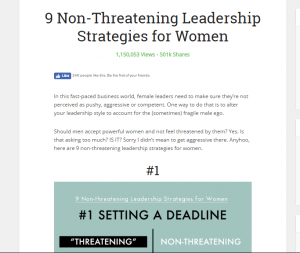
“9 Non-threatening Leadership Strategies for Women,” was a heavily shared graphic article during the summer of 2016. Sarah Cooper published the article on her satirical “office humor blog” known as The Cooper Review, which generates a variety of cartoons, listicles, and videos under the descriptor tagline, “Funny because it’s true.” However, as I dig into the complexities of the article’s simplistic assumptions, this tagline becomes less ironic and more revealing in how the media it promotes is actively harmful in reinforcing particular norms and binaries.

The graphic article begins with an introduction that suggests the audience (females in business work environments), the antagonist (males and “the patriarchy”), and the purpose (how to alter female leadership style in order to avoid negative perception from men): “In this fast-paced business world, female leaders need to make sure they’re not perceived as pushy, aggressive or competent. One way to do that is to alter your leadership style to account for the (sometimes) fragile male ego.” The full introduction, brimming with sarcasm and humor, sets the reader up for the satire to come: “Should men accept powerful women and not feel threatened by them? Yes. Is that asking too much? IS IT? Sorry I didn’t mean to get aggressive there.” The piece goes on to present nine graphics, each with its own caption and “strategy” for women in the workplace. This framework alludes to the “corporate manual” and variations of leadership strategy guides in the corporate world. These guides permeate the business world in the form of books, magazines, online publications, and are sometimes specified towards women, such as Levo League, an online platform dedicated to providing resources, advice, and connections to businesswomen.
cooper-2
Each of the graphics in the article is a colored square framed by the article’s name “9 Non-threatening Leadership Strategies for Women” on top and
The Cooper Review branding on the bottom. Between that framing, bold black letters spell out “#1” through “#9” and range from simple actions (e.g. “sharing your ideas” and “emailing a request”) to responding to external incidents (e.g. “someone steals your idea” and “hearing a sexist comment”). Each square is split by a black line, the left side title “THREATENING” highlighted black and enclosed in sarcastic quotes, while the right side title “NON-THREATENING” is not highlighted and is not enclosed in quotes, making it more approachable. Underneath each title is a simple gray scale drawing of a woman or a woman with a man and a text bubble above the woman’s head. The only differences between the left and right sides of each graphic are the characters’ facial expressions as linked to the text (“threatening” vs. “non-threatening”), showing that the “non-threatening” responses are supposedly more polite and happier for all those involved. The left to right transition, imitating the normal English reading pattern, also subconsciously implies which situation is the “right” way for women to act in order to be respected by men.

Despite the biting sarcastic humor of the graphics and their respective captions, the graphic article makes several assumptions that detract from its explicit attempt to undermine particular gender societal expectations. Most glaringly obvious throughout the nine graphics is the reinforcement of the gender binary and gender stereotypes as well as a complete lack of racial and body size diversity. Cooper’s article is fixated on women versus men and their respective perceptions in a corporate work environment. Every “woman” has long hair (either white or black), white skin, is thin, and wears some sort of blouse or suit jacket. Almost every graphic also includes the image of a “man,” also white with either white, gray, or black hair and a collared shirt and/or tie. In promoting such homogeneous images though, the graphic article reinforces a deeper problem of norms in the corporate world. The graphic images only present two categories of gender identity, one type of body size, one race, and most likely one social class, which perpetuates the same normature that the aforementioned “corporate guides” already promote. By showing one type of person, Cooper falls right into line with the large marketing structures that subconsciously promote homogeneous images and what is acceptable in the corporate world.

cooper-3

Cooper’s #whitefeminism mission leaves out several gender and racial identities, but she also goes further as to pinpoint and use male stereotypes. For example, “#6 When You Already Knew That,” depicts a “threatening” standpoint in which the female character tells the male character that she has already explained something to him. The “non-threatening” side presents the woman saying she would love to hear him explain it again. In the caption below, Cooper states “Men love explaining things.” While she might intend to present men as stereotypes in defiance of the generalized representations of women, such a statement doesn’t lead to a productive outcome for her assumed female audience. In breaking down expectations of women in the workplace, she builds up and reinforces stereotypes and expectations of men. In the last graphic, “#9 When You Disagree,” the only change between “threatening” and “non-threatening” is the fake mustache on the female character. She claims that wearing a mustache makes you “more man-like.” But what does “man-like” even mean? Having facial hair? “Growing a pair”? Although Cooper intends this comment as a joke, there’s also an unfortunate underlying assumption about what masculinity even means. But, her assumption that men receive more respect in a work environment due to their biology also reveals a subtler point about gender characteristics and perceptions. As we discussed in class, butch and femme characteristics receive different treatment outside the LGTBQ+ community, and perhaps more masculine qualities (i.e. butch) receive a greater degree of respect in the office environment. Studies have shown a counter-intuitive wage gap in which gay men receive a smaller salary than straight men while lesbian women receive a larger salary than straight women. Not only does the graphic article present the characters as cisgender, they also appear heterosexual, which brings us back to another corporate normature that Cooper sustains. One of our takeaways from the Wilchins piece discussed in class was that with sexual queerness comes a level of gender queerness and vice versa. Meanwhile, the characters in Cooper’s graphics seem to all fit the socially constructed gender and sexual norms that the typical corporate guide would also promote, whether intentionally or not.

cooper-4

Cooper sets out to critique and disrupt the man/woman dynamic in the corporate workplace and model that has been promoted by countless publications, advertisers, and media. She focuses on women’s oppression in the workplace and uses a male/female inversion to prove the lack of respect women receive. However, this graphic article fails to act as a didactic piece and comes across as only entertainment because she only inverts the heteronormative male/female relationship and reproduces other homogeneous racial, sexual, and class expectations in the corporate world. If she wanted it to be more than a piece of entertainment, highlighting the intersectionality of oppression in the workplace would ultimately teach and flip her audience’s expectations of who really does work in the business world.

Fighting Against Conformity

In the TV show, Orange is the New Black Carrie Black also known as “Boo” is an inmate at Litchfield women’s prison. Her character can be described as outspoken because she is never afraid to say what she feels or to be the way she is. In the episode “Finger in the Dyke” there is a lot that is learned about Boo. The title implies the episode will focus on the sexuality and the way Boo identifies. It is a very graphic name, but it relates to the way the character behaves because those two aspects of her are very important in the way she presents herself in the show; Boo is a very complex character and she depicts one of the many sexual and gender identities that exist. She describes herself as a Butch Lesbian. She has the word Butch tattooed on her arm and she feels it is a really big part of her identity and something she has had to fight for. This show has a lot of underlying messages in general about issues dealing with gender and sexuality, but the scene I wanted to focus on was on season 3 episode 4. It is a scene where Carrie Black “Boo” is young and her mother wants her to wear a dress, but she refuses to wear it. The scene starts off with a very unhappy looking teenage Boo wearing a dress. Her mother in the background seems hopeful that her daughter will finally listen to her and stop dressing in ways that make her stand out. The mother then goes on to say that she shouldn’t try and go against the expectations of society because that would bring the wrong kind of attention. What this suggests about society is that there is a set of structures dictating the behaviors and characteristics of each of the sexes, and to stray away from the expectations set will only result in judgment and ostracism. In society, there is a clear gender binary that has dictated the way males and females have to look like and behave like. The mother then walks away angrily as the father comes in to help her “deal” with the situation and try to convince Boo to wear the dress. The father takes a different approach to “dealing with” Carrie’s opposition to wearing the dress. There are a couple of things he says that help with understanding the way people view those who fall outside the gender norms. He pleads Carrie to just wear the dress to make her mother happy. What can be interpreted from this is how conformity plays a role in society. In the scene, the imagery is very strong because it shows just how intense it can be to not conform. You have the mother who is getting really upset and calling her daughter a bitch because she doesn’t want to fit into the mold that her mother is trying to force her into. Boo is very visibly upset, and she also refuses to give in right away. People conform to the gender norms they don’t always identify with because they want to stay in the boundaries set by society in order to keep everyone happy and prevent conflicts. The father then goes to talk about her teenage hormones. What he is implying from this is he thinks what she is going through is a phase because of her hormones as a teenager. He is being dismissive of the way she feels. Boo expresses this to him because she brings up how she thinks it is not a good enough reason to change the way she is in order to make other people happy.

This is something people who fall outside of the “traditional gender norms” have to deal with. Overall, the scene tries to argue how there are pre-set gender norms that people are expected to fit into. Society has built this idea of what a young girl is supposed to look like, and if the person does not fit the mold, like wearing a dress on picture day, then there is a lot of judgment directed at her. In the reading “Female Masculinity” by Judith Halberstam she talks about being a tomboy; in society being a tomboy comes with difficulties because it is seen as a phase and once the girl goes on to her pubescent stage, then the pressure to conform to the rules of femininity are forced upon her by the people in society and, like in Boo’s case, her parents.  The scene is especially powerful because it brings to the forefront the way family can be at the center of trying to push people into conforming to what society wants. One one hand it is because of the concern that they will be judged by others, but it is also on some level because they also believe it is the way things should be.

The intention of the clip is to show the oppressive nature of gender conformity. The scene focuses on how there is an expectation for young girls to be complacent and to behave in a certain way. They have to wear dresses and have to not want to stand out. The mother mentions how there is a bad kind of attention that Boo is trying to get is not the “good kind.” She brings up the way other kids will make fun of her and that plays into the role of how people are forced to conform because of the way other people will treat them. A lot of what happened in the scene was touched upon in the documentary “Three to Infinity: Beyond Two Genders.” There is this idea that forces people into these two binary roles in society when in fact peoples’ likes and dislikes can go beyond that. People will identify differently and that makes people uncomfortable because it is something they do not see often because there are so many social constructs around who people have to be according to the standards set by society. Anyone who doesn’t meet the criteria for what it means to be feminine or what it is to be masculine is looked at weird because people don’t know how to categorize them. Boo is “Butch” and this identity takes on different characteristics and intersects masculine and feminine traits. The intersection defies the binary spectrum which is something people are not used to seeing, therefore leading to judgments against her. It is an effective in portraying the struggles of gender conformity because it shows the strain on relationships and the anguish of the teens trying to push against the behavioral expectations of their gender.

The target audience would be the younger generation. The show does have a lot of younger women as the main characters, but it is still graphic enough to not have the target audience be young teenagers. This affects how the show is written because it can be more explicit with the way it tries to explain things as well as it can focus on a variety of issues that women have to face. This is important because the show does expose the viewers to stories they may have never thought about before. The show does go beyond the plot of piper chapman in order to increase awareness into the lives of the other women in the prison. The episode. in particular, is trying to make people understand that there are a lot of limits to the traditional binary roles and that there are people who identify outside of them. People have to fight all of their lives to justify who they are if they do not fall into one of the two categories designated by society, and they have to put up with judgments constantly while trying to defend who they are. It is necessary to expand the spectrum of identification and move away from the binary in order to understand gender identity and expression, as well as sexuality, come in various forms.


Works Cited

“Finger in the Dyke.” Orange is the New Black. Netflix. 12 June 2015. Web.

Halberstam, Judith. Female Masculinity. Durham: Duke UP, 1998. Print.

Pretty in Pink? A Media Analysis of a “Progressive” Toy


Pretty in Pink? Media Analysis of a “Progressive” Toy

Gender as a concept is a systemic structure that begins affecting children at a young age. The manipulation of gender and sex starts with advertisements for items such as toys, clothes, and furniture that mold the way children see themselves as soon as they are old enough to register what they see and hear on television and in print. Mass media and industry pushes the binary as a way to sell more items and this process requires children to pick a side: either the feminine side, where the toys are centered on appearance and homemaking, or the masculine, where the toys are more aggressive and active. The push towards a more inclusive toy industry is warped, and is seen through a recent advertisement for a toy called GoldieBlox. GoldieBlox is a set of building blocks and is focused on attracting a young, female audience. The commercial seems to reject the pink, princess-centric world of girls’ toys for a more scientific, active toy. What this commercial does not address, however, is the reinforcement that there are two types of girls: one that enjoys the norm and one that does not fit what we traditionally perceive as a girl’s toy. When the girl does not fit the norm, she is automatically placed in the other category, in which it is imperative that she maintains her femininity even though she rejects the traditional set of toys. In this way, the toy industry’s push to design more “inclusive” toys still remain solidly in the gender binary.

This GoldieBlox commercial, aptly named “The Princess Machine” begins by showing three girls sitting in front of the television, bored by the advertisement for a girly toy. The commercial proceeds when the girls don safety goggles and decide to construct an elaborate machine from their girly toys, such as baby carriages and tea sets. The girls work together to create a series of pulleys, levers, and ramps that extend throughout their whole house, creating a domino effect that moves a ball along the trail of toys. The girls run alongside the ball as it travels from room to room, eagerly awaiting the finale. The advertisement shows them enjoying their final product, which changes the television channel that originally showed the feminine toy commercial to an advertisement for this specific toy. The girls then cheer and celebrate their invention.

This advertisement is expertly crafted in order to appear to be advocating change in how toys are marketed to children, but only breaks down the feminine stereotype enough that it is comfortably available to the mainstream. An example of how it remains entwined in the binary is the toy’s pink packaging, showing a smiling blond girl on the box, plays directly into preconceived and accepted notions of what young girls should look like and how they should spend their time. This toy is no more evolutionary than a Barbie, and is a exemplary instance of Judith Halberstam’s argument in An Introduction to Female Masculinity that, “tomboyism may even be encouraged to the extent that it remains comfortably linked to a stable sense of a girl identity” (6). Girls are allowed to express themselves through traditionally masculine toys only until they hit puberty, when they are expected to become feminine, docile, and disinterested in masculine pursuits. Another interesting aspect of this commercial is its name: The Princess Machine. The name is not mentioned anywhere in the video, but can be found by searching it by name. The naming of this commercial is crucial to the argument that social norms can only be pushed so far, and not broken, as to create discomfort for the audience. The title of this commercial asserts that, although these girls do not want to be princesses, they can still create something feminine and acceptable to the gender binary. Notable, as well, is the race of the girl on the packaging. The use of a blond girl, though cartoon, asserts the argument that this toy is focused on maintaining what the media sells as acceptable for girls to be: white, “pretty”, and feminine. Not only is this toy selling the binary, its selling what society is groomed to think of as beautiful. The commercial, much like it does to the binary, pushes the idea of inclusivity just barely, by including one Caucasian and two girls of colors in it. The packaging tells the consumer that this is the ideal and is the first part of the toy little girls will see, which is no different than any other of the white centric, mainstream advertisements see across all industries. All these aspects of the commercial and packaging are, in a not so subtle way, asserting society’s views that being white, blond, and cis-gender is the ideal identity of a child.

The binary further asserts itself in the sub context of this commercial, narrowing the entire female gender to one of two categories: those who enjoy baby dolls and tea sets, and another, which rejects these items. The commercial seems to, at first glance, break down the stigma that girls enjoy playing solely with baby dolls and tea sets, but the makers have only given females one other option. By discussing femininity by only giving an alternative, this commercial’s message is very similar to the mainstream, exclusive message of the gender binary. This message is reminiscent of Wilchins’ Queer Theory, Gender Theory and her idea that, “Woman could do anything men could do and still retain their femininity” (8). Wilchins is discussing how, instead of completely breaking down and eradicating gender norms, it is popular now to offer an alternative to the “girly girl” while still remaining what is commonly thought of as feminine and therefore comfortable for the general population. Wilchins’ assertion is related to an image seen at the end of the commercial, with the three girls standing shoulder to shoulder, arms crossed, wearing their construction belts and safety goggles. Although this would be considered a common frame if it were little boys, the girls have to remain feminine by wearing girly clothes as to not disrupt the binary. Another pertinent topic discussed by Wilchins is the idea of gender expression, which she defines as, “the manifestation of an individual’s fundamental sense of being masculine or feminine through clothing, behavior, grooming, etc.” As long as the toy user’s gender expression is one that has been seen before and accepted by society, she is allowed to freely enjoy her blocks or dolls. If she were to start acting like or identifying as more masculine, Wilchins says, “[people] will probably be shocked, disgusted, or at least turned off” (9). GoldieBlox is an excellent example of the cunningness of advertisers, who play to their consumer to sell more products.

GoldieBlox is a toy marketed towards an apparent shift in commercial industry towards a more inclusive, neutral business. When analyzed, however, GoldieBlox and its corresponding advertisement do nothing to break down stereotypes and expectations placed on children and the activities they enjoy doing. The resulting advertisement is a misrepresentation of what is it to be a girl with interests that do not include traditional girly toys and fails to acknowledge that feminine ideals are ever present and still being embedded in the minds of the girls watching these commercials.

Works Cited

GoldieBlox & Rube Goldberg. YouTube. N.p., n.d. Web. 30 Aug.

  1. < https://www.youtube.com/watch?v=IIGyVa5Xftw>.

Halberstam, Judith. “An Introduction to Female Masculinity.”

Introduction. Female Masculinity. Durham: Duke UP, 1998. N.

pag. Print.

Wilchins, Riki Anne. Queer Theory, Gender Theory: An Instant

Primer. Los Angeles: Alyson, 2004. Print.


What it Takes to Make the First Lady Great

“We want our children and all children in this nation to know that the only limits to the height of your achievements is the reach of your dreams and your willingness to work for them.” Melania Trump spokciwbk-oukaaubuxe these words at the 2016 Republican National Convention. Perhaps because these words were so poignant and eloquent, it did not take long to journalist Jarrett Hill to show the American public that Melania did not come up with them. Instead, she plagarized Michelle Obama’s 2008 speech from the Democratic National Convention. Shockingly, despite the fact that the First Lady’s intellectual property was stolen on the national stage, no one from the Trump campaign was fired. The Trumps got away with it with no significant loss in support.

But why are Trump fans so loyal to Melania and the Trump clan? Obviously, there is no simple answer to this question, but Ben Garrison, in this May 2016 cartoon, taps into some of the worrisome perceptions about possible future First Lady, Melania Trump and why the American public might be supportive. This cartoon primarily cites the centerfold of the Trump campaign,  “Make America Great Again” to contrast the capabilities of Michelle Obama and Melania Trump. However, the cartoonist only makes strides to represent their differences to be “great” through the depiction of their bodies. All of the visual  differences between Trump and Obama point to one underlying message of the cartoonist: Michelle Obama is less equipped to be a “great” first lady, and has not carried out the position properly. Garrison argues though, that Melania will be able to make the “First Lady great again” for reasons of her physical presentation, the color of her skin, and her femininity.

Immediately, my eye was drawn to the green dress on Michelle Obama. This color green invokes a monster-ish feel, which is in direct contrast to the red dress on Melania. Melania is depicted in an elegant flashy gown, with pearls and fancy make-up.  In fact, Melania’s slit dress is reminiscent of the dress Angelina Jolie wore to the 2012 Oscars. Michelle on the other hand, is wearing chunkier jewelry. Her whole look is far less upscale  than the way that Melania’s is portrayed- white gloves, ball gown in all. Garrison uses this tactic to demonstrate that Melania will bring a level of glamour to the White House in the same way a movie star would, while Michelle’s dress in an ogre-green makes strides towards dehumanizing her. In other words, Garrison  depicts Melania in an expensive outfit, Michelle in one that is “cheap”- Melania is rich and glamorous, while Michelle is poor and less than human. But the notion that their physical representations matter in the evaluation of their “greatness” contributes to the pervasive sexist undertone of the entire cartoon.

Furthermore, there is a racist visual message that is very difficult to ignore. Michelle’s facial expression is in a fixed and disapproving scowl, and the hand on her hip makes her appear stand-offish and enraged. Her whole presence invokes the stereotype of the angry black woman.  In her article, Controlling Images and Black Women’s Oppression, Collins points out, “ As  overly  aggressive,  unfeminine  women,  Black  matriarchs  allegedly  emasculate  their  lovers  and  husbands” [1].  This racist bias holds that black women are oftentimes so “aggressive”that they push people away.  This depiction of Michelle as scowling is degrading because it not only traps her in the stereotype of an angry black woman, but also sends the message that she is not worthy of admiration.  Melania on the other hand, is in a gentle and approachable pose, with a happy smile on her face. Garrison is furthering his argument that Michelle was the kind of First Lady that leaves room for improvement, since she was so aggressive and mean, while Melania is soft, approachable and worthy of admiration. But underlying this attempt to place Melania in a positive light, is the unignorable racial bias that part of the reason Michelle is angry and mad is not only because she is not “great” but  she is not great in part because of the color of her skin.

Lastly, and perhaps most blatantly, Garrison is saying in this cartoon that Michelle failed at her role as a good first lady because of her masculine figure. Michelle’s bulging muscles and strong stature are in direct contrast to the ultra-feminine pose of Melania. In fact, Melania’s figure is almost hyper-sexualized. The large slit in her ball gown is suggestive at best, and an explicit objectification of her body at worst.  Furthermore, Michelle is flat chested and lacking curves,  in comparison to her busty and curvy counterpart. Not only is this an attempt to emasculate Michelle and reveal her as less “womanly” because of the shape of her body, it also sends the message that Melania is more valuable as a first lady because of her physique. Through the depiction of their bodies, Garrison is sending the message that Melania is going to be better at this position of first lady than Michelle ever was because she is looks more like what a woman “should” look like. There is nothing to do with the compared content of their brains, or their hearts for that matter, but rather there is an explicit message that the shape of their bodies and their sexual attractiveness is what should be compared.

Garrison asserts that Melania is better at this conceived role for three main reasons; her physical beauty, the color of her skin, and her perceived femininity. He makes strides to depict Michelle as unattractive and harsh looking, while Melania is physically beautiful, elegant, and well-dressed. Furthermore, Melania is a “great” candidate for First Lady because her presence as a white woman is far less threatening than the depiction of Michelle as an angry, menacing black woman. Lastly, Garrison depicts Melania as a clear preference for First Lady because her body is the feminine ideal. She is curvy, voluptuous, and sexualized, while Michelle is strong in stature and more “manly.” This last idea in particular furthers the idea that a woman matters, only if a man finds her attractive and would want to have sex with her. In all, the extreme contrast in the physical appearance of both women is built on the notion that a woman has worth because of the way that she looks, and only if she looks “great.”

This cartoon is so wrong for so many reasons.  In this cartoon Michelle is attacked for not only being a woman, not only being a black woman, but being a black woman who is not as “sexy” as Melania Trump. Garrison and his hateful opinions reveal a scary voice in the American story. Garrison’s is a voice that screams and taunts and hides behind the concept of “free speech.” I will admit, I oftentimes want to believe that this voice has no power. But with the 2016 election coming up, it is more important than ever to reveal Garrison’s voice for what it truly is- a scared whisper stemming from a hateful mind and a fearful heart.

Works Cited:

Garrison, Ben. “In Trump’s America, the First Lady will be Great Again!” Illustration. Grrgraphics. Web. 16 Sept. 2016.

[1] Hill Collins, Patricia. “Controlling Images and Black Women’s Oppression.” Introduction to Gender and Sexuality Studies. Apr. 2016.  16 Sept. 2016.

Burger or Blow Job?

“Sex sells.” This is a phrase that is ever popular in the advertising world and is used to sell products, services, and businesses alike. This strategy is usually seen as effective, but sometimes advertising companies purposefully push boundaries past what is deemed acceptable in order to evoke shock value in their viewers. In 2009, Burger King did just that with the release of an advertisement promoting their new “Super Seven Incher” burger. The advertisement had a limited release; it was only made public in Singapore, but was pulled from the market very shortly after it began circulation due to its controversial nature.

The images of the advertisement are overtly sexual and intend to depict a woman performing oral sex on the “Super Seven Incher.” The woman is the focus of the advertisement, as her profile from the neck up is shown on the left side of the ad. She is a white woman, has a blonde bob, and a face full of makeup. Her eyes are wide and her red lips are parted in an oval shape. Coming out from the right side of the page is the Super Seven Incher, aimed directly at the woman’s mouth. The advertisement is shaded darker at the corners and becomes increasingly lighter as the focus moves inwards towards the mouth and the burger. Below the image of the woman and the burger are the words “IT’LL BLOW YOUR MIND AWAY” in white, bold letters. Below the phrase is a yellow panel depicting the burger along with a drink and fries and a price of $6.25 for the whole meal. The description of the meal is in the lower right hand corner of the ad.

The target audience of this advertisement is very obviously the heterosexual male and it is supposed to be viewed through the framework of the male gaze. The sexual nature of the image is attention grabbing and conveys the message that by eating the Super Seven Incher, they will receive as much gratification as they would from receiving oral sex. By depicting the act in this way, the ad is designed to create a fantasy for heterosexual males, which can be fulfilled by eating this burger. Eating this burger will make heterosexual males happier, more satisfied, and more appealing to women, according to the ad.

Depicting the woman in the advertisement in such a hyper-feminine way insinuates that the woman’s sole purpose in the advertisement is to provide pleasure and act as a sexual object. Creators of the ad specifically used a young white woman with bright red lips and blonde hair, characteristics that are routinely associated with sex appeal, to target their audience. Although the advertisement was released in Singapore, the woman is white which reinforces the westernized beauty ideals that we see across most media. By portraying the woman in this way, the ad creators have established that this is what a “real woman” should look like and this is how she should act. The woman is submissive to the man and his desires (as represented by the burger) and the ad links her femininity to sexual objectification. Sex sells, but usually only if it is in a heteronormative way. If the roles had been reversed and an image was insinuating that a male was performing oral sex on a female, the reactions would have been different. People would have been taken aback by the overt sexuality, since a male gratifying female sexual desires is not something often portrayed in contemporary media. The same goes for if a woman was illustrated performing oral sex on a woman, a man on another man, or any other combination of gender identifications.

The imagery of the advertisement is extremely sexual and this is furthered by the use of language surrounding the ad. The name of the burger itself, the “Super Seven Incher,” has nothing to do with the taste appeal of the burger. It does not describe what is on the burger or its quality, but instead describes the length of the burger. This burger length is a not so subtle reference to male genitalia, adding to the visualization of the sexual image that is portrayed. In the quote under the burger, the words “IT’LL BLOW” are larger than the rest of the words on the page, immediately catching the viewer’s attention. Slang terms for performing oral sex are “blowing” or “giving a blow job,” so the use of this specific language was no accident. The most glaring use of language to conjure up sexual images was in the description of the burger in the lower right hand corner of the advertisement. The advertisement tells its audience to “Fill your desire with something long, juicy, and flame grilled” and “Yearn for more after you taste the mind blowing burger” Both of these particular quotes describe the burger, but they do so in a way that expresses the longing and need of the heterosexual male to have his desires fulfilled. The “yearning” and “desire” that is expressed can refer to the male’s need for sexual gratification, but can also refer to the female’s desire “for more,” not in reference to the burger, but alluding to it as a representation of male genitalia. Using the images along with the specific choice of words furthers the message of the advertisement and adds to its shock value.

Although the ad was removed from the market, it was successful in the regard that its shock value made it widely circulated and talked about. It successfully perpetuated the image of traditional gender roles and used sexual imagery to maintain heteronormativity. Its purpose was to push boundaries, spark conversation, and evoke a strong emotional response from its viewers, whether it was one of desire or disgust. By this ad fulfilling its purpose, Burger King got the publicity that it wanted, a publicity that has lasted longer than they could have imagined.

Works Cited:

Stransky, Tanner. “Burger King’s Super Seven Incher Ad: Subtlety Is Dead.” EW.com. N.p., 24 June 2009. Web.

“Top 10 Tasteless Ads.” Time.com. N.p. Web. <http://content.time.com/time/specials/packages/article/0,28804,1907218_1907236,00.html>

Respect Me For My Brains, Not My Body

Picture this. You are a blonde, caucasian woman. Perhaps you have large breasts. Perhaps you are frustrated with societal assumptions that because you are blonde, you must not be intelligent. Perhaps you are on the lookout for a company to purchase new glasses from, as you just got a new prescription. Enter Oogmerk Opticians, an eyewear company from Belgium. Their ad campaign, entitled “Get The Respect You Deserve”, contains a simple depiction of the same blonde, white, large lipped, large chested woman with one difference. One of the women is wearing a pair of glasses. In what is an extremely simple cartoon, both women are gifted a singular descriptive adjective below their depictions. The woman without glasses is labeled “easy”; the woman with glasses is labeled “hard”(See picture to the right). oogmerk_hard_rgb_1While the intended purpose of this advertisement is to get women to buy glasses, its main success is perpetuating effects caused by the sexual objectification of white women, namely through self-objectification. Furthermore, this advert does not even skim the surface on the wide ranges of stereotypes and objectifications unique to non-white women.

Culturally, women are objectified in a number of ways. The most prominent kind of objectification seen is sexual objectification, which occurs “when a woman’s body or body parts are singled out and separated from her as a person and she is viewed primarily as an object of male sexual desire” [1]. This dynamic is constructed through a society-wide hierarchy that places white, cisgendered, heterosexual males at the top. Sexual objectification of women can lead to a variety of outcomes on a scale from seemingly harmless to some of the worst experiences people will have to go through in their lives. A direct offshoot of this practice can be seen as the societal scrutiny of women’s bodies which create a wide range of standards and, often, unattainable images for how women can and should look and act. This analysis will focus namely on the experiences of white, heterosexual, cisgendered women, who exist at the top of the femininity hierarchy. However, it is extremely important to remember that these interactions and expectations exist in a wide range of unique ways the varying intersections face these challenges.

Stylistically, this advertisement makes its message crystal clear. The subtle nature of utilizing so few words in this advertisement draws up the image of a picture being worth a thousand words. The secondary sex characteristics, both the enhanced breasts and enhanced lips, depict an obvious statement about the assumed sexual behavior of the women. The viewer is then coerced in a simple manner to adopt this train of thought. Namely, that women who wear glasses are smart and/or stuck up, and therefore are “hard” to get into bed. This parallel structure seen is in no means a novel idea and claims its foundations around the segmenting of the female body. The females depicted are segmented so that the points of focus are their breasts and faces. Societally, women are commonly “seen as parts, rather than a whole”, namely their sexual body parts [2]. This stems from a depiction of sexual desire that reduces women to “a mere tool for sexual purposes,” or to a “sex object” [3]. While this conversation focuses mainly on cleavage, of any variety, as a depiction of a marker for essential female sexuality, the linking of the lips in this instance only aids in painting the portrait of a sexualized woman. Considering the unique role breasts play in conventional femininity, it is not a surprise that they are such sexualized part of the female figures in this advertisement. Breasts are utilized more than any other part of female anatomy in advertising and media images, that society “can barely catch a glimpse of side boob without thinking it’s sexual” [4]. However, an intriguing focus is made in this advertisement as well by enhancing the lips and linking these sex characteristics through color. This makes a subconscious association for the viewer regarding sexual acts that only works to underscore the overarching message.

This sexualization of secondary sex characteristics is solidified with the conquest related terminology applied to each woman. By stating the ease in which, if wanted, a heterosexual man could bed these two women, the objectification is internalized and able to cause a cascade of self-objectification and its effects. Furthermore, this diminishes the ability of women to appear educated, which reinforces the societal threat of women’s intelligence to the patriarchal hierarchy. By viewing these images in a sexual connotation, this concept of women being educated is erased from the thoughts of any potential customers, which allows the grounds for the tag line “get the respect you deserve”.

The language used, albeit simplistic, is probably the most problematic part of this advertisement. The message that women have to control their image in order to be respected, and that one can only be respected if they are “hard” to get into bed, constructs a pre-existing societal framework in which women are judged, as beings, solely for their appearance and not for their character. By evoking these images and concepts in this advertisement, the company is pining to tap into the appearance anxiety of the women viewing it. Appearance anxiety and body shame have been seen heavily in women who have been objectified, due largely to self-objectification [5]. The coopting of these symptoms of sexual objectification has one purpose: to trick women into feeling that they can change societal beliefs about their sexual promiscuity by buying Oogmerk glasses. This is a clear example of the rhetorical appeal of pathos, as its intention is to sway the emotions of its audience [6]. Through an explicitly minimalist approach, combining visual and verbal messages, these effects caused via sexual objectification are exploited to make sales and inherently reinforce these standards and requirements for existing as a “successful” woman. All of this ultimately ties to support the deeply ingrained societal dynamic of sexual objectification of women, which “no woman can opt out” of [7].

While ultimately this is not the most problematic use of objectified tropes surrounding the ties between female sexuality and female body parts, it highlights an overarching problem seen in the advertising industry today. Too often, there are problematic outcomes, like the power dynamics of rape and sexual assault, that stem from these beliefs that women exist as objects for men’s sexual desires.


[1] Szymanski, D. M., L. Moffitt B., and E. Carr R. “Sexual Objectification of Women: Advances to Theory and Research 1 7.” The Counseling Psychologist 39.1 (2010): 6-38. Web.

[2] Pappas, Stephanie, and LiveScience. “Our Brains See Men as Whole and Women as Parts.” Scientific American. N.p., 2012. Web. 16 Sept. 2016.

[3] Papadaki, Evangelia. “Sexual Objectification: From Kant to Contemporary Feminism.” Contemp Polit Theory Contemporary Political Theory 6.3 (2007): 330-48. Web.

[4] By 50 Million Liters Since 2007. “The Sexualisation of Breasts – The Circular.”The Circular. N.p., 03 Mar. 2014. Web. 16 Sept. 2016. <http://thecircular.org/the-sexualisation-of-breasts/>.

[5] Szymanski, D. M., L. Moffitt B., and E. Carr R. “Sexual Objectification of Women: Advances to Theory and Research 1 7.” The Counseling Psychologist 39.1 (2010): 6-38. Web.

[6] “Pathos.” Writing Commons. N.p., n.d. Web. 16 Sept. 2016.

[7] Fischer, A. R., S. K. Bettendorf, and Y.-W. Wang. “Contextualizing Sexual Objectification.” The Counseling Psychologist 39.1 (2010): 127-39. Web.

An Analysis of Facebook Misogynists

Last year, in my high school class’s Facebook group there was a debate I’d like to discuss as it still infuriates me to this day. For context, I’m from a very small, affluent town in Connecticut. My town is known for being quite liberal, generally pretty progressive , and very well-educated. The public school that we all attended is ranked by U.S. News as being number 4 in the state and number 184 in the country. 99% of students who graduate from our high school go to college. For comparison, the national average of high school graduates who enroll in college is 65.9% according to The New York Times (2014). The percentage of Americans who actually attend and graduate from college is even lower. Every single person involved in these conversations is now attending a reputable college, including University of Indiana, Southern Methodist University, and University of Michigan. I don’t say this to brag, but rather to contextualize these comments and explain why I was so shocked by them. Given our shared background and education, this incident was unexpected. To further contextualize this, this occurred on social media with the knowledge that is was a form of mass communication. The people involved were aware of who would be seeing their posts. In order to analyze this, I will be examining some screenshots I have from the private group in which they were posted, and relating their contents to a variety gender and sexuality studies concepts, such as gaslighting, identity politics, and misogyny.

Despite having been graduated for nearly a year at the point when this incident occurred, someone decided resurrect our class Facebook group by creating a post in support of Donald Trump. When a fellow classmate, who happens to be female, spoke up about her dislike of the candidate, two male students felt the need to respond with the following comments: “95% of Hillary 12814413_964920363584441_1240800165149743160_nsupporters are women…BOOM roasted” and “You’re allowed to vote from the kitchen these days?” These comments led me to believe that these boys thought that female supporters of Hillary Clinton do not count and are invalidated in their belief simply because they are women.


As degrading as these comments were, what happened next was, to me and to many others, absolutely enraging. Another former classmate of ours posted a porn video that depicted a female porn actor advocating for a woman’s right to voice her opinion, only to be interrupted by a male porn actor shoving his penis in her mouth. Many people, including myself, were shocked that this boy would look up this video and post it in a group that was intended for school-related information. Despite this, many of my former classmates, both male and female, liked this post before group administrators (who were former student government members, so ex-classmates as well) removed the post. Prior to this however, more hatred and misogyny were spewed at the students who asked for it to be removed. Though it was a relatively small group of boys participating in this hatred, I was still shocked at the number of students participating and what they believed was okay to say, particularly coming from as liberal and well-educated of as place that we do. Ironically, this all occurred on International Women’s Day (March 8th), which, in my mind, solidified the point that we need this day to celebrate women seeing as we still face this misogyny, even from our classmates and supposed friends who are college educated.

I’ve included some of the comments below. These comments included such things as “#nomeansyes,” followed by “and yes means anal,” which reflected an incident we had during our Senior year, when the Women’s Empowerment Club created a rape awareness campaign, and put posters around the school with the statement “Rape is not a joke,” many of which were vandalized with the phrase “lol”. This displays the mindset of many of the students involved in this debate, where they truly don’t see women’s rights or rape (which certainly extends to more than just women) as an issue.
12814106_964919356917875_856941921631290399_n
12806194_964919360251208_3840839426840677950_n12794378_964920243584453_853440003447550235_n
12809523_964920300251114_7954592233995510200_n
12801117_964919713584506_2779395371015545430_n

10371895_964485050294639_14927973729924029_n

Their comments showed to me that these boys see gender as a clear dichotomy; there are only men and women. Not only that, they perceive these two genders in a clear hierarchy where women are the lesser of the two. Their statements not only diminished women but also served to reinforce this dichotomy and created a notion of having to “choose sides” between men and women, or even between feminist and misogynist. The fact that this one boy thought he was “roasting” Hillary and her supporters by calling them women furthers this notion as it’s clear he thought this was an insult of some sort. Furthermore, this displayed a weak and simplistic version of identity politics, where these boys tried to create a sense of comradery and alliance because of their gender. Their beliefs are being shaped by their gender identity and the convictions that come with that. I believe that many of these students, as white, cisgender men, who were raised in a very affluent town, have never been the subject of oppression or faced anyone telling them they are lesser. Most of them have never truly faced hardship, which I can say confidently as I have known the majority of them since they were in diapers. They are able to make these statements because of their position in society.

The student who posted the video defended his actions the next day with this post below. He felt he was justified because, supposedly, girls from our class had messaged him telling him that they agreed that the other girls in the group, who were defending their right to be seen12814811_964485743627903_3451060346602791121_n as equal, were being ridiculous. Because he had some support from females, it was okay. This again ties into the idea of identity politics where he is attempting to justify his beliefs on the basis of his gender and the support of the other gender. Additionally, it could be argued that he is gaslighting, where he is manipulating others into questioning their own beliefs. He refers to this whole situation as a “joke,” trying to diminish the impact of his words and mold the perception of his actions. He tries to defend his own character, implying that if he’s a kind person he couldn’t have done something offensive,insisting he’s “never said a mean thing” to any of his opposers. This likely won’t be shocking, but he was not a kind person in school. He considered himself a class clown of sorts, and was constantly making fun of others, but always under the guise of humor.

The outrage that followed these posts were undermined by the original posters complaining that feminists don’t have a sense of humor and that they couldn’t take a joke, which, from their perspective, is clearly these posts were. The people involved in both these posts and the anti-rape poster incident (which are groups that include many of the same members, unsurprisingly) excuse their words and actions with humor. Words have power. Actions have power. They are not excused because you think they are funny. There were many comments in this thread that told people to “take a joke” or “chill out” or “get a better sense of humor”. However, I believe that the comments they made are rude and insulting, and should certainly not be taken as a joke. This idea that women don’t have a sense of humor when they try to defend their rights as people is derogatory and degrading. This “joke culture” is harmful because it invalidates feminists’ claims as humorless without at12814530_964920476917763_3029247096580930692_ntempting to understand their arguments, valuing humor as the most important factor. It also attempts to minimize the impact of the offending statements and the culpability of those who make them because they “aren’t meant to be taken seriously,” which is problematic because not only are the perpetrators not seeing the other side of the argument, they often don’t even recognize that there is a problem. They don’t see that feminism and comedy can coexist, and that one does not negate the other.

The claim was made that “feminism definitely doesn’t have a sense of humor,” to which I must respond: I’m sorry that I don’t find rape funny. I’m sorry that you think I’m a “bitch” for arguing that all humans –  male, female, or otherwise – should be seen as equal. I’m sorry that I can’t “just chill my nips” and accept injustices. I’m sorry that completely undermining another human and treating them like subhuman for factors that are out of their control is not hilarious to me. If that means that I don’t have a sense of humor, then so be it. I’d rather be able to see the value of a human than be able to take a joke. I’d rather be a feminist than a comedian.