Redefining Sovereignty

The Erotics of Sovereignty by Mark Rifkin interprets native american writers by illustrating the clear impacts of heteronormative white society on indigenous ways of life. The constraints of white society are best shown through the interpersonal lives of native americans. By closely working with excerpts of writings by: Qwo-Li Driskill, Deborah Miranda, Greg Sarris and Chrystos — Mark Rifkin reveals the extent of native america suppression and explains one form of liberation from conservatism through homosexual erotica. Mark Rifkin explores the intersection of sexuality and controlling power.  

The Erotics of Sovereignty illuminates how white patriarchal society has systematically denigrated and infiltrated indigenous society. This monograph particularly focuses on erotica and intimacy as a lens that reveals the extent of suppression within native tribes. The Erotics of Sovereignty expresses empowerment, specifically of queer native american women, through pushing away  homophobic western society. The physicality of this monograph is all about taking back the sovereignty over one’s own body.  Mark Rifkin deconstructs the writings of Qwo-Li Driskill, Deborah Miranda, Greg Sarris and Chrystos to articulate different specific ways white society has infiltrated native society and identity. In the first chapter “the Somatics of Haunting: Embodied Peoplehood in Qwo-Li Driskill’s Walking with Ghosts” Mark Rifkin addresses how the Cherokee have dispelled non heterosexual couples and African Americans, who were former slaves, within their communities. These exclusionary actions were pressured by the American government, they were pressured to keep a pure blood line for continued government recognition. Governmental pressure to prove native heritage is an overarching theme that ties into Native American self identity. Within the last chapter Chrystos writes about trying to maintain her identity even in an urban white society. She shows some of the real social damages American society and government have caused. Also revealing some of this suppression is Deborah Miranda who focuses on the displacement in place because even though her people are still on their land, emotionally they have become disconnected with each other and the earth. Mark Rifkin explores Deborah Miranda’s expelling of white normative constructs in his second chapter  “Landscapes of Desire: Melancholy, Memory, and Fantasy in Deborah Miranda’s The Zen of La Llorona,”.  Mark Rifkin interprets her words about nature and homoerotic sexs as her way to combat the heteronormative society constructed during colonialism. In Mark Rifkin’s chapter “Genealogies of Indianness: The Errancies of Peoplehood in Greg Sarris’s Watermelon Night” he investigates how white governmental suppression has shaped modern native society, particularly the Pomos. Focusing on the constraints and violence that were brought by white American pressures. Mark Rikin’s view of those encapsulates how the laws and formation of society have effected there tribals people’s identities, mental states, protection for those who are vulnerable and their tribes connection with the earth. However, he also shows that by breaking the societal sexual boundary some native americans are able to feel empowered.

Mark Rifkin has a PHD from the university of Pennsylvania and is a professor of Women’s and Gender Studies at University of Greensboro. He is well known for his books Manifesting America: The Imperial Construction of U.S. National Space, When Did Indians Become Straight?: Kinship, the History of Sexuality, and Native Sovereignty, The Erotics of Sovereignty: Queer Native Writing in the Era of Self-Determination and other essays in the area of Native american suppression. Through Mark Rifkin’s extensive work in the intersective fields of gender and sexuality and native american culture, he has established the background to delve into complicated issues of identity and sexuality in The Erotics of Sovereignty.

Mark  Rifkin’s uses the words of Qwo-Li Driskill, Deborah Miranda, Greg Sarris and Chrystos in their personal accounts to support his concept of native american suppression. Excerpts from Walking with Ghosts, The Zen of La Llorona, Watermelon Nights, and Chrystos’s Poetry provide a structure for Mark Rifkin to drape his arguments upon. Also pulling from legal and state documents he is able to provide historical background in an introduction that grounded the true atrocities committed against native people.

One Clear strength of Mark Rifkin’s work is how he found different elements of native society to consider the extent of native suppression. Through the text of four native american writers his is able to add additional dimension to each of their writing styles and perspectives. Through deconstructing small portions of text at a time he is able to articulate and bring finesse to each of his arguments with grace. Even the organizational method of his monograph is well founded. By giving historical background and a thorough introduction Mark Rifkin’s is able to present his argument well, before even diving into the details of his analysis. Even stronger still is his premise for the book that holds the intersection between the interpersonal realm of sexuality and the external power realm of society. By framing personal with societal Mark Rikins is able to imbue The Erotics of Sovereignty with just how deeply white heterosexuality society has been ingrained in current native american lives, all the way down to the erotic itself. By intertwining the two he is able to show how native american women reclaiming their sexuality is a form in which they reclaim their power.

The only weakness that Mark Rifkin’s work holds is that some pieces of his argument are speculative. The inclusion of speculation in The Erotics of Sovereignty is because this monograph is at the forefront of exploring native american society through the lens of Gender and Sexuality Studies. Mark Rifkin has framed this exploration by looking into queer writers personal experiences of suppression. Though immaculately framed and structured there is a strong basis in metaphor and interpretation that goes along with the inclusion of the interpersonal.

Mark Rifkin brings to light the true severity of american laws and societal pressures. By working with the text of four queer native american writers, he is able to examine independence of native culture and sexuality. One element addressed in the introduction is the loss of land and continual violation of promises by the government around rights, even just reconnection, if these indigenous people. Because native americans have such strong ties to the earth it would be interesting to examining how conservative western society effects health and healing practices, especially in relation to women’s health. Honing in on native americans disconnect from the earth, I would be fascinated to understand other ways, beyond sexuality, that native americans have been able to reconnect with the earth and find interpersonal empowerment. Nature is more than aesthetic value, it is what sustains, heals and provides context for an indigenous way of life.

Work Cited

Rifkin, Mark. The Erotics of Sovereignty: Queer Native Writing in the Era of Self-determination. Minneapolis: U of Minnesota, 2012. Print.
Breaking from the Confines of Normalization

“Never judge a book by its cover” – a seemingly simple phrase that surely every child has heard growing up, whether it is at school, at church, or at home.  This humble, concise phrase has taught children for decades that what is on the inside of a person is what truly matters, not what one sees in a person’s appearance.  However, this well-intentioned phrase is made up of multiple philosophical layers that address two parts of the self: the outer self and the inner self.  According to the common phrase, “Never judge a book by its cover,” only one of these entities of the self should be used as an indication of who one truly is; nevertheless, society also insists that individuals make the inner self known through changes in the body and one’s appearance.  In other words, according to society, the inner self is what truly matters, but this inner self can only be fully known and represented with changes to the outer self, or the physical body.  This idea of changing one’s body to represent the inner self is exactly what Cressida J. Heyes is challenging and objects to throughout her scholarly monograph Self-Transformations: Foucault, Ethics, and Normalized Bodies, along with numerous other topics and ideas that relate to the body and one’s identity.  She discusses the idea that importance should not be placed on the body as a representation of one’s inner self and challenges these Western norms and expectations of appearance.

Plastic surgery is a perfect example of society’s normative culture that places emphasis on the body as an expression of the inner self.  More and more “average” individuals go under the knife every year in hopes of creating the outer self they have always imagined reflects how they truly feel on the inside and how they wish others to see them.  Heyes addresses this increasingly popular phenomenon of bodily changes in varied examples of cosmetic surgery, from discussing breast augmentations and nose jobs to forms of weight loss surgery.  She analyzes individuals’ desire for these surgeries and talks about how these desires for surgeries (and the surgeries themselves) are normalizing the process of identity representation or even transformation through changes to the outer self.  As the title of the book implies, Heyes places focus on breaking from the confines of normalization and suggests how individuals can change themselves in order to discover one’s authentic self while avoiding conforming to what society expects one to be.  She explores this idea by objecting to two main claims: the claim that the inner self has a “unique authenticity; that to know oneself… is to know the nature of this individual” (3), and second, the claim that the authentic self “must be made visible through changes to the body” (4).  She is objecting to society’s expectations that one’s true self must be made known through physical appearance, especially because the Western world has expectations of how the body should appear, placing emphasis on changing the “flaws” of the body so that one can express one’s true and “flawless” self, which is in itself conforming to society’s expectations of perfection.  In discussion of these expectations, Heyes discusses the technologies that are now available that give individuals access to processes that will change the body in order to supposedly bridge the gap between one’s inner self and outer self, such as plastic surgery, but also mentions the complexities of these ideas in procedures such sexual reassignment surgeries.  She questions where the line exists between necessary medical intervention that is needed to restore normal function and bodily enhancement that is aimed at making the individual closer to perfection and beyond normal capacities.  In arguing that one should resist society’s emphasis on the body as a reflection of one’s authentic self, Heyes insists that docility must be resisted, and frequently employs the use of “docile bodies” in her objections to conformity and in her support of breaking out of the confines of normalization and into the liberation of freedom.  The overall aim of the book, which Heyes states in the introduction, is to “recognize the moments of truth in such assessments, while offering a framework for ethics, in which not moral judgment but askeses of freedom are the primary goal of analysis” (8), with askesis being defined as a Foucauldian term referring to the “forms of care of the self that underwrite our art of living” (8).  The “assessments” she refers to in this context are evaluating the body as an expression of an inner self.

In order to demonstrate her credibility and both academic and personal experience which give her valid insight into these philosophical ideas, Heyes explains her world travels, research, and academic experience which lead her to write the book in her acknowledgements section prior to the introduction.  She explains how her education attained at Oxford University (where she obtained her undergraduate degree) and McGill University (where she earned her Ph.D. in Philosophy), along with her experience as Canada Research Chair in Philosophy of Gender and Sexuality at the University of Alberta and travels around the world, have allowed her to see the issues she discusses from numerous perspectives, thus allowing her to come to a educated and valid conclusion herself about such matters.  The book is only one among many books she has published, along with numerous journal articles, book chapters, and reviews she has published both before this book and since then.

In order to incorporate this experience throughout the book and to more effectively provide her own insight into the arguments of other scholars and experiences, Heyes uses the first person perspective.  She specifically addresses this method in her introduction, stating that her “ethical commitment to situating the author as a partial, prejudiced, and invested theorist” is the motivation behind why she wrote the book “self-consciously” in the first person (13).  She discusses how she includes her own personal experiences and personal disclosure about her own embodied identity, despite its possible contradictory effects.  Heyes explains how publicly displaying personal experience can invite other individuals’ critique or disappointment, but she is willing to do this because of the possible positive ramifications, such as others being able to identify with her.  She also explains how she takes pride in her use of first person because her goal is also to stand in solidarity with others who are afraid to speak up and be wrongfully judged and misunderstood.  This courageous yet plausibly risky technique is in the end successful because it empowers both the author and the reader because of the boundaries broken and criticisms ignored.  This method perfectly displays Heyes’ intention to teach others how to break away from conformity and to discover how to freely express one’s inner self.  Personal experience is certainly not her only method of demonstrating the legitimacy of her research and exploring the material she covers.  Another very effective and substantially more valid manner she utilizes is analysis and incorporation of the work of numerous authors, including renowned philosophers.  As mentioned in the title of the monograph, Foucault is central to a lot of Heyes’ analysis, but she also includes the arguments of philosophers such as Charles Taylor, Ludwig Wittgenstein, and Kathy Davis.

The book in its entirety contains numerous strengths, whether one examines the methods Heyes utilizes throughout the book, the content itself, the dense philosophical analysis, or simply the topics themselves.  I think the use of the first person is especially successful and is definitely a strength of the book.  The use of Foucauldian rhetoric and philosophical analysis are also especially effective; Heyes’ use of excerpts from Foucault’s famous works (and from numerous other philosophers and authors) gives the book a depth which simply would not be attainable without its presence and the critical analysis which Heyes provides.  These strengths of the book allow each page to contain such densities of ideas that it most definitely takes an educated and experienced reader to fully comprehend the concepts presented.

All of these immense strengths of the book leave few weaknesses; the only area which could be supported or explored a bit more thoroughly is intersectionality when it comes to the topics she discusses.  For example, Heyes does discuss the intersection between socioeconomic class or race and normalization of the body, but does so most specifically in chapter two: “Feminist Solidarity after Queer Theory: The Case of Transgender.”  Here she rejects the idea that there is no demand for transracial medical interference, citing examples of cosmetic modifications that are used with the intent to make identifying ethnic features less noticeable or different from the white majority, next mentioning how socioeconomic class can also be brought into this picture of changing the body in hopes of reducing telling signs of belonging to a lower class.  Heyes’ incorporation of these intersectional ideas in this chapter is exceptional and critical in fully exploring the norms she is rejecting, yet I think that she can incorporate this intersectionality for frequently throughout the book, such as in her chapter on weight loss and her experience with Weight WatchersÒ.  I am curious as to how race and socioeconomic class intersect with programs such as Weight WatchersÒ, so I think that there is a small weakness in Heyes’ exploration of intersectionality in some parts of the book.

In conclusion, Heyes’ analysis of and objection to normalization in her book Self-Transformations: Foucault, Ethics, and Normalized Bodies is rich in complexity and vastly intellectual in density, thus a highly-educated academic audience with experience in philosophy and sexuality studies would benefit most from reading this book.  Overall, the monograph has far more strengths than weaknesses, and Heyes’ exploration of cultural norms and bodily change through the use of her own experiences, along with her analysis of renowned philosophers’ views, causes her arguments to be highly credible and valid.  Her argument against focusing on appearance and her questioning of Western norms truly makes the reader think about the inner self and how one can be authentic without adhering to societal norms, which is an idea that can be universally beneficial to all who delve into the pages of this scholarly monograph.

Works Cited

Heyes, Cressida. Self-Transformations: Foucault, Ethics, and Normalized Bodies. New York: Oxford University Press, 2007. Print.

Exerting Power through Porn: “Smutty Little Movies” Book Review

“If it exists, there is a porn of it,” claims the infamous internet meme. This simple statement provides a lot more value than perhaps its intended shocking effect, which we can see in Peter Alilunas’s Smutty Little Movies when adult content disseminates into any new avenue of technology or thought. The academic monograph examines both the adult video and the societal struggle to regulate and contain pleasure as pornography transitioned from the public to private sphere, new technologies developed, and capitalism and the traditional family model confronted sexual pleasure and a lack of social control. Alilunas gathers research and evidence from a wide spectrum of sources, mostly non-academic in nature, to analyze the codependency of the home video industry and adult film.

Alilunas introduces Smutty Little Movies with several key themes and questions surrounding the movement of explicit material from the public to the private spheres (especially from the big screen and the 1970s Golden Age of adult film to private adult video) and how pornography could be defined as an thought structure, allowing dominant classes to exert power in controlling what was considered “pornographic” and off-limits or inappropriate in any way to other classes or groups. The book is structured into four distinct parts that are tied together through the pornography-as-power ideology. Alilunas first chronologically examines changing technological, cultural, and industrial perspectives, beginning with the invention of the Panoram, a visual jukebox found in public places like bars and drugstores, that eventually turned into a “Solo-Vue” with curtains or walls and displayed images of female nudity. As the Panoram provided more privacy in public, motels, in realizing the economic potential of showing adult films, became the liminal space between the public theater and the private home. The underground film piracy economy was key to this transition since adult content was still made for the big screen only, though some motel owners did start filming their own content. Peep-show booths like the Panoram and motel viewing were outdone by George Atkinson who eventually became known as the father of home video rental after he realized that he could provide adult videos in the security of the home for a major profit. At this point, quantity of adult content became much more important than the quality, and so Alilunas argues that capitalism became one of the driving factors for the quiet and private spread of pornography.

Magazines were also a major marketing arm for the adult video industry. Alilunas looks at a variety of publications. Initially the content was the product, meaning magazines focused on sampling of still images and stories. When Adult Video News (AVN) entered the industry, a strategy for quality and taste further pushed pornography into the private sphere. Rather than sampling, AVN acted almost as newsletter foreplay for the actual videos and presented the idea and context rather than the content. This push for seeking out quality content also further reinforces the problematic gender narrative in which women must be “protected” but also might only be interested in “tasteful” pornography. Alilunas goes on to describe two key women in the rise of the adult video industry, though he acknowledges that neither received the credit they truly deserved, which proves how it is “a male-dominated industry built on women’s bodies” (130). Ginger Lynn made her mark as an adventurous girl-next-door actress around whom the Vivid Video company’s marketing strategy was built, though the male owners did not later acknowledge their combined effort. Candida Royalle stepped behind the camera in order produce real change for women and focused on reestablishing female control rather than submission in sexual pleasure. However, even Royalle’s own production company was backed by male investment. Further, she reinforced the pleasure-in-quality narrative, falling into the same categorical traps that places value on individual pleasure. Finally, Alilunas explores external regulation of adult video, which he claims as being rooted in a fear of changing societal morals and the disruption of the traditional family unit. Regulation took place both legally (e.g. investigations, trials, governmental studies) and through grassroots movements (e.g. religious groups, antiporn feminist groups, and corporate video rental companies refusal to stock adult content).

Alilunas ultimately concludes that although adult video saved the adult film industry, it is only one player in the ongoing discourses of power and controlling pleasure. Whether explicit external regulation or decentralized and constantly shifting discourses around what pornography should be, there will always be something new to discuss, reconcile, and push beyond, such as the Internet, which viewers of the Panoram would not have been able to fathom.  

Peter Alilunas, an Assistant Professor of Media Studies at the University of Oregon, grew up in America in the 1970s and 80s, a time when pornography seemed to be taking over the nation. He explains though that his memories of pornographic images and encounters were fleeting and confusing, which is reflective of his later discovery that academia surrounding the dissemination of pornography is severely lacking. Alilunas’s background in Media Studies is especially relevant since he argues that pornography was a crucial part of the home video’s history (and vice versa) rather than just a consequence of the home video. He received the Society for cinema and Media Studies Dissertation Award of Distinction for Smutty Little Movies in 2014.

Alilunas, despite the lack of literature in pornographic studies and the adult film industry, works to fill in at least some of those gaps on a broad scale, which is also his greatest strength in creating Smutty Little Movies. Rather than pulling together academic content, Alilunas investigates history of the adult video industry and the context surrounding the proliferation of pornography over the years. He is not so media-heavy that he analyzes specific pieces of media but rather pulls from a variety of contextual sources to understand the motivation, process, and outcome of technological, cultural, and industrial changes. More specifically, he pulls from catalogues, magazines, brochures, advertisements, autobiographies, blog posts, fan websites, newspapers, zoning laws, court rulings, etc. to form his own understanding of how society affected pornography and vice versa.

Smutty Little Movies acknowledges many areas in which it could go into more depth, such as queer and race dynamics or even further criticism of problematic gender narratives, but as Alilunas notes at the beginning, his “decision is an effort to limit the scope and scale of the research to a particular industrial history that has not yet received much scholarly interest while simultaneously occupying a massive historical footprint” (31). Having said that though, his ultimate arguments about the power of pornography and societal control could be further grounded in theory, such as Foucault’s thought on the relationship between power and oppression.

As intended, Smutty Little Movies fills in a wide gap in the vast pornographic history, though it’s important to keep in mind that it’s only one gap of many. Observing cultural thought through technology and industry provides a fascinating view of how we are able to both gain control and lose control of our own individual identities. This book is especially relevant for those who grew up in the so-called Golden Age of adult film in the 1970s and the rise of the home video in the 1980s. This study is also important for current college-level students as gender and sexuality disciplines expand and open us up to hidden narratives in our past.

Works Cited:

Alilunas, Peter. Smutty Little Movies. Oakland: University of California, 2016. Print.

Sex Positivity vs. Bodily Autonomy

This blog post critiques the concept of sex positivity for implying that sex is always positive, nice, and valuable to all people. For people on the asexual spectrum, that is not the case. For people who consider themselves sexual but are survivors of rape or assault, sex is more complicated than “nice.” Instead, it proposes a sexual ethos of “bodily autonomy”:

in lieu of sex positivity, i propose a sexual ethos of bodily autonomy.  i believe that all people have the right to dictate how others interact with them sexually.  i believe that all people should be free to structure their sex lives and pursue their sexual interests in whatever way makes them most comfortable, happy, and fulfilled, as long as they are not violating the bodily autonomy of another.  the central concept of bodily autonomy is not that sex is nice, but that your body is yours, and no one else’s.

bodily autonomy attaches no value judgments to sex — it treats sexual contact as an activity that comes with potential risks and rewards like any other.  sex is just a thing you can do with your body, if you choose to.  there is room for the a person to like or dislike sex, have sex frequently or rarely, to hate sex, to fear sex, to love sex, to want sex, and on and on.  the statement “sex is good!” makes no sense in terms of bodily autonomy — one would instead say, “sex is good for me.“

bodily autonomy centers consent explicitly, not implicitly.  it leaves room for a vast multiplicity of experiences with and feelings toward sex without erasure or judgment.  sex positivity is moralistic, but bodily autonomy is flexible.  it’s a big umbrella with room under it for all of us, not just those who enjoy or desire regular sexual contact with others.  what’s more, it’s an ethos that makes me feel safe as a sexual assault survivor, rather than alienated and threatened.  for that reason alone, i think it’s a concept well worth exploring.

Between Women: The Diversity of Same-Sex Relationships of Women in Victorian England

Between Women: Friendship, Desire, and Marriage in Victorian England by Sharon Marcus is a convincing, captivating, and original analysis that uncovers the importance and significance of the relationships between women in typical Victorian life. Marcus discusses how not many women in Victorian England had sexual relationships with each other or lived together in long-standing relationships like marriages. However, she also examines how women in Victorian England were involved in close and intimate relationships, which people at the time “believed cultivated the feminine virtues of sympathy and altruism”—that often had an element of objectification and closeness and affection (in a sexual manner). Marcus’s assertion that female bonds were “not only tolerated but promoted as necessary elements of middle-class femininity” (259) proposes an essential counteracting to the domineering opinions today that people in Victorian England saw all same-sex relationships as disgraceful and appalling.

Marcus goes on to argue that the wishes and needs of women at the time were motivated by consumerism and capitalism, and their friendships were recognized, reinforced, and strengthened by their “families, societies, and churches.” As she explains across a sequence of close readings, same-sex relationships and intimacy occurred in tandem and agreement with and even often promoted heterosexual relationships. Therefore, of course the people around women would support these same-sex relationships because these relationships in turn promoted heterosexual relationships, which led to reproduction and other societal expectations of women at the time.

Marcus goes on to support that images of women in the media at the time did not turn women into submissive and passive people, but on the contrary, represented the “erotic appetite for femininity” of women at that period. The appeal for femininity and fulfilling the ideals and expectations of being a woman in Victorian England drove women to this “erotic appetite. ” Marcus also showed how the relationships between women were a vital and central element of femininity through the analysis of literature, memoirs, letters, and more, and her immense collection of evidence further proves her argument.

When exploring the array of different types of female friendships, she focuses on how in many cases, female friendships just meant regular friendships, and how other times it meant lesbian relationships. Marcus goes on to describe how when same-sex “female marriages” were formed, that to her, they were not the controversial topic that same-sex relationships are today or that people thought they were. Even though these marriages were not legally formed, they were acknowledged in more wide scale social groups. Marcus also writes about a different sort of same-sex relationship between women and that is the relationships between mothers and daughters, and daughters with their dolls that were depicted in illustrations, and how these images had deceptive masochistic and sadistic insinuations and implications.

Sharon Marcus is the Orlando Harriman Professor of English and Comparative Literature at Columbia University. Her area of study is 19th-century British and French literature, specifically, she focuses on “performance studies, theater, and the novel; literary theory; gender and sexuality studies.” (Columbia U. Website) She is the author of Apartment Stories: City and Home in Nineteenth-Century Paris and London (University of California Press, 1999) and also won the Perkins Prize for best study of narrative for Between Women, along with several other awards for this book. Her essays have appeared in The Blackwell Companion to Comparative Literature, The Cambridge History of Victorian Literature, and more. Marcus has also written for The Boston Globe, The Chronicle Review, The Wall Street Journal, and The New York Times Book Review. Marcus was also the recipient of Fulbright, Woodrow Wilson, and ACLS fellowships, and a Columbia Distinguished Faculty Award. In 2014, Marcus was appointed Dean of Humanities at Columbia University.

In conclusion, Between Women by Sharon Marcus is a persuasive and unique examination that unearths the meaning and substance of the interactions between women in standard Victorian life. Very few women in Victorian England had sexual or long-lasting relationships like marriages. Marcus discusses how women in Victorian England were often involved in close and intimate relationships, which they thought encouraged the feminine features of compassion and selflessness. Her claim that female relationships were not only allowed but encouraged and endorsed as necessary for conventional femininity suggests an fundamental response to the widespread opinion that the people in Victorian England saw all same-sex relationships (no matter the degree of sex or sexuality played in the relationship) as outrageous and horrifying.

A Body Not Her Own: The Role of Policy in Limiting Women’s Reproductive Rights

On the morning after Thanksgiving in 2015, a gunman attacked a Colorado Springs Planned Parenthood, eventually killing a police officer and two civilians while injuring nine more before surrendering. In the following court hearings, the attacker, Robert Lewis Dear, Jr., expressed his anti-abortionist and anti-Planned Parenthood opinions, identifying himself as a “warrior for the babies” (Turkewitz and Healy, 1). This attack followed similar violent assaults on clinics or doctors’ offices where abortions are performed, adding to the aggressive climate brought by protestors who harass women and professionals outside of these facilities daily. The topic of abortions and, more generally, women’s reproductive rights has divided Americans, prompting some to execute what they believe is vigilante justice to protect the unborn, while allowing women to suffer physically and emotionally. Women’s reproductive rights, however, go beyond pro-life and pro-choice arguments. When lawmakers begin to judge who should be allowed to get pregnant and see pregnant women as merely a vessel that carries the valuable life of a fetus, as opposed to cherishing the already-existing life of the woman, women effectively lose any bodily integrity. These policies degrade all women, but also disproportionally affect minority, poor, and young women.

As a sociologist, author Jeanne Flavin takes an interesting choice by analyzing policies and other qualitative data, as opposed to gathering her own data. This choice, however, allows for a synthesis of many pieces of information, not yet put together in one place. Flavin, who worked in a prison as a young woman, admits her bias toward protecting women in the criminal justice system. She also hints that she does not intend to have children of her own. This creates a new perspective on the topic: from a woman who has personal experience with mothers in the criminal justice system and, while not planning to become a mother herself, wants to share the importance of supporting these women.

The monograph follows the same timeline of reproduction, focusing on the government’s involvement in women’s lives and bodies before, during, and after pregnancy. The first section “Begetting,” discusses sterilization laws, like those upheld under Skinner v. Oklahoma, that some states use to control “who” has the right to reproduce. Again, these unjust and invasive laws disproportionally affect women of color or of a lower socioeconomic class. The lawmakers justify this by saying these women are not in a position to raise a child to be a productive member of society. Instead of fixing the injustices in government and social institutions that unfairly keep people of color and lower income levels in these positions, the government at every level consistently chooses to punish these women and control their bodies.

This section also discusses the most prevalent reproductive rights issue: abortion. Often the argument of abortion focuses on a choice: whether to end an unwanted or unsafe pregnancy or carry to term and raise the child or give it up for adoption. The famous Roe v. Wade case established a woman’s right to choose, but since this decision, states have tightened their laws as far as they can to render this landmark case relatively ineffective. While this affects all women, Flavin notes that for most minority women, there still is no “choice.” Because of a lack of information, money, transportation, and, on a larger scale, education, women with an unwanted pregnancy cannot often obtain an abortion. This incredibly hypocritical statement by the government – that minority women should not be able to raise children, but if they do get pregnant, they shouldn’t be allowed to have an abortion – puts these women, and their future children, in a dangerous situation. In this section, Flavin flawlessly brings the discussion of abortion out of a pro-life/pro-choice argument, so readers realize the more damning effects these policies have on women without a choice, women who have been betrayed by their own government in many ways and now must give over control of their own bodies.

In the second section, “Bearing,” Flavin examines the discriminatory policies that turn pregnant women into second-class citizens. As soon as a woman becomes pregnant, her fetus becomes the one who must be protected, and she is simply a body, which the government can control in order to protect her future child. Again using policy to enhance her argument, Flavin notes how “fetus-centered laws” such as the Unborn Victims of Violence Act (UVVA), which claims a fetus as a second victim in domestic violence cases, leaves the pregnant women out of the realm of security. These kinds of laws do little to protect the woman, a victim in this violence, from the perpetrator, and instead only emphasize the harm done to the unborn child. Here, Flavin brings in an argument about drug uses, explaining how they have not made a choice to do drugs and instead institutional racism has driven them to this decision. Therefore, these women should not be further punished and deemed unfit to be a mother. While I follow this argument, as I note later, this segue may take away from Flavin’s strong argument.

In this section, Flavin also begins to note how the criminal justice system, not just government policy, devalues pregnant women. These women do not receive proper medical attention for diseases like HPV or even access to an abortion if impregnated by a guard. Flavin again notes the hypocrisy in the viewpoints of lawmakers who fear for the future lives of fetuses, but do not give the proper health care for imprisoned women, which will inevitably have public health consequences.

Lastly, Flavin delineates how, even after a child is born, policies subjugate the mother to high levels of scrutiny, continuing to impede on her rights to her body and her children. First, for women in the criminal justice system, the government strips them of any rights to motherhood. While Child Protective Services policies tend to deter child visitation to their incarcerated mothers, Flavin notes how important the relationship between a child and mother is to their future growth, and by taking that visitation away, children may be sucked back into a dangerous world. Going beyond just the benefits to the child, a mother who has the chance to build ties to her child will be more motivated in her own rehabilitation, better prepared to re-enter society. While not incarcerated, battered women also must battle for custody of their children if they speak of their abuse, as again, ineffective policies, like the flawed Violence Against Women Act, tend to protect the children over the mothers. While the children should certainly be safe, this fear of losing their children, silences many women who stay in abusive situations which continue to harm them and their children. Laws must defend the mother and the child and ensure they will not be separated.

          Our Bodies, Our Crimes fits most easily into feminist studies, as it highlights the impediment of women’s citizenship and their place in society. This monograph also fits into legal studies as Flavin uses myriad court cases and policies as examples in her argument. Notably, this book does not incorporate queer studies. While some queer populations cannot become pregnant, they can still be subjected to the same discriminatory treatment in sexual assault or parenting cases that infringe on their own rights to their bodies and their privacy.

The strength of this monograph lies in its organization. It clearly separates the information into pre-birth, during birth, and post-birth consequences of governmental interference into women’s bodies and lives. As the book proceeds, the reader realizes how extensively policies have been enacted to keep women under governmental control and to place the life of a fetus above that of a woman. The breath of research, legal and academic, Flavin performs roots her argument in evidence, giving more credibility to her case, that at times, can be controversial. She also redirects the conversation at certain points to make readers re-consider their perspectives on the age-old issue of reproductive rights. She does not focus on the pro-life/pro-choice debate as she points out that many women do not really have a choice even if the laws say they do. She also notes the implications of a discriminatory criminal justice system that gives up on its inmates, automatically assuming they cannot and should not be pregnant or mothers. These topics are largely overshadowed in the discussion of reproductive rights, which often focuses on the plight of upper-class white women, which while still relevant, as most social movements, leaves out many other affected women.

While Flavin fills Our Bodies, Our Crimes with an abundant amount of relevant citations from other legal and academic work, in order to make her argument more coherent, I would have left out her interlude into drug users. While after careful thought, I understand her point about the institutional racism that inevitably can cause women to take drugs but should not determine her ability to have a child and mother, this argument may not be easily accepted by other readers. For a more conservative reader, it is difficult to believe that drug users, whose habits may harm the child – a detail she dedicates only a few sentences to – should be able to raise their children away from government agency surveillance. While Flavin may not be targeting this more conservative group of readers, in order to spread her well-thought-out and developed argument to more people, she should tailor her argument a little more. This added point complicates the details of her argument even more, so leaving it out could make for an even more definitive conclusion.

In all, Our Bodies, Our Crimes, opens up the discussion about reproductive rights – moving away from just a debate between pro-life and pro-choice – and toward an inclusion of all intersectional backgrounds. While I would implore everyone to read this book, I believe at least white, liberal-minded people must pick it up. Flavin’s research shows that this group, while often well-intentioned, tends to mistake their rhetoric as improvement for all. Many liberals center themselves in the pro-choice debate, not recognizing how many other people lack the fundamental right of a choice. Institutional racism and classism often place women at a position where they do not have the means of information to make the same decisions upper-class, white women can, and their doubled struggles should be brought to the forefront. This book outlines the effects of infringing reproductive laws at every stage of a pregnancy – from conception to motherhood – with an eye, not just on the effects on upper-middle-class white women, but on those from a lower-socioeconomic or minority background. While these laws burden less-privileged women even more, laws that limit any woman will have a lasting negative impact on the lives and opportunities of all women.


Works Cited

Flavin, Jeanne. Our Bodies, Our Crimes. NYU Press : 2009.

Turkewitz, J. and Healy, J. “3 Are Dead in Colorado Springs Shootout at Planned Parenthood Center.” The New York Times, 27 Nov. 2015.


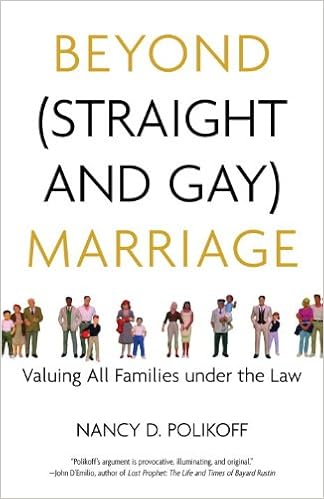
Beyond Marriage: Valuing All Families under the Law

“A woman married to a man for nine months is entitled to Social Security survivor’s benefits when he dies; a woman living for nineteen years with a man or woman to whom she is not married receives nothing.”[1] The debate over marriage equality for same-sex couples was one that took over the country’s social and political agenda in the early 2000’s. Nancy Polikoff’s Beyond (Straight and Gay) Marriage challenges this agenda by asking both straights and gays alike to consider a broader definition of what constitutes a family and how this structure should be protected under the law. Those protected by the institution of marriage have privileged status in regards to tax benefits, estate benefits, government benefits, employment benefits, medical benefits, and death benefits among others. Polikoff calls for a revamping of family law; one that takes into consideration the changing nature of family units while also deemphasizing the status of marriage in our society.

Nancy Polikoff is a professor of law at American University Washington College of Law. She teaches Family Law and a seminar on Children of LGBT Parents and has been writing about, litigating about, and speaking about cases involving LGBT families for the past thirty years. Her accomplishments include co-founding the Washington, DC Feminist Law Collective, supervising family law programs at the Women’s Legal Defense Fund, and co-authoring one of the first law review articles on the custody rights of lesbian mothers. Beyond (Straight and Gay) Marriage is Polikoff’s first book. She has a daughter in her twenties and lives with her partner in Washington, DC.

The first half of the Beyond Marriage gives the reader historical context as to how we got to the position we are in with marriage today. It begins with the advances made by the second-wave feminist movement in the context of marriage, and then describes how those advances have been attacked since the 1970s by the religious right. Betty Freidan, Gloria Steinem and others are cited in this section, along with groundbreaking legislature like Title IX. From there, she moves into the gay rights movement and the intersection of lesbianism and feminism. Eventually she delves into the marriage movement of the conservative right and the how the push for preserving marriage as an institution for heterosexual couples strengthened marriage’s societal status. She then brings the reader to the contemporary fight for marriage equality, the most thorough part of the first half of the monograph.

Generally, there are two dominant perspectives in the contemporary marriage debate. First, there are those who support the institution of marriage and believe that opening it up to non-heterosexual couples will undermine social structure. Second, there are those who support equal access to marriage for LGBT individuals since they deserve the same access to benefits as married heterosexual couples. Throughout the book, Polikoff makes reference to groups on both sides of the argument. Frequently mentioned supporters of the marriage movement include The Institute for American Values, the Alliance Defense Fund, and the Liberty Counsel. Those often mentioned on the side of marriage equality include Lambda Legal, the Human Rights Campaign, and the National Gay and Lesbian Task Force. All of these groups fight for legislation supporting their side of the argument or represent individuals in relevant court cases. Polikoff separates herself from these prominent groups by taking a third stance. She questions the legitimacy of marriage as the necessary qualification for receiving legal benefits and questions whether it is fair to exclude so many other family forms by limiting such benefits. This allows her to reframe the debate over marriage by making the point that the benefits associated with marriage are not inherent, they have been constructed over time and have increasingly drawn a line between families formed through marriage and families formed through other means. By fighting for the right to marriage for LGBT couples, dominant organizations like the Human Rights Campaign are reinforcing the place of marriage in our society as cultural institution that unfairly awards rights to the married and leaves those who are unmarried out to dry. She enforces the argument that marriage is outdated and the benefits that accompany it were developed decades ago when having sex outside of marriage was taboo, illegitimate children were considered outcasts, and marriage had gender roles legally entwined within it. Through the examination of historical movements, she determines that people have changed the way that they view and structure their lives and the current marriage equality movement does not reflect this change.

The second half of the book is dedicated to describing specific aspects of her proposed approach, called “valuing all families,” to make marriage matter less. The most important aspect of this approach is identifying the purpose of specific laws that currently grant marriage-specific legal consequences. By understanding the specific objectives of these laws, relationships can be identified that would further the law’s objective without creating a specific special status for married people. In regards to this approach, she addresses health care, medical leave, medical care, domestic partner benefits, the dissolution of relationships, death, and economic compensation. Polikoff argues that by taking this approach, our society can move more towards a legal system based on the nature of care and dependency in relationships, not just the relationship’s specific name. Her solutions are not only for same-sex couples, they are also for people non-conjugal relationships, like unmarried elderly people, caregivers and the people they help, or friends living together. For instance, through this approach she examines the current family and medical leave practices of businesses across the country, supported by anecdotes of those who were not allowed such leave to care for an ill family member. Many medical leave policies are limited to caring for a spouse or child with serious illness and are often unpaid. Polikoff proposes support of the “Healthy Families Act,” a bill that provides seven days of paid leave per year “to care for a child, a parent, a spouse, or any other individual related by blood or affinity whose close association with the employee is the equivalent of a family relationship.”[2] This kind of reform breaks down barriers and helps to redefine the law’s narrow definitions of family that do not accurately reflect today’s society.

Polikoff’s breadth of knowledge of her field is evident as she provides a comprehensive overview of legal history as it applies to social movements throughout the decades. This method is extremely effective in giving the reader context into the foundational aspects of marriage and establishing the true dividing line that it has become. By making interdisciplinary links through feminism, sexual liberation, class, and justice, her argument is multidimensional and looks at marriage through the views of different legal lenses. The inclusion of a significant amount of laws and court cases is appropriate since the nature of her “valuing all families” solution focuses on reforming these laws. In contrast to the formality of the included law, Polikoff includes many anecdotes and case studies throughout the monograph to explain how the law has failed certain families because of the marriage dividing line. These short stories help to break up the dense law material and make it easy to envision why her reform needs to be implemented in real world situations.

Although at first the idea of diminishing and eventually removing the significance of marriage in a society may seem radical to the general population, Polikoff’s presentation of her argument makes it seem truly possible and reasonable. She provides concrete solutions for reforming laws, many based at the state and local level, and also provides several examples of places where similar laws have been successfully enacted. Even with the abundance of case law, the Beyond Marriage is very much readable by those without Polikoff’s extensive background. This monograph is meant to reach a broad audience due to its increasing relevance, however, due to its connectedness with the marriage equality movement and gay rights, the audience becomes more limited.

Polikoff reinforces in Beyond Marriage that people should have the choice to marry based on their individual beliefs, whether they be cultural, spiritual, or religions in nature. It should not be a choice that people are forced into to obtain unique legal benefits that are specific only to marriage. The end goal of her efforts is a system in which marriage is not the rigid dividing line between who is in and who is out regarding family law, through her “valuing all families” approach. This monograph is a valuable resource for people in all family structures and can help our society move towards a legal system that helps improve the lives of all individuals and families.

Works Cited

Polikoff, Nancy D. Beyond Straight and Gay Marriage: Valuing All Families under the Law. Boston: Beacon Press, 2008.

[1] Nancy D. Polikoff, Beyond Straight and Gay Marriage: Valuing All Families under the Law (Boston: Beacon Press, 2008), Cover page.

[2] Nancy D. Polikoff, Beyond Straight and Gay Marriage: Valuing All Families under the Law (Boston: Beacon Press, 2008), 172.

Breaking Down Another “Normal” in Mimi Schippers’s Beyond Monogamy


Traditional stories tell tales of a princess finding her prince, and more recently the narrative has accepted princesses finding princesses or princes finding princes. But what happens if finding “the one” turns into finding the two? Or three? Mimi Schippers’s Beyond Monogamy: Polyamory and the Future of Polyqueer Sexualities addresses the “compulsory mononormativity” that steers the search for “the one” and silences conversations about non-monogamous relationships.

Schippers has degrees in sociology from Northeastern Illinois University and the University of Wisconsin-Madison. She is currently a professor of both sociology and gender and sexuality studies at Tulane University. Much of her recent research is on polyamorous relationships across cultures and time and how polyamory intersects with race, gender, and sexuality. Beyond Monogamy is her second book and the culmination of a decade’s worth of research and writing about polyqueer relationships (Shippers, web).

The author establishes mononormativity as an institutionalized ideal that intersects with race and gender and attempts to break down the associated hierarchies of “polyqueer” sexualities (Schippers 25). She compares mononormativity to the more well-known heteronormativity as a example of silencing social practices that ostracize groups of people, in this case people who consensually take part in romantic or sexual relationships with multiple people. By looking at a variety of polyqueer situations that take place across gender, race, and class, Schippers calls various power dynamics into question. For example, in a monogamous heterosexual relationship, how would each partner be seen if they were to “cheat” on their partner? A man is assumed to be unsatisfied with his partner, and in the face of an exciting opportunity, is “less likely to control himself (44).” However, a woman who cheats is making a careful decision which “reflects a fundamental character flaw such as selfishness or materialism (45).” In this situation there are gender-based assumptions that place the man in a position in which he can cheat with limited repercussions, meanwhile the woman who cheats is fundamentally flawed. This ideology establishes what it takes to be a “good” woman: being loyal to her partner no matter what. Schippers presents similar arguments applying to black men and bisexual men whose identities are often culturally defined in order to promote certain expectations of respectability, i.e. a relationship with a single woman.

Beyond Monogamy begins with an extensive introduction to the topic of the polyqueer sexualities to situate them within the already established theories of queer sexualities and normativity. Schippers claims that until this point there have not been critiques of mononormativity, a gap she intends to fill with this book (Schippers 10). She address research into incidental cases of non-monogamy within both the straight and queer communities such as male-dominated polygamy, but the author notes that these are examples of isolated exceptions to monogamy (16). Schippers proceeds to identify four situations that take place specifically between two men and one woman that reflect the effects compulsory mononormativity: open-relationships, standards of respectability, competition between men, and a fear of non-heterosexual relationships. Each of these issues is dedicated a chapter in which the author explores the complexities of polyqueer relationships more closely. To do this, she uses research and theory established in the introduction to critically examine fictional narratives that exemplify the relationship at hand. Some of these narratives are creations of the author while others are taken from scenes of movies and play so as to provide concrete examples of non-monogamous relationships that are accessible to a more general audience.

The balance of academic theory and research with analysis of tangible examples is one of the greatest strengths of Beyond Monogamy. Presentation of other research clearly positions Schippers in the academic conversation and helps frame her theory. The conversation with other respected academics and theorists such as Michael Foucault legitimizes her argument and asserts her authority to critique mononormativity. At the same time, the use of concrete narratives caters to both academics and non-academics as a point of entry to her argument. Examples substantiate vocabulary and concepts that are otherwise very specific and theoretical. Even though the introduction is rather dense, the following chapters strive to actively engage a variety of readers who can relate to different situations. This increased accessibility to her book opens up a wider audience who can read and appreciate it.

At the same time, the wider audience that Schippers can attract has its limits. She intentionally limits her discussion to polyqueer relationships between one  cisgender woman and two heterosexual men because, she claims,

“This relationship configuration… is particularly instructive not just in terms of the role of monogamy in hegemonic gender relations, but also in the queer and feminist potential for polyqueer sexualities and relationships to disrupt the meanings and embodiment of racialized masculinities and femininities.” (31)

However, throughout the book she refers tangentially to other polyqueer relationships such as gay men who choose to have a variety of partners at the same time without justifying the importance of these relationships and explaining how they are less relevant than the specific relationship-structure she is examining. Using one specific structure as an ideal of sorts produces a tone of othering of different polyqueer situations that do no follow this pattern. Therefore, even though Schippers produces an argument that is accessible to a non-academic audience, her narrow scope is a severe limitation in terms of who can relate to the theory that she presents.

Overall, the book is a very enlightening introduction to the concept of mononormativity. It clearly presents a variety of instances in which the ideal of monogamy unjustly smothers polyqueer relationships. Her critique of controlling power structures explains the construction of the monogamous “normal” while asserting that those same power structures to more harm than good. The narrow focus of the book leaves room for further inquiry into more diverse polyqueer relationships and serves as a stepping stone to more developments of mononormative  theory.

Works Cited

Schippers, Mimi. Beyond Monogamy: Polyamory and the Future of Polyqueer Sexualities. New York: New York University Press, 2016. Print.

http://www.mimischippers.com

“Superdads”, How Fathers are Changing

Zamir Ode

Professor Gonzalez

GSS 101

10/11/2016


Book Review on Superdads by Gayle Kaufman


More often than not, moms are associated with picking the kids up from school, joining the PTA, and helping kids with their homework on top of their day job; while dads are seen as the breadwinner for the households. Up until the mid twentieth century, the traditional family household was the most popular household structure. In the traditional family, the husband is supposed to devote his life to work to make enough for his family, while the wife is supposed to take care of the kids and household chores. However, roles of both parents have been changing since the 1950s. According to Gayle Kaufman’s book, Superdads, there are three types of dads: old, new, and super (Kaufman 2013). By going through and interviewing 70 different fathers, Kaufman was able to create these categories based on the information given by each father. Through out the book, Kaufman shows through these interviews from different “categories” of dads how each differ with the involvement in their child’s life and how the gender roles of parenting are changing for both men and women.

In Kaufman’s book, she starts to lay out her point about the changing gender roles by describing how dads are starting to become more involved in their children’s lives and leaving behind the title of breadwinner. According to Kaufman, dads can be broken down into three categories: “old”, “new”, and “super”. Kaufman goes on to define these different categories of dads. “Old” dads are defined as the dads who still follow the traditional family household belief, where the man has a job and is the only source of income to support his family while the woman stays home and takes care of the kids. The “new” dads are defined as those who try their best to balance work and family life. These fathers spend time with their kids on the weekdays, but weekends are when the most time is spent with their kids. Then, there are “super” dads. These dads put the caregiver role ahead of the breadwinner role. These dads want to spend as much time as possible with their kids, and feel like they have an equal responsibility of raising the kids. Defining these types of dads early in the book was an important way for Kaufman to set up the flow of her book. Throughout the book, Kaufman shows how these types of dads make choices in response to certain variables of life, i.e. stress, time, and money.

Kaufman begins to describe how these different categories of dads have stress level that vary. When interviewing the 70 fathers, Kaufman found that the “old” dads who are so focused on being a breadwinner were reported to have the highest level of stress regarding work/family life. These dads are so worried about getting extra hours at work to make extra money to be able to support their families as well as worrying about family issues causes high levels of work/family related stress. Kaufman uses one of the fathers, Erik, as an example. In the introduction she introduces him as a father of 2 children who recently took a job at a larger landscape firm for the better economic opportunities. These opportunities came with longer hours which cost him time with his kids. These new hours made Erik have more to balance regarding work and family, which led to more work/family related stress. However, the “super” dads have the lowest stress levels regarding work/family life because they put caregiving first and then make flexible work schedules that will allow them to change hours or drop a shift if something family related comes up. In most interviews done by Kaufman, each father told her that they experienced a changed outlook on work once they had kids. Fathers were quoted to say that before kids, they were spending a lot of time at work, even offering to stay after hours and work overtime since they did not have any other big responsibilities that needed as much time. However, once these fathers had their first born, these fathers were now trying to juggle a full work week to make enough money to support their new family on top of getting home early enough to spend time with their new born and take part in the caregiving process. Multiple fathers said in their interviews that if it were possible, they would change occupations in order to spend more time with their children.

Kaufman furthers the differentiation of the three “classifications” of fathers by asking these 70 fathers about leave from work when their child is first born. It is expected that when a woman is giving birth, they take a maternity leave to take care of the baby for a few weeks. Even though there is no legal requirement for a paid maternity, a lot of companies and institutions have a maternity leave policy. Fathers, on the other hand, are not expected to miss time when their child is born. Kaufman writes that by the 1990s fathers were taking time off for their child’s birth, but it was minimal. Now, fathers are able to take more time off for their kids, but the amount of time they are able to take off is decided by a few economic factors, since this leave from work is unpaid. During the interviews, Kaufman was able to see a pattern of timetables fathers were bale to take off: no time to a short period of time (a few days), about a week or two weeks, and then more than two weeks. These time allotments were mostly dependent on economic status of the family, and income levels of the father. Fathers with higher incomes were more often likely to take more time off when their child was born than those fathers with low income levels. One of the interviews Kaufman did was with a father named Barry, who is a gardener. Barry explained that he was only able to take about two days for the birth of his daughter because that is all he could afford. Since he was paid by the hour, hours he did not spend gardening for people was less money he had to support his family. Even though fathers are now supposed to play a bigger role in the caregiver aspect of their child’s life, the father is still expected to be the financial crutch the family can lean on when the mother is out of work (Kaufman). These fathers still had to go to work to make sure there was money to support their wives and now their new born children. To me, this point about unpaid paternity leave is a positive and negative way to further the point that gender roles for parents are changing. On the positive side, Kaufman shows that fathers who are able to take the time off to be with their new born can be super dads, however, they are only able to be super dads if they have high income jobs. Even though Barry the gardener wants to be a super dad and take off as much time as possible to be with his newborn, he is unable to since his low income household needs all the money it can get. Throughout the book, Kaufman talked about father’s roles changing with regards to involvement in their kids lives. However, this point almost makes it seem like she believes you have to be at least upper middle class to be able to take the time needed to spend with your child, and be a super dad.

Kaufman did a lot of research through different fields of scholarly papers and books. However, her main method for data collection was interviews. Kaufman states in the introduction of the book that her method for research was interviewing different fathers. Kaufman interviewed 70 fathers, and put these fathers into three categories that she defined as different types of dads. Then, she asked questions to each father regarding how time, money, and work impact their relationship with their kids. This book did a good job showing how these different factors impacted the different groups of dads differently.

Throughout the book, Kaufman references multiple professionals in multiple fields, being psychology, sociology, and gender studies. However, the professional that is brought up and referenced more than the others is Arlie Hochshild and her now-classic Second Shift. In the Second Shift, Hochshild writes about the revolution of women starting to flood the work force and how the roles of employed mothers are changing. Hochshild also compares these to change in men’s roles, which to her are “lagging behind women’s changes.” Kaufman uses the Second Shift platform, but uses it for the change in men’s roles. Kaufman acknowledges that women’s roles have changed immensely over the past 50 years, but says that now men’s roles are changing. The entirety of Kaufman’s book was differentiating the types of dads, and also about men’s roles are changing in the family dynamic. Men used to associate the number of hours worked with masculinity (Kaufman 2013). However, this misconception about masculinity is changing, and men are abandoning the role of breadwinner and becoming more involved in their children’s lives. These changing roles of men show how Kaufman uses the basis of Hochshild’s Second Shift to further her own point.

Gayle Kaufman is an author, professor, wife, and mother. Kaufman currently is a professor at Davidson College in the sociology department. She gave birth to her and her husband’s second child after her husband finished law school. Her husband, Kevin Bell, decided to stay home and take care of the kids while Kaufman continued to teach classes at Davidson. Her husband was the inspiration to find out more data about the changing roles of fathers, and write the book Superdads.

One strength of this book was they way Kaufman made her data personal. I was very impressed with how well this book was able to differentiate the types of fathers based on interview answers, as well as show the pattern that follows through each group. In each chapter, Kaufman provides specific answers from each father to further pursue the point. However, to me this book could have been organized better. The book has an introduction, which shows the main focus of the book, which was to point out the three types of dads and how they differ in family roles. Then the book goes into time constraints and paternity leave, then back to the main focus for the rest of the book. I believe that chapters 2 and 3 could have been broken down and spread across the book rather than have their own chapters. I believe that it took away from the book because the organization of information was confusing.

In Kaufman’s book Superdads, a new viewpoint on father’s roles is presented. The book breaks down the three types of fathers: old, new, and super. By interviewing 70 different fathers from around the country, Kaufman was able to make these classifications, and put these 70 fathers into one of the three. Throughout the book Kaufman shows how each type of father differs with different economic and social conflicts regarding time with family. This was a very well written book, as well as it was very interesting. I believe her method of research was perfect, and her method really added to the realness of the information.


Work Cited

Kaufman, G. (2013). Superdads: How fathers balance work and family in the 21st century. NY: New York University Press.


Singled out: how singles are stereotyped, stigmatized, and ignored and still live happily ever after

Stefan Moskowitz
Gonzalez
GSS 101
October 29, 2016

Singled out: how singles are stereotyped, stigmatized, and ignored and still live happily ever after

Until rather recently, the purpose of marriage was to reinforce or elevate one’s social status, to seek political power, to acquire property, to have the family name be carried on from generation to generation or any combination of these. Around the turn of the nineteenth to the twentieth century, Marriage started becoming more associated with love and emotional attachment, which helped establish the notion that a successful marriage was the most important relationship that one could have in their lifetime. Until then, relatives and friends often played a larger role in shaping the well-being and happiness of someone than their spouse, and very few were self-conscious of this (DePaulo, 22 & 23). As the purpose of marriage shifted, those who chose to participate in the institution obtained certain privileges that were unavailable to those who did not, a practice referred to as singlism. Because being single is not perceived as an inherent quality such as race or sexuality, single people are marginalized through productive power much more so than through repressive power, the ism much less frowned upon than others such as racism or sexism and because of this, many feel that it is acceptable to practice singlism explicitly and publicly.

The book Singled Out: how singles are stereotyped, stigmatized, and ignored and still live happily ever after by Bella DePaulo attempts to deconstruct singlism and to make it clear that it is completely unacceptable, especially in the 21st century when many other isms are very much frowned upon and when an increasingly larger portion of the US population is delaying marriage or is choosing not to marry at all. She makes a clear distinction between singlism from government that enables married people to pay fewer taxes and receive each other’s social security benefits, and singlism in “everyday life” where “marriage and coupling are indistinguishable” (DePaulo, 26). To do this she uses methods such as reanalyzing and debunking statistics that support the notion that marriage helps increase happiness and well-being through the identification of logical fallacies such as pointing out the distinction between correlation and causation, as well as recapping interviews of famous people where singlism is clearly present.

At the time the book was published, Bella DePaulo was a psychology professor at the University of California, Santa Barbara, where she is now a project scientist. Her past and current professional activities that are most relevant to the studies of single people and singlism include being the Chair of the Academic Advisory Board of the American Association for Single People, a fellow for the Council on Contemporary Families, a member of the Advisory Board for an organization titled Single-Woman.tv, a member of the Board of Advisors, Single Edition, and a Single Workers Topic Page Editor for the Sloan Work and Family Network. She also received the Excellence in Research award from the American Association of Single People in 2003 (DePaulo, 1 & 3). Some of her later publications on singlism address the psychology of modern discrimination, why some people view singlism as a legitimate prejudice, and the differences between how singles are perceived “compared to those who are in romantic relationships” (DePaulo). This last publication shows that DePaulo wants to actively broaden our understanding of singlism, to also include the discrimination of those who are not in a romantic relationship in addition to those who are not legally married.

To debunk the myth that marriage leads to greater happiness, DePaulo uses the analogy of a fictitious drug study that is flawed on many fronts. The four groups that the study examines include a set of individuals called the drug group that take the drug for the entire experiment, a no-drug group (who never take the drug), a group that begins taking the drug but voluntarily stops taking it who are given the title of no drug – intolerable, and one that begins taking the drug but have it taken away from them at a certain point who are labeled as no drug – withdrawn. The categories of people that DePaulo is representing are people who get married and stay married, people who do not marry , people who get married but then divorce and those who get married but later become widowed, respectively. At the end of the experiment, people from all groups answer the question “Taking all things together, how happy would you say you are these days?” “People who say they are “very happy” get a happiness score of 4; those who are “pretty happy” get a score of 3; people who are “not too happy” are assigned a 2; and people who say they are “not at all happy” are scored as 1. The average scores are 3.3 for the drug group, 3.2 for the no drug group, 2.9 for the no drug – intolerable group, and 2.9 for the no drug – withdrawn group.” It shows that taking the drug does not necessarily make people happier, as those in the no drug – intolerable group and those in the no drug – withdrawn group scored lower than those who never took the drug because either the drug was making them less happy or because they felt deprived from not taking it. The difference between the drug and the no drug group was one-tenth of a point, making it difficult to claim that the drug would make a significant difference in their happiness. Perhaps the people in the drug group were already happier before taking the drug than those in the no drug group, which would mean that the drug made no difference whatsoever (DePaulo, 30 – 33). It is also possible that the people in the drug group were convinced that the drug would make them happier and thus they became happier as a result, known as the placebo effect (medicinenet.com).

DePaulo also refers to the imposition of the mentality that singles only care about themselves by referring to when Chris Wallace interviewed Ralph Nader during the 2000 presidential race, asking him if Bush had a “more mature lifestyle” than Nader because he was married and had raised two daughters (DePaulo, 127). Even after Nader had replied that “he had contributed to the health and safety of children nationwide” through advocating for cleaner water, more nutritious food, safer cars, etc. as well as citing Bush’s own words by stating that “Until he was forty, he was young and irresponsible,” Matthews kept insinuating that because Bush was married and Nader was not, he was more mature (DePaulo, 127 & 128). The more implicit message behind this example, is that singlism distracted the focus of the interview, which should have instead been centered on the differences between the platforms, experience, and voting records of the candidates, all of which are directly relevant to the presidency.

Although DePaulo briefly mentions the differences in how single people with different social identities are treated (DePaulo, 5), there is a lack of examination of the intersectionality between these social identities such as with being single and being a person of color, being female, having a lower income and/or education level, etc. While I completely acknowledge that no ism is better than any other, I believe that only people of a more advantaged positionality have the privilege to believe that singlism is the cause of their oppression. The intersectionality between race, gender, and marital status is especially pervasive amongst black women. The controlling image of a single black woman as either being a dominating matriarch or being a welfare mom regardless of whether she chooses to have children who has a different combination of race and gender (Collins, 270). Although DePaulo did mention that Ronald Reagan aggravated the American public’s image of the Welfare Queen as president (DePaulo, 169), she misinterpreted it is as something discriminatory of single mothers, when in fact it was mainly targeted at single black women. She also neglected to address that one reason for why many black women are single is because black men have one of the highest incarceration rates out of any other group in the US. Leaving race aside, there is no discussion of how language shapes our perceptions of positionality. For example, there is no married variant to the male prefix “Mr.” but the distinction is present when it comes to female prefixes. Another distinction in how single women and single men are treated that the book does not consider is that society often perceives single women as much more lonely and needy than single men, in part because few women attended college or entered the labor force until the 1960’s.

Some of the texts that DePaulo references speak about singlism mainly as a symptom of sexism against women, particularly from the idea that single women attempt to disrupt the patriarchial model that women should help make men complete (Glick and Fiske 109), whereas Singled Out attempts to universalize the prejudice to also include men and single people regardless of their gender. Her lack of regard for gender in many chapters helps establish the notion that singlism should be dealt with in isolation to other forms of discrimination. Another text that DePaulo references addresses the questions of whether stigma awareness and analysis of past experiences that are specific to singlism help boost one’s self-esteem, particularly among women, ultimately concluding that the former has a slight positive effect on self-esteem but that the ladder does not (Morris). Several of Singled Out’s chapter titles are directed toward people of different social identities within the spectrum of single people. DePaulo thereby implies disagreement with these conclusions, as she uses stigma awareness to prove that single people can be just as successful and happy as those who are married or who are in a committed relationship. Jill Reynolds and Margaret Wetherell discuss the idea of compulsory heterosexuality, which cause many women to view being in a romantic relationship with a man as necessary (Reynolds and Wetherell, 490). While they frame this as something that mainly targets women, DePaulo expands this to include everyone by showing a study that concluded that 55 percent of unmarried people were not in a committed relationship nor did they want to be in one (DePaulo, 84).

While I completely agree that prejudice against single people should not be tolerated from any standpoint, I have a fundamental problem with DePaulo’s framing of the issue as an ism. Apart from some financial drawbacks, DePaulo was unable to prove that there are significant material effects to being single. Furthermore, there was no mention of subconscious implicit biases that are universally rooted in our society when it comes to the discrimination of single people, unlike those that cause many to favor some races and genders over others. Part of the reason for why this may be the case is because it is impossible to know whether someone is single just by looking at them in isolation. Some demographics that Singled Out would appeal to include anyone who has not ever been in a relationship and who feels self-conscious about it, anyone who is in a relationship but is not married and who is over a certain age, say 35, as well as anyone who is in a cohabiting relationship but who is not legally married. The book was published in the year 2006, at a time when people were marrying, having children, and entering the workforce at a later median age, which suggests that the stigma against single people was already on the decline. Today, this is even more so the case as rising living costs have made it harder for millennials to purchase housing near where they work (if in fact they do have a stable source of income), thus incentivizing them to live with their parents or with several roommates. Rising college attendance rates, increasing student debt, and more advanced degrees per capita have all helped exacerbate this trend.

References

DePaulo, Bella M. Singled Out: How Singles Are Stereotyped, Stigmatized, and Ignored and Still Live Happily Ever after. New York: St. Martin’s, 2006. Print.

DePaulo, Bella M. “DePaulo VITA May 2015.” belladepaulo.com N.p., n.d. Web. Jan. 2015. 27 Oct. 2016.http://www.belladepaulo.com/about-bella-depaulo/social-scientist-phd-harvard/

DePaulo, Bella M. “Scholarly Papers.” belladepaulo.com. N.p., n.d. Web. 28 Oct. 2016. http://www.belladepaulo.com/singles-research-writing/scholarly-papers/

“Definition of Placebo Effect.” medicinenet.com. N.p., 13 May 2016. Web. 29 Oct. 2016. http://www.medicinenet.com/script/main/art.asp?articlekey=31481

Collins, Patricia Hill. “Controlling Images of Black Women’s Oppression.” N.p., n.d. 29 Oct. 2016.

Glick, Peter, and Susan T. Fiske. “An Ambivalent Alliance: Hostile and Belevolent Sexism as Complementary Justifications for Gender Inequality.” www.sanchezlab.com. N.p., Feb. 2001. Web. 29 Oct. 2016. http://www.sanchezlab.com/pdfs/GlickFiske1.pdf

Reynolds, Jill, and Margaret Wetherell. “Discursive Climate of Singleness: The Consequences of Women’s Negotiation of a Single Identity.” http://fap.sagepub.com. N.p., 11 Sept. 2003. Web. 29 Oct. 2016. http://fap.sagepub.com/content/13/4/489.full.pdf+html

Morris, Wendy Lynn. “Effects of Stigma Awareness on the Self-Esteem of Singles.” http://libraprod.lib.virginia.edu. University of Virginia Library, 2005. Web. 29 Oct. 2016. http://libraprod.lib.virginia.edu/catalog/libra-oa:5282

“Our Dreams Have Become So Small”: A Review of Queer Migration Politics

“Our dreams have become so small.” Karma Chávez concludes her book with this quote from trans activist Mattilda Bernstein Sycamore. Chávez’s Queer Migration Politics, is an attempt to widen the horizons of our current possibilities when it comes to both LGBTQ activism and migration politics. Chávez begins by outlining a brief history of the American political climate towards both members of the LGBTQ community and migrant populations. She points out that in the midst of the AIDS epidemic, George H. W. Bush signed “what was known as ‘homosexual exclusion’” which essentially meant that those who were HIV/AIDS positive, were not permitted to migrate into the U.S.[1] At the same time that this multitude of issues was bubbling up in the American consciousness, so was the movement of LGBTQ activists to try and bring attention to the AIDS epidemic, and in doing so, gave “greater significance in defining a national gay and lesbian political agenda focused on rights and inclusion.”[2] As Deborah B. Gould points out, the AIDS epidemic shaped the “emotional habitus of the LGBTQ community and essentially led activists of the time to, “suppress more confrontational rhetoric and activism that it might compromise their social acceptability.” [3] Thus, the LGBTQ activists of the early nineties were forced to work within existing American frameworks. In the same way that queer activism became centered around “respectability” of members of the LGBTQ community, migration politics in the United States has also become centered around who is “worthy” of citizenship. Chávez in her work, points out how legislation like the DREAM Act, excludes migrants who do not fall into these categories of exceptionalism. Furthermore, so much of migration politics rhetoric has centered around upholding familial values, standards that could only be upheld by heterosexual couples. So as both groups attempt to grapple with standards of respectability and the current discriminatory climate in America, Chávez offers unique perspectives on how these two groups may be able to coalesce to overturn current power dynamics, and create a higher standard of living for everyone.

Before we dig into the content of Chávez’s argument, it is important to have some understanding of the author. Karma R. Chávez is a former assistant professor of Communication Arts and Chican@ and Latin@ Studies at University of Wisconsin-Madison, and now teaches at the University of Texas- Austin. In her introduction, she notes her sense that queerness, “not only refers to a kind of critique and to non- or anti- normative genders and sexualities, but it also implies what is possible for making lives livable.”[4]  One of the reasons I really loved this book is Chávez’s acknowledgment of multiple identities that people can assumed, particularly of those she observes in her work. Also, how these intermeshed identities take shape in the form of politics and experience. Chávez employs a mainly qualitative approach. This is evident by her accounts in Arizona and the comparison she draws between CDH and Wingspan- two different activist organizations. She also makes many references to laws and different activist responses in this piece, signifying her knowledge of legal frameworks and the social push back to these laws.

In order to understand her argument fully, we must understand where this book falls in the greater scholarly conversation. Her work is grounded in the larger field of migration studies, which expands on the important thinking done by feminist scholars on gender and migration. She points towards scholars such as Oliva Espín, Mary Romero, Pierette Hondagneu- Sotelo and Lynn Fujiwara, who shifted the focus from the male migrant experience, to the experiences of women, “negotiating the US immigration system.” [5] However, their work still left out the experiences of queer migrants. Eithne Luibhéid, she notes, tries to bring to light the experiences of queer migrant populations, and many other scholars expand on this work in the late 1990s and early 2000s.[6] Chávez notes that even with the increasing scholarship around the aforementioned issues,  few scholars have really investigated “how migration politics and activism are connected to queer politics and activism.”[7] However, scholars such as Dean Spade, Jasbir K. Puar, and Lisa Duggan, who all examine queerness in a more global context, have contributed greatly to Chávez’s theory and thinking.[8] Chávez’s studies also pay homage to the scholarship of Monisha Das Gupta and Amy L. Brandzel, whose work is dedicated to rethinking the notion of belonging and citizenship for queer migrants. [9]

It is drawing on the work of other scholars and her own observations, that Chávez makes a compelling argument about queer migration policies.  She comes out boldly stating that we need to redraw the lines of the groups we belong to, and create more space for difference in the groups that make up our identity. She states that by rethinking belonging, “individuals reveal that the divisions upheld and promoted within hegemonic constructions of belonging that put, for example, racialized minorities against sexual minorities are not natural.” [10] Essentially, Chávez uses the majority of this book to express that as humans we exist within a set of interlocking oppressions. Thus, oppression that exists in one group should be the concern of another group of oppressed people. She explains that LGBTQ migrants “are invisible within both movements because the migrant rights movement places undue emphasis on heteronormative family relationships and the LGBTQ movement focuses on partners of US citizens.” [11] Thus, it becomes crucial to rethink affiliation with either group, unless these two groups can coalesce to make life better for all. Chávez uses the majority of the second chapter to highlight one particular activist, Yasmin Nair, who is a queer, migrant, woman of color theorist. She works to expose discriminatory measures towards migrants based on race, ethnicity, sexual orientation, and the how the economic system in America exploits the immigrant population. [12]  Nair rejects the idea of promoting individual stories from both the LGBTQ and migrant community, and argues that putting one LGBTQ migrant’s personal story on display in a sense exploits the human and becomes a question of, “whose story can be melodramatically effective?”[13]  Chávez uses Nair as a prime example of an activist who is attempting to rewrite the boundaries of identity and create more expansive areas of belonging.

Since the majority of Chávez’s book is how to effectively build these coalitions across difference, Chávez takes a more in depth look at coalitions around migrant and LGBTQ rights that have already been established. Chávez asserts an interesting analysis of “coming out of the closet” and “coming out of the shadows”- the rhetoric that is normally associated with LGBTQ rights and migrant rights, respectively. She notes that many migrant rights groups have employed the tactic of “coming out as undocumented” not only as an act of empowerment, but also as a rhetorical reference to many LGBTQ activists, who have pronounced their unapologetic pride in their identities. However, as Chávez points out, this idea “reduces the work of challenging marginalization to the private individual.”[14] In essence, the work of individuals, while rhetorically effective in many cases isn’t enough.

She then turns her focus towards examining the relationship between two Arizona groups, Wingspan and Coalición de Derechos Humanos (CDH), an LGBTQ activist organization and a migration rights organization respectively. She highlights the challenges and benefits of forming this coalition across difference. For one, these organizations can pool their resources together to increase the effect of each group. However, Chávez notes the natural challenges of coalescing two seemingly disparate efforts. Wingspan is described as predominantly white whereas CDH is predominantly Latino. Chávez comes to realize that the CDH ends up doing the majority of grassroots organizing in this coalition, citing Geovanna (Wingspan’s breast health educator at the time) who noted, “white people in her organization use large words but neglect action.” Moreover, Chávez contends that CDH doing more grass roots organizing is a matter of race and class.[15] Chávez further highlights the challenges of coalescing across difference by noting the CDH’s alignment with the Catholic Church in Arizona. The Catholic Church is in partnership with CDH because of the Christian belief to welcome the stranger and help the poor. However, the Catholic Church is also very outspoken about their beliefs towards homosexual couples. The pre-existing alignment presents challenges for the tenuous alliance between CDH and Wingspan.[16] Although this coalition is a good start towards rethinking the boundaries of belonging, Chávez indicates that it is obviously flawed.  Furthermore, she mentions that the coalition barely exists now or only when it is politically expedient, saying, “the existence of a relationship with Wingspan is simply assumed… when it is necessary to respond to something or to take action.” [17]

Overall, I appreciate the contents and arguments of the book. Chávez is certainly a dreamer. The biggest strength of her argument is her dedication to seeing possibilities instead of barriers, in the face of difference. As she puts it, “Dissonance fosters acute awareness, though sometimes without clear direction for movement from the awkward tension.”[18] However, one major weakness I see in her argument is the precariousness of the coalition she seeks to build. Her research is focused on the work of two organizations, who in three years after she completed her research in 2007, were no longer in a working relationship. Moreover, when these two organizations were working together, there was debate about whether or not they were a coalition in “name only.” [19] Chávez does a great job of pointing out the problems within this seemingly flimsy coalition, but does not offer other examples of how to coalesce more effectively.  This book is mainly meant to be read by other scholars and activists, who strive to make universal human rights a reality for all people. It should be read by activists that are looking to expand their platforms; but since there is no example of effective coalition building, her utopian thinking does not seem to lend itself to practical solutions.

Overall, I was a huge fan of this book and the lengths Chavez went to write it. While I remain frustrated by the lack of concrete examples of effective coalitions in this realm, I believe that this ineffectiveness is more likely due to the current political climate in America. Yes, most of her argument is impractical and requires utopian thinking, but Chávez’s bold declaration that we can be much more than we have been, and that our boundaries of belonging can be more expansive is an inspiring thought. Queer Migration Politics is a proud pronouncement of ways the oppressed can reclaim their power, in an American culture that demands “respectability” and “worthiness” to access. However, the beginning of this pronouncement must begin in the grass- “the dirt and concrete where people live, work, and play.” [20] As she puts it, “I hope Queer Migrations can be part of what changes the size of our dreams.” [21] I do too.

[1] Karma R. Chávez, Queer Migration Politics: Activist Rhetoric and Coalitional Possibilities (Champaign: University of Illinois, 2013), 1

[2] ibid, 2

[3] Deborah B. Gould, Moving Politics: Emotion and ACT UP’s Fight Against AIDS (Chicago: The University of Chicago Press, 2009), 63-64

[4] Karma R. Chavez, Queer Migration Politics: Activist Rhetoric and Coalitional Possibilities (Champaign: University of Illinois, 2013), 6

[5] ibid, 10

[6] ibid, 11

[7] ibid, 12

[8] ibid, 12

[9] ibid, 13

[10] ibid, 27

[11] ibid, 45

[12] ibid, 52-54

[13] ibid, 62

[14] ibid, 96

[15] ibid, 139

[16] ibid, 136

[17] ibid, 143

[18] ibid, 136

[19] ibid, 140

[20] ibid, 7

[21] ibid, 150

The Politics of Our Selves


9780231136228

Society is built on learned behaviors based on the values of the time. The most impactful source of power comes from social constructs. Social constructs start to have an effect on people as soon as we begin to identify as an individual being. A child will start to look at social queues in order to begin to form their individual personality, and a lot of it is based on what they are able to observe others doing. We mimic behaviors in order to belong to the group. As children, it is very easy to take to heart a lot of what we are told, and there is little speculation on why things are the way they are for children.  The autonomy levels of a person keep expanding as we get older because we are better able to think of ourselves in separated ways. Amy Allen, in her work, will take a deeper look into the autonomy of subjects and frame it along some of Foucault’s theories.

The politics of the self is centered around synthesizing the ideas of many theories. The first thing in the introduction of the is Foucault. The title of the book is taken from one of Foucault quotes; in the quote from Foucault, he is talking about the manner in which to understand the self, there is less of a need to understand the positive aspects of the self, but rather the way in which outside influences such as history and technology have come to affect the politics of our selves. Amy Allen, in her work, she works to analyze the power of subjection and looking at autonomy as a force of self-construction. The book is an intersection of feminism and critical theories. Along with the theoretical accounts, she looks into analyzing the subordination caused by race, class, and sexuality. Her approach critiques these subordinations and considers the social changes that need to come about in order for the changes to be accomplished. In the introduction she states she wishes to create a “Framework that illuminates both aspects of the politics of the self” (Allen, para 4). The two aspects she is talking about in regards to the politics of the self are: power and autonomy (Allen, Para 4).

Allen is a Professor of Philosophy and Women’s and Gender Studies at Dartmouth College. She has done some of her work focusing on how gender subordination must not only encompass race, class, sexuality and gender but must also confront issues dealing with social structures and the effects of colonialism (DesAutels). She brings in a very philosophical approach to the way in which she evaluates the politics of the self and how they are built in a very intersectional manner. The way she writes the book reflects her way of interconnecting ideas because she creates a discourse among many of the different theories relating to feminism, sexuality, and race among other things. Power and autonomy play a big role in the development of social structures because power is the driving force, while autonomy relates to the development of the self within the complex power structures.

A lot of her arguments are integrated with looking at a lot of Foucault’s ideas. What we looked at in class was Foucault’s “repressive hypothesis.” The repressive hypothesis believes that since the rise of the bourgeoisie in the Victorian era, any outflow of simply pleasurable activities has been frowned upon. As a result, sex has been confined to more private spaces and was restricted in open discourses. The only practical and accepted manner of display of sexual discourse took place between a husband and a wife. Sex outside these confines is not simply prohibited, but repressed. That is, there is not simply an effort to prevent extra-marital sex, but also an effort to make it unspeakable and unthinkable. Discourse on sexuality is confined to marriage. The power structure in his idea relates to how the book analyzes the subordination that is caused by repressive discourse. The autonomy of the person is therefore hindered because of the restrictive nature of the power of social norms and ideologies.

Discourse is important to Foucault because to him, language and knowledge are closely linked to power. Speech and writing are not simply the communication of facts that occurs in a vacuum, but instead, they give momentum to ideas and criticism. In her second chapter, she evaluates Foucault’s relationship with Kant’s work. “What Foucault is calling for is a critique of critique, which means not only a criticism of Kant’s project for the way in which it closes off the very opening for thought that it had created”(Allen, ch 2) She evaluates the different theorist through the lens of Foucault. In this, she is trying to relate the arguments by saying that Kant’s writing transcends and helps him shape the notion of subjectivity. To Foucault, Subjectivity is a means to explore the conditions in which subjects are created via discourse and sociocultural conditions. These conditions allow for an analysis of the self in order to evaluate the modern self. What is helpful in her evaluations is how she brings together the ideas jumping back and forth between the different theorist in order to create an argument of her own. In her evaluation, a lot of the theories, such as the one mentioned above, are in discourse with each other in helping to expand the idea of the subjectivity and how people are created through various elements. When she mentions power in parallel to Foucault she ties it into the relationship it has with the repressive hypothesis. She mentions in chapter three how power is a relation of repression, her aim with this is to reconstruct autonomy and argue about how it extends to power and subjectivity (Allen, Ch 3).

One of the things I liked about the book that makes it have a strong argument is the intersection of the different works of theory she incorporates into her evaluation of power. The book has a very introspective form to writing. It doesn’t directly ask the reader to look at themselves through her personal theory alone, but instead, it synthesizes a lot of the different theories of subjectivity that help create the individual in relation to power and autonomy. The points she makes are easy to understand, because before starting to read there are subheadings within the chapter to help guide you to her main arguments. Having the sub-headings allows for her work to follow a flow and move from the different ideas of power, subordination, and autonomy.

There was a lot of theories we have not discussed yet in class, but it was interesting to be exposed to a wider world other thoughts regarding critical theories. What I think is a point of improvement would be, on the basis of no being as familiar with all of the different theories, would be to give a quick summary as to the main points of the theories. In the book, she talks about the different theories and how they are related to each other, but that is assuming you are familiar with all of their theories and have a deeper understanding of them. If her goal would be for a wider range of people to understand her work, framing the theories before going into deeper analysis of them and making connections would make it easier for someone like me to better understand a lot of her arguments. She does go into the contextualization of Habermas and Foucault at the end of her book, but I feel like the contextualization should occur earlier on in the work. Her points on power would be much clearer with the context.

The book was very thought-provoking especially in the way it exposed me to more of the critical theories. I liked looking at the relationships between power and autonomy and their intersections along with race class and gender. The book included theories I had not been exposed to, so I would say some of the things I read went over my head. What I did understand I thought was interesting. I think this book would be better enjoyed by people who are focused on gender and sexuality, or even philosophy. For someone looking to learn about the different theories, the book would not be as great. Her work on Foucault was definitely interesting, and if you would like to learn about a more in-depth analysis of the repressive hypothesis and how it ties in with power and autonomy this is a good book.

Citations

Allen, Amy. The Politics of Our Selves : Power, Autonomy, and Gender in Contemporary Critical Theory.New York: Columbia University Press, 2007. Web. New Directions in Critical Theory; New directions in critical theory.

DesAutels, Peggy. “Amy Allen: November 2013 – APA Committee on the Status of Women.” Amy Allen: November 2013 – APA Committee on the Status of Women. Committee on the Status of Women, 10 Nov. 2013. Web. 25 Oct. 2016. <http://www.apaonlinecsw.org/home/woman_philosopher/amyallennovember2013>.

Fat Gay Men: Girth, Mirth, and the Politics of Stigma Reviewed

While the LGBT movement has gained more support over the last few decades, some groups in the movement still experience discrimination because of the white cisgender groups in the frontlines leaving other marginalized groups in their shadow. Inter groups suffer from intersectionality because they fall under two or more social categorizations in today’s heteronormative society. These groups are often stigmatized and have multiple issues in society. The marginalized groups in LGBT movement often look for a ways they can feel natural and comfortable. The social stigma is so strong that they usually need to get away for a period of time in order to feel confident in their bodies.Image result for fat gay men book

Jason Whitesel, an assistant professor of women’s and gender studies at Pace University, enters the stigmatized world of fat gay men in his book Fat Gay Men: Girth, Mirth, and the Politics of Stigma (2014). Whitesel becomes member of a fat gay men group called Girth & Mirth. His ethnographic study of big gay men is mostly about the Ohio chapter of Girth & Mirth club but it also discusses about the issue more widely. It is a group that provides fat gay men a safe space and support. Stories of members joining when looking for a suicide hotline number for example are really powerful. Whitesel argues that the fat gay men are indeed stigmatized in the LGBT movement because of their size and it is the main reason for their feeling of being excluded. The big men face an awful lot of discrimination and stigmatization in their everyday lives because of their large size. He explains how big gay men are often excluded from the gay community spaces because they are perceived as disgusting and unattractive because of their size. The ideal gay male body according to Whitesel is muscular and skinny. It is a big emotional hit for big gay men that they are not accepted in their own sexuality group because of their size. Whitesel also attends two national fat gay men events with the Girth & Mirth group. One of them is called the super weekend and it is held at Cabana in Oklahoma. The other event is national Convergence in Minnesota. Both of these events have a same idea of creating a safe space for big gay men in our homophobic and sizist society. They need an environment where they are not judged because of their size or sexuality.     Fat gay men are compared to other gay groups throughout the book and even though it ranks at the very bottom of the gay groups, it has a lot of similarities with a group called the bears. Bears are big gay men but their identifying feature is their hairy body type. Whereas fat gay men are seen as emasculate, bears are hairy big guys but are seen as “real men.” Whitesel mainly talks about fat gay men who are part of the Girth & Mirth group but he also talks about other fat gay men who attend the two events I mentioned earlier. Providing safe space is Girth & Mirth’s main purpose and it attacks the stigma of big men by usually gathering over coffee. The dining club method is one of the most effective ways to provide that safe space to club members because eating is the big men’s mutual interest. This works especially well because big men are usually judged when they go out to eat.

Whitesel attends two very different events as a part of his research. First he attends an event called Super Weekend. The event’s purpose is to create a fun and safe environment for big gay men or as Whitesel refers to them as Chubs. The Super Weekend is meant to make everyone feel welcome. The event is held in the largest gay resort in the Southwest in Oklahoma. The other event he attends is a national Convergence on Minnesota. The Convergence is more about promoting the big men’s status in society but it also has similar tendencies to the Super Weekend but on a different scale. Whitesel attended to both of these events as a member of Girth & Mirth club. At Super Weekend he did not reveal his researcher status because of the large group of people. He was perceived as a chaser, a term that the big men give to skinny gays who are attracted to them. At the Convergence he only told some people who he got comfortable with, that he was doing research.

The Super Weekend emphasized chubs’ role as a sexual objects. At the Cabana big men are encouraged to feel just as attractive as any other normal man, because they do not have the pressure of thin-obsessed gay community surrounding them. Partly because of this, the Super Weekend is a hypersexualized event, as we can see from a competition for the doorknob award. The doorknob award is given to the person who has had sex with the most people during the weekend. Things like this make the Super Weekend controversial. It is beneficial for big men to be able to get a weekend away where they can enjoy themselves and have fun both socially and sexually, but it can be over sexualized as well. A similar idea applies to their pool parties during the Super Weekend. When you can feel comfortable because you are with a group of big guys, you are more likely to take your shirt off as well.

The other event that Whitesel participated in was the annual Convergence of big men. It was held in Minneapolis, Minnesota, and had a larger number of participants than the Super Weekend. The Convergence’s purpose was mainly to improve big gay men’s status in the society. It also offered carnival atmosphere, but it was a lot more official than the Super Weekend. Whitesel talks how the class distinction among the participants at Super Weekend and Convergence was obvious. At the Super Weekend men were encouraged to wear comfortable clothes and the Cabana was a lot cheaper than Hotel Marriott, where the Convergence was held. The clothing manufacturers also bring out their big men clothing lines to the Convergence. The Convergence also offers big gay men an opportunity to feel included in events reminiscent of a prom night or a homecoming dance, because the Convergence has similar types of events. Whitesel talks how these men being able to live these events, even though it happens years after high school, has a significant role in their lives. The Convergence attempts to help big men to assimilate to heteronormative middle class living when the Super Weekend is all about fun and comfort.

Whitesel argues that big gay men are a fun loving group just as any other LGBT group and that they are facing a countless amount of criticism and difficulties only because of their physical size. His research goal was to give voice to big men, and he draws ideas from previous studies on both, fat studies and queer studies field. He uses especially Erving Goffman’s studies of the stigma and how stigmatized people try to find social places that provide comfort. Whitesel own status as a homosexual male helped him to fit in the Girth & Mirth group. He was considered as a chaser and this created some difficult situations as he was getting attention from big men.

Overall, Whitesel tries to give big gay men a voice, since they are often discriminated and silenced in the thin-obsessed gay community. Among gay male categories fat gay men fall all the way to the bottom, this is why many big gay men try to escape the discrimination to bears group. It is important to remember that our society is really size discriminating and even heterosexual big men experience discrimination because of their size. Whitesel does good job describing the injuries that big gay men suffer because of their size and sexuality. Because of their discrimination, big gay men have to come out twice and that is what some of the big men refuse to do. They refuse to join these clubs because the members usually embrace their size and are not shamed of it at all. Sizism and homophobia are problems of our society and big gay men have to face this adversity daily.


Works Cited

Whitesel, J. (2014). Fat Gay Men: Girth, Mirth, and the Politics of Stigma. New York, NY: NYU Press.

Mary Edmonia Lewis and Art Historian’s Interpretation of Non-White, Non-Male Artists

In the history of art, white men stand above the rest. In most of human history, institutions were not set up to allow anyone but a white male­­ to succeed in art. The art world is stacked in their favor. In addition, a lack of resources and acknowledgment for women and people of color has led to an art historical timeline filled with white males. Therefore, we still honor the feats of the white male. To progress away from inequity, the field is now turning to look at the work of those less recognized. Yet how can art historians do this without looking at the artist in question as only an ‘other’, a member of a minority group, or an exception? Kirsten Pai Buick’s Child of the Fire attempts to answer the question of revisiting art history’s past by looking at artist Mary Edmonia Lewis. By critiquing the way past historians have viewed Lewis as only either Black, Indian, or female, Buick illuminates the flaws in art history’s assessment of those who are not white males.

The field of art history has a limited scope. There is a lack of research on diverse artists. In the past couple of decades, research has expanded because historians are recognizing artists not originally seen as worthy (a white male). However, the new research tends to reduce the artist to their gender or race. Reduction of an artist extrapolates their art into only their ideological struggle. Kirsten Pai Buick utilizes the story of Mary Edmonia Lewis to examine an understudied artist and consciously works against reducing her to an ideology. Lewis was a late 19th century artist who achieved moderate fame in her lifetime through sculptural work. Buick’s main interest in Lewis is her self-proclaimed identification as a black and Native American woman. Lewis proclaimed herself to be 50% Native American but was actually less than 20%. Combined with her inclusion of African American figures in her work, Buick recognized that Lewis leaned into her ideologies. Buick interprets Lewis’s ownership as her accepting both her own ideologies and the popular titles she was given in the late 1800s as the first great African American and Indian artist. Since Lewis began in the field of art, her ownership of ideologies has affected how she has been assessed as an artist. Buick presents two arguments around how Lewis’s ideologies have affected her. First, Buick explains how she will assess Lewis through her career in order to move discussion away from “ideological baggage” and a focus on Lewis’s life (Buick 2). Evaluating Lewis through her career opens the path for her to be seen as an artist rather than an ideology. Buick continues with her second argument. Using Lewis as a jumping off point, Buick reveals that America still has a “Negro Problem and an Indian Problem and a Women Question” that are all “deeply embedded” in art history (xviii). Buick wields examples of Lewis being seen through racial lenses to explain her two arguments; Lewis had a career, not a life of ideologies, and art history has issues around non-white, non-male artists.

Child of the Fire is the only book that addresses Mary Edmonia Lewis alone and makes an effort to view her in a non-traditional art historical context. Buick is currently an associate art history professor at University of New Mexico. There she continues research in her fields of interest including art of the Americas and representations of the land, African American art, the impact of gender and race in art history, and the history of women as art patrons and collectors. Her motivation to bring themes of intersectionality into art history is still a rare one. Her forthcoming book, White Skins, White Mask: The Performance of Race in British Colonial Portraits moves in a different direction by addressing race head on. A winner of the Driskell Prize, an award to honor contributions to the field of art of the African Diaspora, Buick already has a strong base for her future works.

Buick’s methodology for an exploration of Lewis isn’t a typical one. Since Buick is addressing two arguments; how Lewis has been studied previously and how that relates to art history in total, her main sources are published works from other art historians. While most biographers and art historians focus on primary sources as their forms of evidence to assess an artist, Buick employs other art historian’s works more than sources from the end of the 19th century. Buick acts as a historiographer. She cites works ranging from 1970 to 2000, encapsulating the contemporary viewpoint of Lewis and female artists of color. Using published works that had already considered Lewis by other art historians enables Buick a broader scope. Buick can evaluate art historian’s take on a non-white non-male artist instead of writing a strict biography on Lewis. The use of some primary sources and lots of art historian’s sources around Lewis led Buick to explain the two arguments she posed.

One of the strongest points Buick makes is in regard to how Lewis’s blackness has impeded on her valid assessment as an artist. Buick delves into what she calls the “Negro Problem” of art history (32). She argues an assessment of a black artist is tautological, meaning black artists fall into a pattern of redundancy. One basis of art history is the “maintenance of an uninflected, normalized notion of ‘whiteness’”, a specific white framework that has been engrained into the idea of good art (32). This causes black artists to “affirm and replicate” their difference as ‘blackness’, not as a way to react against this framework, but simply because they do not fit into it (32). Because they are forced in a position of blackness, a black artist is only seen as their identity. The purpose of their art is not important, as the tautological state of a black artist means their work is only their race. Buick brings this back to Lewis when looking at how art historian David C. Driskell interpreted her art. In 1976, Driskell claimed Lewis felt the need to use racial themes because she wanted to show the hatred her father’s race endured. Driskell dismisses the various work Lewis did by putting it under a racial theme umbrella as well as makes up an idea about Lewis’s relationship with her father and race that was never shown in primary evidence. In response Buick states, “It is as if racism were the only experience that shaped her identity and thus the only force that inspired her art” (33). Buick illuminates the tautology of Lewis’s identity makes her art only ‘blackness’. She continues stating that perspectives like Driskell’s make Lewis a “perpetual outsider” to white culture, and therefore good art (33). In opposition to Driskell and the popular stance he stands for, Buick provides a perspective of agency for Lewis. Rather than racial tautology, Lewis’s work sprang from a “negotiated identity” of race, gender, and America itself (35). Her art was more than self-portraiture, but a combination of the various communities she was involved in, and a contribution to the American art scene of her time.

Buick builds on her assessment of the problem of blackness in art history by looking at another artist of the late 19th century, Robert Duncanson. Duncanson, a landscapist, and Lewis are both subject to essentialism in interpretations of their work. Joseph D. Ketner, one of Duncanson’s biographers, claimed that the artist appropriated the landscape to his cultural identity and used it to communicate. In short, Ketner argues the rocks, trees, and other aspects of a Duncanson landscape were the artist’s “metaphors for emancipation and an essential blackness” and a way to communicate art to the African American community (36). There is no evidence that Duncanson intended his landscapes to be interpreted this way. While Duncanson’s work has been reinterpreted by other art historians for what it is, (a landscape), Lewis’s hasn’t. The distinction between the two artists is Lewis provides the black (and Indian) subject in her sculptures, unlike Duncanson, and has therefore always been subject to the essentialism Ketner used against Duncanson. Her work is inherently tautological; the only interpretation art historians present is a racial one. Buick exposes the tautology of race in evaluations of Lewis as an artist, and continues to expand the racial lens to include a Native American one.

An area that could have been explored further in Child of Fire is Lewis’s identity as a woman. Buick also fails to expose how women and women of color’s art has been interpreted in the same way she does for artists of color. A few arguments surrounding gender were made, most specifically with regard to Lewis’s representation of Native American women. Buick notes that Lewis, with her depiction of the story of Hiawatha, attempted to sculpt an ethnographically correct Native American for the first time in recorded art history (132). Up until Lewis, depictions of Indian women had been whitewashed or shown in submissive positions to white males. In the Victorian period, this subtle move broke ground into “who could and could not be considered a woman” in the culture and art (132). However, there Buick ends her discussion on Lewis as a gendered figure. Since the structure of the book was set up with one chapter focused on Lewis as a black subject and two chapters on her as a Native American subject, I suggest that another chapter would have been beneficial. Another chapter could address what it means for Lewis to be assessed as a woman, her time living in Rome with an expat group of gender and sexual fluid women, or her status within racial communities as a woman. A chapter on Lewis’s gender ideology would have answered questions I still have for Buick. Although Buick includes gender focused authors, spending more time in her analysis of Lewis and bringing in feminist art historians such as Linda Nochlin could have balanced intersectionality of Mary Edmonia Lewis.

Child of Fire is at the forefront of progression in art history. For too long the field has been dominated by white males in many ways. There have been few full investigations into artists of different ideologies, and of those assessments most have reduced the artist to a race or gender. Kirsten Pai Buick breaks new ground with her study of Mary Edmonia Lewis. Buick not only evaluates Lewis through her career and not her ideological story, but lays down evidence of the reduction of Lewis’s career by past art historians, and takes on the problems surrounding non-white, non-male artists in art history. This book provides an excellent example for those in the field of what it means to reexamine the artists of history, acknowledge greats of the past, but move forward with artists of different gender and race in a productive way.


Bibliography

Buick, Kirsten Pai. Child of the Fire: Mary Edmonia Lewis and the Problem of Art History’s Black and Indian Subject. Duke University Press, 2010.

“Kirsten Buick.” University of New Mexico: Faculty. Accessed October 24, 2016. http://art.unm.edu/kirsten-buick/.


Queer Theory, Gender Theory

Book Review

Throughout Queer Theory, Gender Theory, Riki Wilchins explores topics such as LGBTQ rights movements, politics of meaning and self, identity politics, feminism, and race. Wilchins analyzes the many complex concepts in such a crafted way, always being careful to never segregate a specific subject. By doing this, she points out that all aspects of gender and queerness intertwine with not only each other, but other social constructions as well. For the entirety of the book, Wilchins encourages readers to step outside of their own identity box momentarily to explore and question what gender truly means, what queerness truly means, and what identity truly means.

Her first few chapters are a very good way for readers to ease into the intricacy of gender and queer theory, but by the end of the book she is challenging readers by asking the big questions. Why has society created such strict binaries, of which we must follow in order to create an identity that others can easily recognize as an identity? Why is it so hard for society to deconstruct these binaries, and is it even possible to do so? How does power work, even within certain rights movement groups, and why does it always tend to create a hierarchy? She uses a range of well-renounced theorists such as Michel Foucault and Judith Butler in order to support her arguments, but she recognizes that the big questions she herself is asking are far too complicated to possibly answer. However, the book was not written to answer the big questions, but rather adventure into and expose the complexity of theory.

Riki Wilchins has written two other books and several essays and articles. Queer Theory, Gender Theory was written in 2004 and is her most recent book. She is a post-operative transgender woman, meaning she has had sex reassignment surgery. This can be offered up as an explanation as to why she first began her career as a leader in the transgender rights movement. In 1995, Wilchins founded GenderPAC, which is the first national transgender advocacy group. Her group, active for 14 years, strived to make public places safe and comfortable for those who did not conform to the traditional roles and attributes of the gender binary. In her writing, she works to examine gender in a post-modernist theoretical light, hoping to bring some of that theory into politics and activism.

Wilchins’ first three chapters are all about rights: women’s rights, gay rights, and transgender rights. Right off the bat, she states, “queer theory is at heart about politics−things like power and identity, language, and difference” (Wilchins 5). Thus, this sets the tone for not only her first chapter on women’s rights, but for the several chapters to follow. She makes references to the black civil rights movements and how it has been a big part of the foundation of the LGBTQ rights movements we see today. “For it is in the black civil rights movement of the 1950s and 1960s that the familiar tools of modern civil rights movements…all come together for the first time” (5). This emphasizes the intersectional lens that Wilchins uses throughout the book to view gender concepts and constructs. She goes on to point out that although at times feminists can seem quite progressive, they often leave out groups of people, thus arguing that even those fighting for equality can get caught up in the power of the all imposing gender binary.

Wilchins then dives into the politics of meaning, which is what she titles chapter 4. She uses the philosopher Jacques Derrida and builds off of his ideology to come to the conclusion that “gender is a language, a system of meanings and symbols, along with the rules, privileges, and punishments pertaining to their use−for power and sexuality…” (35). Wilchins points out that language is flawed in the sense that it can only get us so far. There are certain things we can talk about with language and certain things we simply cannot, for “language favor the Same” (35). So, when people blur the lines of the gender binary, it’s difficult for us to talk about it as a society because language does not allow us that privilege. For example, a trans woman is often not seen as a “real” woman, but rather someone just trying to mimic a woman. Yet, as Wilchins later points out, how do we define a “real” woman? Furthermore, why do these categories of two genders seem to be so exclusive?

This leads Wilchins to dive into Foucault and his theories surrounding power. The authoritarian, end-all-be-all attitude of science often prevents us from obtaining true knowledge. “…the new Science was not interested in knowledge about Sex, but rather power over it” (53.) The discourse that our society has created around gender only allows us to make sense of two certain types of bodies (male and female), which often times makes people who push the binaries of “objects of discourse, not participants in it” (61). Wilchins speaks to repressive and discursive power, and their effects on our perspectives of queerness and what it means to be queer. Which further prompts Wilchins to question our perspectives on sex, something we have often thought of as set in stone and unchangeable. However, intersex people often fall into a very blurry category of sex, one of which our society does not know how to conceptualize, which has in turn led to doctors performing procedures on intersex babies at birth to give them a “real” sex.

Wilchins ties the binaries of race into the binaries of sex. Society has placed significant meaning on what it means to be white and black in this country, just as it has placed significant meaning on what it means to be a man and a woman in this country. “…a central problem for gender theory has been that no matter what telling points are made about gender, Sex lurks right behind, pulling everything right back in the direction of immutable biology” (84). It seems to be that one can just not deconstruct sex. It is an irrefutable Truth. However, Wilchins points out that if this was the case, then we wouldn’t have to teach children what their sex is. If sex were actually an irrefutable Truth, children would just know this about themselves. Wilchins argues that perhaps sex is just another way for society and science to apply cultural meaning to differences that may not be as different as we presume.

The last quarter of the book is quite dense. Wilchins explores post-modernism, its effects on queer theory, and the critiques of it as well. She then explores the deconstruction of race, and how it is much less widely acceptable to deconstruct race than it is to deconstruct gender. Wilchins describes that perhaps race is a “matter of identification created by shared experience and cultural memory” (111). She continues to intertwine race and gender by writing about gendering race and racing gender, stating that the two cannot be separated and by talking about one, you must always talk about the other. Then Wilchins introduces Butler and the problem of identity. The categories of man and women are troubling to both Wilchins and Butler, for “assuming commonality to any identity…can mean assuming a unity that doesn’t exist in reality” (124). So, perhaps Wilchins did answer one of her big questions. Women as a category and identity is something our society has created and bound to us, when in fact, being a woman is far too nuanced to condense into one group.

Throughout Queer Theory, Gender Theory, Wilchins carefully writes about and constructs extremely perplexing and layered topics. The single greatest strength of this book is the way intersectionality continues to come up again and again. It is never neglected, and Wilchins always acknowledges that these concepts must be viewed with several different lenses, in order to fully grasp the complexity of them. The way she writes about race and gender in conversation with each other is necessary for a book like this, but nevertheless still extremely intricately difficult. Wilchins makes sure to never let the reader forget that in order to try and deconstruct gender, one must look at nearly all aspects of our society. She gracefully points out to us that even spaces in which we may think of as un-gendered, actually still are gendered, for it is hard to escape the gender binary society has created. However, as prevalent as intersectionality is throughout this book, at times it was difficult to fully follow. I found myself questioning whom this book was directed towards, and if it was directed towards an audience of which does not identify as LGBTQ, then perhaps it could have been too dense for them. The book is a relatively quick read, however if one has not done previous research on queer theory, then Wilchins’ probably would not be a good introduction to it.

As a Gender & Sexuality Studies major, I very much enjoyed reading this book. It was written concisely and included several real life examples, which sometimes theory fails to do. The book was relatable for me, as I’m sure it was for many others. Wilchins included several philosophers and theorists throughout the book and framed them in a way that was easy to understand and apply to her argument. I believe it would be a great read for others studying queer theory, however as mentioned before, perhaps too dense for someone just introducing themselves to the topic.


Works Cited

Wilchins, Riki Anne. Queer Theory, Gender Theory: An Instant Primer. Los Angeles:

Alyson, 2004. Print.