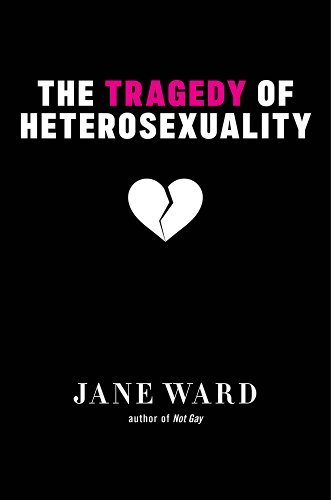

For many straight women, heterosexuality is simultaneously idealized as the ultimate goal and recognized as a painful necessity. While girls grow up being told they should dream about finding and marrying their prince, women often bond over romantic relationships with men who are violent, emotionally unavailable, or simply unpleasant. Queer women regularly acknowledge the struggle of heterosexual relationships for straight women. They both seriously and jokingly discuss how glad they are that their romantic and sexual satisfaction does not depend on straight men. Queer women often feel bad for their straight counterparts’ romantic prospects.
In The Tragedy of Heterosexuality, Jane Ward asks why queer people would feel sorry for straight people if being straight is easy while being gay is a curse that can only be explained by the “born this way” idealogy (which depends on the assumption that no one would choose to be gay). Ward pushes against this narrative and claims that “the basic premise [. . .] that heterosexuality is easier than queerness –requires renewed investigation” (2). Ward uses her perspective as a queer woman to defamiliarize heterosexuality, allowing her to point out its many structural flaws that are often overlooked or accepted as unchangeable. She uses queer relationships as a reference point for creating a healthier type of heterosexuality.


Jane Ward has lots of experience writing and thinking about both straight and queer relationship dynamics. She is a professor of Gender and Sexuality Studies and the program chair of Lesbian, Gay, Bisexual, Intersex, and Transgender Studies at the University of California, Riverside. Her courses are about feminist, queer, and heterosexuality studies. She has a Ph.D. in sociology from the University of California, Santa Barbara. She has published two other books: Respectably Queer: Diversity Culture in LGBT Activist Organizations (2008) and Not Gay: Sex Between Straight White Men (2015). She has explored many facets of sexuality, from queer feminist parenting to straight men who have sex with each other. She brings a refreshing perspective to the conversation around the issues with straight relationships, as she uses queer relationships to demonstrate that straight couples do not have to cope with relationships built on dislike and misunderstanding (an assumption so many books for straight couples work off), but can have an entirely new kind of relationship.
In Chapter 1, “Let’s Call It What It Is: The Tragedy of Heterosexuality,” Ward introduces the premise that heterosexuality is more flawed than straight people are willing to admit. She explains that many queer women internalize the idea of the “tragedy of queerness,” when, in reality, they are grateful for their queer relationships and are relieved not to be a part of straight culture (4). She points to personal conversations with queer parents who feel they should not wish homosexuality on their children despite their own happiness with their sexuality. She also details the work of many feminist scholars and activists such as Audre Lorde, Gloria Anzaldua, and Kate Millet who discuss the discomfort of straight relationships and how they enforce the patriarchy.
Ward questions and denormalizes heterosexuality, leading her to three main conclusions. The first, which she discusses in Chapter 2, “He’s Just Not That Into You: The Misogyny Paradox,” is that “the normalization of violence and mutual dislike was central to straight culture from its modern inception” (172). In this chapter, Ward points out that straight people often do not like the gender to which they are romantically attracted. She explains that men often look to each other for close homosocial connections while they have “disgust or resentment for the object of one’s sexual desire” (37). Ward shows that much of our culture assumes that men and women cannot stand each other and that “mutual likeability” between men and women is a very new idea, as, for most of history, marriages were based on transactions and ownership (34). Ward explores the self-help and beauty industry that has sprung up for straight women to try to get straight men to actually like and respect them. She analyzes historical and modern resources in this industry, including advertisements for douches and the advice of “experts” like John Gray, author of Men are from Mars, Women are from Venus.
In Chapter 3, “Pickup Artists: Inside the Seduction Industry,” Ward explores the bastardization of feminist ideas for heterosexual male gain through the lens of the pick-up industry. Ward sat in on several seminars and classes taught by pick-up artists (men who consider themselves experts at getting women to have sex with them through their flirting and seduction methods) and interviewed the attendees and organizers of these programs about their intentions. She uses her field notes and ethnographic work to illustrate how pick-up artists integrate feminist ideas of respecting and listening to women as a way to have more sex (one instructor even had a seminar on the #MeToo Movement). In Chapter 4, “A Sick and Boring Life: Queer People Diagnose the Tragedy,” Ward has queer friends and colleagues fill out a survey about what disturbs them about straight relationships or culture. She uses these answers to unpack the phenomena of straight culture that are problematic and confusing when not assumed to be the norm. Topics she covers include the boredom of straight relationships (including sexual boredom), men and women’s strong dislike for each other, straight men’s treatment of everyone in their life, and the focus on conformity.
In the final chapter, “Deep Heterosexuality: Toward a Future in Which Straight Men Like Women So Much That They Actually Like Women,” Ward calls on straight men to “put their politics where their lust is: in alignment with women” (155). Ward implores straight couples to stop trying to embrace traditional masculinity and femininity as a way to thrive; the very foundation of men and women as complementary figures is built on a power dynamic. Instead, she encourages men to truly identify with the women in their lives as fully-formed people. She also encourages straight couples to push further than heterosexual expectations in their connection with each other. As an example for straight couples, Ward points to lesbian feminists’ respect and care for the women they are with, which is inseparable from their attraction.
One of the book’s strengths is the in-depth research of a wide variety of people. While there is no way to capture all facets of straight culture in a single book, I loved how Ward dived into so many different areas of heterosexuality. Her work included exploring the phenomenon of pick-up artists (she spent days shadowing “experts” to learn everything she could about how they view women), analyzing media such as t-shirts with jokes about how terrible marriage is, and including the perspectives of more than fifty queer people on the problems with heterosexuality. Ward illustrated each of her points with rich and compelling examples.
One of the book’s weaknesses is the limited age range that Ward discussed. I wish that, along with discussions of the problems of middle-aged heterosexuality, Ward had applied her ideas about heterosexuality to teenage dating and college hook-up culture. While she briefly mentioned that frat culture is an example of men having disdain for women and close relationships with other men, I wish she had gone more in-depth with this analysis. For example, she could have discussed the similarities and differences between straight culture on college campuses to straight culture in other generations.
Overall, I am so glad I read this book, and I will be recommending it to everyone in my life. From older women complaining about their husbands’ incompetency to men my age rolling their eyes whenever their girlfriends speak, it gave voice to and explained much of what I have observed but been unable to describe in my own experiences with heterosexuality. I think many straight women who read this book will have the freeing experience of seeing their relationship struggles validated and see new possibilities for ways of being in relationships with men. However, I also hope many men read this book, so that heterosexual couples can begin to find true partnerships, free from some of the baggage surrounding heterosexuality.
Works Cited
“Jane Ward.” scholarship for the feminist revolution, https://www.janewardphd.com/. Accessed 12 April 2022.
Ward, E. J. (2020). The Tragedy of Heterosexuality (Ser. Sexual cultures). New York University Press.