Referencing the movie Twilight in a room often draws a mixed reaction. Either people are incredibly interested and ready to contribute their fan experience to the conversation, or they immediately groan and drown out any further discussion. No matter its polarizing tendencies, it is undeniable that Twilight has had a major impact as a social phenomenon. In fact, many aspects within this saga perpetuate 1940s family ideals and traditions onto the pregnant body. Kelly Oliver analyzes this film, and the films before it, in her book Knock Me Up, Knock Me Down: Images of Pregnancy in Hollywood Films, which was published in 2012. Within her book, she emphasizes how, despite pregnancy being more openly seen on television over time, Hollywood has not embraced new feminist thought, but has, instead, kept conservative family values at the forefront of heterosexual movies that depict horror, comedy, and/or romantic plots.
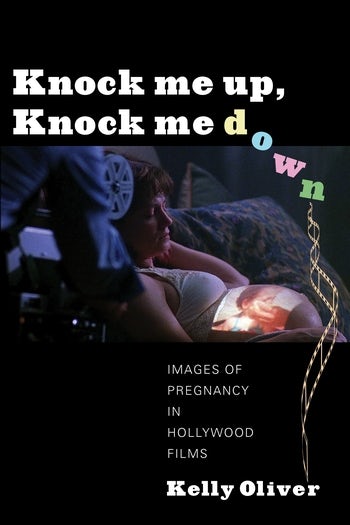
Born and raised in Spokane, WA, Kelly Oliver now teaches as a philosophy professor at Vanderbilt University and has published articles about the refugee crisis, the prominence of rape on college campuses, and about women in the media for newspapers such as The New York Times. Alongside these achievements, she founded philoSOPHIA, which is a feminist philosophy journal. Born in 1958, Oliver most likely watched the developments of pregnancy on-screen throughout her adolescent years. As a young child, she would not have seen much, as the word “pregnancy” was banned on television until 1959, and women were not allowed to look pregnant for several years later (21). But, as she grew up, there would have been increasing visualizations and normalization of pregnancy on-screen; yet, with these developments came a negative side effect that Oliver explores in the rest of her book. Covering the negative representations of pregnancy in film has helped further a specific aspect of the feminist movement: pro-choice and women’s reproductive rights. By exposing how Western media present all of their characters as pro-life, which feeds into anti-abortion conservative beliefs and force excessive social pressures onto moms to be perfect, Oliver’s scholarship works against this media of influence on younger generation girls.
Using the methods of textual analysis, Oliver focuses on symbolism in shows and cinemas to decipher Hollywood’s representations of pregnancy and and women’s reproductive rights, given the prevalence there of men directors and executives. She also takes the time to chronologize pregnancy in film for us within her monograph. Starting in the early 1600s and 1700s, midwifery was transferred to male control resulting in the medicalization of pregnancy (112). This change in labor ties in with Foucalt’s understanding of male experts taking over many lines of work, and that includes midwifery. During this time, women were advised against exercise and encouraged to complete bed rest in order to not disturb the baby (24). On top of the physical restriction women had, they were told their thoughts negatively impacted the child: that mothers “corrupted by forces outside herself, which cause her to have morbidly perverse fantasies and episodes during pregnancy” had moral insanity which caused horrific and monstrous children (115). Hollywood, in this manner, greatly aligned with First-Wave Feminists who perceived women to be the educators and standard for children’s moral upbringing. Regardless, with pregnancy being seen as a private and delicate matter, pregnancy was never mentioned or shown on film. Additionally, since sex and reproduction were linked in this era, viewers would have seen pregnant characters as less pure than ideal. It is not until the popularity of birth control and the Sexual Revolution in the 1960s that we even see sex on-screen without its former ties to reproduction (66). Nevertheless, the newfound acceptance of sex opened the door for a stronger pregnancy presence in the media; to note, we can also thank Demi Moore’s 1991 nude Vanity Fair illustration for pushing more pregnancy representation as well (37). Although these progressions can be seen as beneficial, it is not without their downsides.
Oliver demonstrates that throughout the latter of the twentieth century and early twenty-first, Hollywood has increasingly promoted unhealthy and harmful practices via pregnant characters. In one regard, Hollywood’s portrayal of white mothers in comparison to black or Latina mothers is blatantly racist. For white moms that keep an accidental pregnancy instead of aborting the fetus, they are described as “good choice makers” (100) while their black counterparts are seen as having “‘bad’ babies to ‘put on welfare’” (96). Not only is this stereotypical of socioeconomic status, but it also plays into eugenics and the belief that “educated white women have a duty to have babies because they provide the ‘best’ gene pool” (95). Thus, when Hollywood continuously enforces the idea that middle-class white women have happy endings when they have kids, they exclude the notion that women of other races and social classes can as well. But, Hollywood only supports a specific type of middle-class white woman: the ones that push back their careers in favor of building a family first. Often, career-driven women are explained as “bossy” and “racing against their biological clocks” to have children (67;93). These women’s success is blamed for their “baby hunger,” (93) and the impressionable audience is encouraged to have kids younger, else they too will be “racing against their biological clocks” for kids when they are older. In these cases, the women who are ‘too late’ and resort to IVF, are described as less-satisfied than parents with “real” babies (150). Like in the movie The Backup Plan, Hollywood again displays its conservative values by promoting traditional heterosexual relationships over assisted reproductive technologies which do not depend on a heterosexual couple to reproduce. Moreover, Hollywood also makes pregnant women the butt of its jokes in its films. From comedies’ gross-out humor about women’s excessive cravings, ‘larger-than-life’ size, and constant need to pee, movies and television that partake in these tropes consistently do not take pregnant women seriously (79). With the culmination of all these attributes, it is safe to say that the increase in pregnancy in film has not been completely positive.
Similarly, Twilight has not contributed positive images related to pregnancy. During Bella’s birth in Twilight: Breaking Dawn, we see “the most blood we ever see…associated with birth and women’s role in reproduction” despite previous movies in the series going over vampire wars, hunts, and beheadings (196). These portrayals also reflect the view of “women’s wombs as harboring evil” since Renesmee, Bella’s child, survives by drinking her mother’s blood and ends up temporarily killing her mother in the “nightmarish” labor scene (14,195). This Othering of pregnant women and acknowledging them to be a risk to society exposes how little Hollywood understands about pregnancy and how much they can vilify their pregnancy fears, producing controlling images that shape public ideas about pregnancy. Not only are these fetuses seen as a danger and life-threatening, but knowing that Bella refused to abort the baby continues to show how Hollywood “endorse[s] family values” and disregards abortion as a proper solution to a grave issue (197). END SENTENCE
Oliver engages feminist scholarship on the general stigmatization of pregnancy, including Julia Kristeva, Iris Young, and Simone de Beauvoir. Julia Kristeva, a French Feminist philosopher of the 1970s and 1980s, “described pregnancy and the maternal body in positive body in positive terms” (4). She and her American follower, Iris Young, do not believe that women have a biological clock and that the urgency for early pregnancy is unnecessary (6). Not only does Oliver agree with these two and that regard, but she also agrees when these two assert that pregnant bodies are not abject or gross, but desirable (21). Where Oliver disagrees with Kristeva is on the topic of assisted reproductive technology: while Kristeva goes against the “automation” of reproduction (34), Oliver values its versatility and ability for people to have kids later without worry. Another stance of disagreement comes up with the value of motherhood. While individuals like Simone de Beauvoir, who never had kids or was married, say that pregnancy “renders women docile,” Kristeva and Young do not. In this instance, Oliver takes a more neutral stance and leaves the value of pregnancy up to each individual woman. Although Oliver agrees with de Beauvoir that biology “never completely defines human beings”, she is not as extreme to believe “that women’s reproductive function limits them and prevents their true participation in the social and political spheres” (23). Another circumstance where Oliver partially agrees is with Young’s hope to “resexualize” pregnant bodies (36). Over time, as the media defined pregnant bodies to be abject and horrific, they were not sexualized and Young acknowledges that “the desexualization of the pregnant body can open up a space for ‘self-love,’” yet insists that, since “Patriarchy is founded on the border between motherhood and sexuality,” mothers should be “resexualized” (36). In this sense, Young understands men as the cause of the initial aversion over pregnant bodies, which would be why motherhood and sexuality were not previously associated. Oliver does not agree that the solution to this border is to sexualize any woman; however, she relents that pregnant women can be desirable and that a “desiring body would be liberating for women” (36). To resist the de-sexualization of pregnant women is a way for expecting mothers to take back their independence and have more control over what people should/should not say about their bodies.
Across the board, Oliver has made her stance clear on dispositions against and for pregnant women’s bodies, but that does not mean to say she wrote the perfect book. Though her writing covers the depiction of pregnancy as abhorrent in horror films, she never includes how this may apply to transgender or gay couples too. In this book, Oliver highlights how IVF and assisted reproductive technology help older women have children, but she forgets that these same procedures also help same-sex couples or transgender couples have children as well. The failure to mention the importance of non-heterosexual couples now being able to have kids, and how that may also impact Hollywood’s opinion on these procedures, is unfortunate. However, it is important to note that this book was published in 2012; as a result, some of the LGBTQ+ considerations we have now were not as common then. Still, Oliver was successful in other domains of intersectionality. By including examples of Latin and black moms in film, she put the attention away from the typical middle-class, white mom we usually see and recognizes how racism and classism are still prominent issues within Hollywood–and that includes their pregnancy movies. But, the focus solely on live-action films limits her piece. Mentioning other types of media, such as animation, could have also breached how the lack of pregnancy in these genres represents Hollywood’s unwillingness to have pregnant characters–who are impure in Hollywood’s conservative mindset–shown to the younger audiences that consume animated films. Nonetheless, Oliver has done an incredible job in defining and outlining the portrayal of pregnancy in the media across multiple decades. Her book and the scholarship it provides would be a strong resource for any film producers or avid movie-watchers who want to properly and accurately understand how what we see on screen about reproduction does not correlate to the realities of pregnancy today.
It was interesting to read about Hollywood’s portrayal of white mothers in comparison to black or Latina mothers. While portraying black counterparts are seen as having “‘bad’ babies to ‘put on welfare’ is racist and inaccurate representation, I also am aware that there is overall a lack of representation or discourse on pregnancies of people of color in Hollywood. It makes me wonder what are some of the impacts on people of color or public opinion about pregnancies of people of color due to lack of representation.
This was such an interesting review to read because this is a topic that has never really crossed my mind. It was also super interesting to think about how pregnancy is portrayed in women of color. I read a similar book to this, so this helped build upon my knowledge. Great job!
This analysis of the portrayal of pregnancy in Hollywood is so important, especially since it’s something most people would likely not think of as a problem. The way you communicate the author’s argument about how white vs. black or latina mothers are viewed offers a very important perspective that recognizes several double standards that hold women of color to an unfair expectation. Awesome job!
I had never considered this idea before. After reading your review, I thought about several movies I have watched which incorporate pregnancy. Those movies and the ones that you mention completely affirm family values. I wonder how films today have changed in considering the topic of abortion and motherhood of women of color.