A recent Grey’s Anatomy episode opens with a commentary on the history of hysteria: “In the 1800s, one of the more common reasons women visited the doctor was hysteria—a now-defunct diagnosis. Hysteria was used to describe a wide array of symptoms: chest pain, anxiety, a swollen abdomen, mood swings. They tried a variety of treatments for hysteria ranging from rest to psychosomatic therapy. But true relief for these women didn’t exist until physicians tried using what they called ‘pelvic massage.’ The cure was called a hysterical paroxysm which today has come to be known as an orgasm” (“Let’s”). But what is hysteria? Why was it associated with women and cures associated with sex? What caused hysteria? Andrew Scull, a Distinguished Professor of Sociology at the University of California, San Diego, who has researched and written about the history of psychiatric illnesses for more than three decades, attempts to answer these questions. His scholarly monograph, Hysteria: The Disturbing History, highlights the shifting perspectives on the root cause of hysteria while simultaneously revealing shocking elements of history.
While female hysteria is no longer recognized in The Diagnostic and Statistical Manual of Mental Disorder, Fifth Edition, manifestations of hysteria are recognized in diagnoses of illnesses such as Schizophrenia, Post-traumatic Stress Disorder, Panic Disorder, Borderline Personality Disorder, and Premenstrual Dysphoric Disorder, among other mental illnesses. That said, understanding the history of hysteria is pertinent when forming perceptions and educating oneself about mental health and mental illnesses. Scull recognizes this in his “biography of what contemporaries saw and interpreted as hysteria” as he discusses hysteria’s “fascinating and tortuous medical and cultural history” (6, 8). Scull’s work propelled him to receive the Roy Porter Medal for his lifetime contributions to the history of medicine and the Eric. T. Carlson Award for lifetime contributions to the history of psychiatry (“Andrew”). His research for Hysteria: The Disturbing History serves as an essential base for developing a comprehensive understanding of psychiatry today.
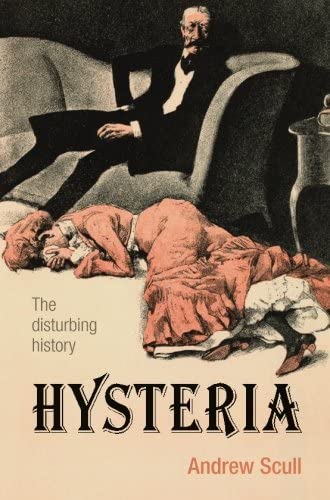
Hysteria was first declared a women’s disease in 5th century BC by Hippocrates on the basis that upset bodies produced upset minds. Arguing on the notion that women were different and their differences were consequential for their health, many physicians placed “women’s reproductive systems at the heart of accounting for their susceptibility to all sorts of disease and debility” (Skull 13). Women were declared as inferior: “moister, looser textured, softer, with spongier flesh. Her body was more readily deranged… by puberty, pregnancy… by menopause, or by suppressed menstruation” (Skull 13). Women’s said inferiority and susceptibility to hysteria were rooted in the female reproductive organs, as evidenced by the derivation of the term hysteria from the Greek word for uterus. Hippocrates adopted this notion, asserting that the womb would travel through the body, causing troubling symptoms:
For the uterus is a most important organ, and brings the whole body to sympathize with it… When the uterus either rises up or falls down, or is in any way put out of place or is seized with spasm—how dreadful, then, are the mental aberrations, the delirium, the melancholy, the paroxysms of frenzy, as if the affected person were under the domination of spells, and all arising from unnatural states of the uterus. (Scull 31)
In the 17th century, Thomas Willis, coiner of the term “neurologie,” discredited this theory, concluding “that in cases of hysteria and hypochondria ‘the chief disorder is in the nervous system’” (Skull 31). However, the association of hysteria with females continued long past this assertion.
Shortly after, the reasoning behind hysteria’s prominence shifted. Contrary to early views about hysteria, the malady came to symbolize a badge of honor: “the more refined, delicate nervous systems of the elite put them at risk of falling into hysteria and related nervous states” (Scull 48). To be hysterical was a sign of wealth and power—a view that is infrequently commented on today. The book demonstrates that wealthy people with symptoms of hysteria received a wide array of private treatments; on the other hand, poor people were publicly shamed for symptoms. Some poor patients were even put on display in a “circus.” Public humiliation was said to treat their symptoms. Scull notes that despite shifts from original views about hysteria, gendered implications remained present: “women were still seen as contributing a disproportionate share to the ranks of the female sufferers… the female nervous system, were simply a frailer, lest robust version of the male. Women’s nerves were more delicate, their brains more susceptible to breakdown” (Skull 55). Women’s roles in society, and femininity as a whole, were all tied to the development of hysteric symptoms: “Puberty, pregnancy, parturition, lactation, menstruation, and the menopause—each added to the constant shock and strain on the female bodily system, prompting in all too many cases the shipwreck of the intellect, the collapse of the will, and the dissolution of all semblance of self-control” (Scull 73). In an attempt to treat hysteric symptoms, hydrotherapy, magnetic fluid treatment, electric treatment, treatment through various pills, psychoanalysis, clitoridectomies, and ovariectomies were all introduced. As Scull puts forth, W. Tyler Smith even suggested symptoms be treated “by a course of injections of ice water into the rectum, introduction of ice into the vagina, and leeching of the labia and cervix” and Robert Brudenell Carter suggested hysteria originated from a lack of orgasms (Scull 66-7). Despite some patients claiming immediate relief, others experienced continuous symptoms; thus, the period of abusive and seemingly random treatments began.
When men began to experience symptoms of hysteria, the medical mindset shifted. For doctors, bankers, and lawyers, “nervous prostration was thus a sign of their superior endowments and attainments… a condition brought on by overwork and overstress” (Scull 157, 168). However, this was only true for some men; the disparity between views of hysteric men versus hysteric women was not in favor of veterans. Labeled as experiencing “shell shock,” veterans experiencing symptoms related to wartime trauma were considered “unmanly cowards and malingers, seeking to shirk their patriotic duty… the line between shell shock and cowardice seemed blurred at best” (Scull 157, 168). While still viewed in a negative light, Scull notes that this was one of the first times hysteria was unassociated with the female reproductive system. Then, come the early twentieth century, hysteria “disappeared.” Was it because individuals experiencing similar symptoms to hysteria were labeled as suffering from other psychiatric questions? Was it because of the introduction of drugs such as Prozac and Zoloft, among many others? Or was it because medical professionals choose to just ignore hysteria? Scull leaves readers pondering these questions.
Many historians and literary scholars remain fascinated by the subject of hysteria. Scull builds his monograph based on derived data, therefore employing a method traditionally seen in historical research. Building off other scholarly literature related to the topic, Scull evaluates other sources while inserting his own narrative and exposition related to the topic of hysteria. He begins the monograph with an anecdote about Mary Glover, a 14-year-old-girl experiencing early symptoms of hysteria, which at this time were considered “actions and reactions… of a person bewitched or diabolically possessed” (Scull 5). He dives into the early origins of hysteria, then referred to as mysteria, while commenting on the establishment of neurology as a field of study and the ways in which neurology fueled the association between hysteria and an English malady. He criticizes Freud’s theories of hysteria and Jean-Martin Charcot’s establishment of hysteria as a circus and spectacle. From here he engages in written discourse about the hysteria’s presentation in veterans before proposing theories behind the sudden death of hysteria. Scull’s engagement in the critical analysis of primary sources and secondary sources from other scholars, coupled with the fact that he is writing in his discipline, bolsters the validity and reliability of the monograph. For that reason, his research method proves successful.
For much of history, hysteria was tied solely to women. Scholars have been to provide a more nuanced view of hysteria’s history, citing evidence from both the female and male experience. Scull strengthens his scholarly position by delineating experiences beyond historically gendered reports. In his inclusion of the male hypochondriac, the hysteric and overworked wealthy man, and the victims of shell shock, Scull efficaciously broadens perspectives. That said, considering that hysteria was tied to the female reproductive system for such an extensive period, I feel that Scull should have acknowledged his privileged position as a male. While his scholarly position is based on factual evidence, bias is almost unavoidable. Because he likely has never experienced the impacts that beliefs about female hysteria have on society today, his position likely varies from that of a female scholar. I feel like an acknowledgment of such would help to strengthen his credibility. However, this is only a minor weakness; his academic work is cogent and sound.
Giving a thoughtful insight into hysteria, Scull offers a critical examination of the history of hysteria. Scull discloses theories behind hysteria’s causes, summarizes modes of “curing” and “treating” hysteria, and combats inaccurate notions of hysteria in an effective examination of hysteria in the context of gender, power, and inherent social hierarchies. While hysteria is no longer considered an adequate medical diagnosis, the gendered ties of hysteria to women linger in the medical field. Female patients are continuously gaslighted about their physical and mental health. Stephanie Trentacoste McNally, an OBGYN at the Katz Institute for Women’s Health, comments on this: “It’s no accident that the word ‘hysteria’ originates from the Greek word for ‘uterus.’ There’s still this pervasive belief in the medical community that anytime a woman complains about her health, it’s either related to her hormones or all in her head” (“Gaslighting”). Taking that into consideration, the audience for Hysteria: The Disturbing History is quite broad. Mental health and medical professionals would benefit from reading the monograph as a method of stimulating analysis of their inherent biases that impact the treatment they provide. But, on an even larger note, women fighting for their voices to be heard—to be understood and acknowledged—would also benefit from reading this book. Recognizing how far women have come in fighting gender disparity to ensure proper medical treatment, and rights in general, empowers women to continue their fight. This is needed now more than ever.
Works Cited
“Andrew Scull.” Department of Sociology, UC San Diego, sociology.ucsd.edu/people/faculty/emeritus/andrew-scull.html. Accessed 11 November 2022.
“Gaslighting in Women’s Health: No, It’s Not Just in Your Head.” Katz Institute for Women’s Health, Northwell Health, www.northwell.edu/katz-institute-for-womens-health/articles/gaslighting-in-womens-health. Accessed 11 November 2022.
“Let’s Talk About Sex.” Greys Anatomy, written by Shonda Rhimes, Michelle Lirtzman, and Jess Righthand, directed by Kevin McKidd, American Broadcasting Company, 20 October 2022.
Scull, Andrew. Hysteria: The Disturbing History. Oxford University Press, 2009.
I agree with you that Scull should have acknowledged his position as a man discussing a topic related to females. When I first started reading your review I thought how uncomfortable it was for a man to write about this and how it almost reeks of historical wrongs. If he had acknowledged being a man the monograph surely would have benefitted.
I found your review really interesting. Hysteria was a term I have known about, but I did not know about the sexist history of it. I didn’t realize how ingrained the sexism was either, so learning the word oriented from the word uterus shocked me. As I kept reading, I was disappointed but not surprised to read about the way hysteria was defined as a disease solely for women and then how it was used against them. It was interesting to see how once men started displaying signs of hysteria the negative narrative around it started to change.
I found your book review to be very interesting, but honestly not at all surprising. I am not shocked that doctors deemed women hysterical when they instead had potentially a number of other disorders. I love that you highlighted that doctors realized men experienced it to, but this entire book review just demonstrates how woman were basically ignored by the medical community for being “dramatic” about their health. I remember discussing this in class about black women’s pregnancy in the 1900’s I believe, and how doctors would ignore their concerns just because they were female and black.
This was so incredibly interesting to read. This is definitely something that is not talked about enough, and it still happens today. Women for so long have been deemed emotional or “hysterical” or over dramatic and not to be taken seriously when in reality the issue at hand needs attention. I think it is important that it is specified that this especially has affected women of color or trans or queer women, that intersectionality is important to address. I also agree with your point about the author being a man- he could have recognized and addressed this as he is a man talking about a history of women.
This is very interesting. I agree with the comments above that Scull should have acknowledged his position very early on in this work. Regardless of the quality of the work in general, I think including certain female scholars that are professionals surrounding this topic is a great way to make this monograph more inclusive. While he is simply basing it off of factual evidence, sometimes, an individual’s position simply isn’t right.