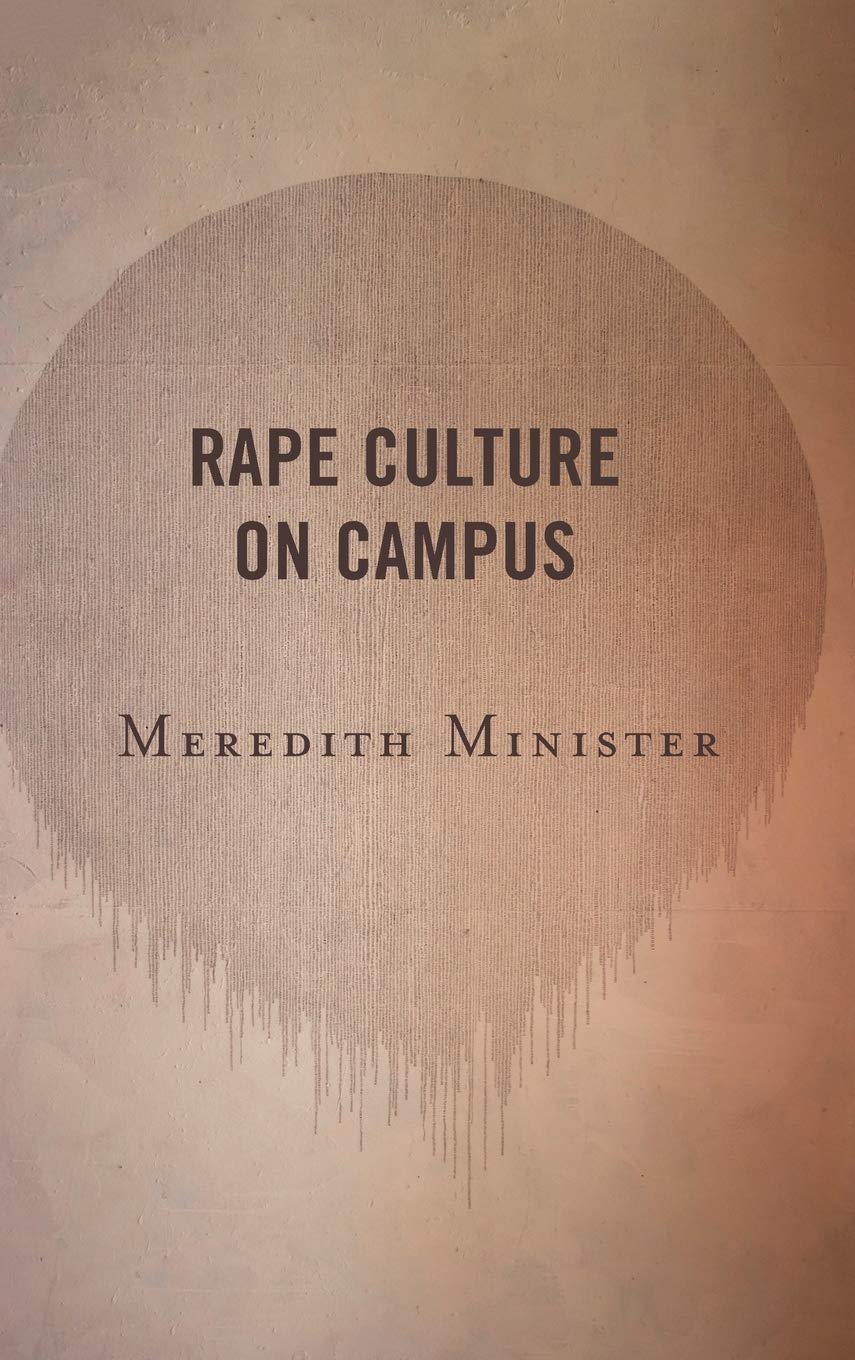
Within college campuses, rape culture is a prominent issue that is often addressed on a surface level, leading to little or no change in the occurrence of sexual assualt and sexual violence. Meredith Minister breaks down how rape culture is continually perpetuated on college campuses and offers solutions to reducing the prominence of sexual assualt on campus in her book, Rape Culture on Campus. Minister emphasizes that not only is rape culture an issue that requires a change in ideolgies and how we approach sexual assault prevention, but also that rape culture is partially a result of binaries that often exclude gender, sexual, racial, and ethnic minorities.
Minster begins her book by introducing how she defines rape culture, specifically saying that rape culture is “a socially accepted pattern that legitimates violence to police socially nonconforming activities, including expressions of sexuality and gender” (1). She equates the issue of rape culture existing in the first place to the way we view society and the people within that society. Colonial ways of thinking about gender and sexuality exacerbate the occurence of rape culture in society. She expands on her definition of rape culture by breaking the causes and continuation of rape culture down into pieces. Minister’s writing provides an up close look at how rape culture has defined college campuses and how colleges can do better to break the cycle of continuing the voilent pattern. Mininter draws on her educational expertise to include how purity culture, religion, and autonomy, in addition to policing and trigger warnings, do not assist in interrupting the rape culture pattern on college campuses.
Meredith Minister currently works at Shenandoah University in Virginia as an assistant professor of religious studies. She also teaches in the discipline of gender and women’s studies at Shenandoah University. She has published other previous works regarding the relationship between religion and culture, including a closely related work of hers called Rape, Religion, and the Classroom: Critical and Pedagogical Engagements, written with Rhiannon Graybill and Beatrice Lawrence, fellow religious studies professors. Minister brings her knowledge of religion and its influences on purity culture into her work of Rape Culture on Campus, as the two are intertwined with one another.
Minister uses her knowledge in the disciplinary methods of religious studies, as well as gender and women’s studies, while pulling from other scholars in the same fields to develop her analyses. She begins the discussion of the causes of rape culture in society with the widespread acceptance of purity culture in Chapter One, “Purity Culture”. Purity culture cultivates a sense that those who are not “pure” are basically asking to be raped and that someone not being pure then creates an excuse for them to be raped. Purity culture comes from evangelical Christian beliefs, but they have spread beyond the religion to everyday society. As a result, “when people, especially gender, sexual, and/or racial minorities, fail to be sexually normative (pure), their failure becomes an excuse for rape” (4). The creation for the excuses for rape, even though there actually are none, then normalizes rape, creating a bigger issue. Purity culture has systems of social order where “pure individual bodies are produced by and reflect the social order while impaired individual bodies exist on the margins of the social order” (6). This means that the social order depends on determining who is pure and who is not pure. Altogether, Minister composes the argument that due to the creation of social orders based on purity culture, sexual violence cannot be responded to individually. It is an entire social issue that cannot be addressed privately for the denormalization of rape culture itself to occur. She also addresses how historically white women have been viewed as more pure than Black women, leading to an injustice in the social order of Black people in general when compared to white people. In Chapter Two, “Violence and Policing,” Minister continues with the point that race creates an injustice in general, not just within rape culture. She points out that “The African American Policy Forum reports that Black women and girls make up 13 percent of the female population in the United States, but 33 percent of women shot to death by the police…[this is] part of a racialized pattern in which Black women are killed at a higher rate than white women” (37). These statistics are unfortunately not surprising, but they are saddening. Race creates differences in who suffers more, such as with police shootings. Black women are seen as less pure, so they also suffer more than their white counterparts.
In Chapter Three, “Exploring Institutional Structures,” Minister brings colleges specifically into the conversation of rape culture. She concludes that a major issue with schools’ actions against sexual violence is that they see it as “one that is isolatable and fixable” (53). They tackle each one individually, rather than creating “significant institutional change” (55). The issue with the actions that the schools’ take is that because they see each instance of sexual violence as its own separate situation, rather than one larger issue. Gender stereotypes are another issue within sexual violence, because it gives the sense that all women are sexually available, but this is not the case. Minister explains both the positives and the negatives of Title IX within institutions. Although having a Title IX coordinator gives students another well-equiped person to talk to regarding sexual violence, some schools have a mandatory reporting policy that requires anyone who learns of a potential instance of sexual violence to report it. The issue with this is that sometimes that is not what the victim wants. Without victim autonomy, the victim may feel as though they are experiencing the violence again to go through the investigation. Often, institutions that report instances of sexual violence also get local law enforcement involved, potentially exacerbating the situation for the victim. This goes back to Chapter Two with the policing of people. Many schools have these policies in place to make things better. However, sometimes “policies can become the substitute for action” (69). Then the issue becomes rather than taking true action to change a systemic issue, policies continue to be thrown at the issue to try to subdue the actual level of intervention the situation warrants. Chapter Four, “Assumptions of Autonomy in Cocurricular Responses to Sexual Violence,” includes how disability and “Crip Theory” associate with bystander intervention. Throughout Chapter Four, an example of a Public Service Announcement (PSA), under President Obama’s administration for the “Not Alone” campaign, is used to show how often sexual violence becomes a gendered crime. In the PSA, there are many famous men that suggest if a bystander sees an act of sexual violence occurring, one should intervene and stop it. This PSA takes on the idea that sexual violence only happens to women by men, and that men should step up to become a hero and stop sexual violence in the moment. This partially creates a false conversation because it has gendered the roles of sexual violence, when in reality all genders can potentially be victims or perpetrators of sexual violence. Conversations surrounding sexual violence also often come with trigger warnings.
Chapter Five of Minister’s work, “De-Individualizating Sexual Violence in the Classroom,” focuses on tirgger warnings and how sometimes we do not need them because the content that goes with them is not essential to the learning outcomes of the class. Rather than including potentially triggering content and including trigger warnings, eliminating that content entirely, as long as it is not crucial to learning outcomes, is the more inclusive method to making a classroom as safe as possible. Minister adds to this point that “space is never objectively safe for everyone. If trigger warnings function to protect an objectively safe space, they will fail” (92). Trigger warnings will fail in this sense because anti-violence spaces, where these trigger warnings originally come from, have far different goals than those of a classroom. She adds an important point that deserves more attention than she gives it. She contributes “the suggestion to include trigger warnings [as] a suggestion faculty should consider as we consider accommodating mental illness in the classroom” (96). Rather than simply stating a trigger warning, faculty should recognize the general toll of mental illness on the students in their class. Ultimately, “trigger warnings might serve to heighten awareness of structural bias among faculty…[and students] to create the positive change” (101). This way of looking to make positive change leads into the last chapter of her book. Chapter Six, “Transforming Rape Culture through the Classroom,” discusses how “the classroom in the university’s ‘soft flesh’” (109). She makes an important, large final point in this last chapter stating that she believes one of the best ways to implement true change within the colleges is to take advantage of the general end goals of a classroom, learning. Part of the issue that she sees is that the classroom often sets an expectation to leave whatever is happening outside at the door and focus purely on the goal of learning. However, this then “treats these issues as secondary to learning rather than the place learning begins” (110). In other words, while the classroom is indeed a place for learning, the experiences that everyone has outside of the classroom are also an influential part of learning. She emphasizes this point by saying that “the classroom is not self-contained. The classroom, rather, is an extension of its social context” (110). To finalize her thoughts, she once more promotes new ideas on how colleges can begin to implement change. She suggests that schools “require students to take a course in gender and sexuality studies” (116) and that universities begin educating on sexual violence throughout students time there, not just when they first arrive. Sexual violence is an issue that can be tackled in the classroom, but classrooms have to be willing to accept that challenge for the greater good of the campus to change rape culture.
Minister identifies a lot of the common issues within the framework of sexual violence education and the approach that many have to prevention of sexual violence. Part of the issue within sexual violence prevention is that many colleges treat it as a “one-time, large group programming for entering first-year students, …[even though it must] become an integral part of the curriculum of an institution” (85). Minister blatantly describes the issues in how colleges address sexual violence prevention. Not only does she display widespread issues, she proposes new ideas and ways to change how colleges approach sexual violence prevention to change to social pattern of rape culture. She says that “because rape manifests and diverse context and rape culture intersects with multiple cultural discourses, understanding and responding to rape on college campuses should involve…rape culture and different cultural discourses” (xi). Minister’s strength is that she provides the reader with new techniques to answer the common question of “how?” when someone says that change needs to be made. She ends every chapter with a conclusion and what she thinks would create effective change to combat rape culture’s prominence within the higher education system. Oftentimes a reader is left with the urge to create change, but is unsure where to start. Minister changes this and gives the reader a point for where start with changing rape culture pattern on college campuses. This is especially important since many who read this type of work are often either professors or college students, providing the right audience with the necessary information to implement changes.
While Minister’s book provides issues with and solutions to the perpetuation of rape culture, there is a weakness within the content of some explanations. The sometimes ignorant lack of inclusion of statistics of males affected by sexual assault, in addition to gender minorities, such as those who identify as non-binary or transgender, for example, is an issue with the composition of evidence. Even though society often forgets that males can also be victims of sexual assault, Minister also leaving out in some chapters how males are impacted by rape culture protentially feeds into what she says about ideologies continuing the pattern of rape culture. In addition, she also minimally goes in depth in how those who do not identify as neither male nor female are commonly victims/survivors of sexual violence from perpetuated rape culture. Gender minorities are occasionally included in the discussion of views from a religious perspective on gender minorities, but are sometimes excluded from the larger conversation of the book. Chapter Five begins with a personal anecdote on how students have often come up to her after classes that involved conversations on sexual violence to discuss their own experiences. Following her experience with hearing students’ stories, she includes statistics of how many men and women overall are victims of sexual violence. She writes that “statistical evidence gathered from national studies suggests that 20-25 percent of women and 5 percent of men are sexually assaulted during college” (89). Her inclusion of these numbers are important to driving her point of the chapter; however, she creates a gender binary at the beginning of this chapter that continues in what follows. She states often in the book how part of what continues the pattern of rape culture is the oppressive gender binary that many still believe in or follow, and yet, she unknowingly does it herself to a certain extent. Her book is inclusive and covers many identities; however, some are not discussed nearly as frequently as others are within her book, providing a small weakness within her research.
The subject matter of the book surrounding rape and sexual violence is often a difficult topic of discussion. However, Minister goes to great lengths to maintain sincerity by including only the necessary details of her discussion on rape culture to limit potential triggers and discomforting feelings while reading. I will admit that some of the reading is dense due to her extensive knowledge on the subject. However, the ability to understand her explanations and conclusions is likely accessible to most in college or older, including faculty and staff, as long as focus is put in when reading. Anyone who is somehow affiliated with a college or university would benefit from this reading and hopefully appreciate the lengths to which Minister went to present new ideas on breaking rape culture’s pattern of abuse. I found this book to change the way that I view many things that I have incurred since coming to Davidson. For example, I have been introduced to trigger warnings and, like Minister said, a one-time education on important topics, such as drinking and sexual violence, at the beginning of my freshman year here. Minister changed the way I think of trigger warnings and educated me on how I should implement trigger warnings in the future. She also made me realize that the one-time education system many colleges have implemented is not the most effective in prevention practices for sustaining a safe environment. Even though the material seems heavy, it is actually not as heavy as I thought it would be and, as I am sure, most would also think judging just by the title of the book. Rape Culture on Campus is a very informative book that many should read to grasp how change would be more effective to prevent continuing rape culture on college campuses to create a more safe and inclusive environment for years to come.
Works Cited
Minister, Meredith. Rape Culture on Campus. Lexington Books, 2018.
“Rape Culture on Campus Book Cover.” Amazon, https://www.amazon.com/Rape-Culture-Campus-Meredith-Minister/dp/149856514X.
This is a great review, Jenna! This book looks quite interesting, and it is important to discuss how colleges can better combat rape culture on campus. The perspective that administrations should educate students more thoroughly reminded me of the emergency meeting students had on last Wednesday night to discuss how to prevent sexual assault at on-campus parties. Our discussion produces some important next steps, like providing phone numbers for individuals in distress to call for help, but we realized that we need more support from the administration. Ministers solution of more education could be quite useful at Davidson, as I think that students would benefit greatly from attending sexual assault prevention training throughout their college careers, rather than simply during orientation. The administration can absolutely make this happen. I enjoyed your thought provoking review
I loved your review Jenna! The book I read also focused on the aspects of rape culture. Something that both of our books touched on is the rhetoric surrounding white women, while leaving out other demographics, especially Black women and girls. From your discussion on Chapter 2, it is apparent that Black women suffer more from rape culture, yet their stories receive less attention. I think within rape prevention discourse, there needs to be much more discussion of what Black women, and essentially all other women other than white, experience. So many campaigns focus on saving the “white pure woman,” which needs to change for true progress to be made.
Hi Jenna, super review! I thought the conversation surrounding trigger warnings was incredibly interesting. I usually use trigger warnings for SA because I know a lot of people who have had experience with SA and appreciate them. However, I see the point of not including triggering material at all since it could be damaging for at least some students. I think that does raise a question of what content in classroom settings will be lost without the inclusion of trigger warnings – for instance, talking about sexual violence within social science or history classes (esp in relation to other forms of oppression such as slavery or sex trafficking). An interesting question!