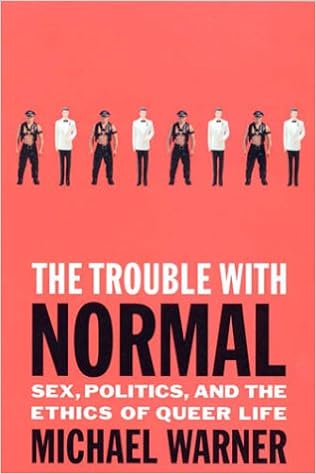
The Trouble with Normal- A Review

the trouble with normal

As a child, flying on a plane is a terrifying endeavor. On my first trip to Orlando, Florida to see the attractions, there was a toddler, probably around the same age as my brother (two years old). I remember my brother smiling as he slept, the toddler in the other row screaming at the top of his lungs. My earplugs could not fit in my ears so I listened to him wail instead, culminating in the harsh whisper of his mother, “Why can’t you just act normal”. In this case, ‘normal’ seems to be fairly cut and dry; the mother wanted her son to be normal, which to her meant quient, well-behaved. Such ideas of normalcy are ingrained in us from an even earlier age as this, wehre non-normal means different, means troublesome. Michael Warner’s book, The Trouble with Normal: Sex, Politics, and the Ethics of Queer Life, he examines this idea of “normalcy” by focusing it with a lens of queer theory, and as he proceeds through his work he continues to narrow that lens, focusing it down on a narrative and demographic similar to his own. He begins by addressing sexual stigma in broad terms, each subsequent chapter moving from the idea of ‘normality’ in general to a narrowed focus on gay, lesbian, and queer individuals.

Part of the brilliance and also the complexity of Warner’s argument is that there is no one such argument. Throughout The Trouble with Normal, we see complete shifts not only from topic to topic, but also from argument to argument. However, I take Warner’s argument to be one of politics, or the application of normalcy which he brings up strongly as a theme in every one of his chapters. In his chapter “What’s Wrong with Normal?” I believe Warner’s clearest argument presents itself, “the politics I advocate” Warner says, “—a frank embrace of queer sex in all its apparent indignity, together with a frank challenge to the damaging hierarchies of respectability—” (Warner, 74). Warner’s ‘solution’ of sorts does not mess with the concept of integration, but rather the ‘embrace’ he mentions is one of understanding and a moral acceptance, rather than a physical acceptance into currently policy, structures, and politics. This semi-utopic ideal that he presents also comes with a more confrontational aspect, a ‘challenge’ to the way that respectability is perceived and its exclusion of queers and queer culture. For the purposes of this review, I will use the term ‘queer’ as Warner himself uniquely defines it, saying, “the term “queer” is used in a deliberately capacious way in this book, as it is much in queer theory, in order to suggest how many people can find themselves at odds with straight culture,” (38). Warner is using the word queer as a defining term to separate, in a way, those that have been eclipsed by straight culture in social and political matters. He then goes on to suggest that using the phrase ‘homophobia’ and ‘gays and lesbians’ are not sufficient, as it “blinds itself both to the subtlety of the oppressive culture and to the breadth of possible resistances,” (39). It is clear that Warner’s definition of the world queer hints to the subject of his main argument, the differentiation and potential intersection of two groups: straight culture, and queer culture.         Currently a professor of English at Yale university, Warner has published several seminal works in queer studies, particularly the essay “Sex in Public,” co-authored with Lauren Berlant, and Fear of a Queer Planet. The Trouble with Normal was among many of Warner’s foundational works in queer theory. His social criticisms are heard through many periodicals in addition to his monographs. on Yale’s English department page, Warner lists his many interests, but then unifies them, saying, “One common thread across these fields is the way different social worlds are built up out of different circulating media and ways of reading or hearing” (English.yale.edu). His comment upon differing social worlds is particularly interesting, as Warner is an outspoken voice against marriage equality being the forefront of the ‘queer agenda’, believing it has negative implications, and that these moves towards normalcy “are bad not just for gays but for everyone,” instead calling for “a vision of true sexual autonomy”.

The main method employed by Warner in his analysis and progress of thought is engaging with other voices from queer theory, as well as publicized media events such as the Clinton impeachment. The diversity of resources he draws from not only extends the understanding of a mere layperson, but also brings back his theories to concrete social events that the reader knows about and might have experienced. As I stated earlier, Warner’s book is written in an editorial style a constantly evolving persuasion of his audience. He moves from one topic to the next without lingering long in one area. Structurally, it is divided into five main parts: “The Ethics of Sexual Shame”, “What’s Wrong with Normal?”, “Beyond Gay Marriage”, “Zoning Out Sex”, and “The Politics of Shame and HIV Prevention”. Material wise, he begins in a broad stroke with sexual shame, the politics of moral panic, hierarchies of shame, and he finally settles on the the ethics of queer life in preparing for the focusing of part two, discussing the idea of what “normal” is, gay and lesbian movement involvement and the ambivalence of identity, and the “normalized movement”. Focusing even deeper, his third chapter narrows to just gay marriage, explaining his reasons against it, and delving into the idea of “marriage without cost”. Chapter four narrows further into zoning out sex, the private and the public aspects of sexual acts as well as who becomes political targets. The conclusion of his work ends with the most focused aspect and demographic of all, those infected with HIV.

Warner’s writing can be dense, giving him the space to hit all of these issues, but as an overarching theme it is clear that the narrowing of his scope brings his topic from the general public, down to people of his own demographic, with similar narratives. Rather than describing and unwrapping all of Warner’s thoughts, I intend to focus on what I believe to be his greatest strength, as well as his main point (as indicated by his title)—normalcy.

Fittingly, the part of Warner’s monograph that I found the most persuasive was his second chapter, “What’s Wrong with Normal?”. Essentially, Warner associates humans’ obsession with the idea of what is ‘normal’ with the rise of statistics in the 19th century. Until this point, nobody had been concerned with what was normal, only with their normative ideas about right and wrong. In assessing the validity of a lust for normalcy, Warner cites Mary Poovey, who leads him to wonder “why anyone would want to be normal”, alter saying “It is not normal to be a genius, die a virgin, or be well endowed. That [normalcy], again, tells us nothing about what one should want,” (54). Such a statement has the power to throw any reader back into their memories, searching for moments they disproved or accepted the idea that normal was, indeed better; it’s strength lies in its universal application. Focusing this down to the linguistic element, Warner continues, tracing the word normal back to the true English meaning: “meeting a set of normative standards,” (56). He asserts that in a language such a French, the world normal has retained more of its original connotation, “refer[ring] to the whole process of training, testing, and authorizing people as full members of society,” (56). Here, we see Warner backing up his claims about normalcy by taking things back; normal wasn’t even intended to mean what we think it means!

Warner offers us a clear definition of the term “queer”, that he uses, attempting to use it in a particularly “capacious way”—all encompassing and inclusive. That being said, I found that Warner’s argument tended to fall into the trap of writing and speaking into the gay and lesbian categories that he made it his goal to undermine. He originally speaks from this perspective of an upheaval and destabilizing of the societal norms we have put into practice. Even towards the beginning, though, it is clear that Warner doesn’t always focus on the queer movement as a whole, but attempts to encapsulate it all by referring to homosexuality. Page 72 shows us a clear example of this, “pragmatism in gay politics requires some sense of principle, and some accountability to gays and lesbians.” What is interesting about this is his isolation of gay and lesbian terminology, continuing on to state that an issue with the hugeness of the marriage equality movement is it’s blindsiding certain groups (trans* people, gender non-conforming, etc.) Other areas of the book include brief mention of these groups, but the lack of consistency on Warner’s part seems to undermine his argument against gay marriage.

Warner’s book, The Trouble with Normal, does an amazing job of covering a variety of topics from the ubiquity of sexual stigma to the prevalence and more focused stigma of having HIV/AIDS. Warner is able to successfully balance a variety of academic sources and their research with contemporary examples that everyone is familiar with, giving him the ability to speak topic-wise to a larger audience. However, due to the level of nuance and complex theories discussed by Warner, I would say that the ideal audience consists of those aware of the marriage equality movement, with some familiarity with the idea of stigma and how it pertains to queer theory. While he introduces his topics well enough for most anyone to read and understand, I believe the most understanding will come from a place of prior knowledge of the subject.


Warner, Michael. Michael Warner: Seymour H. Knox Professor of English, Professor of American Studies. Yale U. Web. 23 Feb 2016.


Warner, Michael. The Trouble with Normal. Cambridge: Harvard University Press, 1998. Print.

Coming Out or Coming Home? Thoughts on The Coming Out Monologues

I want to begin this post by conjuring a HUGE *virtual* round of applause for Alex Kane (and the Queers & Allies as a whole) for an awesome event last night: I think I speak for most everyone when I say The Coming Out Monologues were hugely successful and should be a source of pride for everyone who participated in any way: way to go!

I can’t recall at time, here in Davidson or ever, where I have felt such a intense sense of community as I did last night in (of all places) the 900 room. I want to take this time to congratulate anyone who participated by reading, anonymously sharing, or just attending the event: take pride in the fact that you contributed, even if just in a small way, to something remarkable. To be honest, the warmth and inspiration I felt last night made me question Judith Butler’s claim that “If I claim to be a lesbian, I ‘come out’ only to produce a new a different ‘closet.’ The ‘you’ to whom I come out now has access to a different region of opacity” (Butler 309). Last night didn’t feel like we were constructing new closets, it felt like we were burning them down!

Last class Andres, Caroline, and I talked about the hypothetical genesis of our own feminist manifesto and how we would bring it to life. I think events like The Coming Out Monologues are essential to any sort of activism whether its in the name of a manifesto or something else entirely and, I encourage each and every one of you to go to events like this one when ever you have to opportunity because, I promise you, you don’t want to miss out!

Homosexuality is Not a Switch

Screen Shot 2016-02-24 at 9.35.09 AM

In Borderlands, Anzaldua makes a surprsing statement on page 4 saying, “Being lesbian and raised Catholic, indoctrinated straight, I made the choice to be queer (for some it is genetically inherent).”  The class discussed this statement as possibly meaning that Anzaldua “chose” to accept her queerness rather than “choosing” to be gay.  Gayness as a choice is a discussion that used to be highly debated but is less debated in contemporary times, with society accepting that people can be born “not straight”.  This led to a more detailed discussion outlining the problem with the binary system of either being born gay or born straight because this does not allow room for gender fluidity.  In light of our class discussion, which will be resumed during a later class; I found this photograph on social media, which illustrates the idea of “choosing to be gay” as if it were simply a switch in the body.

Art through Words and Art through Pictures

Today in class we analyzed Anzaldua’s Borderlands/La Frontera and Walker’s In Search of Our Mother’s Gardens.  Both of these pieces did a wonderful job of discussing their own experiences with intersectionality.  These authors were different than others because they wrote in a non/semi academic style, expressing a lot of literary creativity and imagery.  My favorite example of vivid/artistic language from these two pieces was in In Search of Our Mother’s Gardens, when Walker is describing her mother’s love using her mother’s knack of gardening to say, “the woman who literally covered the holes in our walls with sunflower”.  I thought that this was absolutely beautiful; the idea that her mother used everything she had and loved to help the family.  I think it is important for language to create mental images in the reader’s mind.  After procrastinating and wasting time on Buzz Feed I came across an interesting article about beautiful Instagrams that portray queer love.  This Buzz Feed article reminded me of the “artistic” values found in the readings because the Instagram pictures are incredibly artistic and thought-provoking about how different love can look.

http://www.buzzfeed.com/skarlan/never-too-early-to-daydream#.eh4gJXm4e


Girls Can Enjoy Sex?

http://www.hercampus.com/love/sex/how-get-what-you-need-want-sex

In an article written recently for Her Campus, it gives advice to girls for how to get what they need and what they want from sex.  Her Campus’s advice it to: first talk about sex with your partner, then figure out what you like and what you don’t like, and how it is normal and okay to have different preferences than your partner.  I found this article intriguing because the idea of women enjoying sex and wanting sex as much as males is still somewhat new for society.  I say this because when I saw the article I even blushed a little because society has taught girls that they shouldn’t discuss or talk about sex because it is “unlady like”.  The idea of sex having the capacity to be pleasurable for women reminded me of Katz and how he discussed the human body serving as “a means towards procreation and production” because the “penis and vagina were instruments of reproduction, not pleasure”.  This transition from sex being a biological necessity to it serving as an act of gratification served as a turning point for sexual relations.  Today the exploration of sexual acts for pleasure can serve as an integral part for some relationships.

Like Father Like Son

The age old question of how significantly our parents influence who we are (and by extension who we grow up to be) has been long debated and disputed. In her piece In Search of Our Mother’s Gardens Alice Walker argues that our parents and those who come before us have a great impact on who we become and, furthermore, that we exist as marks of what they achieved. She says “Perhaps Phillis Wheatley’s mother was also an artist. Perhaps in more than Phillis Wheatley’s biological life is her mother’s signature made clear” (409). This sentiment reminded me of the very first slam poem I ever heard, “Knock knock” by Daniel Beaty. In the poem Beaty, speaking from his father’s perspective, says “the best of me still lives in you.” Both Walker and Beaty explore the idea that we exist as the legacies of our parents, of those that came before us. It is not an uncommon philosophy that humans, on a fundamental level, are working to leave their mark on this world and I am intrigued by the notion that one of the ways through which we try to do this, as evinced by Beaty and Walker, is through our children.

Book Review: Steel Closets

Anne Balay, in her book Steel Closets: Voices of Gay, Lesbian, and Transgender Steelworkers, challenges prevailing notions of queerness, particularly that queer means male, wealthy, educated, and most likely monogamous. While in recent years, the United States has seen a newfound acceptance for gays, such acceptance is limited to those who fit this stereotype. Steel Closets is one of the few academic works to engage with working-class queers, specifically steelworkers. Balay investigates how the environment of their workspace influences not only how LGBT people interact with others, but also themselves with regards to sexuality—that is, if they come out or stay closeted and why, as well as conceptions of their own sexuality. Such a discussion quickly becomes complex, as it must take into account the mills as physical places, gender stereotypes, class differences, and many other things. Anne Balay does all of this through the voices of steelworkers themselves, since this work is built off of forty interviews, which ultimately makes this piece genuine, powerful, and meaningful.

As a queer woman with experience in blue-collar work herself, this book hit a particularly personal note. Many of her own experiences seep into the narrative—but only to benefit the overall work. With a background as an English professor at both the University of Illinois and Indiana University Northwest, she decided to investigate, from an academic vantage point, a world to which she could relate. First and foremost, her personal experiences shaped the initial questions she set out to answer. In her introduction, she says “I was immediately intrigued…I’m a lesbian, and I had previously worked as a car mechanic, so I had the experience as a woman in a traditionally male occupation—one that offers more dirt and danger than respect—which increased my interest in what interviews with steelworkers might revel” (20-21). But her personal experiences also shaped process. In fact, being a lesbian with experience in blue-collar work gave her a certain level of access, which enabled her to gather the information she needed. She admits, “often I got people to talk by sharing experiences I had had as a mechanic, and I encouraged them to continue by flirting, and by caring” (19). In essence, the type of access she had determined her ultimate method.

Since little scholarly work about working-class queers existed at the time she was writing, Balay had to go retrieve information herself. Steel Closets is built on forty interviews, and thus personal stories. In describing her methodology, she explains that her background in English in many ways shaped her approach. She explains, “I’m a listener, but also a reader” (19). After conducting these interviews, she went back and “sought out patterns, recurring themes, and significant words, phases, or images…I combed through the transcripts like a literary scholar searching for meaning” (19). Usually, she let the steelworkers take the initiative since she “didn’t want to sensationalize their experiences or shut down some stories by fishing for others” (19). She describes the steelworkers as “consummate storytellers who use narrative to construct and understand their lives…they are narratives that provide the tellers with agency, voice, and opportunity to understand themselves in the context of their worlds” (19). So, in some ways, her subjects made the collection of information easier. But finding gay steelworkers was in itself difficult. Balay says that initially she imagined “a snowball sampling,” where one queer steelworker would lead her to another (22). However, queer steelworkers were too closeted for even that. This led her on quite the escapade to find gays—frequenting bars, reaching out to gay and regional media, using newspaper columns, among other things.

The crux of her book focuses on the pattern of abuse of LGBT workers. Steelworkers “blame this hostility to gay people on two factors: the physical isolation of the mills and the hazardous and communal nature of the work” (15). In essence, these two factors shape how gay steelworkers interact with other workers and shape their opinions of their own sexuality. Hence, the first chapter sets the scene, illustrating the steel mill as “isolated, slow to change, stable” (41). She explores “what it is about the steel mills—the work, location, the people, the history—that makes them so inhospitable to queers” (34). The next chapter analyzes the separation, or lack of separation, of work and home life. Balay claims, “issues of personal and home life saturate the steel mill’s work culture, and how its presence affects the work, and the workers” (64). This openness has a particular impact on non-straight workers, since “being openly gay is discouraged, but taking steps to hide it is punished as well” (71). This in turn just further isolates many gay workers. Next, Balay more closely investigates why so many steelworkers are closeted and the consequences of remaining closeted. In the subsequent sections, she discusses male and female masculinity. In what is often called “a man’s world,” the expression of masculinity plays a huge role determining the overall experience of a particular worker. This very fact speaks to why the experiences of gay men and gay women are not necessarily parallel. Balay then goes on to further describe the dangers of the mills—very much a reality for all the individuals she interviewed. And in her final chapter, Balay discusses Unions and labor movements and some of the problems that exist—another vital part of these individuals’ experience as workers. As specific and small as this topic might seem, this book clearly has a broad scope.

 Steel Closets is a powerful and meaningful piece concerning a topic often left out, even in academia. Anne Balay is careful in her analysis—trying not to make broad assumptions, being specific, and giving her informants agency in explaining their own experiences. But the greatest strength of this piece is how genuine it is. By giving her interviewees agency and letting the reader hear their voices as they “share their lives and stories” (13). Steel Closets becomes a candid account of a group of people who are too often left out of the narrative.

While Steel Closets has so many strengths, it is important to mention some of its weaknesses. Its greatest point of weakness is the small number of interviewees. Such a small pool begs the question of accuracy. Anne Balay does a great job of noting the experience of these forty individuals, but can one be confident in the consistency of this narrative across mills in the United States? The pool of interviewees also lacks diversity—particularly racial diversity. While she is upfront about this fact, the lack of different voices certainly hinders the work as a whole.

Overall, in her book Steel Closets, Anne Balay artfully provides us with an honest, accessible account of a voice historically ignored and passed over. This work is vitally important—even beyond the world of academia. While it is a piece of scholarly literature concerning a topic rarely investigated, it challenges our conceptions of queerness, specifically what it means to be queer. And it reminds us to always take into account the intersectionality of experience based on race, gender, class, and sexuality.

Works Cited

Balay, Anne. Steel Closets: Voices of Gay, Lesbian, and Transgender Steelworkers. Chapel Hill:

University of North Carolina Press, 2014. Print.

Acting Wilde: Victorian Sexuality, Theatre, and Oscar Wilde

Acting Wilde: Victorian Sexuality, Theatre, and Oscar Wilde

Given the modern perceptions of Victorian-era society as one which held strict views on issues of gender and sexuality, it’s no surprise that a writer like Oscar Wilde has created such a lasting legacy. Kerry Powell, a Professor of English at Miami University, studies Oscar Wilde through the lens of Victorian sexuality in his book, Acting Wilde: Victorian Sexuality, Theatre, and Oscar Wilde. Wilde, an Irish playwright, novelist, and poet, was one of the most popular yet controversial writers of the 1980s, known especially for his society comedies. Much of the controversy over Wilde was rooted in the fact that he was quite open about sexuality in his works, and even alluded to homosexuality, which was an extremely taboo topic during the time period. For instance, one of his most famous works, The Picture of Dorian Gray, was heavily criticized for its homo-eroticism. However, the infamous trials that led to Wilde’s downfall were perhaps the most controversial aspects of his life and legacy. As a consequence of these trials, his literature, and his wild persona during his lifetime, Wilde became an iconic gay figure, remaining so today. According to Powell, whose research interests include not only Victorian literature, but also gender and performance studies, “Wilde was among the first to discern that life is a continuum of performance, and everyone an actor” (1). The objective of Powell’s book is to examine Wilde’s ideas of gendered and sexual identity, and analyze them through the framework of Victorian ideas of concepts such as masculinity and homosexuality. Powell claims that “Wilde’s revolutionary contribution was not only to conceive of gender, personal identity, and life itself as ‘performed,’ but to welcome this recognition with open arms and adopt, in both theory and practice, a calculate strategy of self-fashioning” (5).

Powell organizes his book into six different chapters in order to discuss various aspects of Oscar Wilde’s life and legacy, and how it tied into Victorian society during the time period. The first chapter, “Posing and dis-posing: Oscar Wilde in America and beyond” discusses Wilde’s ideas of self-enactment and how he presented himself through art. It also examines various representations of Wilde in Victorian society and popular culture, such as photographs and portraits, many of which were satire. The satirical nature of these representations were largely due to how Wilde was thought to have acted and styled himself in gender-non-conforming ways, particularly ways that were not considered masculine by contemporary ideals. Newspaper publications tended to focus on Wilde’s physical appearance, often describing him in meticulous detail. For example, The Daily Tribune wrote, “His nether garments did not extend to his ankles, as those of modest men ought to do, but stopped at his knees” (16). It also commented on how his “‘femininely disposed hair’ and ‘redundancy of collar and cravat’ made him look like ‘a great homely girl – one of those girls whose brother is sure to be good looking, ,and who would be good looking herself had she been born a boy” (17). Such descriptions demonstrate how important style of dress can be as a form of self-expression, both artistic and gendered, indicating how the rigidity of Victorian gender roles extended to clothing. Likewise, various magazines featured satirical comic-like images of Wilde depicted in “feminine” poses surrounded by clichéd images of “femininity,” like flowers. Interestingly, although people laughed at the way he dressed and found humor in these images, Wilde did not seem to take offense to such caricatures but instead found them rather entertaining. Wilde’s disregard for adhering to societal gender norms was a bold statement in more than one way – Wilde considered self-portraits to be forms in which he could “realize himself artistically and sexually, for art is a ‘mode of acting,’ and attempt by the artist to perform and develop his own personality” (33).

Nevertheless, although Powell presents some insightful information in Chapter 1, I believe Powell missed an opportunity to delve deeper into what these representations meant on a larger scale. He could have included greater discussion on Victorian ideas of gender and sexuality, Victorian constructions of gender normativity, and how Wilde threatened these gender norms. Instead, Powell mainly focuses on the representations themselves, and not as much on why Wilde was presented that way, or how those conceptions of him came to be. Meanwhile, chapters two, three, and four of Powell’s book examine Wilde’s works, including: Lady Windermere’s Fan, Salomé, A Woman of No Importance, An Ideal Husband, and The Importance of Being Earnest. These chapters analyze how these literary works challenged common perceptions of gender and sexuality during the time period. However, the bulk of the analysis involves close readings of the texts, and is therefore primarily aimed at audiences familiar with Wilde’s works. As a result, these chapters do not pertain to the larger scholarly discourse in gender and sexuality studies to the same extent as the other chapters in the book. Perhaps the most important takeaway from these chapters is the claim that “Wilde’s greatest plays of the 1890s are the acting out of the author’s conflict and to a high degree his compromise with an increasingly powerful variety of late-Victorian feminism – rigid in its insistence that the ‘law of purity’ be applied to men and women alike” (41). This “law of purity,” in other words, refers to the double standard regarding chastity in men and women in Victorian society, a concern which Wilde addresses in his plays. Skipping over to the sixth and final chapter, in “Prison performativity,” Powell discusses Oscar Wilde’s experience during his two years in prison and how it connects to his performed identity. While the chapter analyzes Wilde’s letter from prison, De Profundis, which documents his personal experiences, much of Powell’s emphasis is on Wilde’s identity in his artistry rather than in his sexuality.

On the other hand, the fifth chapter of Powell’s book, “The ‘lost’ transcript, sexual acting, and the meaning of Wilde’s trials,” which focuses on the infamous trials that led to Oscar Wilde’s demise, contains perhaps the most significant contribution to other scholarship on gender and sexuality studies. Powell initially points out, “Although the trials in Wilde’s retrospective view were an irredeemably coarse drama – not metaphorically, but really – they have come to be seen more positively in our own time as a painful yet valuable crisis of transition between the Victorian world and what came after” (11). However, Powell’s research is more concerned with the meaning of these trials during Wilde’s lifetime as opposed to its meaning for modern society. In the course of doing research for his book, Powell examined the recently recovered transcript of Wilde’s first courtroom trial – a transcript he describes as “one of the top-security items in the British Library” and having only “been seen first-hand by very few people” (131). During the time period of Wilde’s trials, any case involving homosexual activity would have been heavily censored in written accounts, and this censorship also applies to the Wilde transcript. This erasure of detail in the transcript reflects how homosexuality was an unspeakable, taboo topic in Victorian society. Powell suggests, “The Victorian code of silence on this matter, therefore, hardly means that homosexuality did not exist before Wilde – and the fact that so many scholars today believe that Wilde was the “first Homosexual” is testimony to the power of a social policy of silence whose entire point and purpose was to erase all traces of the existence of homosexuality even while policing it” (139). This Victorian silence also pertains to the Criminal Law Amendment Act of 1885, the law which Wilde was persecuted for violating. This law forbade “any male, in public or private, committing any act of gross indecency with another male” (135). Interestingly, the law fails to specify what exactly constitutes “gross indecency,” making the reference to homosexual activity very vague. Furthermore, the law only refers to males, not females, demonstrating the double standard in Victorian society that Wilde wrote about in relation to the “law of purity.” The exclusion of females also relates to the Victorian controversy over what it means to be a man, or what it means to be masculine. Although Powell only touches on these points, he clearly articulates in this chapter how “Part of the inestimably great value of the lost and now recovered transcript of Wilde’s first trial is that it breaks through [the] veil of silence and allows us a glimpse of homosexual culture” (139). Ultimately, as a comprehensive piece, Kerry Powell’s Acting Wilde: Victorian Sexuality, Theatre, and Oscar Wilde offers an insightful glimpse of not just Victorian homosexuality, but gender and sexuality in general. Powell’s book successfully presents the audience with a more realistic, rather than romanticized, portrayal of Oscar Wilde’s life that stays true to the historical and social circumstances of the time period.


Work Cited:

Powell, Kerry. Acting Wilde: Victorian Sexuality, Theatre, and Oscar Wilde. Cambridge: Cambridge University Press, 2009. Print.

Will we ever escape compulsory heterosexuality?

Screenshot_2016-02-22-01-10-46

No matter how hard we try, we can’t seem to ditch Rich. Since reading about Adrienne Rich’s theory of compulsory heterosexuality I see evidence of Rich’s theory (and its theoretical successor, heteronormativity) everywhere. Last night, when I was mindlessly scrolling through the –rather angsty- late night Yaks (as one does) I came across a Yak where someone was asking for advice on how to handle their unrequited love of a Davidson girl. The first commenter, assuming the original poster was a guy because they were pining for a girl, recommended that OP “whip out the dong” to which OP responded “Sorry, don’t have one of those.” The OP was a girl. The fact that the first commenter immediately assumed OP was heterosexual and, thus, must be a guy demonstrates how pervasive heteronormativity is in today’s society and, further, reminds us all to be mindful of that when posting on social media.

Bex, Med Techs, and Intersex: A Review of Contesting Intersex

In the Grey’s Anatomy episode “Begin the Begin” Bex, a fourteen-year-old, comes in for a biopsy on an enlargement of a pelvic lymph node. In the process, it is discovered that Bex has a benign tumor compressing, not an ovary, but a testicle: Bex is intersex. Her parents, in light of this discovery, request that the doctors remove her intersex trait without telling Bex. Appalled, the doctors refuse, forcing Bex’s parents to tell her the truth (see appendix for clips from the episode). In “Begin the Begin” the medical professionals are painted as the heroic advocates for intersex individuals while the parents appear insensitive and selfish. Contesting Intersex, the scholarly monograph by Georgiann Davis, offers a different view. In Contesting Intersex, Davis argues “that medical professionals have replaced intersex language with disorder of sex development nomenclature, a linguistic move designed to reclaim their authority and jurisdiction over the intersex body.”[1] Far from being the heroes we see in “Begin the Begin,” in her monograph, Davis paints the medical professionals as antagonists to intersexuality and those it affects.

Davis is uniquely qualified to author such a text in that she herself is an intersex individual who has experienced firsthand the negative impacts the medical field can have on intersexuality and those who experience it. When Davis was thirteen, she was diagnosed with complete androgen insensitivity syndrome (CAIS). Worried that knowledge of her condition would stunt her developmental trajectory, her parents and doctors concealed her diagnosis: “the doctors told me that I had underdeveloped ovaries that had a very high risk of being cancerous and would need to be surgically removed before my eighteenth birthday […] The purported ovaries were actually undescended testes […] and when I was seventeen, I had surgery to remove the supposedly dangerous organs.”[2] It was not until she requested a copy of her medical records when she was nineteen that Davis discovered the truth. Almost a decade later, liberated by her feminist studies in her sociology doctoral program, Davis felt empowered enough to have her first experience with the intersex community at a meeting of the Androgen Insensitivity Syndrome Support-Group- USA in Chicago. It was there that Davis decided she wanted to “pursue a sociological analysis of intersex in contemporary U.S. society”[3] and the idea behind Contesting Intersex was born.

Formally, Contesting Intersex resembles Anne Balay’s Steel Closets, parts of which we read in class. Like Balay, Davis compiled a collection of interviews to compose an oral history on the subject of intersexuality. Davis interviewed sixty-five individuals: thirty-six adults with intersex traits, seventeen parents of children with intersex traits, ten medical experts on intersexuality and two social movement organization board members. To preserve their anonymity, participants chose a pseudonym at the beginning of the interview and Davis assigned medical professionals letters, A through J. Davis then used what the interviewees told her to explore a host of issues surrounding intersexuality in an attempt “to understand the complexities of living outside sex, gender, and sexual binaries”[4] and “to elucidate how those binaries constrain all of us, whatever our genitalia.”[5] Davis’s argument is focused on three facets of intersexuality: Nikolas Rose and Carlos Novas’s theory of digital biocitizenship, sociologist Barbara Risman’s gender structure theory, and the shift from intersex language to the terminology of disorders of sexual development (DSD) as a result of the 2006 “Consensus statement on the Management of Intersex Disorders.”

Before we can understand how gender theory and the theory of biocitizenship (both of which later serve as lenses through which Davis does much of her analysis) intersect Davis’s argument, we must first understand DSD terminology and the tensions it has created within the intersex community. In 2006, the medical community switched from defining those with intersex traits as intersex to defining them as individuals with disorders of sexual development. Davis argues that “DSD terminology has heightened tension within the intersex community. Some individuals born with intersex traits are embracing the new nomenclature; others resist it, citing the pathologization that underlines the term disorder.”[6] Furthermore, from her interviews, Davis determined that those who embrace intersex language, rather than DSD, have more positive self-identities or ideas about themselves but, have troubled relationships with medical professionals and parents while those who embraced DSD nomenclature tend to report positive relationships with doctors and parents but have less positive views of themselves. Davis argues that this is because “Disorder of Sexual development implies that the sex binary system is natural”[7] and, thus, portrays intersex as a negative deviation or mutation from the “natural” system.

Davis uses Nikolas Rose and Carlos Novas’s idea of digital biocitizenship and sociologist Barbara Risman’s gender structure theory to explore how DSD terminology, and by extension the medical community, is detrimental to the intersex community. Digital biocitizenship (a term Davis uses interchangeably with biological citizenship) is the electronic connection of an individual to a specific community via “a support group website or email listserv.”[8] This is significant because Davis argues that “for intersex people, biological citizenship is accessible only to those willing to engage with DSD nomenclature.”[9]

While biocitizenship demonstrates the issues with DSD on one level, Davis uses Risman’s theory to show the pervasive detriments of DSD on all levels of society. Davis explains that the theory “conceptualizes gender as deeply embedded as a basis for stratification not just in our personalities, our cultural rules or institutions but in all these, and in complicated ways.”[10] By looking at intersexuality through this lens (that is, the idea that gender and sexuality affect three levels of society: the individual, the institutional, and the interactional) Davis is able to analyze her interviews for “the consequences of meanings of intersex at the institutional, individual, and interactional levels.”[11] This, then, is what the majority of her book is dedicated to: the exploration of intersexuality and the consequences of DSD terminology on all three levels. She concludes the text by highlighting “the possibility for social change in the form of practical actions that intersex activists and allies can take to decrease intersex stigma and the shame and secrecy that surround it”[12] and the need for “medical allies”[13] to the intersex community to help said change come about.

When evaluating Contesting Intersex, it is important to consider not just the strength of the book’s argument (which is well supported by a plethora of anecdotes and, further, compelling analysis of those anecdotes) but also its value in the greater context of queer theory. Because of the unique authorship of Contesting Intersex, it is more important to highlight the overall generic value of the text rather than a specific strength within the text itself. What makes Contesting Intersex remarkable in intersex scholarship, and queer theory in general, is that it is written by a member of the intersex community. Throughout the text, Davis highlights her unique perspective and how her “personal experience with intersexuality provided an inroad into the field and community.”[14]  Because she was an “insider” her interviewees trusted her and were willing to share, perhaps more willing than they would have been with someone approaching the same issue from the outside. As Peggy –on of the intersex individuals Davis interviewed- said to Davis: “I feel that you’re going to be on my side. You’re not like someone at the zoo saying, ‘well I’m a human being and I’m taking notes on monkeys.’ You’re the monkey in the cage with me.”[15] Contesting Intersex contains many very personal delicate anecdotes that offer eye-opening insight into intersexuality and it’s possible that these valuable contributions would have been censored, altered, or kept secret if the interviewees hadn’t felt that they could share with Davis because of their common struggle. Thus, a strength of Contesting Intersex is that it offers its readership valuable and obscure understanding of something most of us cannot experience firsthand and may not have access to secondhand.

In a somewhat paradoxical notion, the greatest strength of Contesting Intersex and the greatest limitation concern the same aspect of the text. Contesting Intersex is valuable and strong because it provides important, new, and normally inaccessible information to queer theory and the public in the form of its interviews but, just as the book is strengthened by the interviews, it is also limited. Davis contained her research to four intersex support organizations and, in doing so, homogenized the pool from which she was gathering information. In her own words: “because my recruitment was limited to the four organizations […] it was difficult to locate participants who did not have a formal higher education.”[16] Although the pool contained individuals of racial and ethnic diversity, there was very little diversity with regards to the education levels of the interviewees, which may have lead to a lessening in the diversity of experiences Davis, and by extension her readership, were privy to. “Given that the racial and ethnic minorities in my sample had completed at least some college and most held college degrees, it seems likely that the absence of racial/ethnic differences has more to do with common education backgrounds than with any potential claim that racial and ethnic minorities at large experience intersexuality in a similar way to white individuals.”[17]  Davis admitted in her introduction that, for the most part, those who attend support groups and actively seek out the intersex community have achieved a certain level of education. I felt that by not limiting her research to the support groups Davis would have been better able to see how diversity affects intersex individuals and come to some conclusions regarding the intersection of race, class, ethnicity and intersexuality.

I was diagnosed with Type One Diabetes when I was two years old and it was my wonderful medical team that got myself and my family through the tough diagnosis and the subsequent years (to this day, in fact, I am still heavily dependent on a multitude of medical professionals). Because of this, I have always idealized medical experts and seen them as everyday superheroes without the capes. Thus, the premise of Contesting Intersex was, for me at least, radically eye-opening and slightly horrifying. That being said, I value it for its bold exposé of the darker side of the medical world. Well-supported and convincing, Davis’s argument demonstrating modern medicine’s use of DSD terminology to commandeer intersex agency is engaging and well written and is a text that anyone looking to holistically understand today’s medical institutions (or the general challenges intersex individuals face in today’s society) should absolutely check out.

Appendix

Bibliography

Georgiann Davis. Contesting Intersex: The Dubious Diagnosis. New York: New York

University Press, 2015.

 Footnotes

[1] Georgiann Davis. Contesting Intersex: The Dubious Diagnosis. New York: New York University Press, 2015, 2.

[2] Davis, Contesting Intersex, 4.

[3] Davis, Contesting Intersex, 5.

[4] Davis, Contesting Intersex, 7.

[5] Davis, Contesting Intersex, 7.

[6] Davis, Contesting Intersex, 2.

[7] Davis, Contesting Intersex, 89.

[8] Davis, Contesting Intersex, 3.

[9] Davis, Contesting Intersex, 21.

[10] Davis, Contesting Intersex, 8.

[11] Davis, Contesting Intersex, 9.

[12] Davis, Contesting Intersex, 24.

[13] Davis, Contesting Intersex, 144.

[14] Davis, Contesting Intersex, 5.

[15] Davis, Contesting Intersex, 5.

[16] Davis, Contesting Intersex, 12.

[17] Davis, Contesting Intersex, 14.

Steel Nerves

Miles Powell

Dr. Gonzalez

GSS 101

19 February 2016

Steel Nerves

What do Anderson Cooper, Tim Cook, and Neil Patrick Harris have in common? Beyond mere fame, they share wealth, white skin, and urban lives; in other words, each involuntarily matches stereotypical public perceptions of LGBTQ+ (hereafter “queer”) existence. In fact, Out.com’s recent “Power 50” list of “the most influential voices in LGBT America” includes only sixteen women and twelve non-whites, with significant overlap between categories (“Out”). If Out’s list is indicative of Americans’ perceptions regarding queer demographics, then the public may believe white gay males actually comprise fifty-two percent of the entire queer community. Such parochial assumptions are troubling for numerous reasons worthy of confrontation. In Dr. Anne Balay’s 2014 work Steel Closets: Voices of Gay, Lesbian, and Transgender Steelworkers, she challenges popular public stereotypes of queers as invariably educated, middle-class, gay Caucasians. Balay accomplishes this through an enormous five-year research monograph including forty personal testimonies related by queer steelworkers, whose lives operate in the dangerous intersection of archaic labor, ossified masculinity, and public blindness. Already, Steel Closets has won the Lambda Literary Emerging Writer Award and the Sarah A. Whaley Book Award for its compelling narrative organization (Author).

Balay didn’t set out intending to complete such laborious research. But no such data or stories had ever before been collected and published. Even in encompassing Ivy League libraries, research on blue-collar queer existence was woefully lacking, forcing Balay to pursue field work in steel mills, gay bars, even remote trailer parks. Dressing in a car mechanic’s jacket from prior work, Balay shed her professorial image to emerge approachable and relatable, thereby maximizing her ability to connect with potential interviewees. While transcribing forty queer steelworkers’ personal testimonies and distilling them into a coherent call-to-arms, she discovers the incredible courage of a vulnerable population. As Balay relates, “there is no safe way to be gay in the mills” (Balay p. 59). And yet, queer steelworkers “would always keep [their] heads up and try and carry on [their lives] the way [they] wanted to,” demonstrating a remarkably persistent flame of humanity flickering on Lake Michigan’s windswept shores (p.156).

But public perceptions of queer existence remain grounded in a singular, stereotypical narrative: gay, male, white-collar, educated, urban, monogamous. This is problematic for many  reasons, ranging from the fact that “gay” represents only a speck along the greater spectrum of sexuality, male isn’t even half of the population because the binary is falsely dichotomous, white-collar ignores both blue-collar workers and non labor –force individuals, few Americans ever receive college diplomas, many queers reside outside major metropolises, and sexual liberation applies not only to heterosexuals. By examining queer existence in perhaps the most repressive, masculine, industrial environment still operating, Balay increases visibility of all queers outside popular imagination and thereby redirects the ears of policymakers towards an audience never before considered. Already, her channeling of marginalized working-class queer personal testimonies has produced reform momentum.

Balay is uniquely qualified to investigate and translate queer steelworker life. Having both a PhD in English from the University of Chicago, and experience working in an auto shop as a gay women, Balay possesses the ability to contextualize and empathize with her subjects in profound ways.

Balay grew up in New Haven, Connecticut, the daughter of a Yale University librarian (AB’86). After earning a Doctorate in English from the University of Chicago, she “promptly” became a car mechanic, a fact she now relates with a wry chuckle (SPEECH AT DAVIDSON). She spent several years navigating this physical, blue-collar job– a heterosexual, masculine, men’s club offering “more danger and dirt than respect—“   as a lesbian woman, later recalling bonding with coworkers by sexualizing women and procuring bulk sales of “girlfriend parts” (p. 8, 16). Never did she challenge underlying assumptions of attraction to women present in her hypersexualized work space. Quite contrarily, she played up her “shared interest in women” to “gain respect and fit in” with coworkers (p. 13). This background, bringing calloused hands, forward self-presentation, a mechanic’s jacket, and blunt humor, would prove invaluable during subsequent career stages.

Balay eventually abandoned auto repair work and returned to academia to teach at the University of Illinois and at Indiana University Northwest. Throughout her teaching career, however, even amidst university pomp and polish, she always retained strong interest in blue collar environments. In Gary, Indiana, her curiosity manifested itself in her compulsion to unearth queer steelworker stories. However, no germane research existed, so she changed “costumes” from professor to mechanic, and began a relentless five-year hunt for knowledge, balancing her previous and current images to optimize research. Because Balay is a white, well-off, educated, monogamous, committed lesbian, great irony exists in that the stereotype incarnate is fights its own propagation. In a sense, she isn’t particularly distanced from the singular narrative whose perceived ubiquity she seeks to disprove.

Though Steel Closets is divided into seven chapters, Balay’s ethnographic work can be segmented into three rhetorical sections: structural chapters about mill history and operation, human chapters about queer invisibility and gender-specific experience, and policy chapters about vulnerability and union involvement.

Age is etched into daily working in steel mills. It’s inescapable; steel and associated metaphors frame American lore. Sheer factory enormity intimidates workers and represents an era gone by. Balay is blunt: “Resistance to change… characterizes the physical space of the mills and rubs off on the people whose lives are shaped by them” (p. 22). Moreover, what little change has occurred is concentrated in technological advancement, leading to reductions in the work force and thereby reducing mill visibility in steel regions. This isolation, according to Balay, constitutes a “closed community” in which inherited patterns are reinforced (p. 23). Thus, separate and apart from evolution just outside mill boundaries, within the complexes, everything stereotypical hyper-masculinity entails has been preserved and propagated. Steelworkers take substantial down time to bond over shared “palpable bitterness and insecurity,” often being extremely explicit (p.35). This creates tremendous anxiety among queer workers, because in detailed conversations meandering through family and romantic relationships, they must toe the line between friendliness and self-preservation. Workers have been yelled at for not socializing enough, for not sharing enough— of necessity, queer “steelworkers perfect the art of talking without saying anything” (42). Such conditions preclude community development and are both demoralizing and dehumanizing.

Human conditions are as impersonal as the physical and hierarchical structures maintaining them. Even when harassment isn’t explicit, there is a prevailing “atmosphere of constant antagonism” (p. 65). Public presuppositions about queerness and blue-collar labor create mutually-sustaining social attitudes toward both. Inhospitality is so cutting, and protective laws so nonexistent, that queer populations suffer significantly heightened rates of alcoholism (around Gary, Indiana, some queer millworkers refer to Alcoholics Anonymous as “Gay A” (p. 69)). Queer men and women run different gauntlets each day at the mill. Steel’s masculine history effectively erases femininity from contemporary mills. Women, typically lesbian, must exhibit masculinity and sexually objectify women to “fit in” at work—sometimes even as a “price of admission” (p. 87). Women are also subjected to intimidation up to and including rape. Despite attempts to change gende Female mill workers can be sexist; Fern, a worker, believes few women can take a “true ass-chewing” without tears (p. 81). Men, by contrast, exhibit masculinity not to fit in, per se, but as a defense mechanism implying heterosexuality. Risk-seeking behavior in particular helps men assert masculinity, with gay men often taking chances especially desperately (p. 110). Interestingly, owing to the working-class homoerotic continuum, masculinity is determined not by sexual partners but by gender presentation (p. 115). But perhaps most tragic is the inescapable sense of entrapment many queers feel knowing that coming out and remaining closeted both “foster self-loathing and self-blame” (p. 67).

Policy structures accomplish similar end results by pandering to popular support in a cowardly method failing to uphold any normative judgments. Unions do woefully little to safeguard members’ rights, preferring to stick to the “straighter path” to maximize popular support (p. 152). This effectively means ignoring queer suffering entirely, even as queers express concern at being killed by purposeful coworker negligence and at becoming mere statistics (p. 123). Generally speaking, unions are helpful in processing external claims against firms, but tend to turn a blind eye toward internal harassment of queers. In such alienating environments, is it any wonder “most [queer] folks… believed they were the only gay person working in basic steel” (p. 9)?

Balay exceeds expectations in her unique ability to bridge the socioeconomic divide between privileged target audience and silenced sample population. She distills, rather than dilutes, the heart-wrenching narratives of abuse and trauma suffered by queer steelworkers. She thus delivers a concentrated jolt to readers’ hearts and minds alike, engendering perspectival broadening and painful realizations of the duality privilege and subjugation constitute in modern America. Who could argue? Working class bodies are devalued and queer bodies even more so. Of the forty people interviewed, twenty-five currently have cancer. Many more are, presumably, currently developing serious career-related health complications. Steelworkers interviewed by Balay agree: “it’s a man’s world… a good meal ticket at the price of ten years off your life” (p. 30). Furthermore, Balay exhibits a unique emphasis on empowering women’s voices; (AB’86) only two percent of millworkers identify as women (four transgender people were interviewed) but women receive half of Steel Closets’ interview slots. Though some might regard such over-representation of women as underrepresentation of men, given Balay’s explicit aspiration to provide invisible and silenced peoples with opportunities to be heard, relative overrepresentation of women reinforces functionality of form.

Systemic underrepresentation is also present, however. The glaring flaw in Steel Closets is lack of racial diversity. In Balay’s sample group of men, nineteen of twenty are white. Women’s diversity is hardly better, with fourteen of twenty being white. When considering systemic subjugation and silencing of sexual and racial minorities, providing representative anecdotal data is crucial. Especially considering de facto segregation, in which the “hot side” of steel mills “houses the hardest, hottest, and most dangerous work… [and] the lowest-paid jobs… and the most minority workers,” hearing these voices is necessary for Balay’s undertaking to achieve well-roundedness (p.33). A truly phenomenal iteration of Balay’s project would seek to tease minority queer steelworkers from their work “against the brutal scale of the mill and its machinery” (p. 5). However, given the difficulty in connecting with white queer workers, it is unsurprising that so few even less privileged minority queer workers responded. Compounding queerness with racial minority status and the innumerable burdens thereby imposed by society creates a perfect storm of vulnerability, so Balay cannot personally be held accountable for such little minority representation when lacking participation is borne of a need for survival.

Balay’s Steel Closets has not only disproven conventional stereotypes about queer existence, but has helped redefine what it means to be queer across socioeconomic spectrums. LGBTQ+ existence can so conveniently be imagined in terms of educated, white, well-off gays, but that ignores the vast majority of queer populations. And even though social acceptance of non-heterosexuality is increasing, “working-class and poor gay people don’t benefit from this change as much as urban, middle-class queers do” (p. 6). It is only through forceful distillation of raw personal testimonies that ideological, social, and policy change can be catalyzed- other mediums lack the brutal pathos Steel Closets so deftly. After all, as Balay states, “stories are power” (p. 6).


Works Cited:

“Anne Balay, AB’86, AM’88, PhD’94.” University of Chicago LGBT Alumni Network. Web. 19

            Feb. 2016.

Anne Balay at Davidson College. By Anne Balay. Hance Auditorium, Davidson, NC. 4 Feb. 2016. Performance.

“Anne Balay — Author, Professor, Activist, Mother.” Anne Balay. Web. 19 Feb. 2016.

Balay, Anne. Steel Closets: Voices of Gay, Lesbian, and Transgender Steelworkers. Chapel Hill,

NC: UNC, 2014. Print.

“Power 50 Famous Gay People.” Out. Web. 21 Feb. 2016.


LGBT Community and Greek Life

I know what you are thinking: “LGBT Community and Greek Life”… cue the apocalypse. But this article I found really caught my attention as I am part of an eating house at Davidson College. There has been a movement within PCC at Davidson to push for gender equality and respectable acknowledgement. For example, Warner Hall has recently changed its house chant from “all the boys will tell you so” to “everyone will tell you so.” First this new revision speaks to all members of the eating house who may not identify as a straight female. Also as a house, the original chant seemed to convey that members needed the approval of fraternity men; this was not okay. As a college woman, I see the importance of standing for equality, acceptance, and individuality even within the eating house culture. So when reading about fraternities–culturally stereotyped as a “boys club” and based on traditional heteronormative notions”–I found this piece to be inspiring.

This first step to societal change within the college culture reminds me of discussing Risman at the beginning of the semester. Gender is a social construct that is created on three levels: the individual, social interaction, and the institution. By individuals coming together and saying anyone who identifies as a man can join their fraternity, is changing the daily interactions of members of both the LGBT community and Greek life. This step is going to hopefully start a movement on all college campuses to create a “comfortable place” for trans men to join Greek life.

“We didn’t think it should be special. It was just a common sense approach.”

http://www.buzzfeed.com/tasneemnashrulla/two-university-of-oregon-fraternaties-begin-accepting-transg#.brQwwyV9R

A Nuanced Presentation of Gender in the Middle East

k8281

Until recently, little work has been done to sufficiently address the extensive history of women in the Middle East. Much of this shortcoming arises from the inherent difficulties of finding documentation and sources to trace the history of a marginalized group. As women in the Middle East have traditionally been confined to roles in the home, little is known about their unique history. Middle Eastern history in general is problematic because of the lack of written documentation until around the third Islamic century (tenth century C.E.).[1] Nikki Keddie’s book Women in the Middle East Past and Present serves to correct the faults of recent histories by bringing pieces of this complex puzzle together and attempting to create a broad overview of the field. To accomplish this daunting task, Keddie’s work attempts to take current work pertaining to Middle Eastern women’s history and compiles them into a singular narrative history ranging from pre-Islamic times to the present.

In the introduction to her work, Keddie lays the groundwork for her analysis, engaging with the reader and discussing her arguments and choices in compiling this history. Within the book, she divides her discussions of women’s histories largely by country. Although she does acknowledge that the borders in the Middle East are largely arbitrary, Keddie uses them as an appropriate means of analysis given that different nations have adopted different legal policies on gender. Though she deliberately engages in country division within chapters, she states that her divisions between chapters are fairly random as she traces this history.

Engaging with so many different sources also lends itself to a variety of interpretations. Within this work, Keddie attempts to capture the different viewpoints and stances that people take on various historical artifacts. She makes this choice because historians decide to spin sources uniquely. Historically, Western interpretations have heavily focused on the negative side of the treatment of women, while in fact many of these documents contain nuanced takes on gender relations. However, until recently sources have been limited to elite men writing about upper class women, and thus there has been a lack of information on the life of the “everyday” woman in the Middle East.

Keddie later addresses the issue of Islam and its link to women’s subjugation. She writes, “it is impossible to escape an emphasis on early Islam and the Quran, as these have been central themes of local discourse about women over the centuries and to a degree remain so today” (10). It is important to recognize that in the Middle East much of women’s subjugation has come about as a result of Qur’anic interpretation and judicial rulings rather than the actual text itself. Too often, the West tends to intricately link Islam to the oppression of women when in fact the Quran proves to be a fairly gender-egalitarian text for the time it was written in. Furthermore, Keddie points out that gender relations in Middle Eastern countries were often more egalitarian in practice than texts would suggest. Women for centuries have been finding ways within existing structures to find agency and empowerment in subtle, subversive ways.

Keddie bases her analysis not just on other people’s work, but also explores legal and official state documents from Middle Eastern empires. Furthermore, she uses information from present-day Middle Eastern states to inform her analysis of more recent history. She opens the book by examining gender roles in pre-Islamic times, demonstrating the differences that existed in a decentralized society. Essentially, gender roles arose out of the necessity to protect male honor. Keddie talks about how, historically, female virginity and chastity have been primary components of the preservation of male honor (17). Because of this emphasis on male honor, wealthier urban families tended to isolate their women in the home and veil them. Conversely, nomadic tribes could not afford to do the same because the women were central to everyday life in their societies. Keddie writes, “nomadic tribes had far less economic surplus and hence less social and gender stratification, as everyone had to do various physical tasks” (16). Keddie’s next section of the book focuses on the solidification of gender stratification in Middle Eastern society after the rise of Islam. Islam led to the collective unification of much of the Middle East, and as a result much of society settled in towns or villages and nomadic tribes ceased to be prevalent. During this time period, legal rulings and precedent solidified gender roles in Islamic nations for hundreds of years to follow. Keddie asserts, “the writings of the strict ulama (men with Islamic education and functions) stressed the importance of clear definition and separation of male and female, with no cross-dressing or homosexuality permitted” (31). Thus, Islamic jurisprudence played a central role in dividing men and women and creating a divided, heteronormative society. For the rest of the book, Keddie divides her discussion into specific time periods, including the invasion of the Mongols in the Middle Ages, the 19th century, the start of World War I to the end of World War II, and then all the way up to the present. Within each of these periods, she examines the changes that occurred in Middle Eastern civilization in different countries, specifically looking at them through the lens of gender relations. Her discussion is too broad to examine in detail, thus I will be looking at some specific examples discussing Egypt from each of her sections to demonstrate how she paints this broad picture.

During Mamluk rule in medieval Egypt, women found ways to circumvent social codes or avoid them altogether. Indeed, one scholar was extremely distraught at all of the activities that women were partaking in. Keddie writes, “these included women’s going out in several ways that allowed their being in contact with men, including shopping, … , partying and picnicking with their families in public parks, and even receiving unrelated men in their homes” (52). Even though women were restricted, they worked around the rules to take control and agency over their circumstances. Dissent towards legal discourse tended to be dispersed until mainstream discussion and writing arose in the late nineteenth century. Qasim Amin, a notable Egyptian writer, voiced loud dissent in The Liberation of Women (1899). Keddie writes, “Amin advocated Western ways and strongly criticized Egyptian ones, especially the ulama’s ideas. Amin used Islamic modernist arguments to oppose patriarchal oppression” (71). Later as time went on women became more influential in mainstream discussion and discourse, “their role is often ignored in discussions of Middle Eastern intellectual history. Their writings on scientific domesticity included much practical advice on homemaking and child rearing, including health, hygiene, and child care at a time when infant and child mortality was high” (92). Finally, modern day discussions about feminism and modernity often concern the imposition of Western culture. Keddie elaborates, “Egypt, like several Arab countries, has also seen growing concern about ‘authenticity,’ both Islamic and national, in part against feminisms that are tainted as being Western” (126-127). This idea has been a major hindrance towards the advancement of women’s rights in Egypt and the Middle East in general.

I would argue that the major strength of Keddie’s book comes from her effective synthesis of vast swaths of information. She tackles a large mountain of information and delivers it in a digestible manner. She successfully takes hundreds of years of history and packs it into 150 pages of valuable information and analysis. Furthermore, taking a narrative approach allows the history to unfold like a story. While her synthesis is powerful, Keddie’s narrative plays into the weaknesses of previous narratives and focuses largely on the experiences of the elite, creating a narrow viewpoint of class. Though this weakness comes as a result of the nature of the sources she works with, she does little to address different classes given the opportunity in her chapter addressing modern times. Ultimately, Keddie’s overview comes at the cost of painting too broad of a picture that groups diverse Middle Eastern women together.

Keddie seeks to offer a general overview of the field in as simple a way as possible. She was extremely qualified to write this book based on her past academic work. For decades, Keddie has been one of the foremost academics in the field of Middle Eastern studies. Within this field, her specialty has always been women’s issues. By tracing this history she creates a more comprehensive narrative than ever before created. Overall, it presents a good starting point for further comprehensive work on the subject of Middle Eastern women’s history.

[1] Nikki R. Keddie, Women in the Middle East Past and Present, (Princeton: Princeton University Press, 2007), 9.

Hook Ups: A Pervasive Force on College Campuses

Thrill seeking, sexual gratification, and intense infatuation are all reasons college students engage in hookup culture as Kathleen Bogle describes in Hooking Up: Sex, Dating, and Relationship On Campus (2008), the culmination of years of research done on two college campuses that includes studies of sexual double standards, gender norms, and how relationships and sex have changed overtime. Bogle chronologically presents the evolution of hookup culture, from its roots in dating and calling to its present widespread cultural norm. Through interviews with seventy-six people (fifty-one undergraduates and twenty-five alumni), Bogle questions how these students understand this culture, how they participate, their interaction with the opposite and same sex, as well as fall into the structural roles that this sexual culture makes available.


In Hooking Up, Bogle addresses the chronology of hookup culture and how it has changed over time. Yet, she lacks a central argument. The interviews and reasoning based on opinions that she hears are not brought forth in a constructed viewpoint; rather the argument is left for the reader to construct. However, Bogle’s work does present a couple major conclusions. First, hookup culture and its script are less gendered, as both men and women have the ability to access these sexual interactions. Second, even with different powers in this system, there are still double standards between men and women that negatively affect the success and experiences of college women. Third, hookup culture supports those in the majority in terms of race, ethnicity, gender, and sexuality. Heterosexual white men, especially those involved in Greek life, tend to maintain dominance in this world of hook ups, while heterosexual women, gays, lesbians, minorities, and others are subverted and forced to find other methods of socialization. This book carries importance in understanding how hookup culture has evolved and changes within itself; the culture is very fluid and influential, but there are not many mainstream works that compile some brutally honest, eye-opening, and comprehensive discourse on this aspect of college like Kathleen Bogle has. Hooking Up provides many examples on the emotional, institutional, and systematic ways in which men have successfully taken full advantage of this hookup culture, while in the process of participation, have been able to maintain a higher status and control than women could ever hope to have.


Dr. Kathleen Bogle, author of Hooking Up, is an assistant professor of sociology and criminal justice at LaSalle University in Philadelphia, Pennsylvania. She received her bachelor’s and master’s degrees from St. Joseph’s University and her Ph.D. from the University of Delaware. Hooking Up is her first book, but she has also published an article titled “The Shift from dating to hooking up in college: What scholars have missed” and a paper titled “Exploring the Connection between Pornography and Sexual Violence.” To this conversation of youth hookup culture, Dr. Bogle’s publications rightfully place her in the middle of the conversation; more than a few times in Hooking Up, she speaks to her work as being one of its kind as many previous scholars have failed to study this subject in the same way.


To compile her research, Boyle conducted qualitative data collection from 2001-2006 through interviews with thirty-three college women, eighteen college men, sixteen male alumni, and nine female alumni (Bogle 187-188). To find these interviewees, she asked professors at an unnamed religious college and a state university to find volunteers for her study. She used vague solicitations to these students so that a larger group of people would be interested in being a part of the study instead of a small group deciding to participate based on very specific characteristics (187-188) Her interviews were recorded and transcribed, lasting between one hour and ninety minutes (187-188). In this interview process, Bogle used a relaxed, conversational way of interviewing as a way to gain as much knowledge as possible from the participant, as the likelihood remains that they would reveal more of their opinions if they were comfortable.


In Bogle’s work, she gives chronological background to dating and hookup culture, interspersing quotes and conversation from interviews as they fit into this discourse. In the second half of her work, she includes more interviews as she tries to reveal more intrinsic and subconscious aspects of the culture. Beginning with a definition of a hookup, Bogle cites a national study of college women’s sexual behaviors that states that a hookup occurs when a girl and a guy get together for a physical encounter and don’t necessarily expect anything further (2). She proceeds to describe to question the change from adolescence to college life to life as an adult as denoting different norms of what sex and romantic culture should look like. She describes different sexual scripts that culture participants use in their different encounters overtime; in the early 1900s, the practice of calling, where young men call young women in the hope of getting invited to the woman’s home to meet their family, was well-practiced, but as time persisted, the concept of the date came around, as dating was more individual and less focused on the family (7, 12, 14).


The gender imbalance of power in the hookup culture arguably began as men went off to war in the 1940s. There were a lot fewer men available and after they returned from overseas, the popularized concept of domestic life took hold for a few decades (17). Men were the ones who held the jobs, made money, paid for dates, and made decisions regarding where they and their significant other were going and doing. In addition to the post-World War II culture change, the 1960s were a defining decade in terms of liberation and feminist movements, group socialization, and party culture. Feminist movements encouraged women to be free as sexual beings and to value the expression of personal choice (21-22). This support of free expression was only furthered by the increased availability of the birth control pill (21). Both men and women were encouraged to start sexual interactions, taking away the role traditionally served by the male. Sexuality became more public, accepted, and supported; this openness can be considered a catalyst for the rise and continued popularity of hookup culture.


After describing the evolution of this culture, Bogle transcribes many interviews that ask students how hooking up occurs, stereotypes and sexualization of the other gender, factors that play into the hookup, and the gender roles that come into effect in a hookup. Bogle finds that women can remain under the impression that they must not be as sexually active in a first hookup with a male so as to be sure that the male does not think less of them because they are perceived as being aggressively sexual (38). This is only one of the many places in which Bogle points to the unfair conceptions of this culture that males and females undertake.
Later, Bogle speaks more to the logistics of hooking up on a college campus. As women tend to be enrolled in college at a greater ratio than men (80 men to 100 women), this presents another structural constraint to the already marginalized female (19). There remains very little incentive for men to settle into one relationship; instead, it has become normalized that males can have sexual interactions with more women than is acceptable for women to have with men (55). In these situations, alcohol is a resource that makes initiating sexual contact a much easier feat, as it sets a tone of relaxation (63).


After an exploration of campus culture and the logistics of a hook up, Bogle summarizes different arguments and opinions regarding the double standards that persist for men and women. Using Doris Day and Sandra Dee as examples of the squeaky clean, virginlike image of a woman, she divides undergraduate sexual desires as women looking more for relationships and men enjoying the status quo of the hookup culture (96, 97). Men garner little to no stigma for their sexual exploits, even if they are called a man-whore or slut, it tends to be perceived as a joke; for women, it is very easy to be labeled as a slut (103-104). Bogle describes this process of labeling as being one that alters one’s sense of self and leads to a self-fulfilling prophecy that subverts and harms, even if it was not their own construction (113).


Many of the factors that affect hooking up disappear after college as individuals tend to become more isolated and have less factors and comparisons to create between them and their peers. Alcohol remains central to adult socializing, but hooking up with strangers in unfamiliar places is a logistic factor that presents itself in this adult world (130, 133). Though these adults are older than their college days, there remain sentiments of a game, arguably inspired by the college hookup culture, including being more respectful, polite, and caring to women, as the circumstances expect formality as well as seriousness (137). Speaking to adult relationships, one male interviewee indicates that the less a girl does sexually the better (150). Though one’s environment has changed from the college campus to the working adult environment, this process of othering and subverting the woman, even as an adult, seems to have persisted.

One of Bogle’s strengths in her book and research is that she offers very clear examples of the gender hierarchy and the beliefs, concepts, and areas of influence that gender comes into effect. Bogle will question the men she interviews when they tell her their opinions on what women should do in their role in hookup culture and she turns the question to them, asking why he should not adhere to the same expectations.

A very obvious weakness is Bogle’s research is the lack of minority acknowledgment inside this college culture. At the schools she surveyed, there was a predominantly white student body, but there was a significant amount of minority (racial, sexual, etc.) representation. In the few thoughts she contributed to the discussion of minority students, she generalizes opinions heard from interviewees and says that many minority students are not interested in sexual encounters with white students and vice versa (68). Though she does speak to the lack of queer-positive cultures and spaces on college campuses, she marginalizes the already less supported minority groups by putting them all in the categories of inner-socialization and tied to friends from home (68-69).

In my opinion, Bogle’s Hooking Up does offer a more contemporary and knowledgeable analysis of the hookup culture that has become normalized since its evolution from the era of calling and dating. Personally, I thought the shear amount of interviews she had with clear demonstrations of male privilege and the subversion of women were very valuable to her overarching arguments. One can talk about the sexual double standard, but until those opinions are truly expressed with valid examples, there will be no acknowledgment of a need for change. Bogle’s research does well in identifying the amount of sexualization, stereotypes, and preconceptions play into the game of hooking up. Though Bogle has recognized that this work is not intended to speak to all of college students, as well as in any large way to minorities, it would be good for further research to expand on Bogle’s to include sexual, ethnic, and racial minority hook up culture, so as to offer some deeper insight in the possible different spectrums of college youth culture. Audiences that enjoy this work would include college students, as a way to reflect on one’s role in the culture that may or may not be present around them, as well as adults, administrators, and other outsiders that would like to learn more about the sexual culture perpetuated on college campuses.


BookReview (Full paper attached w/ footnotes included)

Third Wave Manifesta: Blind-Spot Central

IMG_1094


During Thursday’s class we were supposed to discuss potential blind spots in the thirteen point agenda produced by Bumgarder and Richards. Carolina and I found issues with point 4: “To bring down the double standard in sex and sexual health, and foster male responsibility and assertiveness in the following areas: achieving freedom from STD’s more fairly dividing the burden of family planning as well as responsibilities such as child care; and eliminating violence against women”

The wording of this point tends to leave out lesbian and gay couples. We created this meme to point out how the point should have been worded along the lines of “equal sexual responsibility among partners, regardless of sex” so that the sexual health of lesbian couples is also included.