Beyonce’s newly released visual album has brought in a lot of attention about the black women’s place in society. However, with that being said, many individuals have given their critique and their own interpretation of the album. These individuals include commentary from the white community. Comments from them have included how black women are being cheated on regardless of who they are. (i.e. if Beyonce can’t keep his man in line… than no one can). The attached article explains why white commentary on Lemonade is unacceptable. The writer mentions “To interpret LEMONADE in place of black women is to disrespect and neglect the voices of black women,” which shows exactly what many people are doing. See attached for the full article!
Photo Project: The Intersectionality of Being African and Queer
After exploring intersectionality this semester, I found this article very interesting. Mikael Owunna is the founded and contributor to Limit(less)–a website that advocates for the freedom of expression of LGBTQ Africans by telling their stories through photographs. Limit(less) aims to bridge the gaps in African communities between those who discriminate and those who are discriminated against. Limit9less) primarily focuses on Africans in the African Diaspora, but also reaches out to Africans trying to express themselves in the face of “homophobia, transphobia, racism, xenophobia and discrimination in their respective communities.”
This photo project reminded me of the past reading “Slivers of the Journey: Using Photovoice and Storytelling to Examine FTM Experiences of Health Care Access” by Wendy Hussey. The similarities these two pieces share is that they illustrate the discrimination and struggles those of the LGBTQ community experience.
http://www.huffingtonpost.com/jaimee-a-swift/this-photo-project-african-lgbtq_b_9775092.html
Sport Athletes Treated Differently Based on Gender
Continuing the post I wrote awhile ago about U.S. women’s soccer team not receiving the same amount of payment as the U.S. men’s national soccer team, I found this video a couple of days ago and found it relevant. In this video, male sport stars are asked a series of questions referring to their bodies, relationships, etc. that are framed in a way that would be so called “acceptable” to ask female athletes. What I found interesting in this video is the reactions of the men; their faces are utterly confused and disgusted by the questions and seem to reflect the sentiment “Why on earth would you ask such a pointless, objectifying question?” But at the end of the video, instead of expressing similar facial and vocal responses as the men, the women athlete interviewed simply laughs and “acts like a lady,” which was disheartening to watch.
https://www.youtube.com/watch?v=q_LDG8vM3_E
1972 Sex Positivity Booth: Female Condoms
This project was produced by myself, Miles Powell, and William Botchway
Prior to this project, our group, like most booth visitors, had little to no idea how female condoms work. This is silly because benefits warrant fair consideration.
Benefits of female condom use are diverse.They are made of non-allergenic nitrile, so latex and hormone concerns are mitigated. They may be inserted up to eight hours before intercourse. Best of all, female condoms are an important tool for women’s empowerment. If a woman’s—or man’s, accounting for male-male anal intercourse– male partner doesn’t wish to wear a condom, she has full control over contraceptive use. She also becomes a more active participant, regardless of her partner’s attitudes. Female condoms may even offer slight clitoral stimulation. All sexually-active peole with biologically-male partners should at least consider what such a device has to offer them. They should also consider the downsides, however.

Female condoms have significant disadvantages. Their bulky packages, bagginess, and initial discomfort may discourage use, as may social stigmas owing to a lack of female condom awareness. They are costlier than male condoms (though this may be due to the aforementioned lack of awareness), which makes them especially impractical for the same poor regions typically targeted for sexual protection campaign. Everywhere, however, they have lower pregnancy prevention rates than male condoms do. Normal use is 75-82% effective in preventing pregnancy; for correct use, that number rises to 95%. Male condoms are 98% effective by the same year-long, regular-use metric (Advocates). Male condoms are undeniably more economical, but the balance between pros and cons in using female condoms suggests their use should be a fairly considered.
While working on this booth, our group realized that our research on female condoms connected to what we were learning in class. Generally, women are seen as the passive partner in the act of heterosexual sex. In The egg and the sperm: How science has constructed a romance based on stereotypical male-female roles, Emily Martin demonstrates that this false belief affects how reproductive biology is described: “The egg is seen as large and passive. It does not move or journey, but passively ‘is transported,’ ‘is swept,’ or even ‘drifts’ along the fallopian tube. In utter contrast, sperm are small, ‘streamlined,’ and invariably active. [emphasis in quote]” (489). The female condom allows women to make an active decision to have protected sex. They are able to protect themselves from STDs independent from the man and his body.
Speaking of biology, contraceptives have been a vital contribution to challenging the belief that women are solely meant to be child-rearers. The Boston Women’s Health Collective states that, “the courageous and dedicated work of people like Margaret Sanger started in the early twentieth century to spread and make available birth control methods that women could use, thereby freeing us from the traditional lifetime of pregnancies” (297). More awareness for female condoms will allow women to have another method of pregnancy protection, allowing them to be more than just mothers.
Traditionally, women, especially women of color haven’t been in charge of their reproductive health, as Jael Silliman discusses: “women of color are subjected to racist and sexist stereotypes which send messages that theys hould not be in charge of their own reproductive and sexual destinies” (14). The fact that the female condom allows women to control their reproductive health is incredibly important, as is the agency that it gives women of color who are systematically oppressed in more than one way.
This booth was the first experience that many of us had with female condoms, and we found that a lot of our visitors were new to them as well. A lot of people were shocked by how the condom looked, as well as confused as to how to use it. In addition to educating people about the female condom, our booth was supplied with a bunch of dental dams; there was a surplus somewhere, so they ended up at our booth. People had a lot of fun at our booth not only touching a female condom for the first time, but also tasting the many different flavors of dental dams. Overall, our booth—and the Sex Positivity Fair as a whole—served as a place where both the creators of booths and the visitors could step out of the comfort zones, and be free to try new things. Never did any of us think we would be tasting lube on a random Wednesday night, but that’s the fantastic part about an event like this, where people can learn and have fun while stepping (sometimes very far) outside of their comfort zones.
Works Cited
Martin, Emily. “The egg and the sperm: How science has constructed a romance based on stereotypical male-female roles.” Signs 16.3 (1991): 485-501.
Norsigian, Judy, et al. “The Boston women’s health book collective and our bodies, ourselves: A brief history and reflection.” JOURNAL-AMERICAN MEDICAL WOMENS ASSOCIATION 54 (1999): 35-36.
Silliman, Jael Miriam. Undivided rights: Women of color organize for reproductive justice. South End Press, 2004.
http://www.ripnroll.com/pages/female-condoms
http://www.aidsmap.com/Providing-and-promoting-the-female-condom/page/1746299/
https://www.guttmacher.org/about/journals/ipsrh/2010/introducing-female-condoms-female-sex-workers-central-america
https://www.nlm.nih.gov/medlineplus/ency/article/004002.htm
http://www.genderhealth.org/files/uploads/pepfar_watch/publications/unfinishedimperative.pdf
http://www.advocatesforyouth.org/publications/publications-a-z/416-condom-effectiveness
Performing Parts Symposium
Erica Miller
Grant Proposal Alternative
Performing Parts: Gender, Sexuality, and Media Symposium
Prior to the symposium, we were instructed to watch Edouard Lock’s Amelia. At first watch, I thought the performance was constructed to create a piece in which gender roles did not influence the piece. In other words, a piece that was completely “gender free.” Upon further discussion, the deeper meaning of the piece was revealed. Lock created this piece to not only question gender roles on the performing stage, but also display how gender equality does not necessarily equate with gender neutrality and equality does not necessarily equate with progressiveness.
Our discussion focused around two of the duets in the piece. In the first, both individuals, one male and one female, were wearing suits, slicked back hair, make-up, and female point shoes. One would assume the goal was to become gender neutral. However, these performers were very gendered wearing both male and female stereotypical outfits. Lock intended to show that this elimination of strict gender roles did not by necessity promote female empowerment or gender equality. Similarly, he wanted to show that by just because you have a gender equal performance it does not by necessity be gender neutral. Emily Martin argues, “Stereotypes imply not only that female biological processes are less worthy than their male counterparts but also that women are less worthy than men” (485-486). I believe Lock would agree with this statement, but would argue that when on the stage, it must be displayed and constructed differently. Females on the stage can embrace these stereotypes, such as wearing tutu’s and pointe shoes, while their male counterparts are in suits, and demonstrate their strengths, creating gender equality without succumbing to gender neutrality.
The second duet involved two individuals that were often indistinguishable, and instead of focusing on the bodies exclusively, the camera would focus on the silhouettes of the individuals. However, the movements of the individuals were very controlling, making one individual submit to the will of the other, as a puppet to a puppeteer. Again, Lock is pushing against the notion that equality on the stage automatically links with progressiveness. As the Beijing Declaration reads, “inequalities between women and men have persisted and major obstacles remain,” however forcing equality will not always be the most effective way to go (2). Instead, a more progressive movement would have been partners alternating lift sequences, challenging the notion that females must rely on their male counterparts to lift them.
Lock challenges his viewers to look at the different representations of gender on the stage and how these representations fit into the mold of equality that we have envisioned in our lives. Holla summed it up best with, “The fact that there are still such incendiary notions should tell us that American women have a way to go before they enter the promised land of equality” (9).
Works Cited
Amelia. Chor. Edouard Lock. Performance.
Holla, H. “Blame It on Feminism.” Editorial. Mother Jones Sept. 1991: 24. Print.
The Fourth World Conference on Women. Beijing Declaration and Platform for Action. 15 Sept. 1995. Web.
Martin, Emily. “The Egg and the Sperm: How Science Has Constructed a Romance Based on Stereotypical Male-Female Roles.” Journal of Women in Culture and Society 16.31 (1991): 485-501. Web.
GSS – Artist Statement – Seminar GSS -Seminar Proposal – Performance Lecture
1972 Sex Positivity Fair: Body Image
 1972 Sex Positivity Fair: Body Image by Rachael, Maryanna, Malia, and Caroline B.
“If we start from a position of neutrality, and do not make an a priori assumption that higher BMI is unhealthy, we are left with numerous studies showing health benefits based on quality nutrition, regular physical activity, social support, restful sleep, freedom from violence and stigma, abstention from smoking and excessive alcohol and drug use, access to quality medical care, and so on” (Burgard, 47).
According to Jen Baker in her TED Talk Total Body Love, “4% of women will call themselves beautiful, and in my experience men are very similar.” By creating an exhibit for the 1972 Sex Positivity Fair, we seek to discover why only 4% of women would call themselves beautiful. As students of GSS 101, we have learned to identify the voices seeking to force, in both subtle and blatant ways, the image of the “ideal” body upon us. We have learned to reject these voices in the name of Total Body Love. We have identified three voices that are loud, though sometimes unrecognized in our culture: advertising and media, the health/wellness industry, and the medical world.
In a society overridden by advertisements and media, we are constantly bombarded with both conspicuous and inconspicuous symbolism in images dictating what “attractive” means. These images pervading online, in the news, and even in public spaces, are in almost all instances edited to depict what those believe to be a desirable body type for both men and women. For example, in Agnes Rocamora’s article about the fashion industry titled “Personal Fashion Blogs: Screens and Mirrors in Digital Self Portraits,” she states, “in a field, fashion, where those in charge of taking photographs have been predominantly men, and those photographed women, visuals show the latter behind the camera actively engaged in an act of self-representation contrast with doxic views of men as photographing subject and women as photographed object” (Rocamora, 420). Our culture teaches us that the woman’s body is valued only when serving a specific audience – whether that is the male gaze, commercial gain, or even representations of purity or innocence. The woman’s ideal body type has changed drastically over time, however. Today the ideal female body type depicted in the media is widely accepted as unrealistic and photoshopped, and many companies have moved towards a “body positive” approach to their advertising as in the case of Aerie’s #AerieReal campaign featuring models with untouched bodies. Conversely, advertisements featuring the male body are frequently also photoshopped to unrealistic proportions of musculature, which acts to shape society’s interpretation of masculinity. However, this issue has yet to take off as a widely accepted false representation of the male body, which can lead to low self-esteem and poor body image in the male population.

The health and wellness industry contributes to an unrealistic body image by creating an unattainable picture of health. There are men and women whose bodies simply cannot be shaped and molded into the hard, athletic lines of a stereotypical gym-goer. The pressure to be toned and muscular has led to an increase in disorders like muscle dysmorphia: an obsessive preoccupation via a delusional or exaggerated belief that one’s body is too small, too skinny, insufficiently muscular, or insufficiently lean. Muscle Dysmorphia and other related disorders concerned with the strength of the body (together referred to as “The Adonis Complex”) are often overlooked. Because those affected by muscle dysmorphia are not seeking to drop significant amounts of weight, if at all, they are sometimes considered outside the realm of eating (or body) disorders. We are reminded of Marilyn Wann’s claim that “The weight divide is not just a fat/thin binary… People feel superiority or self-loathing based on each calorie or gram of food consumed or not consumed, in each belt notch, pound, or inch gained or lost, in each clothing size smaller or larger” (Wann xv). We learned that identifying voices seeking to shape body image in a way not immediately identifiable with the pressure to be thin or beautiful are especially insidious, and need to be addressed. 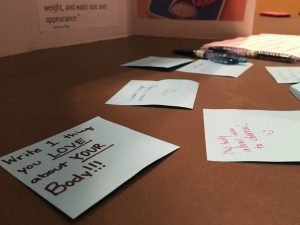 Because they are encouraged to subscribe to patriarchal standards of “masculinity,” many men are imprisoned by society’s definition of “healthy.” Harrison Pope argues in his book Rise of the Adonis Complex, “Over the last three decades, the Adonis Complex has spread dramatically among boys and men, and more and more men are struggling to improve their appearance in one way or another.” This obsession men experience with body image echoes Harrison Pope’s study, which reported “95% of college-aged men being dissatisfied with some part of their bodies.” Muscle dysmorphia and other disorders of the health/wellness world need to be more widely recognized in order to make effective and valuable changes.
Another voice seeking to define which bodies should be loved and which should be shamed comes out of the medical world. Fat studies scholars like Marilyn Wann and Deb Burgard argue that the unrealistic and scientifically false standards of “health” set up by health and wellness industries are perpetuated by members of the medical world through measures like BMI. BMI, or Body Mass Index, is one of a variety of “ideal” weight charts used by the federal government to mandate who is healthy and who is not. The problem with BMI is that it is too simple, and does not account for the full range of human diversity, especially in children. BMI works by juxtaposing height and weight to create a n
umber from 12-42. The oversimplification of the incredible varieties of the human body leads to the “medicalization of human diversity,” which “ inspires a misplaced search for a ‘cure’ for naturally occurring difference. Far from generating sympathy for fat people, medicalization of weight fuels anti-fat prejudice and discrimination in all areas of society” (Wann xiii). Medical professionals who seek to determine patient’s achievement of “good health” based on flawed scales like BMI contribute to the chorus of voices that say, falsely, that our bodies are too fat, not muscular enough, too short; basically, that our bodies are incorrect. We still need to seek advice from medical professionals; there are men and women who have completed years of training in order to help us live our best lives. Through this project, we discovered the importance of seeking medical professionals who understand and appreciate the diversity in human bodies and also encourage us to seek out a truly healthy lifestyle (in every sense of the word).
Works Cited
Rocamora, Agnès. “Personal fashion blogs: screens and mirrors in digital self-portraits.” Fashion Theory. Vol 15, No. 4, 2011.
Wann, Marilyn. Foreword to the Fat Studies Reader, by Marilyn Wann, xxi-xxvii. New York: New York University Press, 2009.
“Why Postpartum Depression is a Feminist Issue”
http://www.huffingtonpost.com/maureen-shaw/why-postpartum-depression_b_5980276.html
Continuing the conversation we had in class yesterday, I found this article in the Huffington Post that serves as an affect perspective about postpartum depression and how our society fuels the continuation of this social pressure onto new mothers. As this article states, motherhood is already highly politicized and therefore the public is weighing in on their opinions of “what a mother should truly be.” Postpartum depression is increasingly becoming a talking point, along with conversations about rape and the wage gap, but the issue could be more talked about.
Textbooks: The Dangers of Language and Misrepresentation
Our assignment for class today (4/26) was to “Browse articles from Against Equality; Feministing; and Wear Your Voice. Pick one that relates to something that [we] learned in GSS 101 for the very first time, particularly an idea that surprised [us], led [us] to shift [our] understanding of some aspect of our world.” I wasn’t able to be in class today because I am very ill (posting from my bed, tbh) but, I wanted to share with y’all an insight that I had. I was really intrigued by the Emily Martin reading “The Egg and the Sperm: How Science Has Constructed a Romance Based on Stereotypical Male-Female Roles.” So fascinatedin fact, that I decided to write my WRI 101 final paper on gendered language in textbooks for entry level courses. Thus, when I was looking for an article on one on the above three websites to disscuss in class, my attention was caught by an article entitled “THE BATTLE TO REPRESENT MARGINALIZED HISTORIES IN CALIFORNIA TEXTBOOKS.” In this article author Reina Gattuso describes how “conservative Hindu-American groups are attempting to push a number of edits into California’s public school history teachers’ guides. These edits contest the use of “South Asia” for pre-Independence India and minimize the role of caste injustice and gender injustice in Indian — and specifically Hindu — history” (1). Although not gendered language, this is another example, just like Martin’s writing, of how disenfranchised groups are being harmed by the language and content of textbooks.
P.S. If y’all want any information on other examples of gendered language in textbooks, I’d be happy to share some of my research with you!
http://feministing.com/2016/04/19/the-battle-to-represent-marginalized-histories-in-california-textbooks/
The North Carolina “Bathroom Law”

In Riki Wilchins writing of “Queer theory, Gender Theory”, he introduces the history of struggle for the transgender community and the meaning behind their emergence and activism. He outlines 2 important bullet points summarizing the difficulties that the transgender community faces in society, but for this post I will focus on the second point that he makes, which is “Second, for most people, crossing gender lines is still a source of shame, and not something to be claimed, especially as a basis for identity.” At the moment this topic of transgenders feeling shamed is particularly relevant with the passing of the House Bill 2, the Public Facilities Privacy & Security Act, which puts in place a statewide policy that bans individuals from using public bathrooms that do not correspond to their biological sex. I recently found an article on BuzzFeed written by a trans-woman who wanted to challenged the new “Bathroom Law”. She posted on Instagram a picture of herself in a bathroom with the following caption, “Here i am using a women’s restroom in North Carolina that I’m technically barred from being in. They say I’m a pervert. They say I’m a man dressed as a woman. They say I’m a threat to their children. They say I’m confused. They say I’m dangerous. And they say accepting me as the person I have fought my life to be seen as reflects the downfall of a once great nation. I’m just a person. We are all just people. Trying to pee in peace. Trying to live our lives as fully and authentically as possible. Barring me from this restroom doesn’t help anyone. And allowing me to continue to use this bathroom – just without fear of discrimination and harassment – doesn’t hurt anyone. Stop this. We are good people.” She does a wonderful job of fighting for the rights that she deserves. As citizens of a great country that prides itself on freedom and justice, everyone should have equal access to this freedom and justice. This BuzzFeed article highlights the discrimination that trans people feel, which Wilchins talks about in “Queer theory, Gender Theory”.
Abortion: A Cultural Taboo

In a New York Magazine article, 26 brave women share their stories of aborting their child. The article shares some shocking statistics saying, “abortion is part of our everyday experience. Nearly half of all pregnancies are unintended; about half of those—1.2 million—will end in abortion each year.” If abortion is so relevant to our everyday lives, and apparently occurs so frequently, then why do we never hear stories concerning women’s abortions? This is because women are shamed if they admit to having one, or at least parts of society will shame them. The article shares these stories in an attempt to normalize abortion and show that “normal” women can have unwanted pregnancies and that ultimately it is there right to do what they want with their bodies. These stories reminded me of when we read “How It All Began: I Have Had an Abortion”. This was written by a woman who chose to remain anonymous, which further proves how taboo of a topic it is. In the piece she writes “The courage of these women was enormous. No one can imagine today what it meant to admit to an abortion at all, not to mention a public confession.” Although it may be easier to admit to an abortion in contemporary times, I would still argue that it takes a significant amount of bravery. This piece touched on how shameful women feel by society when they decide to actively take control of their own body. I am not totally sure about where I stand on abortion, but I do respect these women’s stand for protecting their reproductive justice.
The Benefits of Marriage for Men

In a recent article written in ask.men, it discusses the Top 10 Reason’s for a man to get married. Interestingly enough reason #5 was Financial Benefits. The fact that financial benefits was prioritized as high as #5 on the list further proves how “marriage has become the central legitimating institution by which the state regulates and permeates people’s most intimate lives”, like Warner said in his writing of “Trouble with Normal: Sex, Politics, and the Ethics of Queer Life.” Other scholars like Polikoff argue for marriage to only hold importance in a social, religious, or cultural settings rather than an economical state as well. As Polikoff wrote, “It is possible to envision family law and policy without marriage being the rigid diving line between who is in and who is out. Keeping the state out of marriage entirely making marriage only a relies, cultural, spiritual matter, would be one way to accomplish this.” As they argue, if marriage did not come with health and financial benefits then it would discriminate less against those who do not wish to get married or those who believe in different types of relationships. Even ask.men understands that marriage is not solely based on love or mutual romantic feelings, but that there is actually more at stake, like financial benefits. This increase in other benefits causes those who do not believe in marriage to be at a significant disadvantage in life. Although it would be difficult to allocate advantages in a manner that did not include marriage, I completely agree that it would lead to a less discriminatory society.
The Story of the Aggressive Egg

I found the Emily Martin reading of “The Egg and the Sperm: How Science Has Constructed a Romance Based on Stereotypical Male-Female Roles”, to be fascinating. Martin’s work looked at analyzing how science has been a victim of using stereotypical feminine/masculine qualities to describe the process of reproduction. Martin believed that “One clear feminist challenge is to wake up sleeping metaphors in science,particularly those involved in descriptions of the egg and the sperm” and that once we wake up the sleeping metaphors we can finally neutralize our social conventions about gender. Upon reading it I went to Google and started searching for more examples of how the egg is only described in stereotypical feminine terms, while the sperm portrays stereotypical masculine qualities. When doing this I of course came across several examples of what Martin was discussing in her writing, but I also came across an article written in Discover Magazine analyzing Martin’s work. In the Discover Magazine article, “New Theory on How the Aggressive Egg Attracts the Sperm”, David Freedman examines the claims that Martin has made and how they are changing the way people view the process of reproduction. In his opening paragraph he provides an example for how a textbook may describe reproduction through an Emily Martin lens saying, “First, a wastefully huge swarm of sperm weakly flops along, its members bumping into walls and flailing aimlessly through thick strands of mucus. Eventually, through sheer odds of pinball-like bouncing more than anything else, a few sperm end up close to an egg. As they mill around, the egg selects one and reels it in, pinning it down in spite of its efforts to escape. It’s no contest, really. The gigantic, hardy egg yanks this tiny sperm inside, distills out the chromosomes, and sets out to become an embryo.” My first reaction to this was that he was grossly over-exaggerating the situation and going too an extreme. But after looking at other examples in textbooks I realized that this was not that overly-exagerrated compared to some of the descriptions that I have read in favor of the active sperm and passive egg. I find this all so fascinating because reproduction is such a big biological subject and the idea that it can be tainted so easily and so silently with stereotypes is crazy to me! Science should almost be the most unbiased subject, yet it has been polluted by social stereotypes that causes it to completely change the meaning/understanding of the process.
Reproductive Justice for Women of Color

Reproductive justice is a battle women of color have been fighting for a significant amount of time. In order to fight for these rights, women of color have created several different organizations and groups. I recently came across one group in particular, Voice of Our Own, which is a Nationally recognized group whose agenda is fighting for and raising awareness for the reproductive justice for women of color. This organization clearly reminded me of our reading of Jael Sillman’s “Women of Color and Their Struggle for Reproductive Justice”. In this piece the struggle for women of color is summarized by saying, “the external challenges confronting communities of color and constraining their reproduction are — population control, sterilization abuse, unsafe contraceptive, welfare reform, the criminalization of women who use drugs and alcohol during pregnancy, and coercive and intrusive family planning programs and policies.” The website for Voice of Our Own outlines their mission statement saying it is “to amplify and lift up the voices of Black women at the national and regional levels in our ongoing fight to secure Reproductive Justice for all women and girls.” They take pride in fighting for 4 rights in particular 1) Abortion Rights 2) Contraceptive Equity 3) Reproductive Justice 4) Comprehensive Sex Education. I perused this website for awhile and loved the balance of fighting for equality, while also stressing education as another way to reach equality. As a current student, I easily see the importance of education and the impact that it has on the way I think and the way I act. I believe that this initiative to educate is not only unique, but incredibly important for the growth and success for reproductive justice for women of color.
representation
I saw this video on buzzfeed and it reminded me of our discussion way back in the beginning of the year when we read Rich’s “Compulsory Heterosexuality and Lesbian Experience.” The video highlights how underrepresented the LGBTQ+ community is in media and how rare it is to see and an LGBT character in a starring role. In the video one of the men talks about tokenism and how just having one minor LGBT character in a movie/tv show is not good enough representation. Actually seeing the these recreated movie posters transformed really makes me hope that in the future there will be more main LGBT characters with authentic story lines besides the “gay best friend” trope.
http://www.buzzfeed.com/mathewjedeikin/lgbt-people-recreate-iconic-movie-posters#.hfKVkDNoQ
Marriage Equality: “Nothing changed, everything changed”
Emily McGaughty describes in “Nothing Changed, Everything Changed: How Marriage Equality Strengthened my Marriage” how the recent Supreme Court ruling in many ways was unimpactful for her and her “partner” (the two considered themselves married after having had an unofficial wedding in 2013). Long before their 2013 ceremony, the two had felt all the gravity of a lifetime commitment, so the “heart and soul” of their relationship didn’t change with the ruling. But their decision to get legally married the day of the decision changed their lives in many legal ways, including tax and insurance benefits. Though it’s wonderful that they and all gay couples can now be legally married, it is problematic that the state must still put a stamp of approval on human relationships to determine which ones are suitable for exclusive benefits. Nancy Polikoff proposes rectifying this issue through “valuing all families,” a clever twist on the “family values” espoused by conservatives. Generally, gay marriage advocates “[did] not say that “special rights” should be reserved for those who marry” (p. 7). Although gay marriage has since been legalized, the problem still remains that not all family structures do or should include marriage, and it is exclusive and socially-unhealthy to discriminate against unmarried couples and families when providing certain benefits. Were marriage not the only path to certain important rights, its importance would diminish, and valuing all families would occur.