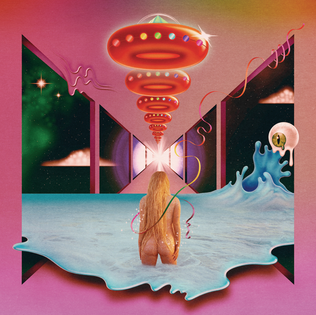
Feminist Mixtape: *He Thinks He’ll Keep Her* by Mary Chapin Carpenter

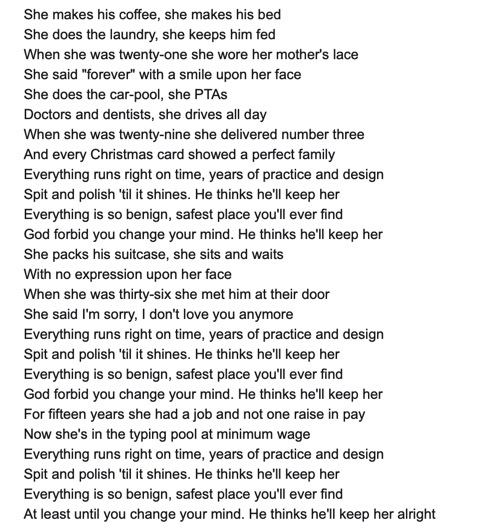
Mary Chapin Carpenter is an American rock, folk, and country music singer-songwriter who signed in the late 1980s with Columbia Records, who promoted her as a country singer. One of her most famous songs is her 1992 hit, He Thinks He’ll Keep Her. This song is widely credited with illustrating the salvation of a woman freeing herself from the traditional atomic family into the workplace. The song begins by documenting a few items that make it evident that she is a housewife – one who appears to do everything for her husband. For example: making his coffee, his bed, doing his laundry, and keeping him fed. Following a few of these examples, the verses, “When she was twenty-one she wore her mother’s lace and said “forever” with a smile upon her face,” briefly touch on the “norm” of marriage as something that is supposed to happen when coming of the right age. The lines that come after continue to paint the picture of outdated stereotypical gender roles: taking care of the kids; putting on a surface front that portrays a perfect family despite her unhappiness that is prevalent in this song; and her keeping everything in line and on time like clockwork. The line, “He thinks he’ll keep her,” is inserted occasionally at the end of some verses, alluding to the strength that she will eventually find to leave the husband that takes her for granted and confines her abilities. This does indeed happen and there is a shift when she talks about being thirty-six and finally putting her foot down to leave him. One line that I think carries a lot of weight is “for fifteen years she had a job and not one raise in pay, now she’s in the typing pool at minimum wage.” I feel these verses highlight the difficulty of working hard for many years without any sort of compensation other than a rabbit-hole of a comfort zone that can seem extremely terrifying to leave. More importantly, she does in fact leave and even though she is starting from the bottom, she is slowly working to make her own way. 

This can be tied back to a few of the readings we did in class. For example, in Towards Equality, it highlights that marriage and motherhood should not be disabilities for women and in this song – it is very clear that the duties being performed by the woman are constraining both her happiness and ability to go out and do things for herself. Additionally, in Our Bodies, Our Selves, it emphasizes choice over destiny and I feel like this relates back to women being not properly educated about their bodies and having children that they did not necessarily want or getting married simply because that is what “everyone” did by a certain age. In a similar way, The Feminine Mystique, discusses that housewives feel trapped within themselves and their own minds – convincing them of the falsehood that motherhood and marriage is all that life has to give them. In this song, it isn’t until she leaves her husband that she finds her own life and what she wants. 

The song, however, does have specific limitations as a representation of feminisms broadly constructed. For example, her limited scope of just female and male relationships excludes the LGBTQ community and it implies that the type of situation being described in the song only occurs between heterosexual members of the community.

“Mary Chapin Carpenter – He Thinks He’ll Keep Her.” Genius, https://genius.com/Mary-chapin-carpenter-he-thinks-hell-keep-her-lyrics. 
Feminist Mixtape: *Sisters Are Doin’ It For Themselves*

Music Video for “Sisters Are Doin’ It For Themselves” by Eurythmics feat. Aretha Franklin

In “Sisters Are Doin’ It For Themselves,” Eurythmics and Aretha Franklin come together to express women’s liberation and empowerment through the art of music. The song starts off strong with, “Now there was a time/When they used to say/That behind every great man/There had to be a great woman/But in these times of change/You know that it’s no longer true/So we’re comin’ out of the kitchen” (0:13-0:38), demonstrating not only the power of women but also the unison of a white woman and a black woman combatting the patriarchy together.

Unlike Betty Friedan’s white, middle-class centric views, Aretha and Annie Lennox (Eurythmics’ lead singer) join forces in this feminist song to empower women and demonstrate that women are capable of “doin’ it for themselves.” I believe this song captures bell hooks’ ideal version of feminism and can be related to second wave feminism. The addition of Aretha to this song strengthens its message because it adds the perspective of a black woman to the conversation, and the song is not focused on an issue that only affects white, middle-class women; the song is focused on liberating women and acknowledging their power as women, including women from different cultures.

The harmony created by Aretha and Annie is amazing, and the music video that accompanies this song does not focus on one sole type of woman; there is a focus on all women and their successes, but the spotlight is still focused on white woman in the beginning of the video. However, I like how Annie collaborates with Aretha to make the world aware of women’s strengths across different cultures and perspectives. This reminds me of bell hooks, especially when she says, “Had middle-class black women begun a movement […] no one would have taken them seriously,” and she continues, “[t]his was not the case with white bourgeois feminists, for they could appeal to a large audience of women like themselves who were eager to change their lot in life” (bell hooks 7). This song incorporates a black woman’s voice, and Annie does not overshadow Aretha; she uplifts her, incorporating Aretha’s voice into the conversation through music. There is a mixture of perspectives, but they are brought together with the idea of women’s liberation. Annie seems to be using her whiteness to bring awareness to the issues all women face, the opposite of Betty Friedan and taking into consideration bell hooks’ advice and criticism of Friedan.

In conclusion, Annie and Aretha created an empowering piece for all women, taking into consideration the women from different cultures and focusing on empowering women instead of focusing on a particular issue that only certain women deal with. The inclusion of black women in the music video and song is showing the power of women when they are united and not divided.

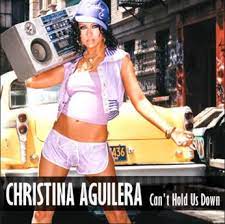
Feminist Mixtape: *Can’t Hold Us Down* by Christina Aguilera

Can’t Hold Us Down by Christina Aguilera

Christina Aguilera is a strong feminist icon. With countless songs regarding feminism and female empowerment, Christina Aguilera consistently emphasizes the importance of respecting women in society. The song Can’t Hold Us Down by Christina Aguilera was released in the year 2002 which was shortly after the third feminist wave that occurred during the 1990s. In the song, she focuses on the double standards pit against women in contrast to men as well as the restrictions women face due to their silencing authorized by men and society.  

In the beginning of the song, Aguilera sings “Should I keep quiet just because I am a woman”. This line presents the familiar idea of silencing women and the assumptions that a woman’s word has no value. This idea is not only seen between the exchange of men and women on a daily basis, but it was and is also seen within the cultures of third world families as was discussed in Uma Narayan’s Contesting Cultures. In Narayan’s piece, she mentions how she was taught that “good daughters hold their tongue”, and this phrase alone embodies the circulated idea of women’s silencing in all aspects of a woman’s life (Narayan 398). In regards to Aguilera questioning that she should keep quiet because she is a woman, she later sings “Take a deep breath and say it loud”. This phrase inspires woman that listen to the song to voice their thoughts and opinions because they simply have the right and should not have any fear.  

Later on in the song, Aguilera sings “The guy gets all the glory the more he can score, while the girl can do the same yet you call her a whore”. These two lines in the song are powerful because it exemplifies the double standard between men and women presented in our world. It raises the question of why should men be able to do one thing while women are shamed to do the same? Aguilera wants to declare how this idea is a problem and her call to action comes when she sings “All my ladies come together and make a change”. 

One main critique of Christina Aguilera’s song is her fail to include and mention the LGBTQ community. Her consistent usage of male and female relations makes the assumption that these acts of silencing and double standards only occur to heterosexual members of the community and exclude other prominent relationships between transmen/women.  

Overall, Can’t Hold Us Down presents circulated ideas and focuses regarding the feminist community and calls for female empowerment and confidence.  

Feminist Mixtape: “You Don’t Own Me” by Lesley Gore

During the height of second wave feminism in 1963, singer and composer Lesley Gore released her feminist anthem, “You Don’t Own Me”. As indicated by the title, Gore’s song is a call to men to stop trying to control women, as well as a sign of encouragement to women to live their lives the way they want to.

Gore sings, “I’m young and I love to be young/I’m free and I love to be free/To live my life the way I want”. She is claiming autonomy over her life, her body, and her choices as a young woman, as well as finding freedom from male control. This message is similarly echoed in Our Bodies, Ourselves (1973), which highlights the transformation of women being controlled by patriarchal and sexist societal roles to learning from one other and finding freedom in their shared experiences. Second wave feminism largely focused on women’s rights and equality, fighting against the expectation of women to follow the “rigid role of wife-and-motherhood from the moment [they are] born female” (Boston Women’s Health Book Collective 297). During the 1960s and 70s, many women felt freedom from this expectation as they learned other women did not desire pregnancy and had the power to “take control of [their] bodies and [their] bodies’ needs” (Boston Women’s Health Book Collective 296).

Gore advocates for this stance in “You Don’t Own Me” when she sings, “I’m not just one of your many toys” and “don’t tell me what to do/don’t tell me what to say”. She rejects the notion that men can treat their romantic partners as “toys,” signifying that she will not allow men to control her words and behaviors in her own life as they might control a toy in a game. Gore clearly refuses the traditional role of women as reproducing mothers and housewives when she says, “Don’t tie me down ‘cause I’d never stay”. Gore’s opposition to being tied down, perhaps to both one man and one role (being a housewife), is reflected in Betty Freidan’s The Feminine Mystique, also published in 1963. Friedan explains that housewives feel trapped due to the “chains in [their] own mind[s] and spirit[s]”, metaphorically tying them down to the incorrect belief that motherhood is all that life has to offer her (Friedan 277). Both Friedan and Gore encourage women to discover their needs, abilities, and passions, or as Gore sings, “just let me be myself” and “say and do whatever I please”.  

Furthermore, Gore instructs men: “And please, when I go out with you/Don’t put me on display”. Throughout history, women have been held to unrealistic standards of beauty. Gore does not want to be “displayed,” or boasted and shown off to other men based on her looks. She implies that this action not only ties her down but prevents her from being her most authentic self. Similarly, in Our Bodies, Ourselves, the authors assert that a woman cannot be her best self when “she drains her energy trying to change her face, her figure, her hair, her smells, to match some ideal norm set by magazines, movies, and TV” (Boston Women’s Health Book Collective 298).

It is important to consider how Gore frames several of her lines. Although she often uses commands, she does include “please” and “that’s all I ask of you” in her song. Her ask for permission from men to be herself slightly weakens this feminist message. “You Don’t Own Me” also focuses on heterosexual relationship, which Gore indicates when she sings, “Don’t say I can’t go with other boys”. Thus, her song may not appeal to the audience of women with diverse sexual orientations. This is quite interesting given that Lesley Gore was a lesbian herself (“Lesley Gore” Wikipedia). Regardless, Gore created a powerful, feminist song in the heat of second wave feminism that has remained popular to this day.

Feminist Mixtape: ‘Like a Girl’ by Lizzo

Like a Girl by Lizzo is absolutely one of my favorite songs of all time, and is a great representation of all that we have discussed within GSS-101.

To begin, this song (and many of Lizzo’s songs) is a complete rejection of gender norms that exist within our society. Lizzo owns her identity and makes it clear that she is in control of her life throughout the song. For example, at the beginning of the song, she talks about running for president, and adding “a little estrogen” into the Executive Branch of the US government. Unfortunately, our society has normalized male domination within the government, and so Lizzo’s intervention is a clear rejection of gender norms.

Thinking beyond gender norms, one might claim that this song is rejecting the social constructs of gender and sexuality as a whole. Moreover, throughout the song, Lizzo’s dominant and powerful energy combined with her description of how she likes to live her personality is so authentic and does not conform to many aspects of gender. While it is oxymoronic that the song is titled Like a Girl, and throughout the song, Lizzo says that she is “working [her] femininity,” I would argue that she is attempting to expose the flaws of the social construct of gender, and that she is her own person and others should follow in her suit.

On another note, this song is incredibly sex positive. At one point, Lizzo references masturbation and self-pleasure when she says, “buy my whip by myself.” This representation of self-pleasure and self-love is powerful because through this, Lizzo demonstrates the importance of individuality and respect for other people.

In conclusion, Like a Girl is an amazing demonstration of what it looks like to love and accept oneself while authentically sharing who one is with their society. Everyone go listen to it!

Feminist Mixtape: “Woman” by Kesha

Rainbow by Kesha

Kesha is no doubt a cultural icon and one of the most notable artists of our generation. Kesha’s studio album Rainbow made the headlines for its themes on forgiveness, self-worth, and female empowerment. “Woman” by Kesha falls directly under this category of female empowerment by emphasizing the importance of women’s independence. “Woman” has become a feminist anthem with its emphasis on liberation from patronizing attitudes as well as economic freedom, two elements that liberal feminism encompasses. 

Kesha begins “Woman” by telling those around her to “be serious” and “shut up” (Kesha 0:00-0:04). The act of telling others to be serious or shut up may have been a controversial decision, as women are socialized to not be outspoken or direct. However, by starting “Woman” with the attitude that she’s in charge, Kesha already sets the tone for the rest of the song. 

Kesha then lists a series of items she’s bought with her own money: she pays her own bills, she’s bought “these diamond rings,” she owns “automobiles,” etc. (Kesha 0:07-0:13). Kesha then explains that she buys what she wants because she “work[s] real hard every day” (Kesha 0:27). This notion is commenting on traditional gender roles, especially situated in American history which places men as breadwinners and therefore the ones in power. However, women are as capable as working hard and generating wealth, Kesha’s main theme of the song. 

Kesha then moves into the chorus: “I’m a motherfucking woman, baby, alright / I don’t need a man to be holding me too tight” (Kesha 0:29-0:34). By tying womanhood around economic independence and, specifically, independence from men, “Woman” embodies liberal feminism. Liberal feminism focuses on the individual and empowerment within oppressive systems such as capitalism. Betty Friedan’s The Feminist Mystique highlights this concept by describing the typical suburban woman and her dissatisfaction with “the domestic routine of the housewife” (Friedan 277). Rather than dismantling the system, Friedan opts for women to “look for jobs equal to their actual capacities” and for the government to provide more education for women (Friedan 280). While this concept may seem outdated, it’s very similar to Kesha’s message that a working woman is a free woman. However, working women are still alienated from their labor, eliciting the question of if working women are truly free. Specifically related to Kesha, I’m sure much of her profits go to her recording studio, her manager, etc. rather than directly into her bank account. 

The bridge of “Woman” repeats a couple of notable phrases. First, she sings “don’t buy me a drink, I make my money,” continuing the theme of liberal feminism and the expectation that women don’t have their own capital (Kesha 1:45-1:48). This line also comments on the expectation that men should pay for women’s dinners or drinks, a gender norm rooted in stereotypes about who has the ability and power to pay. Then, she sings, “don’t touch my weave, don’t call me honey” (Kesha 1:48-1:50). This line touches on patronizing attitudes many women (and specifically women of color) face from men. Although people of all races wear weaves, black women most notably face discrimination and micro-aggressions regarding their textured and thick hair. 

My main criticism of “Woman” is that Kesha ties womanhood to capitalism despite capitalism being an oppressor to women as well. Not only do unjust laws such as the wage gap or unpaid maternity leave disproportionately affect women (and women of color), the system of capitalism was built for the subjugation of all people. Furthermore, Kesha centers womanhood around men, but I believe that womanhood should be situated around the narratives of and love between women. Nevertheless, you will still find me loudly belting “I’m a motherfucking woman” as I grapple with my own beliefs about womanhood and feminism.

Feminist Mix-tape: “Girls in the Hood”

Since gaining massive popularity and consistently increasing her fanbase over the last few years, Megan Thee Stallion is transforming the genre of rap through the incorporation of feminist ideology within her song lyrics while displaying how the racially charged controlling image of the Jezebel still persists today. Through her explicit lyrics in the majority of her songs, she confidently discusses her sexuality while empowering other women to do the same. Specifically, in her song “Girls in the Hood,” she refuses to appease the fragile male ego by voicing “You’ll never catch me callin’ these [guys] daddy (nope). I ain’t lyin’ ’bout my nut just to make a [guy] happy.” Megan encourages women to demand pleasure from sex while crushing the taboo surrounding the sexuality of women at large. However, her assertive compositions working against misogyny within the music industry is certainly not immune from controversy. Many people apply the controlling image of the Jezebel, a concept discussed by Patricia Hill Collins in her work Controlling Images and Black Women’s Oppression, to Megan Thee Stallion in response to her song lyrics and overall confidence. This controlling image of the Jezebel, stronger than just a stereotype, represents a “whore, or sexually aggressive woman [and] is central in the nexus of elite white male images of Black womanhood because efforts to control Black women’s sexuality lie at the heart of Black women’s oppression” (Collins 271). Labeling Megan as a Jezebel attempts to continue the music industry’s long history of misogyny and racism, as well as counter the massive influence she has over the public through her songs like “Girls in the Hood.” This example of the placement of racially charged controlling images on Black women is an issue womansim, essentially Black feminism, confronts that white feminism usually fails to acknowledge (Duke University). But despite this projection onto Megan and the overall pushback her work receives, she continues to encourage the empowerment of women, especially related to sexuality, and transform the general messages promoted by the music industry.