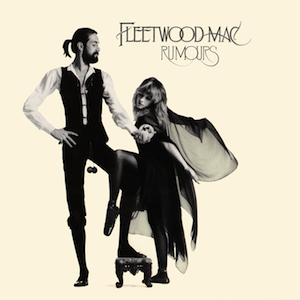
It’s been almost 50 years since the release of Fleetwood Mac’s Rumors (1977), but this album is still as popular as ever. From song versions sung by the Glee cast to a viral TikTok trend involving cranberry juice and “Dreams,” teenagers and adults alike fangirl over this influential record. They live for the drama, the ethereal energy, and the tack piano. But why, oh why, is there a pair of balls dangling between Mick Fleetwood’s legs, and who draped Stevie Nicks across Fleetwood like a damsel in distress? This blog post is an analysis of the album cover to Fleetwood Mac’s magnum opus and what it says about power dynamics between genders.
If you’ve ever watched Superman, you know how much power superheroes exude solely from their stances. On the Rumors album cover, Mick Fleetwood stands tall and proud, one foot resting on a stool. His chest is proudly stretched, and his hand rests firmly on his hip. He’s set in place, grounded as he holds a crystal ball. On the other hand, Stevie Nicks is anything but steady. Her body is positioned closer to the floor, and her arm flexes behind her as if she’s turning (or possibly falling). She lacks balance, utilizing Fleetwood’s leg for support. At first glance, their stances are nothing to consider. However, this contrast of poses creates a clear power dynamic between Fleetwood and Nicks: Fleetwood is an object of power while Nicks floats along with little structure, reliant on Fleetwood’s body. These same power dynamics have dominated modern-day family and economic systems. During the 1950s, the cult of domesticity established the prevailing trend of male breadwinners. Even today, men are still seen as financial providers and political leaders of whom women are in desperate need.
Along with posture, the juxtaposition of masculinity and femininity is apparent in Nicks’ attire. Nicks dons a black flowy shawl and is dressed as Rhiannon, the Welsh witch known from the song of the same name from Fleetwood Mac’s eponymous 1975 album. Throughout history, witches have been one of the most widespread images of female empowerment and resistance to patriarchal norms. Persecution of witches has existed as early as the creation of the Bible; the witch trials in The United States (most famously Salem, Massachusetts) and the United Kingdom merely dispersed witch hysteria throughout the world. Witch hunts often punished powerless women who were on the fringes of society: women of color, women that spoke against the man, outwardly sexual women, etc. Essentially, women – generally speaking, people – that didn’t conform to expectations set by society and the patriarchy were susceptible to being charged with witchcraft. Witchcraft’s connection to the feminine is also apparent in a witch’s connection to nature. While nature isn’t necessarily feminine, much of the discourse around women and motherhood connects to the Earth. Furthermore, women and the Earth alike have been subject to much exploitation, oppression, and destruction. Witches communicate with these forces of the environment, blurring the line between humans and nature. Now, what does this have to do with Stevie Nicks or Rumors? For much of the ‘80s, tabloids and haters alike speculated that Stevie Nicks was a witch. Rather than run from these harrowing accusations, Nicks embraced the identity – she embraced Rhiannon. Nicks even appeared on American Horror Story as the “White Witch.” She became this mystical, feminine icon in the male-dominated genre of rock, a “fuck you” to both the industry and patriarchy. This begs the question: if Nicks is a model of feminine power, what does the Rumors album cover say about the relationship between man and woman? Why is Fleetwood holding a crystal ball, Rhiannon’s median of art? Has he taken it, are they sharing it? Why is Fleetwood towering over Nicks, positioned as if he’s Captain Morgan overpowering the feminine? Is he part of the witch hunt? Expanding on the analysis of their gender dynamics from their posture, the cover art suggests an imperial conquest of wild and unruly women, i.e., witches.
The last narrative piece that brings this analysis full circle is how Fleetwood himself is accessorized: with a pair of balls that hang below his pelvis. Why is it so crucial that Fleetwood reminds not just Nicks but the listeners (and therefore the world) of his genitals? The answer to this question is simple. He wants everyone to remember that he has balls. He wants his power as a man – as a person with a penis and testicles – to be known. We live in a world where power systems predominantly benefit those with one set of genitalia, so images related to testicles or phallic symbols can also be correlated to potency and strength. Today, we see phallic imagery in areas related to power, such as swords, rockets, skyscrapers, and cigars. These images create a subconscious association in our minds with hegemonic masculinity, a constant reminder of who and what is in charge. Similarly, Mick Fleetwood’s balls generate a reminder of his position in society and in relation to Rhiannon.
Does this mean you should stop listening to the silky melodies of Fleetwood Mac? Absolutely not – I’ll always need my daily dose of Stevie! However, you should study and recognize the many messages the cover art delivers. Rumors has one of the most recognizable album designs of all time, so dissecting images that circulate pop culture is vital to understanding the social contexts in which we live. That being said, the next time you add “Songbird” to your Spotify queue, analyze the different stories hidden within the album cover and question any resemblances to your own relationship to gender and power.
Written by Anaya Patel with Autostraddle
Oh my gosh, I absolutely love your analysis of this album cover. For me, Rumors has always been an album to listen to in the car, when I have nothing else to listen to, or to having playing at my job. I never thought about it this way, especially because I never noticed the pair of balls (it’s not very subtle either). I think the connection you made to Stevie Nicks and Rhiannon is so true, especially because the ethereal portrayal of her on the cover fits with many of the songs and her vocal style (especially in Rhiannon, Dreams, and many other songs). I like how while it is present as a “fuck you” to classic rock, the power that she holds can so easily be taken away with the placement of one small item (Fleetwood holding the crystal ball). So interesting how male power structures take hold in such subtle areas!