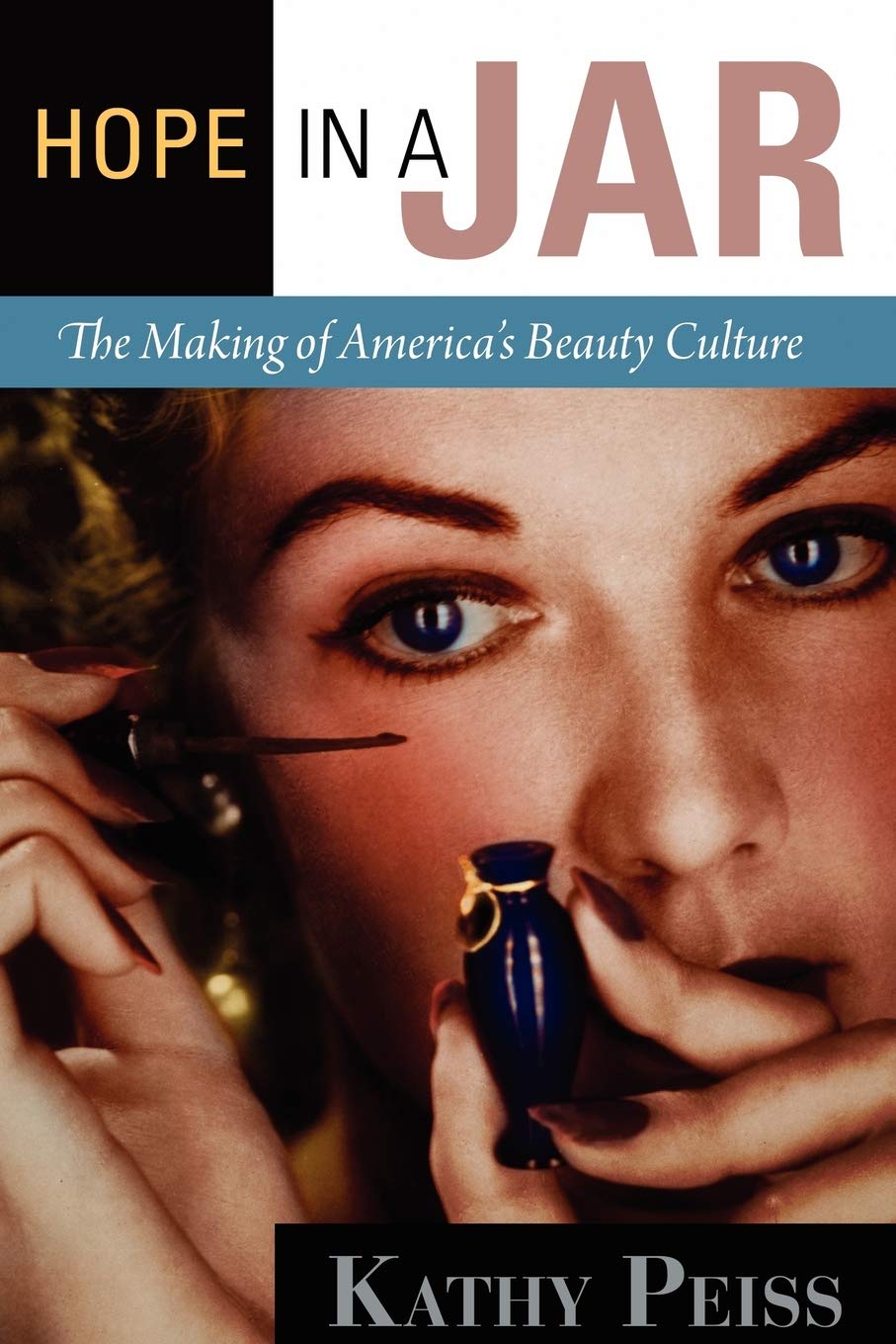
Beauty in American culture has been constructed around an accepted norm or a set-standard of what makes someone desirable and beautiful. Overtime, cosmetics have become deeply intertwined with this beauty culture in America and it is no small industry – a $43.6 billion industry to be exact(1). The vastness of this industry has caused a lot of examination of beauty culture and cosmetics during the nineteenth and twentieth century and picking apart common misconceptions associated with the beginning of cosmetics. It has been a long standing assumption that the beauty industry was pioneered and dominated by males in order to sway women into a singular, confined definition of beauty, however, in Kathy Lee Peiss’s book, Hope in a Jar: The Making of America’s Beauty Culture, she demonstrates that this is not the case. Within this book, Peiss illustrates a beauty industry powered by women in the late 1800s and early 1900s – one where women owned the companies producing the cosmetics and one where women sold the cosmetics. Hope in a Jar: The Making of America’s Beauty Culture elaborates on two things that cosmetics gave women: opportunity for expression through make-up and employment for women.
As someone born during the baby boom and coming of age in the 1960s(2), Peiss watched as the judgments surrounding manufactured beauty changed with great speed. The meaning of cosmetics in relation to beauty standards, ideals of femininity, profit making, and politics remained difficult to pin-point. However, Peiss argues that beauty culture should be understood not only as a type of commerce but as a system of meaning that helps women navigate the changing conditions of modern social experience. Women dipping their toe in “modernity,” often placed them into a public space that was not always welcoming. In the history of beauty culture, there lies a web of intimate rituals, social relationships, and female institutions. Over decades, women have passed down the teachings of cosmetics to their children and in these little jars of makeup, lies a detailed history of women’s ambition, pleasure, and community.
Kathy Lee Peiss, born in 1953, is a well-known author and American historian. She received her Bachelor at Carleton College and her Master of Arts and Doctorate of Philosophy at Brown University. During her lifetime, she was an instructor at Rutgers University and New Brunswick, Canada from 1980 to 1981. Additionally, from 1981 to 1986, Peiss worked as an assistant professor at the University of Maryland and as an associate professor at the University of Massachusetts from 1986 to 1992. Since this time, she has continued to teach as a professor. Peiss has also been listed as a noteworthy History educator by Marquis Who’s Who. In 2011, she chronicled the purpose of cosmetics over time and the impact they have in regards to economic, sociological, and psychological aspects(3).
Peiss uses a mix of both qualitative and quantitative methods by developing her argument with participants and observations; first hand accounts of people’s experiences; and consumer surveys. Peiss begins her novel towards the end of the 19th century. During this time, cosmetics often contained toxic substances (i.e. lead) and were associated with “hussies” or prostitutes. In the introduction, she brings this up in the example of two lipstick shades named Lady and Hussy. The Hussy shade outsold Lady 15:1. Additionally, cosmetics were condemned by society saying that they created false needs, manipulated fears of the consumer, and raised superficiality over true substance. All this being said, Peiss makes sure to bring it back to the beauty business being largely built by women – some of the most successful entrepreneurs being immigrants, working class, and black women. The focused attention on face and figure paved the way for the pursuit of beauty to be acceptable and respectable. Transitioning into the early 20th century, women began to embrace cosmetics a lot more. However, advertising and social pressure to be “attractive” lowered self-esteem. In the first chapter, Peiss talks about an incident involving a 24 year old housewife who applied a commercial skin lightener who was admitted to the hospital and became paralyzed from the elbow down. This led to a focus on cosmetic preparation. Women were expected to be able to gather roots, distill essences, identify different herbs, and compound remedies for the skin. Many household manuals during this time included information regarding waters, oils, powders, and ointments meant to aid in the beautification of women. In this chapter, Peiss also discusses the origin of different cosmetics and beauty techniques. For example, indigenous plants were used to treat skin problems and methods like using crushed berries to redden cheeks were brought from Native Americans and West Africa. Moving on to chapter 2, Peiss describes the ideal beauty image as pale and because of this, white powder and skin lighteners became a big part of daily life for both white and African Americans, thus further propelling the aesthetic dimension of racism. Additionally, the rise of photography changed how people perceived their appearances. Portraits gave many people an idealistic version of how they looked – therefore, when people began to be photographed, they were not pleased with how they appeared. This resulted in the retouching of photos with painting or simply just wearing more makeup during photography sessions. Similarly, as photographs became more widely available, a domino effect was instituted: celebrities becoming beauty icons; celebrities using more makeup; the acceptance and consumption of makeup continually growing; and the cosmetics industry evolving into a commercialized industry. And of course, with the growth of a new “trend,” many opinions followed. Some people stood firm in their belief that painting was morally corrupt. Others sat more towards the middle, feeling that it was alright only if it was worn in a conservative fashion. Then on the other end, makeup was viewed by some as helping out the women who had not been blessed with “beauty” at birth. The key takeaway from this chapter is that someone painting their face moved from a trait of prostitutes and hussies to that of the “average” woman. During a time where it had been prohibited, chapter three centers on the transition of women into the commercial beauty industry. The Achilles heel of the beauty industry at this time was that it was a quiet industry. Many who used these products did not speak about their use of them in addition to wanting no one to know about their purchasings of them. However, in contrast to the women who were ashamed, there were the women who saw their own potential within the beauty industry. They saw an industry focused mainly around women as a place where they could get their foot in the door. Peiss drops a few names of entrepreneurs within the industry: Florence Nightingale Graham, Helena Rubinstein, Annie Malone, and Madam C.J. Walker. All were successful within their respective careers, however, their approaches were not all the same. Rubinstein and Graham sold their products in a more primitive “boutique” style, while Malone and Walker tried to market to everyday women. Transitioning onto chapter four, The Rise of the Mass Market, Peiss expands on the growth of the market for cosmetics following World War I. Between the years 1909 and 1929, the number of cosmetic manufacturers nearly doubled and their value rose exponentially. With this came a large scale system of mass production, distribution, marketing, and advertising that later transformed the initial patterns of buying and selling. The cosmetics industry transitioned to producing goods for national sale. Then, in promoting the Made-Up Woman, during the 1920s, mass produced images of glamorous screen stars, flappers, and beautiful women began to influence the fashionable ideal and beauty rituals. However, within this were racial divisions.The mass market’s democratic vision of beauty denied African Americans entry due to the unfortunate fact that white women were the target audience for national advertising. In Peiss’s sixth chapter, she talks about the beauty industry’s success in convincing their consumers that in order to fulfill individuality and femininity, one would need to purchase cosmetics. However, where information is pulled from is skewed due to its sources being limited to white middle and working class women. The use of cosmetics boomed in larger cities like New York and Chicago and came into play a lot later in smaller towns. Then, wrapping up in Peiss’s final two chapters, she discussed the white-dominated ideal “appearance,” and the weight that these powder and porcelain jars had in the war of cultural visions. Many black reformers and educators spoke out about the political meaning of appearance. The beauty industry increased the discontent of African Americans, gay activists, and feminists in regards to commercial exploitation by the long-standing beauty ideals.
One area in Hope in a Jar: The Making of America’s Beauty Culture, that Peiss really excels at is disproving the wide-spread assumption that the cosmetic industry painted women as the victim in its narrative. The history of beauty in America is often looked back upon as one where the women experienced shame and they were looked at as being on the losing side. Peiss’s greatest strength within her novel is combatting this misconception but in chapter 3, Peiss does an exceptional job of illustrating that the cosmetic industry resulted in both social and economic empowerment for women. Beauty was the catalyst that allowed women to break from the confinements that labeled working as taboo unless their social class truly depended on it. It is depicted and regarded as women viewing it as a way to get their foot in the door – it was something for them – specific to them. Peiss even uses accounts of four entreprenuers to further her argument regarding the doors that the cosmetic industry opened for them.
Overall, Peiss does a great job in her documentation and elaboration of the cosmetic industry in her novel – however, that is the only thing she focuses on. I would have loved for her to dive deeper into related areas since she alludes throughout the book to discussing beauty as a whole. This is not necessarily a weakness, but I think her writing could have been further developed and well-rounded by drawing parallels between fashion, plastic surgery trends, diet culture, and “ideal beauty.” The title of Peiss’s book is Hope in a Jar: The Making of America’s Beauty Culture, with emphasis on that second part: the making of America’s beauty culture. By Peiss only focusing on the wearing and history of cosmetics – I feel that it shadows other very important fields that are within the umbrella of beauty culture. More specifically, she could’ve addressed those other fields and made connections with the dangerous and sometimes unhealthy lengths people would go to in order to fall within the parameters of America’s beauty culture.
After reading this book, it is safe to say that my initial view of the history of the cosmetic industry has been broadened. I feel that this could be a really good book for college students or anyone wanting to look deeper into the history of the oppression of women or even just women’s beginnings in the workplace. I now see the opportunities that the industry gave to many women. However, I believe after reading this book that women were victims at times, victorious at times, and sometimes even the ones being the oppressors. This is a read I would love to revisit and draw deeper connections with other viewpoints after my completion of the GSS 101 course. .
(1) Manager, Jonas Sickler SEO. “Beauty Industry: Cosmetics Market Share, Trends, and Statistics.” Terakeet, 22 Oct. 2021, https://terakeet.com/blog/beauty-industry/.
(2) Peiss, Kathy Lee. Hope in a Jar: The Making of America’s Beauty Culture. University of Pennsylvania Press, 2011.
(3) “Kathy Lee Peiss.” Prabook.com, https://prabook.com/web/kathy_lee.peiss/639345.