The Burqa

While reading Lila Abu-Lughod’s study arguing about whether Muslim woman need saving or not, I remembered two pictures that I had recently come across.

indexwomen western-hypocrisy-e1403117669494

The first image reminded me of Abu-Lughod’s argument when she was referring to the burqa.  It is a common belief of those outside of the Muslim culture to believe that the burqa is a form of severe oppression, which is depicted in the first image as the burqa literally has prison bars running across the opening.  The second image continued to remind me of her argument, especially when she wrote, “as anthropologists know perfectly well, people wear the appropriate form of dress for their social communities and are guided by socially shared standards, religious beliefs, and moral ideals, unless they deliberately transgress to make a point or are unable to afford proper cover”.  Most people fail to see that the burqa is a piece of culture rather than oppression.  Westerners have learned to except other forms of conservative clothing (like in the images above) as culturally acceptable and respectable, but because the burqa is foreign; it is not understood and many do not take the time to understand the meaning behind it.  As Abu-Lughod said, “why are we surprised that Afghan women do not throw off their burqas when we know perfectly well that it would not be appropriate to wear shorts to the opera”.  This analogy summarizes what the image is saying perfectly, that the burqa raises the problem of “how to deal with cultural “others”, rather than how to protect/save these women from their own culture.

Continuation of the FGM discussion in class…

In my Introduction to Clinical Ethics class and Anthropology courses, we discussed and contrasted the ethnocentric and cultural relativism perspectives in Western society and in the medical clinic society. Although these courses recognize the cultural significance of FGM, there is a major concern for Western physicians who are asked to perform these procedures. Some physicians are for performing the surgery, because this allows women to be in a sanitary clinic with anesthesia and a better chance for less complications to occur. Without this practice in a clinic or other medical setting, many are afraid that women in the US will refer to “back alley” methods.

FGM is continued to be practiced in certain regions of the world, because as Lila Abu-Lughod said in “Do Muslim Women Really Need Saving? Anthropological Reflections on Cultural Relativism and Its Others,” women who are mothers continue to teach their daughters the acceptance of cultural traditions, like FGM, in silence.

Here are some interesting articles to read if you get the chance. The first link will take you to the WHO teaching methods for interventions in societies that promote FGM. The second link discusses the ethics behind FGM and the arguments for and against continuing the practice in western societies, especially in a hospital setting where the procedure can be sanitary and no complications can arise. These two articles can help put the cultural context into perspective and see the light of both ethnocentric and cultural relativism arguments.

http://www.who.int/gender/other_health/teachersguide.pdf

http://www.sciencedirect.com/science/article/pii/S0884217515335218


Body Painting Depicts Societal Pressure to be Skinny

https://www.youtube.com/watch?v=VKb12aDy0K8

In this video Jody Steel uses her talent with body painting to convey an important message to society about body image.  In this video Steel creates the illusion of her stomach being tied into a knot by and incredibly tight and restricting rope.  This rope binds her stomach, not allowing it to expand.  This video is meant to depict that way society “binds” the stomachs’ of women, causing them to believe that they must be thin/skinny in order to be accepted.  Although society causes women to believe this, this video shows just how aggressive and horrifying it is to put this sort of a restraint on women.  This video reminded me of the Jean Kilbourne TedTalk and her research on how society and the media has affected the way we perceive beauty and the way we treat our own bodies.  This societal pressure to be skinny in order to be beautiful is harmful and needs to be addressed.

Zara: Genderless Clothing Line

Screen Shot 2016-03-13 at 6.44.28 PM

The clothing company Zara is starting a movement to blur the lines of gender in the fashion industry.  Zara has created an engendered clothing line.  “The fast-fashion retailer released a set of unisex pieces that include jeans, shorts, sweatshirts, tanks, and sweaters. The new styles are modeled on its website by both men and women, proving how versatile the basics can be when the aren’t labeled by gender.” When hearing about this push towards showing the world that gender should be seen as a spectrum rather than a binary option, it reminded me of Butler when she wrote, “there is no “proper” gender, a gender proper to one sex rather than another, which is in some sense that sex’s cultural property” and “I am permanently troubled by identity categories, consider them to be invariable stumbling blocks”.  This new wave in society to move away from a binary gender system is becoming more popular, so much so that high-end fashion designers are supporting and marketing for it.

Mental Health Trivialization

http://www.huffingtonpost.com/max-baumbach/why-bernie-sanders-mental-health-joke_b_9412124.html

Max Baumbach argues in “Why Bernie Sanders Should Apologize for his Mental Health Joke” that Bernie’s Republican mental-illness joke and use of the words “crazy” and “lunatic” in discussing violence trivializes and further stigmatizes “non-neurotypical people.” Bernie is merely saying what is popular, meaning that statements like his are more symptom than cause. America as a whole tends to blame gun violence on mental illness, which not only fails to address the real issue, but also perpetuates the widespread mental health stigmatization which has led to the incarceration of 1.2 million mentally-ill Americans. Baumbach is quick to note that this is “ten times the number receiving treatment in state hospitals.” He explains his particular frustration with Sanders below:

“The reason this quip really rubbed me the wrong way is not because I found it particularly shocking; language that associates non-neurotypical people with moral inferiority and violence remains rampant and largely unquestioned in virtually all social circles, including those that purport to care about social justice. The left-wing habit of calling conservatives crazy or “wingnuts” is as vogue as calling violent people crazy or “lunatics” — something Bernie Sanders did multiple times during the debate. Even people with psychiatric diagnoses are taught to essentialize a relationship between mental illness and violent tendencies as an objective matter with no bearing on how we’re perceived and perceive ourselves.” (Baumbach)

Issues of systemic ableism require addressing, but doing so effectively will require a modernization of current cultural norms. McRuer suggests that current discussions of disability “reveals more about the able-bodied culture doing the asking than about the bodies being interrogated” (McRuer p. 93). The problem is that all of our cultural dialogues (hmmm…. Perhaps monologues) about disability start with the presumption that able-bodied perspectives constitute the ideal, and the patronizing implicit question “yes, but in the end, wouldn’t you rather be more like me?” (McRuer p. 93). Until we welcome the non-able-bodied and “non-neurotypical” as equal participants in, rather than subjects of, our discussions on health, we cannot make progress. This is something even well-meaning proponents of healthcare improvements such as Bernie Sanders must come to terms with.

Science Says Fat-Shaming Backfires

https://authoritynutrition.com/fat-shaming-makes-things-worse/

In “Science Confirms: ‘Fat Shaming’ Just Makes Things Worse,” Kris Gunnars advises people to avoid fat-shaming. Not only is it morally-repugnant to make normative statements about others’ bodies, but even well-intentioned “motivating” comments usually backfire. Authority Nutrition, the host site, touts itself as “evidence-based approach,” reminding readers of the healthy skepticism various literature and even our own thinking processes deserve. And contrary to popular opinion, the evidence is there: an abundance of psychological research suggests fat-shaming often results in stress-triggered overeating. In a cruel irony, platforms such as Reddit’s now-closed fatpeoplehate subreddit actually perpetuate that which they mock. A study of nearly three thousand people found that “weight discrimination was linked to a whopping 6.67 times greater risk of becoming obese.” (Gunnars). Moreover, if people realized that risk of suicidal behavior is twenty-one times higher among the extremely obese than among the average pool of people, they would stop and consider that “health” encompasses physical and mental. Depression, low self-esteem, and eating disorders are not “healthy.” These effects are especially strong among women, whom society typically judges more harshly than men based upon weight. This brings issues of intersectionality into play.

“Dominant paradigms, predefined concepts that exist as unquestionable, unchallengeable, are transmitted to us through the culture. Culture is made by those in power: men…. The culture expects women to show greater acceptance of, and commitment to, the value system than men” (Anzualda p. 2).

Anzualda wrote these words in a very different context, but they hold true in discussions of fat-shaming. Are not women held to higher standards of sexual restraint, beauty, and many other traits under the umbrella of femininity? To be a woman is to face a unique set of challenges, as is to be fat. However, combining the two creates an entirely new experience involving more harassment and judgment. This is entirely avoidable, and following the science leads people to the same conclusion as does basic respect: support and acceptance are both morally- and scientifically-superior.

Labels and Disability

http://finance.minyanville.com/minyanville/news/read?GUID=31651515

“Special Olympics and Best Buddies International Celebrate 8th Annual Spread the Word to End the Word Day on March 2nd” describes global efforts to inform people of the misuse of the word “retarded.” The article references a recent report by Maria Shriver, from which three key numbers emerge: Although 89% of Americans think it’s offensive to call someone with clear intellectual and developmental disabilities (IDD) “retarded,” more than half think it’s acceptable to use the word to jokingly reference oneself, and 38% think it’s okay to use the word on a friend doing something foolish. Millenium women are found by a Harris Poll conducted survey to be most accepting of IDD but there is much progress to be made even for them. What gives this word so much destructive power? I look to the Naming section of Eli Clare’s “Freaks and Queers” for insight.

Clare goes word by word, from handicapped to disabled to cripple to… retard. He recalls the specific pain that word caused him in childhood, whether it was spoken out of pity or with intent to bruise. Though he embraces some of those terms in an act of defiance, that word is not among them. Neither is “freak.” Says Clare, in exploring the untouchability of the word “freak,” “The social construction of freaks always relied upon the perceived gap between [able-bodied] normality and a freak’s abnormality” (p. 76). In denying the spectrum of human bodies and minds, society seeks to reinforce binaries of ability, gender, sexuality, etc through the fabrication of the “original” from the “other.” Using pathological, offensive, and outdated terms does nothing to advance humanity’s interests, and is in fact destructive.

Fat-Shaming in Clothing

http://www.businessinsider.com/wish-fat-shaming-fail-2016-3?utm_source=feedburner&utm_medium=referral

In this Business Insider article posted just yesterday, Mallory Schlossberg lambasts Wish.com’s offensive plus-size apparel advertisement. Noting that clothing shopping is “notoriously different for curvy women” already, she suggests that online shopping has presented larger women with a safe and reliable retail environment– until now. Wish’s ad shows a thin woman standing in one leg of a pair of plus-size shorts, holding the excess waist room far out to the side to exaggerate its bagginess on her frame. Imagine marketing skinny jeans to thinner people by showing a larger person trying to fit in them. It’s incredibly offensive to persons of size in both cases; note that due to widespread social stigmas even the reverse of Wish’s fat-shaming ad would still be fat-shaming.

In “What is Health at Every Size?,” Deb Burgard argues that “weight discrimination and stigma” may very well be the “primary health threat” to fat people (Burgard 45). The seriousness of this claim is illustrated by the fact that the weight loss industry commands $58.6 annually, whereas plus-size clothing is worth a mere $17.5 billion per year (Wann 9, Schlossberg). If fat-shaming weren’t so ubiquitous, perhaps clothing, a basic necessity for all people, would represent greater expenditures than an spending on an industry devoted to upholding beauty norms and selling nonfunctional products. Moreover, it’s absurd that businesses are reluctant to cater to plus-size clothing shoppers when they’re shelling out so much for clothing each year.

Can Supplement Overuse Classify as an Eating Disorder?

http://www.foxnews.com/health/2015/08/06/experts-mens-overuse-supplements-classifies-as-eating-disorder.html

I found a very interesting article written for Fox New’s Men’s Health, which elaborates on a male’s desire for large muscles and a masculine physique.  Several men will take supplements in order to help gain the “perfect masculine” body because of the way society has caused them to believe that they should look.  Some men who do not achieve the fit/toned body feel ashamed of their body, which is when men can become obsessed with supplements and muscle gaining. This article argues that this excessive desire to achieve this masculine body image should be considered an eating disorder. This article reminded me of what HAES stands for in Burgard’s What is “Health at Every Size”.  HAES stands for “1) Enhancing health 2) Size and self-acceptance 3) The pleasure of eating well 4) The joy of movement and 5) An end to weight bias.  In particular, the Fox News article reminded me of HAES’s second bullet point, which was elaborated on by Burgard saying, it means “respecting and appreciating the wonderful diversity of body shapes, sizes, and features (including one’s own!), rather than pursuing an idealized weight, shape, or physical feature.”  The men suffering from the eating disorder of obsessing over supplements and dietary restrictions in order to achieve a body type would benefit from the goals of HAES.

Years & Years Challenges

In their newest music video for their song “Desire”, the band Years & Years takes on the issues of Compulsory Heterosexuality first brought up by Adrienne Rich, sex positivity, and even white male privilege. The lead singer of the band Olly Alexander writes about his experience as a gay male in the pop industry, the industries relation to sexuality, and what this new video means to him below. I couldn’t find a way to embed his post from Facebook, so I have copied it and pasted it below along with the video.

Most of the pop videos I’ve seen that have any male and female interaction are usually centred around a romance, and that’s great, I am all for romance, but let’s face it there are a lot of other sexualities and identities that are well deserving of some shiny pop video love.

I’ve been wanting to make a video with some of my queer family for a long time and ‘Desire’ felt like the right time to do it. Every Y&Y video has some similar elements that run through it: magical worlds, symbolism, pretty lights and this time I wanted sex added into that mixture.

I wanted the video to feel sexy. Everyone has a different definition of what they find sexy, so why do we so often get given one version of what sexy is time and time again? Is there a rulebook for men and women on how to feel sexy or what sexy is? For me, whoever it is, two women, two men, a group of gender-queer people, it’s all cute. It can all be a positive and a joyful expression of sexiness and sexuality, you don’t have to be a specific gender to enjoy it.

Pop music has a pretty good track record of embracing queer culture, it’s been a safe place for some of our most visible queer icons, we have more out and open non-straight stars than ever before. The word queer first started being used in the late 1980’s by members of the community who wanted to reclaim something negative and turn it into a positive. It’s still a painful word for some and lots of people don’t identify with it but for me it’s a helpful and empowering term that unifies an ever growing community.

I LOVE POP (obviously) so, why is it that in 2016, a Pop video featuring people expressing their sexuality who aren’t cis-gendered or heterosexual, feel at all unusual or progressive? Well for a lot of people, it doesn’t- they live and think outside of the societal binary most of us are used to, but for a lot of other people, myself included, it does. It shouldn’t, but it does. I am an openly gay male singer, in a band called Years & Years, we make pop music. We’re not the only queer-frontman-led acts nor am I the only openly gay male singer but all that being said there aren’t that many of us and at times I’ve felt real pressure to hide or to limit my sexuality. Some of that pressure has come from myself and my own internal struggles and some of it has come from the wider world. Most often I see the following kind of attitude – we don’t mind if you’re gay, just don’t be too gay or that’s a bit much; a bit camp; a bit weird; don’t shove it in our faces etc. Well, if “shoving it in your face” essentially refers to the way that lots of straight pop stars get to assert their sexuality then I’ll be damned if I’m not gonna shove it in your face if I want to.

So yeah, gay people have sex, and it’s not just gay people, it’s all kinds of people! All these non-straight people, they’re out there, having sex! Sex, between two consenting adults, can be a healthy, positive, safe and enjoyable thing! Hopefully most of you know this and you don’t need me to give you a sex ed lesson (I didn’t have any sex ed at school so I’d probably be bad at it) and to be fair, not everybody wants to hear me bang on about my sex life. But here’s the thing, I like having sex, being able to assert myself and talk about my sexuality is an empowering thing for me. It’s a difficult road from shame to acceptance and part of making that journey easier is owning and embracing it all. As a teenager I was inspired by stars who I felt were doing just that. They were almost exclusively women; Madonna, Destiny’s Child, Alanis Morisette, Britney and Whitney – they asserted or acknowledged their sexuality in varying and different ways and to me they were ways that felt powerful. They were singing about men and I wanted to sing about men. They were seductive and sensual in their videos – I wanted to be seductive and sensual in my videos (and believe me I made a lot of these kind of home videos). They were so much more interesting to me than the majority of male musicians whose Type A macho masculinity felt completely un-relatable. Now, I feel like it’s important to state here that I will never be Beyonce, I am a white male and that is an extremely large privilege, I don’t know what it’s like to be a woman. I can talk about sexuality all I want but I will never know what it’s like to be a woman. Women in Pop music are expected to be sexy, most of the time they don’t have any choice – I have the privilege of choice. I chose to make this video about sex, to portray myself as a sexual character. I choose this because I do not want to hide or limit my sexuality, I want to make videos and songs and art that celebrate all different kinds of sexuality and queer identities.

What do we expect from pop music? From our pop stars? What do we expect from the ones that are gay? I don’t know the answers to these questions but I for one don’t want to see a narrow representation of gender and identity on our screens or in our music. I want diversity. We shouldn’t have to feel scared about putting our sexualities and identities on display in all their beautiful, interlocking, multi-layered multi-coloured glory. I want to be proud. Proud to shove it in people’s faces if I want to.

Thank you for reading – it’s the support from you guys that has got me to a place where I’m able to say things like this, to not feel so scared to shout about what I believe in. Hope you enjoy the video. Lots of love, Olly xxx

Oppressions or Privilege Points?

The exercise we did in class last Thursday where we listed our privileges and oppressions reminded me of this video entitled “Modern Educayshun” written by Neel Kolhatkar, an Australian entertainer. It explores (to a dystopian extreme) the detriments of today’s political correctness and the phenomenon the “oppression Olympics.” Although the point of our exercise in class was far removed from the Privilege Point system seen in this video, many of my personal oppressions (and those of the people with whom I was discussing) voiced in class correspond/reappear as “Privilege Points” in the video, something I think is very interesting.

Income Inequality Across Countries

In this article published by The New York Times, Melinda Gates brings to attention the income equalities between men and women in the United States and other countries. Similar to the “Committee on the Status of Women in India,” Mrs. Gates points out that economic change needs to begin at the root of culture. This document addressing India states that ” [the] distinction between man’s work and woman’s work in respect of household jobs will have to be removed” as well as acknowledge that “management of a family should be admitted as economically… contributing to national savings and development.” The interview with Mrs. Gates and the manifesto in India show that economic inequality has been a constant problem even since 1974 (when the document was published) to today in 2016.

“We need to call work what it is — work — whether you do it at home or whether you do it out in the labor force, and then give men and women options to choose what they want to do.” – Melinda Gates

http://www.nytimes.com/2016/02/23/upshot/how-society-pays-when-womens-work-is-unpaid.html?_r=0

BetchesLoveThis, Feminist?

After hearing mention of it during one of our class discussions, I revisited Betcheslovethis.com, is one of the most interesting conglomerations of humor, news, and on-trend articles. It’s difficult to not laugh while reading anything from Betches, and as it geared primarily towards college aged females, the abundance of slang and humor as well as super-contemporary references makes it an appealing place to browse, seeing what is going on in the world of politics, fashion, and social media, amongst other things. After unpacking the Riot Grrrl Manifesto and discussing exploration of new and unheard of ideas through media, it is easy to see Betches as a liberating source of such media, opening up a multitude of dialogues that are not only important, but frequently shamed among other news outlets. Pretty feminist, right? Betches seems to have all of the best motives, bringing the media back to women in a way that is easy to explore, fun to read, and hilarious.

Because Betches is a community of different writers (similar to Buzzfeed or any other contemporary media news source), there is much diversity in the tone as well as topic of articles. From a brief thirty-second peruse, I saw tiles for furry-nail trends, dessert instagrams, and updates on the newest pop hits.


Screen Shot 2016-02-25 at 8.53.52 PM

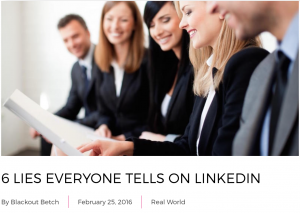
One article that caught my attention was this. Upon opening this article by a writer who calls herself “Blackout Betch”, I was frankly a little astounded. For those who might not have time to read the article itself, it begins thus, “If you think people lie on Facebook you clearly haven’t ever heard of LinkedIn. Cropping your fat arm out of your profile picture is one thing, but pretending to have any kind of career skills is another”. Interestingly enough, Blackout Betch seems not to find much value in accurately advertising career skills, but also begins by reinforcing the societal idea of what it means to be a “skinny woman” or as their website refers to them, a “skinny betch“. A mere click on their ‘Food and Fitness’ section, and I was swept up into a world of quick weight loss tips, ideas on making the perfect green smoothie, and even an article, “Learn to be Skinny”.

Returning to the LinkedIn article, another quote that stood out to me was, in the section talking about your “All of Your Connections” on LinkedIn, which Betches clarifies as, “AKA all of the guys you slept with in college and all of the girls you pretended to be bestie with.” This article, along with many others, does an interesting job of not only reinforcing heterosexual norms to appeal to a very specific demographic of women, but also seems to encourage the societal compartmentalization of gender, reinforcing the idea that women must all be a certain size, have a certain sexual orientation as well as promiscuity, and apparently, be ready to lie on LinkedIn and “pretend to be besties”.

Broadcast Lives: Radio, Television, Idealism, and Reality for British Women

Domesticating the Airwaves

Maggie Andrews explores the role of radio and television in the changing constructions of domesticity and femininity in Great Britain beginning in the 1930s through the 1980s in her book Domesticating the Airwaves: Broadcasting, Domesticity and Femininity. Andrews begins by detailing the movement of radio into women’s purview as it claimed an increasingly important place in domestic spaces, while broadcasts became more targeted at women. She argues that broadcasting focused a great deal on domesticity and domestic life for a variety of reasons that changed as over time, but the place of radio and television in the home rooted them in domestic and consequently feminine space. While broadcasts were influenced by cultural and social perceptions of domesticity, these broadcasts also focused increasingly on the performativity of domesticity and so challenged the idealized narrative of home life.

In the 1930s the ongoing global depression put increased pressure on women as managers of their homes to find creative ways to make ends meet—a pressure that only grew during and following World War II. The war tore families apart as sons and fathers were sent overseas to fight, leaving the radio to fill the void and alleviate the loneliness of the housewives left behind. While this is likely in cases in which families gave multiple children or only sons, perhaps in addition to the father, it seems to me that in cases where women were left to take care of younger children as essentially single mothers would have little time for leisure in which radio would replace absent relationships. Andrews argues that radio found its place in the heart of the home and became an “intrinsic element of ‘domestic comfort’” (23). However, radios remained too expensive for many working class families, which, I think, does not necessarily undermine her argument with regard to middle and upper class families. It does, however, leave me with questions as to how working class families interacted with radio broadcasts differently given their limited access to them and to what extent working class domesticity developed differently as a result of this lack of access. While Andrews glosses over class in her discussion of the growing importance of radio in the late 1930s and through World War II, she does discuss class to a larger extent as she delves into consumerism.

Andrews asserts that women’s magazines differentiated themselves by the class they were directed toward. The 1930s and 1940s witnessed increasing emphasis on consumerism and consumption of domestic goods. While the ideal domesticity captured in broadcasts and advertising did not match the actuality of many women’s lives, Andrews claims it “gave meaning to the lived experiences of domesticity for urban, suburban and rural women” (31). Domesticity, in her view, was an ideal that appealed to working class women who struggled to make ends meet and often took on domestic tasks in addition to work outside the home. As wartime and post-war economic hardships set in, domestic life became increasingly unstable and unattainable the home was elevated as an ideal in need of protection (82). This ideal was also, Andrews argues, central to the war effort as a large part of what the war was being fought for—a home that was created by and contained women, and was protected by men in times of war. Women’s role in maintaining the home front was vital to the war effort, if underappreciated and unrecognized, while broadcasting engaged in propaganda related to domestic life and comforts, especially in the post-war years during which time rationing was put in place that significantly limited many families’ access to various types of food. Andrews makes an interesting point here when she discusses food as a marker of class, tastes, and identity. She discusses this in broad strokes, specifically focusing on class identity, but narrows inward to talk about the special importance of food and cooking to women’s identity in the ways they were linked to women’s status and power base. While at first read this argument seems to play into traditional stereotypes about women and their place in the home, I think Andrews makes this argument to demonstrate one of the primary ways in which women could exercise agency and perhaps individuality in a world that significantly limited their options. Andrews discusses the ways in which radio broadcasts presented an idealized domesticity and femininity that did not align with women’s real experiences. In contrast, television provided a new medium for portrayal of domestic life and took a different approach that highlighted the actuality of women’s lived experiences and the flaws in the ideal of domesticity.

In some ways, Andrews illustrates that television began much like radio in the way it quickly locked onto women as an important target audience because of the amount of time they spent in the home, and so with a television, as well as because of their role as managers of domestic spending, targeting them as consumers. She asserts that consumerism played to the imperfect nature of domesticity in the post-war era, presenting itself as the means to get to the ideal life these women dreamed of from their imperfect starting point (132). While Andrews discusses the advent of new programming directed toward women, of greater interest is her argument about the ways television broadcasts portrayed housework, domesticity, and femininity. Television programs emphasized the performative nature of domestic labor that it made visible in a way radio could not, which ties into the increased use and purchase of consumer goods by housewives much more so than in radio broadcasts because television put these goods on display (138). Andrews argues that this emphasis on the performativity of domestic labor in radio and television broadcasts stemmed from the audience they targeted, essentially that they had to portray domesticity in a way that made sense to those listening, perhaps echoed their own experiences, “in order to be credible for domestic audience” (148). Broadcasted domesticity sought to capture the variety of domestic experiences, the difficulties associated with it, and how women worked and lived in the gap between their actual experiences and the idealized life they dreamed of. Television shows like I Love Lucy reflected women’s dissatisfaction with domestic life as Lucy longed to pursue her dream of being an actress, although Lucy as a middle class wife, in my opinion, would have spoken much more to women in a similar socioeconomic position rather than a large swathe of British women. I Love Lucy provides one example for me of Andrews’ argument for middle class domesticity as the norm even in broadcasting, while working class domesticities were seen as a sort of “cultural tourism” for the middle and upper classes (152). Andrews discusses the similarities between radio and television in the ways they targeted women as a prime audience, but argues that television carried radio’s portrayals of domesticity further, showing dissatisfaction with domestic life in more obvious ways that better mirrored the real lives of women. While television broadcasts resonated with middle and working class women differently, Andrews makes clear that the middle and upper classes had great anxiety about working class domesticity, and it is this anxiety that she follows into broadcasting in the 1960s and 70s.

Andrews argues that domesticity was an “endorsed” or “reasonable dream” of working class people, but the reality of their lives made it a less realistic dream than many imagined. She asserts that the social upheaval of the 1960s stemmed from two connected things: a cultural revolution and the modernization of technology that threated working class life (149). Changing lifestyles and cultural and sexual morays influenced new understanding and ideas about domesticity, which were reflected increasingly as time passed. Andrews makes an important note that television broadcasts often focused on the most unconventional, most shocking working class families and domesticities in a way that failed to capture the actuality of most peoples’ lives, which makes sense to me in considering the ways that television today focuses on the exceptional, the most out of the ordinary to attract attention, shock value, and captivate audiences in whatever way possible. She discusses the impact of the political visibility of second wave feminism, in which some feminists argued that unpaid domestic labor was tied to women’s low status, as feminine domesticity was assumed to be natural (180). Andrews claims that broadcasting had already disproved the “’naturalness’ of feminine domesticity” through its emphasis on the performativity of domesticity (180). However, I think that if this were true, second wave feminists would not have needed to argue about it or publish work revealing it as a persistent and harmful assumption. As economic hardship continued to strain primarily working class women, new broadcasts sought to capture their struggles but continued to focus on the worst off. While this emphasis is good in terms of making known the real challenges some women faced, it still failed accurately represent most working class women’s lives. As these challenges persisted through the 1970s and 80s, Britain witnessed a shift in responsibility, moving away from the state caring for families and toward domestic life supporting the function of the state (187). Broadcasting changed alongside politics and culture, and the advent of chat shows in the late 1980s and early 1990s allowed working class people to claim space in public life, although this space was small and restricted. Andrews argues that chat shows sought ratings through sensationalism primarily of the domestic sphere, as they “repeatedly conveyed the domestic sphere as in turmoil, fragile, fluid, temporary, sexually unregulated and distanced from the middle class ideals of family life” (191). This focus on sexuality and sexual relations made the private affairs of people’s lives public like the familiar aspects of domesticity that had been public for decades. Andrews talks primarily of domesticity in this section, but neglects to talk about women apart from domesticity in what could have been a fruitful discussion of the way femininity is positioned as responsible for controlling masculine sexuality. Women were the primary focuses of chat shows that gave great attention to their sexuality with men as sort of supporting actors. Broadcasting companies continued to try to negotiate the balance between showing “real” domesticity and the idealized version into the twenty-first century. Idealized domesticities continued to show up on television screens; however, these were “emphatically performative—neither natural, private, calm or necessarily feminized” (210). Twenty-first century broadcasting wrestled with the same difficulties radio and television faced decades earlier, but new mediums and types of shows provided new avenues to explore the dichotomy between real and ideal domesticity.

Andrews takes on an enormous project in seeking to analyze the ways broadcasting, domesticity, and femininity shaped one another over the course of nearly eight decades. While her discussions of domestic life and broadcasting provide great detail, especially during and immediately following World War II, her attention is almost entirely devoted to domesticity, with femininity as an afterthought in some places. Her other major shortcoming in this work is the lack of a discussion on race. While one could argue that Britain was overwhelmingly white in the pre-war years, the influx of immigrants following the war created significant diversity, which Andrews ignores. Her discussion of domesticity, then, can be only considered in white terms and echoing white experiences. Although a meaningful discussion of race would have made her project even larger, it would have provided a valuable piece to a greater understanding of the evolution of British domesticity. Andrews’ work provides significant insight into the role of broadcasting into the evolution of white British domesticity over an expansive time period, and primarily wrestles with the balance between the ideal people envisioned and the reality of most peoples’ lives.


Coming Out or Coming Home? Thoughts on The Coming Out Monologues

I want to begin this post by conjuring a HUGE *virtual* round of applause for Alex Kane (and the Queers & Allies as a whole) for an awesome event last night: I think I speak for most everyone when I say The Coming Out Monologues were hugely successful and should be a source of pride for everyone who participated in any way: way to go!

I can’t recall at time, here in Davidson or ever, where I have felt such a intense sense of community as I did last night in (of all places) the 900 room. I want to take this time to congratulate anyone who participated by reading, anonymously sharing, or just attending the event: take pride in the fact that you contributed, even if just in a small way, to something remarkable. To be honest, the warmth and inspiration I felt last night made me question Judith Butler’s claim that “If I claim to be a lesbian, I ‘come out’ only to produce a new a different ‘closet.’ The ‘you’ to whom I come out now has access to a different region of opacity” (Butler 309). Last night didn’t feel like we were constructing new closets, it felt like we were burning them down!

Last class Andres, Caroline, and I talked about the hypothetical genesis of our own feminist manifesto and how we would bring it to life. I think events like The Coming Out Monologues are essential to any sort of activism whether its in the name of a manifesto or something else entirely and, I encourage each and every one of you to go to events like this one when ever you have to opportunity because, I promise you, you don’t want to miss out!