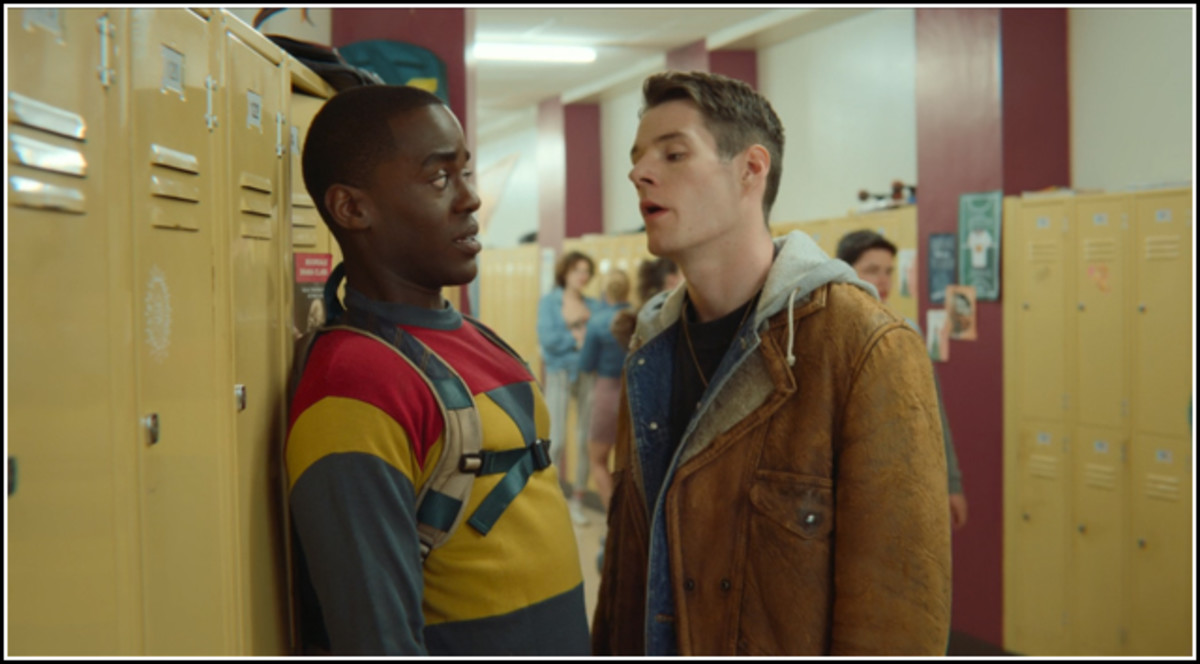
Netflix’s hit series Sex Education is one that attempts to address many of the multifaceted aspects of not only sex but the emotions, relationships, and trauma of both teenagers and adults alike. Instead of turning to adults about the multitude of issues regarding going through adolescence, the students of Moorsdale Secondary School seek the unprofessional but shrewd advice of fellow classmate Otis Milburn, son of sex therapist Jean Milburn. In the show, the character of Adam Groff stands out for me particularly. Adam is the son of the principal and a clear embodiment of the jerk jock trope. He is often seen tormenting Eric Effiong, an openly gay black character multiple times throughout the first season. Since the very beginning, it is obvious that Adam has trouble coming to terms with his own sexual orientation as he fails to sense arousal when engaging in intercourse with his then girlfriend Aimee. As the show slowly progresses, we can see Adam’s evolution from the jerk jock to the closeted homophobe trope. Although Hollywood often demonizes these characters from the start to the end, I would like to explore how Sex Education does Adam justice.
Eric Effiong, being the best friend of Otis Milburn, quickly establishes that he isn’t one of the popular kids at school. Being both black and gay, and not to mention his affinity with drag, his minority status makes him an easy target for any bully. For emotionally and sexually repressed Adam, Eric couldn’t have been a better prey. As the son of the school’s strict principal, Adam fails to meet his father’s expectations in any way except for being a toxic masculine jock. Unable to recognize nor express his own attraction to Eric, he takes it out on Eric physically as a form of frustration relief and sexual expression.
The closeted homophobe trope isn’t a stranger in Hollywood. While it does give a (most typically) gay man more complexity, it’s morally dubious to portray a large number of gay men as bitter and resentful when reality doesn’t necessarily reflect that situation. Netflix’s show does Adam more justice. Sex Education gives him more complexity. Contrary to many characters whose development reaches a climax without further exploration, Adam’s journey has just started after engaging in oral sex with Eric during detention. He begins to explore his overall identity and passion even more. Contrary to what the typical jock does, Adam begins to pick up dog racing and trains his dogs to do different tricks and stunts. As opposed to his bitter and resentful self in the first season, Adam finds a new passion and begins to smile more as he treads through this journey. It is truly a redemption arc.
It’s worth noting that the series not only does the closeted homophobe justice by giving him further development, but there’s also a lot of backstories given on why he potentially turned out this way. One primary source of influence is his father, Mr. Groff. Originally, I believed that Adam’s constant bullying is an outlet to express his frustrations of never living up to his father’s expectations or not receiving any fatherly love. Headmaster Groff has difficulty loving his family, repressing his emotions so much that he simply doesn’t feel them anymore. It’s not difficult to see who Adam takes after.
After I talked so much about how the closeted homophobe is given justice in Sex Education, I would still refrain from fully endorsing this trope from appearing in future movies and series. Not only does it misrepresent a large portion of the LGBTQ+ community, an abundance of such character may influence the audience to think that many gay men portray themselves as such. Even when Sex Education gives Adam Groff more complexity, he isn’t yet a fully round character. This may be attributed to the way the directors would like to portray this character, but from my perspective, it is indeed morally questionable.
It’s also worth speaking about the fact that the actor portraying Adam Groff isn’t gay in real life. Knowing this fact after research, I wonder if the show is taking opportunities away for LGBTQ+ actors. Although the show isn’t intentionally trying to mislead its viewers, having a straight man act as a gay man may destroy some of the authenticity of the experience depicted in the series. This simply reinforces the fact that Hollywood and popular media still has a long way to go in terms of fully representing the world’s people. But then again, an issue with representation that people are fighting for is always good, for if there are no issues, the whole business is one.
I think your take on Sex Education is really interesting. I loved the show the moment it came out in 2019, but also felt that many of the characters were based off of many different stereotypical tropes. Adam was not the only one, but also Maeve Wiley, Ruby Mattews, and Aimee Gibbs. As the show progressed the characters developed–straying away from the tropes. I agree, though, and believe Hollywood should try and stop using those tropes for their characters.
Thank you for highlighting the issues in the closeted homophobe trope. I feel like any form of “they’re just picking on you because they like you” is problematic, but especially in queer representation in media, this trope is one of many unhealthy examples of queer relationships. Of course, Adam proves himself later in Sex Education, but he also harassed Eric for years at school. I think “morally questionable” is such a good way to describe the trope as a whole. I would say though, straight actors playing queer characters is such a difficult topic. I was previously very against it because, just as you said, it takes opportunities away from LGBTQ actors, but since the issue with Kit Connor, I’ve been struggling with the idea a bit more. It’s hard to say only LGBTQ actors can be cast, because it really means only out LGBTQ actors can be cast. I’m not saying I believe the actor that plays Adam is secretly gay, but I think the issue itself is just complicated
I agree with the comments so far on this post. I think the discussion of casting is so interesting and nuanced. On the one hand, you could have identity blind casting that allows any person to play any role that they can perform convincingly. On the other side, purposeful casting can be so powerful to people who need icons in their life–actors to look up to that share an identity with them. I think the correct answer is that decision-making should be done on a case-by-case basis with as much dedication to the craft as there is to respecting various identities and their surrounding communities.
I really like how you gave credit to the show for its portrayal of the character, but also refrained from endorsing it completely. I completely agree that it is an overused and inaccurate representation of gay men. However, as someone from a South Aisan country, I have to admit that the ‘closeted homophobe’ is a very realistic trope. I think that is also because the level of stigma and prejudice against the LGBTQ+ community is very severe in countries like India. Unless you are born into a very liberal, modern, upper-middle class family, it is highly unlikely that your family, friends, religion and community will accept your homosexuality. Hence, most men do end up being closeted homophobes. Adam’s character was loved in India so much, because people felt seen. He is not just portrayed as a bully, but his character growth is given importance through the next seasons. He gave people an example of how you can accept yourself and change, despite having an unsupportive family, which is a situation many Indian men could relate to.
I think you have a very nuanced review of Sex Education. I love this show and the representation in it, yet there are still some issues with it, such as the casting of a straight man playing a gay character. I also think that the idea that the homophobe is just a closeted gay is very problematic. I know that Mattxiv on Instagram (a popular queer instagram influencer who discusses a lot of issues related to gender and sexuality studies) has discussed this trope a lot. The trope suggests that all homophobic people are just hiding a big secret that they are actually gay. However, in reality, a lot of people are just homophobic, and there isn’t an excuse for it. Even though I find this trope problematic, I enjoy Sex Education, and I think it gives much better queer representation than most TV shows.
This was so interesting to read. I really enjoyed watching sex education, but didn’t love when I realized, “oh of course, he’s gay, that’s internalized homophobia.” Like, I don’t think that excuses being homophobic? From what I remember, Otis had issues with this too, but I haven’t seen it since the last season ended so forgive me if I’m misremembering. I also didn’t know the actor for Adam was straight, which definitely adds a layer of complication to this. Maybe he was the best character to play Adam in casting, but it still feels weird. We talked about this in class a bit, in terms of cisgender people playing trans characters in media and how that is often problematic.