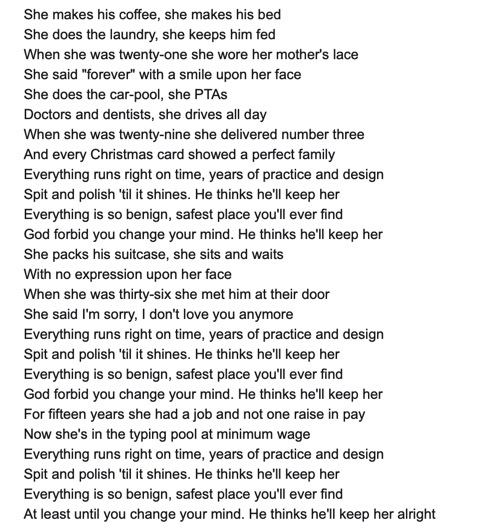
Mary Chapin Carpenter is an American rock, folk, and country music singer-songwriter who signed in the late 1980s with Columbia Records, who promoted her as a country singer. One of her most famous songs is her 1992 hit, He Thinks He’ll Keep Her. This song is widely credited with illustrating the salvation of a woman freeing herself from the traditional atomic family into the workplace. The song begins by documenting a few items that make it evident that she is a housewife – one who appears to do everything for her husband. For example: making his coffee, his bed, doing his laundry, and keeping him fed. Following a few of these examples, the verses, “When she was twenty-one she wore her mother’s lace and said “forever” with a smile upon her face,” briefly touch on the “norm” of marriage as something that is supposed to happen when coming of the right age. The lines that come after continue to paint the picture of outdated stereotypical gender roles: taking care of the kids; putting on a surface front that portrays a perfect family despite her unhappiness that is prevalent in this song; and her keeping everything in line and on time like clockwork. The line, “He thinks he’ll keep her,” is inserted occasionally at the end of some verses, alluding to the strength that she will eventually find to leave the husband that takes her for granted and confines her abilities. This does indeed happen and there is a shift when she talks about being thirty-six and finally putting her foot down to leave him. One line that I think carries a lot of weight is “for fifteen years she had a job and not one raise in pay, now she’s in the typing pool at minimum wage.” I feel these verses highlight the difficulty of working hard for many years without any sort of compensation other than a rabbit-hole of a comfort zone that can seem extremely terrifying to leave. More importantly, she does in fact leave and even though she is starting from the bottom, she is slowly working to make her own way.
This can be tied back to a few of the readings we did in class. For example, in Towards Equality, it highlights that marriage and motherhood should not be disabilities for women and in this song – it is very clear that the duties being performed by the woman are constraining both her happiness and ability to go out and do things for herself. Additionally, in Our Bodies, Our Selves, it emphasizes choice over destiny and I feel like this relates back to women being not properly educated about their bodies and having children that they did not necessarily want or getting married simply because that is what “everyone” did by a certain age. In a similar way, The Feminine Mystique, discusses that housewives feel trapped within themselves and their own minds – convincing them of the falsehood that motherhood and marriage is all that life has to give them. In this song, it isn’t until she leaves her husband that she finds her own life and what she wants.
The song, however, does have specific limitations as a representation of feminisms broadly constructed. For example, her limited scope of just female and male relationships excludes the LGBTQ community and it implies that the type of situation being described in the song only occurs between heterosexual members of the community.
“Mary Chapin Carpenter – He Thinks He’ll Keep Her.” Genius, https://genius.com/Mary-chapin-carpenter-he-thinks-hell-keep-her-lyrics.
It’s fascinating that this fear of the economic and social instability that comes from leaving one’s husband is still such a reality for women today. Although it’s much more common for women to be the breadwinner of their family or to share that responsibility with their husband, there are still many women who rely on their husband’s income for financial security. And the same goes for LGBTQ+ couples with one sole financial contributor as well. We’ve made progress in terms of gender equality since the 80s and 90s but it’s eerie how similar some things stay.
This is a really interesting analysis of this song, Shea! I agree with your point that women often get into relationships (or marriages) very young, and stay in these relationships because of the feeling of safety they provide. Carpenter makes clear that this is untrue, and that women can feel safe outside the home and away from a man who clearly takes her for granted. She seems to list all the things she does for her husband mindlessly, which may be how she feels when she is doing them. Your connection to the Feminine Mystique is great because they both portray the message that there is so much more to life than being a housewife. “He Thinks He’ll Keep Her” reminds me of the song I chose, “You Don’t Own Me” in the way that both repeat those two lines, indicating how the women are really trying to drive home those points. Although both are written my white women about heterosexual relationships, they highlight and promote the idea that women are capable of breaking free from the “chains” that hold them down as a housewife. I wonder what a song that talks about what these women do AFTER leaving the relationship would sound like!
Beautiful analysis, Shea! I like how you discussed about how stereotypical women roles are damaging to women instead of empowering. I also like the emphasis you placed on women feeling forced to remain in relationships because of economic status. Women were unable to sustain themselves and survive without men due to the wage gap. Overall, great analysis!
Hey Shea–awesome work! I love your analysis of the songs depiction of gender roles and the stereotypes people are immediately placed into at birth. I also love that you brought Our Bodies, Our Selves because I think so much of this feminist mixtape will have dual focuses on feminisms as they relate to female bodies. Great job–and thanks for posting the full lyrics!