by Yuncong Hu
Written for Autostraddle
Last week, Desperate Housewives just released episode 9 of season 3, named “Beautiful Girls” after the character Gabrielle Solis’s plotline in this episode. Since 2004, when its first season started airing on ABC, the show has been positively received for its exploration on the inner dark sides and complicated personalities of the ordinary upper-class housewives, in contrast to the traditional plain, dour mother/wife figures on screen. Surprisingly in this episode, Gabrielle’s story isn’t technically boundary-breaking, and instead, it is borderline-misogynist.
For those of you who haven’t watched Desperate Housewives, Gabrielle Solis is one of the four female protagonists, all of whom are close friends and neighbors living in a fictitious suburb are called Wisteria Lane. Gabrielle has a Mexican heritage, and the other three housewives are white. In S309, Gabrielle’s divorce is finalized. With the failed attempt to go back to her modeling career in last episode, Gabrielle accepts the fact that she is becoming an unemployed divorcée. In need of a distraction from her empty life, she accepts invitation from her gay personal shopper, Vern, to coach young pageant girls for his new beauty pageant consulting firm. While she reluctantly takes the offer, she later finds herself enjoying coaching the girls as her modeling expertise is incredibly idolized by these younger women. However, when she is reminiscing on her old modeling days, she accidentally tells the girls about some ill-advised weight-loss methods such as sticking fingers in throats and smoking. Later on, some girls are caught by their parents smoking and vomiting, and Gabrielle is fired. She then comes to the mothers of the girls, confesses to them that beauty pageant coaching is now the one single meaningful thing in the life of a woman without husband and family, and makes a subtle offer to give illegal diet pills to them. The parents give her a second chance.
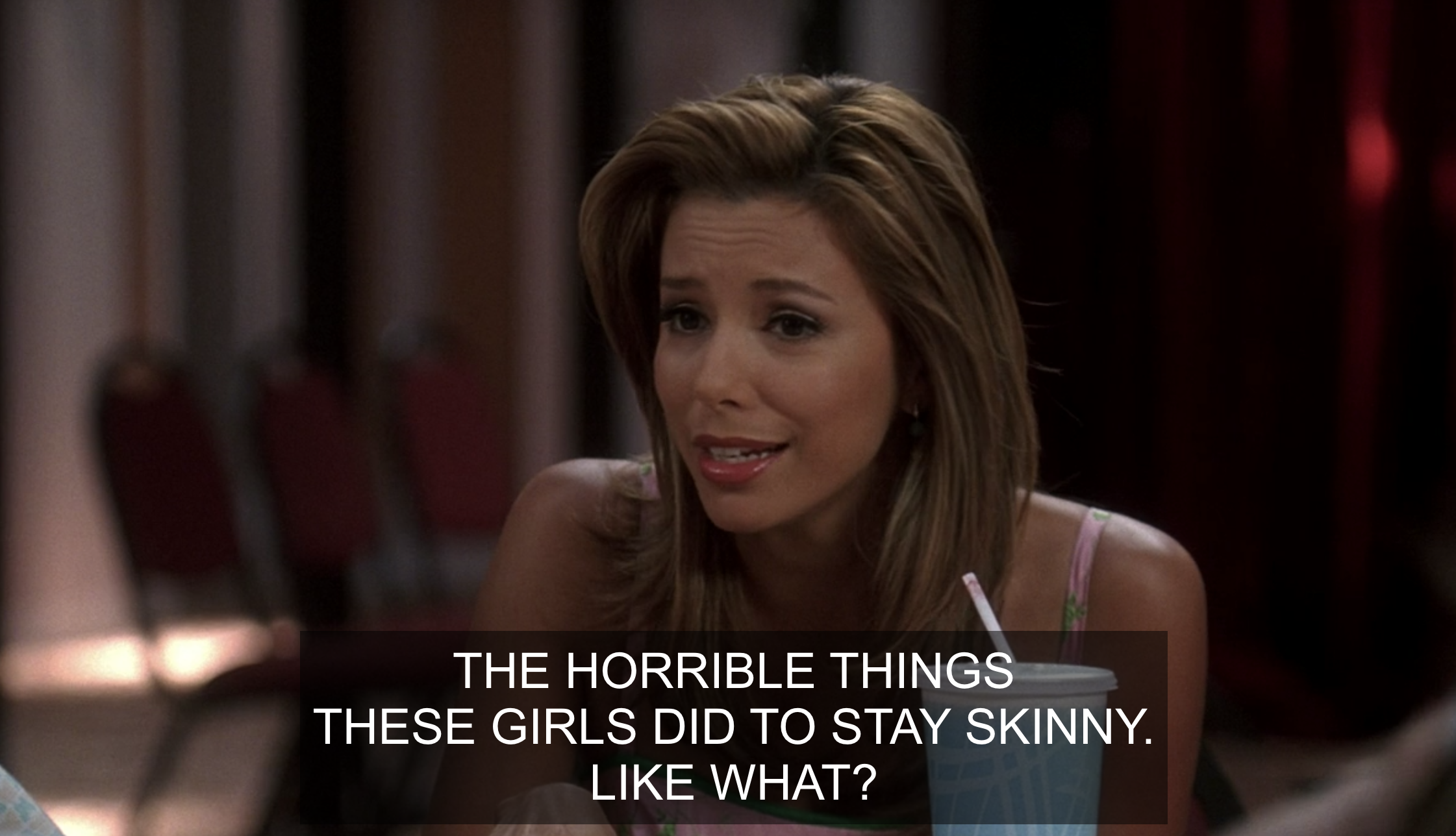

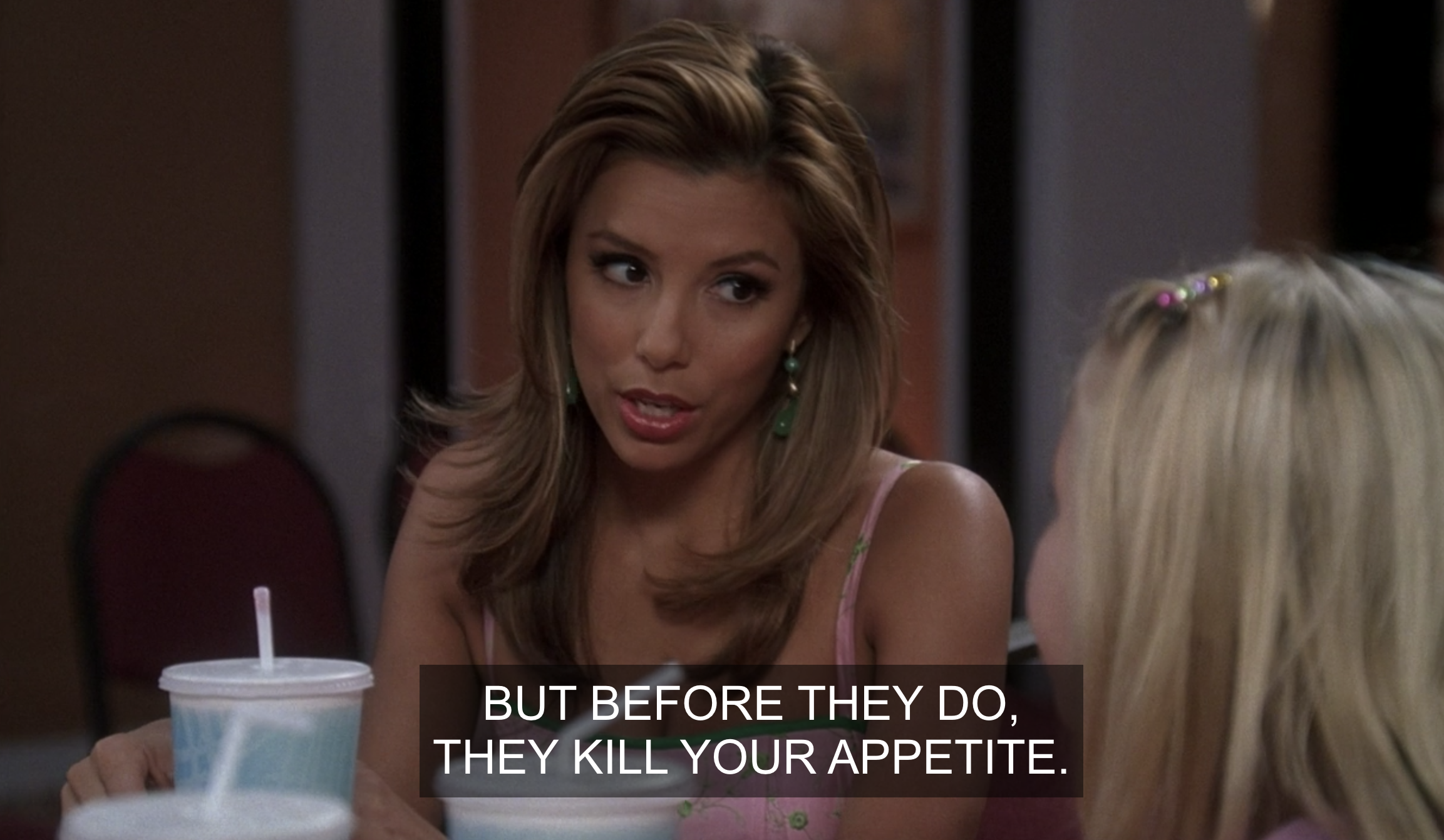
It is noticeable that Gabrielle’s conversation with the girls in this particular scene demonstrate how fat stigmatization is socially institutionalized in popular culture. Specifically, Gabrielle starts with the warning “You would not believe all the horrible things model do to stay skinny” and “I never did it” before she introduced the kids into smoking and vomiting as weight-loss methods. The children, though aware of “smoking will kill you”, still ask “Do you have to be skinny to be a model?”, to which she answers, “When was the last time you saw a fat person on a magazine cover?” This is a highly representative example of anti-fat beliefs being passed on by someone elder and experienced to a younger generation, thereby creating an invisible social structure that is constantly renewing and strengthening itself. In her introduction to Fat Studies Readers, Marilyn Wann comments on this structure, “Every person who lives in a fat-hating culture inevitably absorbs anti-fat beliefs, assumptions and stereotypes, and also inevitably comes to occupy a position in relation to power arrangements that are based on weight,” The power relationship in this narrative is clearly the contrast between professional fashion models and some 9-to-12-year-old who wish they could be beauty pageant girls. As a result, Gabrielle herself, without realizing it, teaches the girls about the established beauty standard that discriminate against fat people. Her expertise, just like the enormous power of social norms behind beauty standards, is invisible and very restrictive, as the girls immediately accepts the norms and attempt to fit into them. Even worse, when she acknowledges that the methods she mentions is “horrible”, she is also explaining the conventional rules for fat people, that they need to suffer to lose weight, that being fat is even more dreadful than being unhealthy. These rules are internalized by the girls and soon, they start to punish themselves for being fat.
There is more to the fatphobia side of this episode. While it gives us an example of how fat-stigmatization transforms into social structures, it fails to offer any critical resolution towards it. This presentation of this story, which primarily focuses on weight and beauty standards, chooses to continue conforming to anti-fat beliefs and misrepresenting fat community. In the last scene, a sharp contrast is made between Gabrielle and the parents:

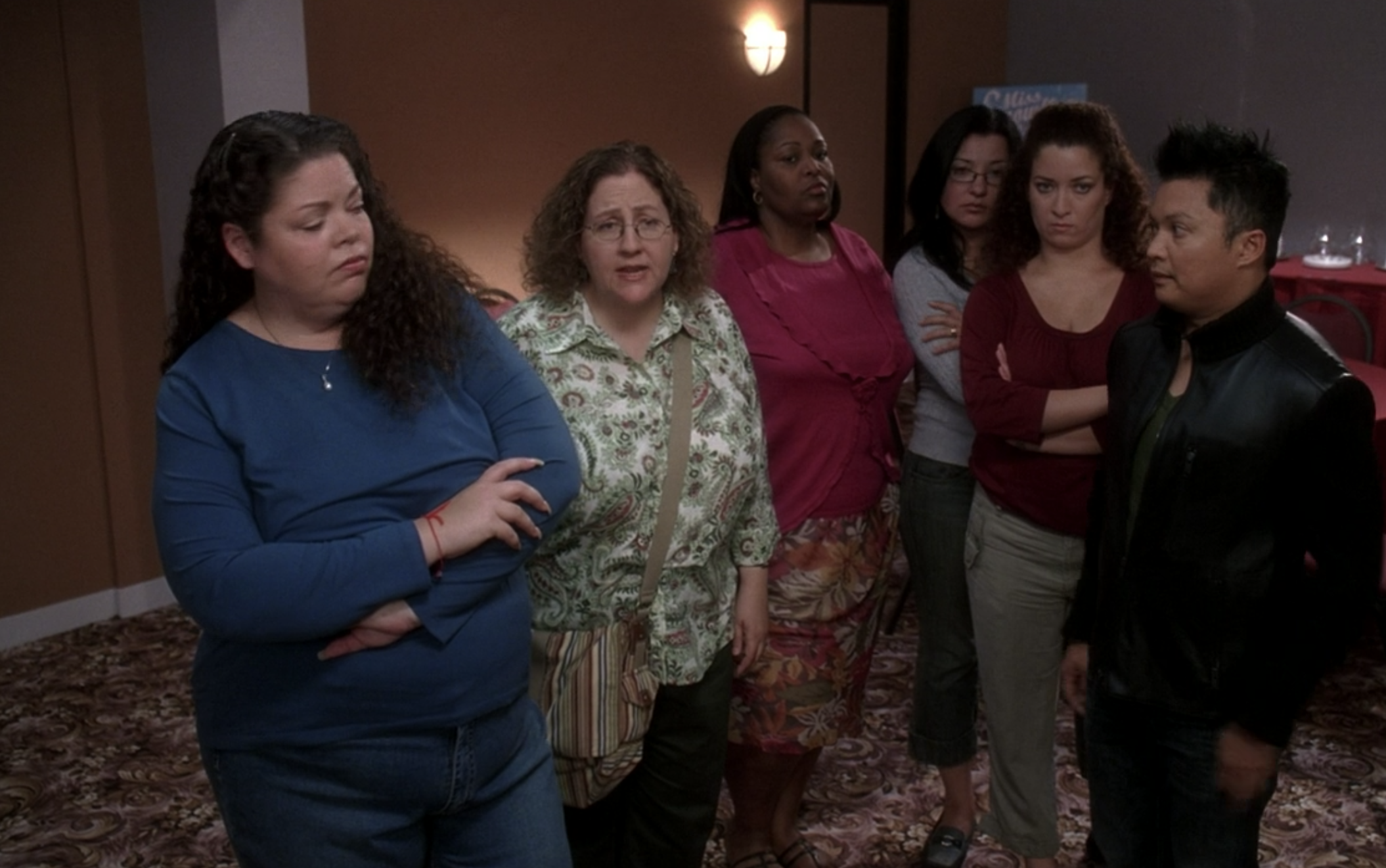
Eva Longoria, as Gabrielle, is intentionally put into better clothes, hair, accessories and make-up in this scene, while the other actors are clearly not. Gabrielle is wearing a full-length, Versace-styled ball gown while holding a clutch. Her hair is curly and silky, and she has full-makeup on. The other ladies are all wearing dowdy clothes, much less make-up and three of them can definitely be considered as fat. These women quickly changed their idea about firing Gabrielle after she mentions she has “highly effective non-FDA approved diet pills from Zurich”, and claim that “I guess the Christian thing is to forgive her” without admitting that they are attracted by the pills in reality. The plot and lines intuitively assume the beauty standards between two binaries – fat and thin, and coveys the implied message that thinner people do look better to its audience. Moreover, it falsely represents fat people by portraying them as automatically desiring losing weight at any cost. Therefore, it inevitably represents another effort to normalize weight-loss and anti-fat health promotion by making an assumption that fat people need to lose weight. In doing so, they neglect the group of audiences who belong to the self-accepting fat community.
In addition, the underlying assumption about Gabrielle’s social class is striking. She is a wealthy woman who can afford a personal shopper even after losing her steady income – her ex-husband. Her motivation for this job is not for survival, but only spiritual fulfilment. Just like Gabrielle, her other friends share the same social class and work motivation: they are married to lawyers, doctors, managers, etc. Essentially, the depiction of women’s struggle is mainly about upper-middle class, white women’s struggle (Gabrielle is the only POC protagonist in the show) A vast majority of women are already excluded in the production of this episode, as well as the whole series.
As the only non-white protagonist, the character of Gabrielle also indicates conformity to racial and gender stereotypes prevalent in America. She is undoubtedly, even in the script description, the most attractive housewife of all four, and a Latina ex-supermodel. There is a hyper-sexuality attached to her with her race, a form of over-sexualization of Latin women. The character has no choice but to be a gorgeous stereotype like a lot of other Latin women on screen, while diversity is allowed in white women. The same thing is applied to Gabrielle’s background. She is the only one who has a background story: she comes from a poor family, goes into modeling at a very young age, earns a new life through her new social circle, marries a rich husband and retires from fashion industry. Interestingly, Desperate Housewives does not introduce the backgrounds of other three white protagonists. They are assumed to be raised, educated and married normally as if they are in a standard white family, while Gabrielle needs an explanation of why she lives in a rich, white suburbs neighborhood. In other words, The abnormality in the life of a female, like Gabrielle, is highlighted and associated with her racialized background.
Above all, the series Desperate Housewives does have many things to complement about: it gives a space for more female-centered narratives in the male-dominating media world, and it strives to tell stories from women’s points of view. Still, one must not neglect the problematic assumptions and stereotypes of women that it displays in only one episode. The production team need to inspect its work with more consciousness of preventing prejudices and assumption. And the audiences, while enjoying the marvelous episodes, should be aware of these problems.
Works Cited:
Wann, Marilyn. Foreword To Fat Studies Reader. NYU Press. 2009