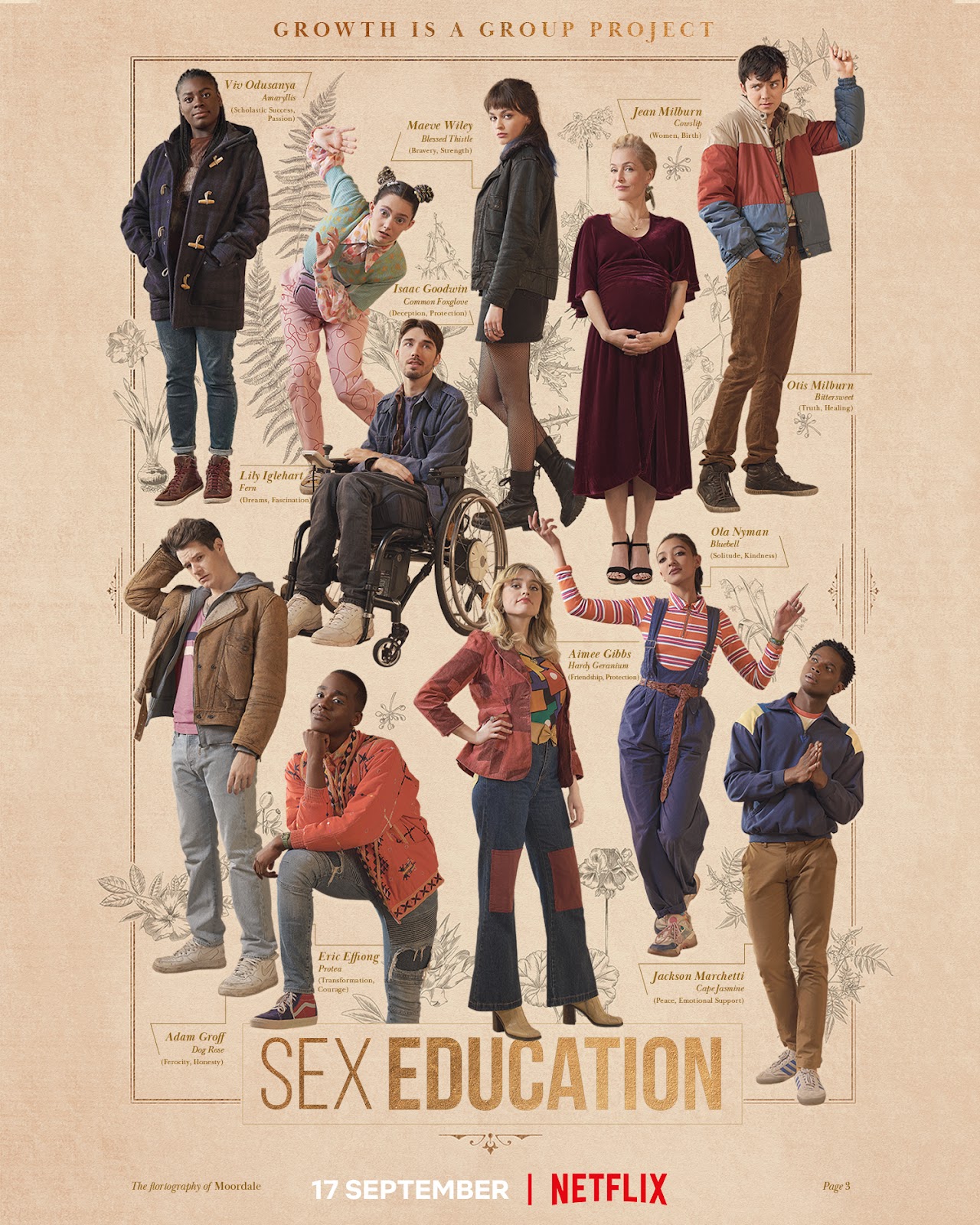
I remember waiting for the third season of Sex Education to come out – I was reposting the promotional posters on my story on Instagram and sending it to my friends. When Sex Education finally came out, I was surprised at how different this season was from its previous seasons. Sex Education started as a show navigating the life of Otis, whose mother is a sex therapist. Because of this, Otis has learned the techniques of how to talk to someone. He then tries this at school with an unexpected friend at the time called Maeve. As a result, they both start making this a regular thing after success. Moving on from this, in season 3, the sex therapist students are not quite as much in this picture but are rather dealing with Moordale’s new principal Headmistress Hope who moves Moordale in a backward way, removing self-expression and promoting heterosexuality, while shaming anything different. Cal and Headmistress Hope are two of the new characters this season, and they are complete opposites, to say the least. Hope’s backward idea of how to run a school is a great reason to show why such classes like GSS exist.
One episode in particular that struck me was a scene from this seasons Ep. 4:
Firstly, this scene I want to talk about in particular. Prior to this scene, Headmistress Hope tells Viv, her student assistant, to tell the people of Moordale to separate themselves into two lines based on their gender. However, because Cal is non-binary, they don’t separate themselves into a line and have an argument with Hope. Cal then goes on to say “So we go to the vagina or penis line? Is that what you’re saying?” This itself shows how bent Hope’s thinking is: there are only two genders and that it depends on your genitalia. For centuries, we have always decided to look at someone’s genitalia and say “They are a boy” or “they are a girl,” and it’s time we step away from this disgusting perspective.
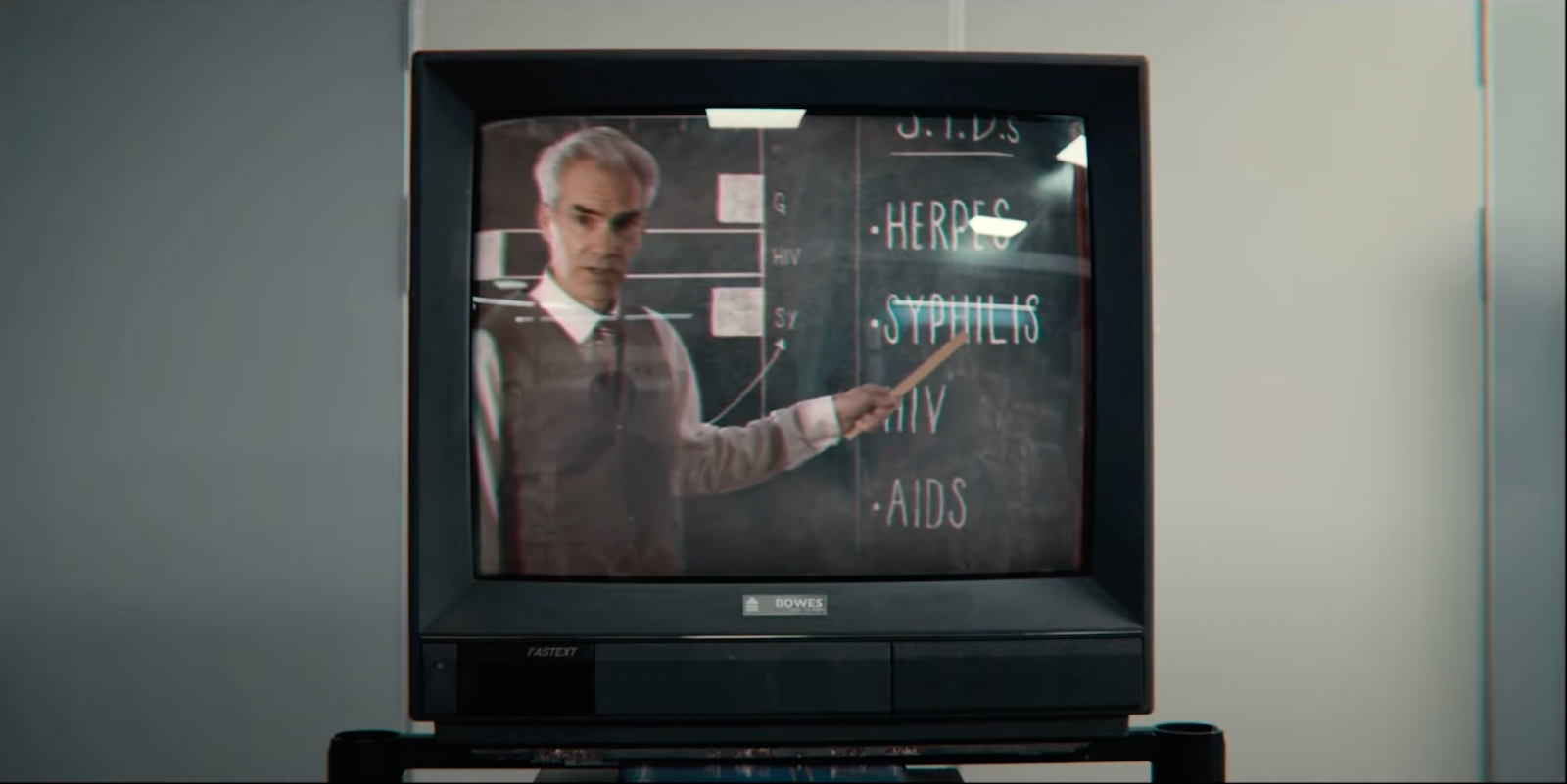
Focusing more on this scene, the boys get a talk about homophobia and stating that homosexuals have a higher chance of getting an STD. Meanwhile, the girls are getting a talk about how sex is scary and can ruin your life. Maeve, one of the earliest main characters, however, tells the group speaker of the girls group that sex isn’t and shouldn’t be scary. Maeve gives a progressive speech suggesting that students should instead see that sex gives them insight into their body, like what they like, and that girls shouldn’t be the only one getting the talk of “sex is a mistake because it leads to unwanted pregnancy.” This ties into the idea of Foucault where the idea of sex shouldn’t be talked about and that people should be shamed for having these ideas and thoughts. And, further in this episode, the students of Moordale are scared because they’ve been involved in sexual activities prior to this meeting and that their lives could be in danger just because of what they’ve been told. Society makes sex seem as a bad thing and that only bad things will happen if you engage in the act of sex, but nothing will happen if you go about it in a safe direction.
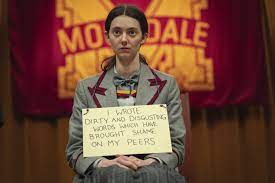
Another interesting part of season 3 lies within episode 6. Hope decides to publicly shame students who caused a bad reputation for Moordale. While she shames 3 students, Lily, a student who writes sexual stories about aliens and such things, and Cal in particular are shamed for being themselves. To explain, Cal is told that they are a messy troublemaker when all they have done to “disrespect” Moordale is ask for equity. Cal is constantly reminded by Hope to fit in a certain category by her forcefully putting labels on their gender when they are non-binary, but never lashes out against Hope. For Lily, she is told that she has brought shame to her peers with “dirty and disgusting words,” which comes from Lily’s sexual fantasy stories. Again, especially for teenagers in high school going through puberty, students should not be shamed for having sexual desires. Additionally, the idea of fantasies and fetishes shouldn’t be shamed either. Lily is a great character at showcasing these fantasies and, earlier in the season, Lily used to wear makeup and style her hair to indicate this love for her fantasies.
Season 3 was something entirely different, but I did enjoy it. It helps show how different people are from one another, and that we shouldn’t be putting others down for having differences or looking different. We should be encouraging these differences and seeing how much more a society could be if individuality was promoted. Sex Education does a great job in this season to showcase this.
I only started Sex Education a while back, but when I saw this Media Analysis post, I knew I needed to finish the series before reading it. Overall, I honestly really enjoyed this season and I think your post does a great job at highlighting the variety of identities of characters in this show. I loved what you said in your conclusion about how important individuality is for society, because I think at the heart of the show, the students connect with each other through feeling no shame for their uniqueness.
I have been a devout fan of Sex Education since it was released on Netflix in 2019. I immediately grew attached to the characters and thoroughly enjoyed the representation within the cast/characters. I did not think about it much until after reading your post, but I also found it interesting how they took the show in a different direction–focusing on the issues within the school rather than specific characters. I really enjoyed it as it started to investigate more systemic issues that take place at many schools, and also believed they showcased it well.
Sex education is a show that I have personally never watched but has been recommended to me on multiple occasions. The last part of your blog post is directly tied to Focault’s “History of Sexuality.” The students are shamed for talking about sex or writing about sex. Fantasies and fetishes are looked down upon and people are shamed for simply discussing the idea of sex. Similarly, the repressive hypothesis that Focault identifies notes that particularly in Western cultures, there has been a shift from a society that welcomes sexual discourse to one where these free expressions and talks about sex and sexuality are repressed, forbidden, and shamed. I truly feel that for us to grow as a society and to understand the topics of gender and sexuality, the openness to discuss these complex topics is necessary.
I have never watched Sex Education, but from this seen it is clear that women are, for the most part, the ones that are shamed for unwanted pregnancies. Even though you need both sperm and an egg to become pregnant, in most teen or young adult pregnancies the woman is left to deal with the child or the ones scolded for the unwanted pregnancy. I also find it disgusting that the teachers are preaching abstinence to both groups instead of teaching safe sex and ways to prevent pregnancy and the spread of STDs. It is inevitable that some teens and young adults are going to have sex. Its apart of our biological make up to desire others, so it is not right to shame others for these feelings.
Sex Education is such a great show. It promotes inclusivity on so many levels. The third season made me feel aggravated because of the new principal and what she did with the school, though I am glad that the show included it because it is such reality applies to so many schools around the world. The show is available to watch for so many individuals, a great number of them might come from environments of abstinence sex education and being shamed for having sex. They can learn so much from the show and it can motivate them to be the change they want to see, maybe push them to address the issue (just like Maeve did!). Thank you for highlighting the show in your post!
I love the show sex education so much! I agree that season 3 is not what I expected it to be, but I was pleasantly surprised by the new additions! I think the old headmaster, Mr.Groff, did not exemplify the harsh reality of administration against gender/sexuality expression in high school. I know that he was not necessarily a fan of their expressions, but Hope took it to a whole new level. It made me think of my own high school and what they would have done if Cal had told them they didn’t fit into a boy girl divide, something that was frequently instructed. This is a reality in our schools today and I think sex education does a great job of bringing in real world issues that are being debated as the show heirs. I will be interested to see what they do next season and what issues they continue to address. Also, im curious to see if this can act as an example for administrators as to why they should not enforce gender norms or attempt to dull self expression.
Sex Education is one of my favorite shows and when season 3 came out I watched it all in one day because it was so good. I didn’t really think about how different it was from the other seasons until reading your post but the points you made were all very true. I like the direction season 3 went in and I think it was a good way to shed light on a lot of issues surrounding gender and sexuality. I’m excited to see where the next season goes and hope that they continue to spread awareness about these issues through the show.