Every August over two thousand college freshman flock to the University of Alabama two weeks before the start of the academic semester to begin the infamous and demanding Greek life rush process. These two weeks involve primarily female-presenting individuals who participate in a variety of daily social mixers and events designed to introduce potential new members (P.N.M.s) to life as a member of a sorority at the University of Alabama. Throughout the two weeks the P.N.Ms make judgements regarding their desired sororities and the current sorority members make judgements on which P.N.Ms they would like to allow into the sorority. This exclusionary process results in only a specific section of girls getting the house they desire with many P.N.M left disappointed with the selection they received or dropped from the process entirely.
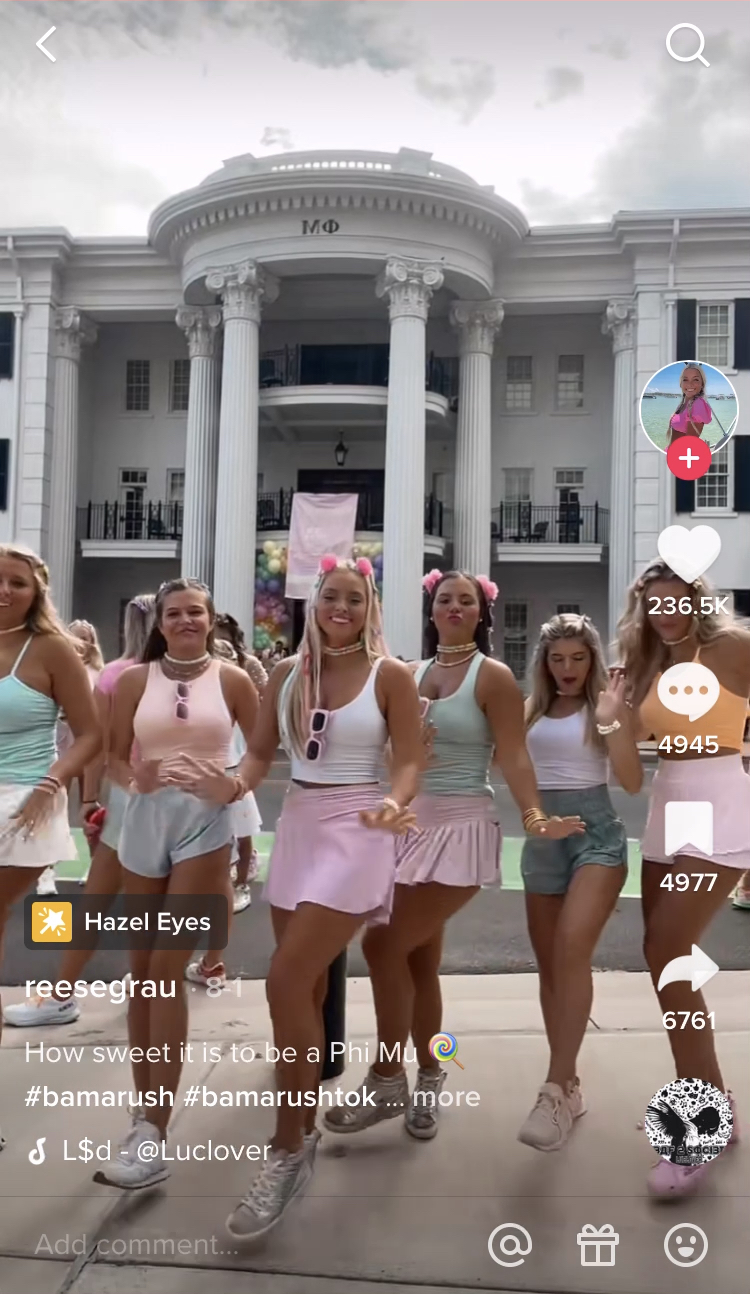
This sorority rush tradition has existed for decades, but the process came directly into the spotlight last year when P.N.M.s began to post TikTok videos highlighting their experiences with the rush process. Millions of people both in the United States and other countries began to obsessively follow these P.N.M.s throughout their recruitment process. Much of the attention directed towards this recruitment process comes from viewer’s fascination with the outward perception demonstrated by the participants of this cultural phenomenon. Despite the participation of over two thousand new members in the sorority recruitment process, there is a uniformity to this process that allows for only a small amount of individual expression among participants. In order to, be recognized by the sorority a P.N.M must meet this standard. A standard P.N.M could be described as the stereotypical “perfect southern girl”; often pictured in a pink feminine outfit, with perfectly curled blond hair, and tanned skin. To be successful in this process and gain internet fame it is often necessary to be from a higher economic class, be of a lower body weight, societally judged as attractive, and have meticulously selected clothes and hair.
These ideals are demonstrated by the viral TikTok videos that can be found under the hashtag #BamaRush. The screenshot below depicts an Outfit of the Day video (OOTD) which is popular way for a P.N.M. to show off the intricately chosen outfits they have selected for that day’s activities. The clothes shown often come from high fashion brands. In this OOTD, which has 5.9 million views and over 300 thousand likes, the designer brands mentioned include: Gucci, Cartier and Louis Vuitton.
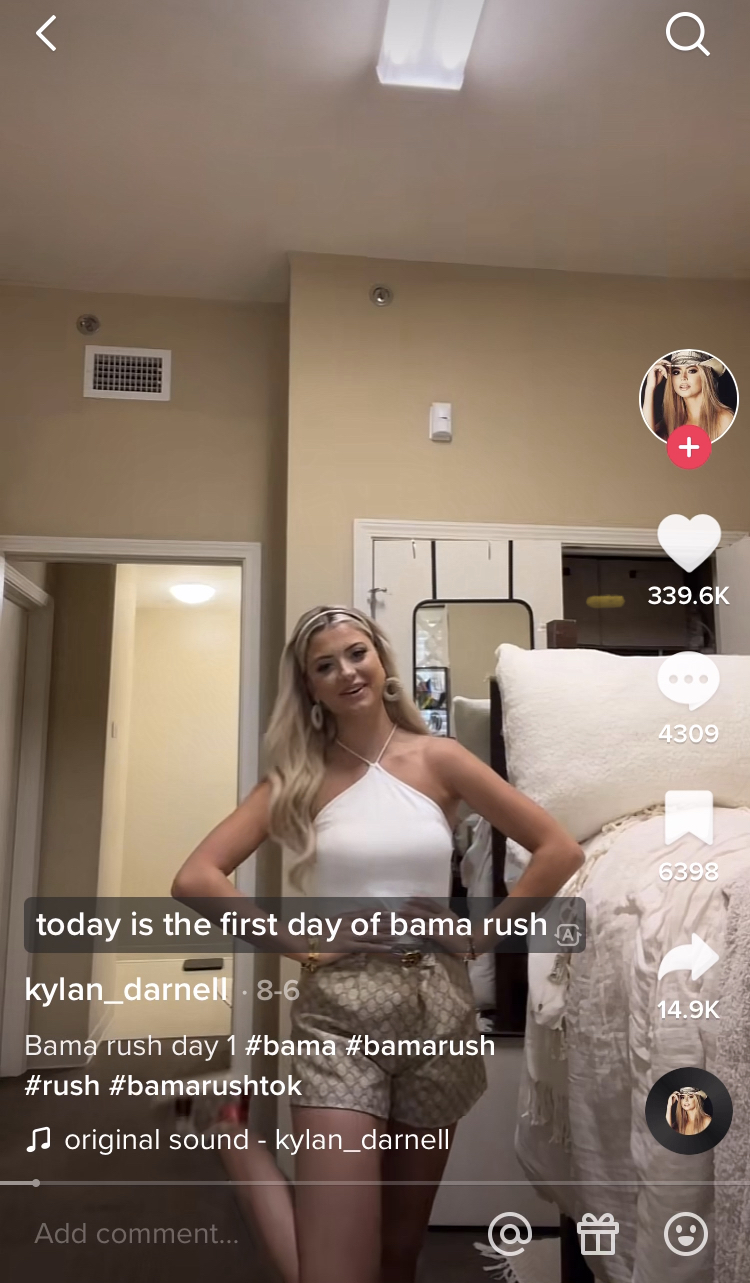
The creator of the video is a girl named Kylan Darnell who became one of the faces of Alabama Rush 2022. She now has over 500 thousand followers on TikTok and numerous brand deals with popular clothing and jewelry brands. Kylan is just one example of someone who rose to fame due to her documentation of her experience with the recruitment process. Her videos demonstrate a level of financial inaccessibility that is manifested throughout the sorority culture. In addition to the hundreds of dollars spent on the clothing for the recruitment process, the sorority dues per semester average $4100, which can be a financial burden for many participants and their families.
The media craze surrounding these sororities has become so large that current members have whole days of preparation designated as “media days.” On these days, each member focuses on producing content that can be posted on social media to capture the attention of P.N.Ms as well as other viewers. The content produced by these members portray a very specific type of member.
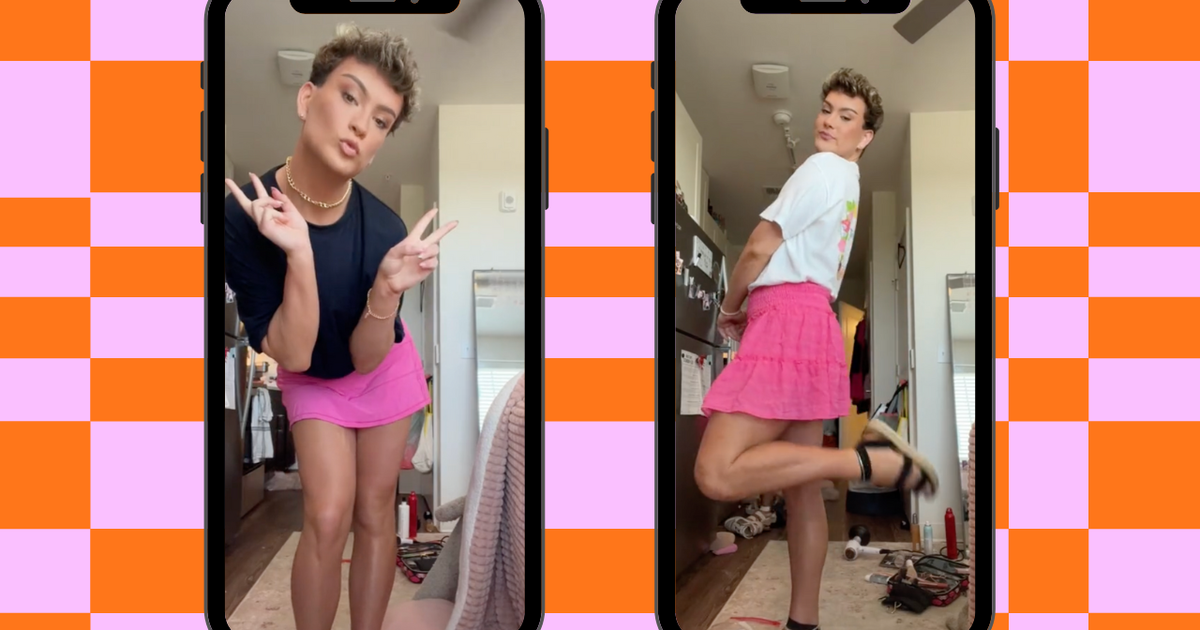
The exclusionary methods of rush extended beyond socioeconomic class and appearance, YourTango reports that of the twenty-six national sororities only three of them have made formal policies that include trans women. The exclusion of non-cisgender individuals is demonstrated within the Alabama Rush process. The image below shows Grant Sikes a nonbinary person who participated in the rush process this past year. Grant was not met with enthusiasm throughout the rush process. In an Instagram post Grant states “out of the almost 20 chapters- I was dropped by every single one except 2 before day 1.” Grant was not selected by any sororities at the end of recruitment.
These TikTok videos represent only a small selection of sorority life available at the University of Alabama and might not be representative of all Greek life. However, the intense public focus on these specific sororities and P.N.Ms demonstrate the hyper-feminization perpetuated by these sororities and consumed by the wider public. The mass amounts of media attention placed on the participants of the rush process endorses the negative ideals held up by the Greek life system.
I think that you bring up some great points! I closely followed Bama Rush Tok in 2021 and found the whole ordeal fascinating. Rush at Alabama and other SEC schools is a display of hyper-femininity, and I find it interesting how the long blonde hair and tanned skin look is the ideal everyone seemingly aspires to, regardless of their natural features. The look is incredibly euro-centric, and I am interested in how this is influenced by the broader Greek life culture on campus, especially with reference to fraternities. The topic of fraternity culture and toxic masculinity is a whole other issue, but I find it interesting how Greek organizations in general encourage an extreme and homogenous display of the members’ gender expression. It is also interesting how women need to prove their worth when rushing a sorority through material displays of wealth and their looks, while in fraternities, it’s more about a PNM’s ability to act macho and impress the other brothers. I think that #rushtok could be a fascinating sociological lens to look at gender roles and expectations in the South, and on college campuses, more generally.
It makes me sad that even after all we have learned so far in GSS, part of me still wants to be the girls in those tik toks.
I have a middle school friend who goes to Alabama and while she isn’t in a sorority (as far as I know) she is a “Crimsonette”. She posts pictures on instagram all the time of herself with her fellow crimsonettes and they all look the same. They all have ridiculously perfect long blonde hair, cherry red lipstick, and a full face of makeup to go with their skimpy sparkly red uniforms and flat stomachs. This isn’t a reflection of how most women look and it makes me wonder if a fat person with just as much baton twirling talent would be accepted into the group or how the group would handle it if a member wasn’t comfortable wearing such revealing clothes.
I feel like I see a lot of similar standards at other big state schools and it makes me so glad to be at Davidson. While we certainly have our problems, I don’t feel like unrealistic body standards are as prevalent.
The Greek life process has always interested me as well. When all of my friends went through sorority rush earlier this semester, me and my mom tried to guess which sorority each girl would end up in. I find it fascinating that at each school, certain sororities are deemed “better” than others just based on how the girls look and act. One of my good friends made it into Kappa Delta at UGA which apparently is a HUGE deal because KD is one of the “top tier” sororities. Most of the women in the sorority are bleached blonde, tan, and skinny and there is very little diversity. Even my mom has said to me that she finds it disappointing that some sororities are considered better than others, and she was the definition of blonde hair and tan skin in a sorority at Auburn. It all seems like a huge popularity contest and I think social media has made the process even worst for PMNs.
I have also followed this trend very closely. One concept that sticks out to me relating to the rushing process are legacy bids. Like college admissions, you have a stronger chance of getting into a sorority if your relative was a member. This feels like a de facto grandfather clause measure that helps maintain the white majority in sororities. Additionally, I know that many sororities have strict rules for members so that they can maintain their lady like reputation. I am glad that the system at Davidson is far more equitable.
Every year, whether I want to or not, I get bama rush content, and every year i am appalled by the insane standards these girls are expected to meet. Over the past two years it has made me reflect on how we incorporate greek life here at Davidson and how we have, and can continue to, better our system to not be as problematic. Admittedly the eating houses and frats are not perfect, but some changes do seem to have created a safer space. The one I think of is the inclusion of all gender minorities in eating houses. I know that some sororities do this, but it is definitely not the norm. Do you think it would make things such as bama rush more diverse, or at least open a gateway to incorporating more diversity? I hope in the coming years we get to see development in diversity and a downfall in the incredibly white-washed, privileged time that is rush week at Alabama.
I really really loved reading your post about this. This year, one of my best friends, someone I have known since third grade, decided to rush at university of Alabama. We had sort of grown apart as high school progressed, but I still consider her one of my best friends. Anyways, she was in the rush process this year at Bama, and I asked her if she could send me daily vlogs about her rush experience, just because I was so so insanely curious about what it actually looked like. And I was beyond shocked at the amount of time, money, new clothes, fake tans, perfect tik toks, and designer brand things were involved. She told me that for one week of rush she had to have a new outfit every day and they had a specific theme for each day. If you didn’t have something designer in your outfit, you were often looked down upon. Rush tiktok fascinated me just because of how absurd it seems if you take a step back. The lack of diversity is also something that should be commented upon more. The stat of only three national sororities including trans women is so crazy to me. While this process brings joy to a select group of the “perfect southern girls”, so many negative ideals are upheld through this process.
As someone who just moved to the US for college, I had never come across the concepts of sororities before. It was something I had only seen in American movies, and it never struck me that it was actually a real thing. I find it the concept fascinating and equally concerning. I cannot imagine how mentally draining it may be to try to fit such high beauty standards just to get into a sorority. The entire process just seems so toxic!
I think that you make good points here. The greek life process is one that is racist, classist, fatphobic, and transphobic, yet it is one that most of our society has just accepted. One thing that I noticed about the Bama Rush trend on Tiktok is that generally, the houses that are considered “lower tier” are the houses that are more inclusive. Personally, I think that even though the eating houses system is certainly not perfect, I think that a system that is run at the school level and not the national level is better than the type of greek life that we see on tiktok at schools such as Bama.
I’m so glad you wrote about this. I’ll admit, I was definitely drawn to rush tok because I used to want to be in a sorority and I honestly found it fascinating and fun to watch. Over time, I’ve become disenchanted about sororities and am glad that we don’t really have them here, and it’s clearly such an exclusive, elitist, racist, transphobic, heteronormative, fatphobic system. I definitely had some hope for Grant and hope that the process would be different from what it usually is. I was disappointed to find out no one accepted her in the end. I wonder if people at Alabama are speaking up about this, or did speak up about it, but I haven’t heard much.
You make some great points. I’ve always found the entire rush process to be terrible. Being from rural Georgia, many of the girls I went to high school with and many of my cousins went through rush at the University of Georgia, Auburn, Alabama, Georgia State, and similar colleges, and my mom went through it herself, so I’ve heard firsthand what it’s like. From my understanding, in the first round, you meet with members of each sorority for a very brief amount of time in a social environment before they decide whether they want you to move to the next round or not, causing their decision to be based entirely on first impression. This is not at all an accurate representation of what people are really like, and makes it likely that people will be judged off appearance. I think this is a big reason why members of sororities often look very similar–they’re accepting people who look like them, excluding other groups from joining.
I would like to second the comments about the pressure on these girls. If it takes a whole day to prepare and probably the whole weekend to participate in activities, are these girls getting school work done? I am also curious to hear what (probably heavily biased) reasons these chapters cited to justify dropping Grant. I am curious as to whether these descriptions are made by the sorority as a whole or if it is a select group of people who make them.
Definitely this is a concern academically because of all that they do during this process but also just balancing their own personal health. It seems as if during the rush process, the health of each of these girls is not prioritized either and this definitely has led to the creation of toxic and harmful environments within these sororities.