Ondessa Kiliru-Liontree
Black literature is often criticized more heavily and held to a higher standard than the literature of other races. The lack of historical Black narratives has left many Black writers focused on constructing non-fictional literature and realistic portrayals to rewrite history and break down racist ideologies. Non-fiction has always and will continue to have a place in society, however, much can be learned and expressed through speculative fiction. Bodyminds Reimagined investigates Black speculative fiction as a necessary avenue to understand the implications of the intersectionality of (dis)ability, race, and gender. However, many Black authors criticize this hybrid genre and accuse other Black writers of betraying their mission. The question then arises, does Black speculative fiction have a place in Black literature and provide alternative modes for understanding oppression?
Bodyminds Reimagined focuses on two main parts: the impact of Black speculative fiction on our ideas of marginalized groups and the intersectionality of (dis)ability, race, gender, and sexuality in activism. Bodyminds Reimagined does this work by featuring (dis)ability representation from Black speculative fiction authors such as Octavia Butler, Phyllis Alesia Perry, and Nora Keita Jemisin. Speculative fiction is a creative form of literature that focuses on worlds in which reality is warped such as ones within science fiction, magical realism, and dystopian/utopian fiction. Speculative fiction and Black speculative fiction in particular deconstruct present ideas of oppression by placing them in imaginary worlds, which in turn, changes the way we approach and think about real issues. The term “bodyminds” is used by Schalk to highlight the simultaneous physical, mental, and spiritual effects of oppression on an individual. She uses bodyminds to display that (dis)ability can take both materialist and metaphorical interpretations in literature. According to Schalk, the purpose of the book is to stand as “A call to black feminists to include (dis)ability in our work and investigate both ableism and ability privilege in our intellectual and activist communities. It is an exhortation to disability studies scholars to not merely include race, but to allow black feminist and critical race theories to transform the field” (Schalk 4). Bodyminds Reimagined aims to express how marginalized people are operating with oppressions that are not separate and distinct, but overlapping. In particular, Schalk wants to focus on how (dis)ability often gets lost in conversations about racism, sexism, and activism.

Sami Schalk is an assistant professor at the University of Wisconsin-Madison and teaches Gender and Women’s Studies. She attended Miami University for undergraduate studies in English and later went to the University of Notre Dame where she received her MFA in Poetry. She also attended Indiana University where she earned her Ph.D. in Gender Studies. Schalk is a highly qualified writer and scholar in gender and sexuality. She is a self-identified “fat, Black, queer, femme, cisgender, middle-class, disabled woman” (Schalk). She also identifies as polyamorous and has been involved in pleasure activism. Most of Sami Schalk’s work focuses on the intersections of oppression and in particular the relationship between Black literature and gender, race, sexuality, and (dis)ability. Schalk also went viral online when she twerked with Lizzo and out of that, she started a campaign in 2019 titled, “#twerkwithlizzo”, to incorporate pleasure activism into issues such as fatphobia, racism, and sexism. I believe this work connects to the wider idea of intersectionality and how oppressions cannot act independently of each other. In order to work towards a more equitable world, we must address all aspects of inequality. As many scholars say, “No one can be free until Black women are free.”
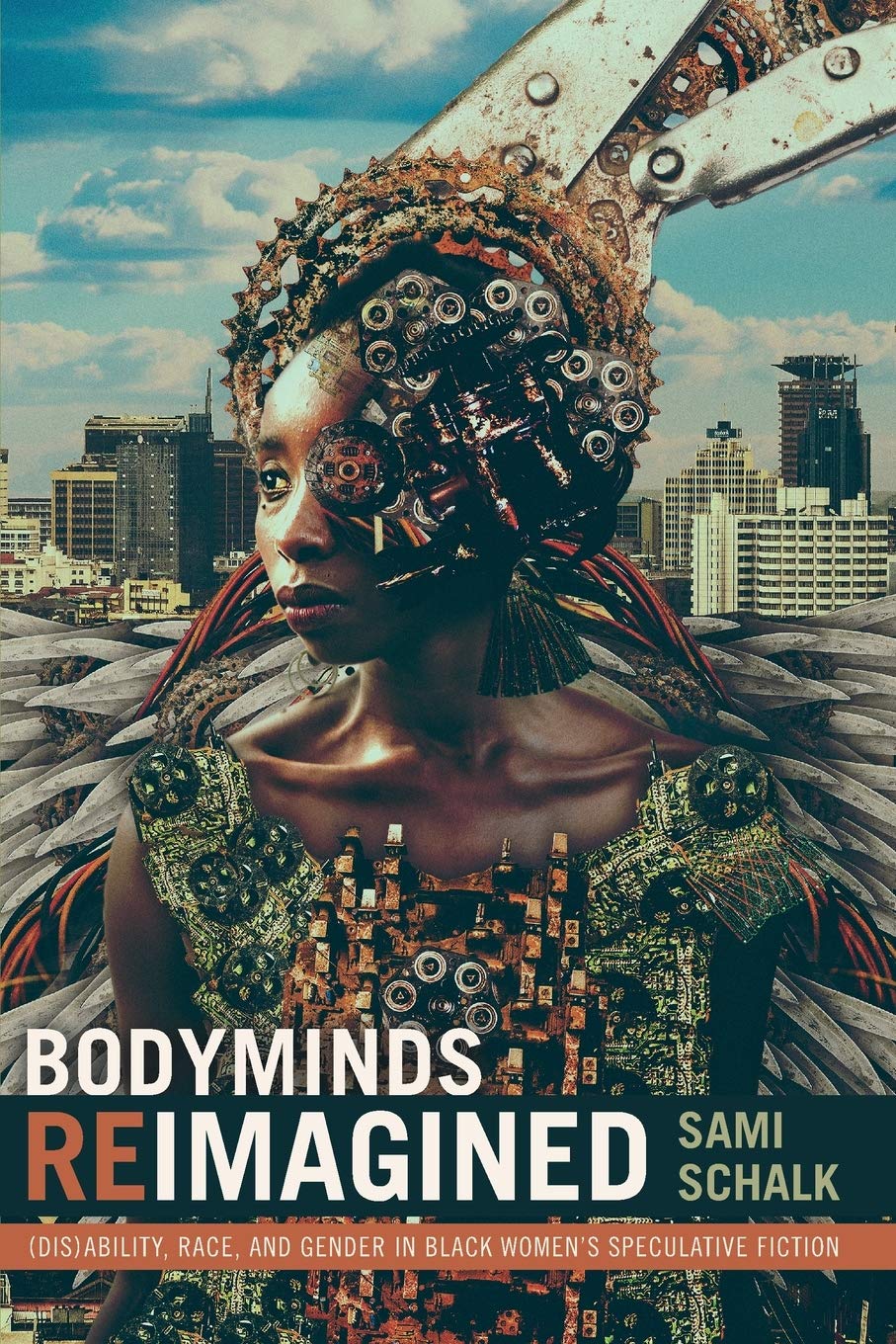
Bodyminds Reimagined analyzes a range of speculative fiction to exhibit how (dis)ability is intertwined with other oppressions and manifested through metaphorical and materialistic consequences. Some of the books include Kindred by Octavia Butler, Stigmata by Phyllis Alesia Perry, The Parable Series by Octavia Butler, and The Broken Kingdoms Series by N. K. Jemisin. While Schalk reads and analyzes the chosen books, she uses three reading methods that include, rejecting the idea of binaries, taking into account all aspects of characters and environment, as well as reading within the reality of the dictionary text. The interpretation of speculative fiction must follow the rules of reality in the literature. Sami Schalk uses a range of methodology to criticize, analyze, and write Bodyminds Reimagined. She uses the rhetorical analysis of previous scholars to criticize their review of speculative fiction. She uses critical theory to express her argument and develop ideas such as bodyminds and (dis)ability. Throughout the book, she also exhibits personal reflection by using first-person narration.
The first chapter of Bodyminds Reimagined uses Kindred by Octavia Bulter to explain how disability in slave and neo-slave narratives are metaphors for both the history of violence towards Black people as well as the materialistic trauma that survives through generations. The purpose of this analysis is to show that the trauma of Black bodies cannot be separated from oppression and that slavery inherently produces disability.
The second chapter is dedicated to Stigmata by Phyllis Alesia Perry to describe how able-mindedness is socially constructed and intertwined with gender and racial standards. I am going to focus on this chapter to help readers get a scope into Schalk’s research. Stigmata follows the life of Lizzie, a Black woman who experiences multiple consciousnesses from her enslaved ancestors through visions and physical injuries. As a result, Lizzie spends most of the book institutionalized for her assumed mental illness and attempted suicide. Analysis of this book from other scholars believes that the purpose is to break down sexism and racism, however, Schalk argues that it is breaking down the intersectionality of ableism, racism, and sexism. Schalk explains, “Lizzie’s multiple consciousnesses are symbolic of the legacy of slavery on contemporary African Americans, and they are, in the speculative fictional context of the novel, literally real within and upon her body-mind. In this literal sense, Lizzie experiences her multiple consciousnesses as disabling…[she] tries to explain her experiences, and is read as delusional. Lizzie is then interpreted as mentally disabled by those around her and institutionalized. As a result, in this second layer of metaphor and materiality, Lizzie’s experience in a psychiatric institution provides an additional metaphor for the dismissal of historical knowledge and the afterlife of oppression as well as a direct material critique of the social construction of able-mindedness and the ableist, racist, and sexist practices of the psychiatric medical-industrial complex” (Schalk 68). The point that Schalk is trying to make is that race and gender directly impact who society labels as mentally disabled and the different repercussions of treatment because of it. Since slavery, Black people have been positioned outside the realm of able-mindedness (“socially determined label of mental ability that broadly encompasses a wide range of concepts such as rationality, intelligence, social awareness, self-control, and more”) which allows for the justification of violence such as police brutality and rejection of Black anger, anxiety, paranoia, and trauma (Schalk 63). Some Black women who are blamed for being too angry are considered crazy and hysterical, whereas white women are simply angry. The standards society holds in relation to race and gender determine how we react and treat people with disabilities. Black women who are reluctant about the medical system are labeled as paranoid when most people do not understand the racist history associated with medical professionals and Black women. Throughout this chapter, Schalk critiques the psychiatric medical-industrial complex and challenges our notions of what (dis)ability really means.
The third chapter broadcasts how (dis)ability and varied bodyminds appear in the future through The Parable Series by Octavia Butler. Schalk argues showing disability through a fictional viewpoint, in this case, hyperempathy, deconstructs our ideas, assumptions, and knowledge about (dis)ability. It also provides a world where (dis)ability is not fixed or erased from advanced futuristic technology. The final chapter of Bodyminds Reimagined examines the speculative fiction, The Broken Kingdom, with nonhuman personifications to understand (dis)ability, race, and gender in environments foreign to what we consider real. It also allows for the reinterpretation of gender and sexuality because gods, godlings, and nonhumans do not follow conventional categories that society creates or have genders at all.
Sami Schalk does an exemplary job at using primary sources of other scholarly reviews to criticize their analysis and explain why she has a contrasting perspective. I found the evidence provided from the chosen books easy to follow and beneficial to the argument she was making. I also liked how she gave background information on each of the books she was analyzing so the reader does not have to be familiar with the texts to engage with her writing. This book makes a persuasive, compelling argument for speculative fiction and makes me want to read more literature in this genre. I actually own The Parable Series that Schalk analyzed, however, I never got around to reading it. Now that I have read Bodyminds Reimaged and gained insight into the metaphorical and material conditions of disability, I believe my interpretation of The Parable Series will develop in a new light.
Bodyminds Reimaged could do a better job at explaining gender in relation to Blackness and (dis)ability. The subtitle of the book is as follows, “(Dis)ability, Race, and Gender in Black Women’s Speculative Fiction,” however, gender almost gets lost in the focus of (dis)ability. It mentions gender and race numerous times without analyzing the connection. I believe the book expects readers to have previous knowledge of the intersectionality of Black women and the history of violence. As a self-identified Black woman, I can understand and connect to the experience of Black women she attempts to portray, however, this topic is important and should be accessible to all people. The clear audience of this book is scholars and educated persons on Blackness and Black women specifically. Another weakness of the book was there was almost too much comparative analysis. In some of the chapters, the author analyzed multiple books to progress her argument which made it slightly confusing. Her findings would sometimes get lost in the myriad of other scholars’ opinions. However, overall, I enjoyed reading this book and found it very educational.
Bodyminds Reimaged begins the conversation of incorporating disability studies into Black literature and vice versa. I believe the purpose of the book is to show the importance of Black speculative fiction and the intersectionality of (di)ability with race and gender. Although the book was dense, I found it overall thought-provoking. I would recommend this book to students and scholars who have previous knowledge of intersectionality and the oppression of Black women.
Bibliography
Schalk, Samantha Dawn. Bodyminds Reimagined (Dis)Ability, Race, and Gender in Black Women’s Speculative Fiction. Duke University Press, 2018.
Schalk, Samantha. “Bio & CV.” Dr. Sami Schalk, 12 Apr. 2022, https://samischalk.com/cv/.