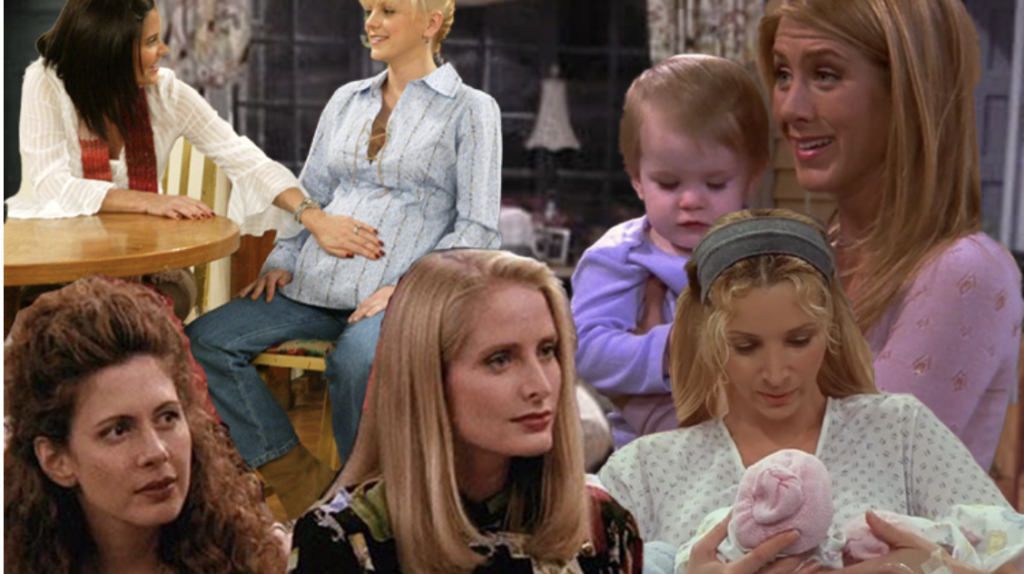
The first baby born in Friends was Ben, Ross and Carol’s son. Ben was an unexpected pregnancy; Ross found out his ex wife, Carol, was pregnant shortly after she left him for another woman. This birth was controversial in the 90s, not only were the parents not married (yet, Carol and Susan get married later in the show) but the baby had 3 parents. Although this sitcom was not perfect and incorporated many homophobic jokes, it was also one of the only shows at this time to feature a lesbian wedding. The show also did a decent job with their family relationship. Each and every family is unique, and we got to watch as Ross, Carol, and Susan figured out a new dynamic as they raised Ben.
Phoebe Buffay, A badass hippie, was a surrogate to her brother’s children. Frank Buffay and his wife, Alice, had a very large age gap. Alice was Frank’s Professor in college and was over twice his age. Although their marriage was mostly used as a joke in the show, it did highlight and bring attention to age differences. When Phoebe first found out about their relationship, she was shocked but by the end of the episode came to the belief that love is love. Later in the show, Frank and Alice want to have a child but are unable to due to Alice’s age, so they ask Phoebe to be their surrogate. In the show they express the pregnancy and surrogacy well, but do make jokes such as when Phoebe tells the nurse at the hospital, “the father is my brother”. Many of these quotes are lighthearted. They bring up some of the harder parts of surrogacy such as carrying and birthing a child that is not theirs and having to give the babies to their parents. Ultimately the directors and writers wrote this story well and for the most part accurately portrayed the ups and downs of Phoebe’s decision.
Rachel Green is from a very posh family in which she was raised to believe that her goals in life should be to marry a wealthy man and be a stay at home mother. This ideology was quickly challenged for her when she ran from her fiancé on her wedding day and then decided to get a job and become an independent woman. Later she also had an unconventional pregnancy for this era because she got pregnant and did not get married. Despite how she was raised and societal pressure from her family, she decided to have the baby on her own; Ross was still there to raise the child, but they were not together. At one point during a family convention, Ross’s mother even tells them to pretend they got married because they had been telling that to friends. Despite the pressure to get married by both their families, she still decided it was not the right time. And even though Rachel was not in a relationship to help raise Emma, she still had a ton of support from Ross, her family, and friends. She proved to many that you can be a single mother, work, date, and succeed, breaking many conventionalized beliefs.
Monica Geller was one of the more heartbreaking stories. When her dream of having kids was put on hold because she had a hostile uterus and was unable to bear a child, she and Chandler started looking into other options and got into adoption. After being put on a list, they met a mother that agreed to let them adopt the baby when it was born. Although this process went by a lot faster than it normally would in real life, it still very accurately described this unconventional way of becoming a mother.
All 7 babies born into this show either had unconventional births or family dynamics, but no matter the story they all had friends and family that supported their decisions. Recognizing that this sitcom did make many jokes that are viewed as offensive today, they were not seen as offensive in the 90s. The show incorporates these stories into their plot well, some may not even realize that all 4 main characters had unconventional stories. Even though this show was not perfect, it enforced the fact that there is no right or wrong to being a mother.
Hey Parker! You pose a very interesting idea about motherhood and the different roads one can take to become a mother. Rachel Green’s story resonated with me the most because it addresses the changing family dynamic, gender roles, and expectations for marriage. Rachel ran away from her wealthy fiance on her wedding day because she did not want to have to be a stay at home mother with the man solely providing for the family; she wanted to be a self-sufficient, independent woman. This supports Susan B Anthony’s claim in her Declaration of Sentiments that women should not only be morally responsible, but they should also be intellectually equal to men. In other words, women should have access to education in order to provide for the family as well. Anthony argued that “there is a feminine as well as a masculine side to the truth” in her Declaration of Sentiments which is reinforced in the show Friends when Rachel is raising her child, balancing a job, providing for herself, and not solely relying on a man for the intellect and money. In a broader context, I like how the show tries its best to destigmatize conventional parenting – having a mother and a father and having a mother who stays home and a father who works for the family. This was a nice selection to analyze for the media analysis!